How To Make Money In Currency Speculation – And Why You Should Think Carefully Before Trying

Currency speculation is the practice of buying and selling foreign currencies with the sole intent of profiting from fluctuations in their exchange rates. Operating within the global foreign exchange, or forex, market, participants wager on how relative currency values will shift over time. Unlike international travelers exchanging money for overseas spending, businesses settling invoices with foreign suppliers, or central banks managing sovereign reserves, speculators do not hold currencies for practical commercial utility. Instead, their operations are driven entirely by financial gain, capitalizing on the continuous price movements that ripple through global financial networks.
Because exchange rates adjust constantly, the market presents frequent opportunities to generate returns, but that same volatility creates substantial danger. A sudden geopolitical development, policy announcement, or economic report can reverse price trajectories in seconds. Currency speculation is a high-risk, high-reward endeavor that demands thorough preparation, macroeconomic awareness, and strict psychological discipline. Anyone considering entering the currency markets must carefully evaluate the severe risks of financial loss against the prospective rewards before allocating real capital.
Key takeaways
- Currency speculation involves buying and selling currency pairs solely to profit from price fluctuations rather than for everyday commercial use.
- Trading requires a structured approach built on fundamental economic analysis, technical chart reading, and disciplined risk management.
- High volatility and the magnifying effect of leverage expose traders to the rapid loss of their entire capital.
- Prospective speculators should master a single strategy and test their approach in a simulated demo environment before committing live funds.
The Mechanics of the Foreign Exchange Market
To navigate currency speculation, one must first grasp how the decentralized forex market operates. Unlike traditional equity markets that run through centralized physical or electronic exchanges with fixed opening and closing bells, the foreign exchange market functions as an interconnected, continuous over-the-counter network. Financial institutions, multinational corporations, retail brokerages, and independent speculators trade across global financial hubs around the clock during the standard working week.
Because currencies reflect the financial health of one nation against another, currencies are always traded in pairs. When executing a trade, an individual simultaneously buys one currency while selling another. For example, in a standard pair, the speculator bets whether the base currency will strengthen or weaken against the quote currency. Exchange rates represent the collective global assessment of supply and demand for those currencies. If economic data indicates robust growth in a specific country, international demand for its currency often rises, lifting its relative valuation. Conversely, worsening economic indicators or political instability can drive demand downward, depressing its market price.
Core Foundations for Speculating in Currencies
Succeeding in the currency markets requires moving beyond casual hunches. Long-term market participants rely on a structured operational framework built around five essential pillars.
The first pillar is a thorough grasp of market basics. Prospective speculators must understand quote conventions, pip values, spread costs, and how global financial events influence price action. Developing this baseline requires ongoing education through courses, webinars, and analytical literature. Entering the foreign exchange arena without this baseline foundation transforms financial trading into outright gambling.
Without a firm comprehension of market mechanics and risk management, stepping into currency speculation is functionally equivalent to gambling.
The second pillar involves technical analysis. Technical analysts evaluate historical price charts, trading volume, and geometric patterns to forecast future price behavior. By identifying recurring market structures, such as support and resistance levels, speculators identify tactical entry and exit locations. Technical analysis does not concern itself with the underlying health of an economy; rather, it focuses purely on the statistical and psychological footprint left behind by market participants.
The third pillar centers on monitoring economic indicators. Economic data releases act as the primary catalysts for significant exchange rate movements. Speculators monitor key indicators including:
- Gross domestic product figures reflecting national economic expansion or contraction.
- Inflation statistics that influence central bank monetary policies and interest rate expectations.
- Labor market metrics, including unemployment levels and job creation numbers.
- Central bank interest rate decisions and accompanying policy statements.
The final and most crucial pillar is strict risk management. The overarching goal of any speculator is capital preservation. This objective requires establishing clear boundaries on every trade through the use of stop-loss orders, avoiding overconcentration by diversifying across different currency pairings, and utilizing leverage with extreme caution. Leverage allows traders to control large positions with a modest initial deposit, but it multiplies losses just as readily as it multiplies gains.

Primary Trading Strategies
A trading strategy provides the behavioral roadmap that dictates when to enter the market, when to exit, and how much capital to allocate. Choosing the right approach depends on individual temperament, daily availability, and overall risk tolerance.
Trend following
Trend following is designed to identify and exploit sustained directional movements in a currency pair. Traders who adopt this approach analyze charts to spot overarching upward or downward trajectories driven by macroeconomic conditions or prolonged market sentiment. Rather than attempting to anticipate the exact bottom or top of a price move, trend followers wait for a definitive direction to establish itself and enter positions aligned with that broader momentum. This methodology typically involves fewer trades, allowing positions to unfold over several days, weeks, or even months.
Swing trading
Swing trading focuses on capturing intermediate price oscillations that materialize within broader ranges or emerging trends. These traders hold positions over days or weeks, aiming to capture the "swings" between local price highs and lows. Swing traders rely heavily on a combination of technical chart patterns and scheduled economic data releases to time their entries near key turning points. This strategy suits individuals who want active market engagement without the relentless pressure of monitoring screens every minute of the day.
Scalping
Scalping is an intensive, high-speed trading strategy centered on capturing tiny price fluctuations across very brief intervals. Scalpers execute dozens or even hundreds of transactions throughout a single trading session, holding positions for minutes or mere seconds. The goal is to accumulate small, incremental profits while minimizing the exposure time to broader market shifts. Scalping demands extreme concentration, rapid execution reflexes, and strict risk discipline, as a single large loss can easily erase the gains from numerous successful scalp trades.
| Strategy | Holding Period | Trading Frequency | Primary Objective |
|---|---|---|---|
| Trend following | Days to months | Low to moderate | Capture broad, sustained market momentum |
| Swing trading | Days to weeks | Moderate | Capture intermediate price oscillations between highs and lows |
| Scalping | Seconds to minutes | Very high | Extract modest gains from rapid, micro-level price movements |
The Daily Workflow of a Speculative Trade
Examining how a currency trade unfolds illustrates the discipline needed to operate effectively. A speculator does not begin by immediately opening an order ticket. The process starts with pre-market preparation, beginning with an inspection of the daily economic calendar to verify when major data releases—such as employment numbers or central bank press conferences—are scheduled. Knowing the timing of these events prevents the trader from being caught off guard by erratic volatility.
Next, the trader reviews charts across multiple timeframes. Applying technical analysis, the speculator marks crucial support and resistance zones, identifies the dominant trend, and watches for specific entry triggers defined in their written strategy. If a valid setup emerges that aligns with the prevailing economic context, the trader calculates their position size based on mathematical risk, rather than picking an arbitrary number of lots.
Before executing the trade, the trader defines the exact price level where their market thesis is invalidated. A stop-loss order is assigned to that price. By measuring the distance between the entry price and the stop-loss level, the speculator ensures that the maximum potential monetary loss stays strictly within acceptable personal boundaries. Once the trade is active, the trader monitors the position objectively, allowing predetermined take-profit targets or trailing stop orders to close the transaction automatically, removing emotional hesitation from the process.
Significant Dangers: Why You Must Think Carefully
While the prospect of profiting from the global currency market attracts substantial interest, the structural realities of forex trading create severe hazards for uninformed participants.
Severe market volatility and account depletion
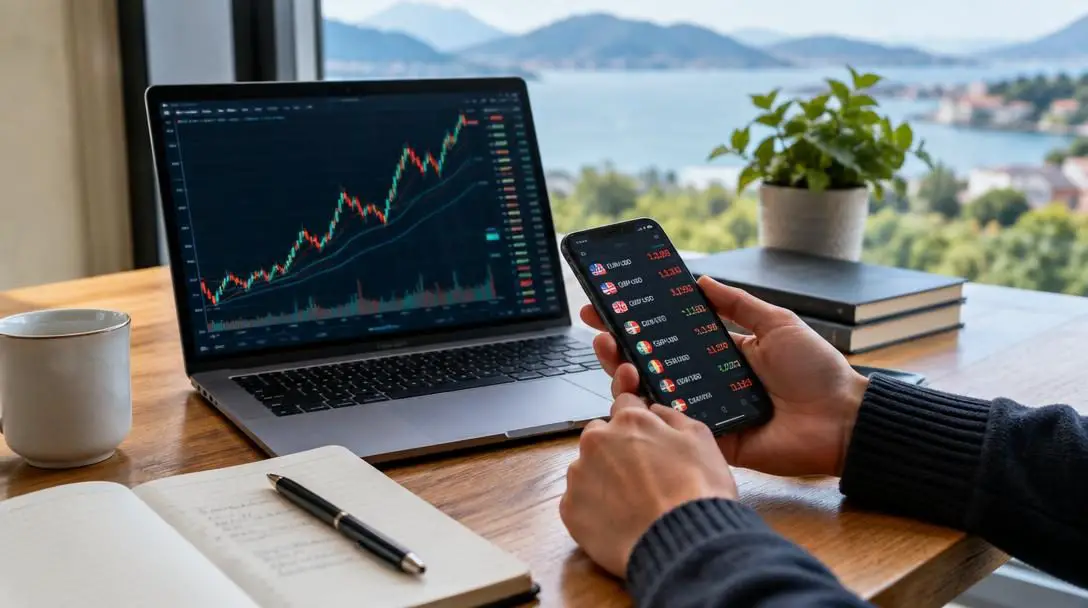
Exchange rates respond aggressively to breaking economic developments, geopolitical conflicts, and central bank commentary. In sudden market dislocations, prices can gap across levels, triggering rapid losses. Speculators who trade without adequate stop-loss mechanisms or who commit excessive capital to single positions can see their trading balances wiped out in a matter of hours.
Complex analytical requirements
Currency values are dictated by complex macroeconomic relationships. Successfully anticipating exchange rate moves requires evaluating international trade balances, sovereign debt conditions, differential interest rates, and national employment data. Speculators are competing against well-funded institutional trading desks equipped with teams of quantitative analysts and immediate access to market data. Casual intuition is insufficient to gain an edge against institutional participants.
Intense emotional strain and time commitments
Managing capital in an active market places substantial psychological stress on an individual. Fear frequently causes traders to close profitable positions prematurely, while greed or denial can lead them to hold losing trades in hopes of a turnaround. Furthermore, because currency markets operate around the clock, market-moving events can happen outside local business hours, demanding continuous attention and disrupting everyday routines.
A Step-by-Step Path to Starting Safely
For those who have weighed the hazards and still wish to pursue currency speculation, approaching the craft through structured preparation minimizes the risk of catastrophic loss.
- Commit to foundational education by studying currency mechanics, bid-ask spreads, quote conventions, and macroeconomic drivers using webinars, financial texts, and courses.
- Select a single specialized trading strategy, such as trend following or swing trading, that fits your personal schedule, temperament, and risk tolerance.
- Establish firm risk parameters, ensuring that no single trade risks more than a predetermined small percentage of your overall speculative capital.
- Document a written trading plan that specifies exact conditions for trade entries, profit-taking exits, stop-loss placement, and emotional management.
- Practice executing trades within a simulated demo account using live market data to validate your methodology without risking real money.
- Transition to live trading with minimal capital, maintaining conservative position sizes until you achieve consistent operational discipline under real emotional stakes.
Common Speculative Pitfalls to Avoid
Many novice currency traders fail not because the market lacks opportunity, but because they succumb to common behavioral errors. Avoiding these pitfalls is critical to long-term capital preservation:
- Overusing financial leverage: Taking on oversized positions relative to account size ensures that even routine market noise can trigger an account liquidation.
- Refusing to use stop-loss orders: Believing a losing trade will eventually recover often leads to catastrophic drawdowns when the market maintains a persistent trend against the position.
- Trading without a concrete plan: Entering trades based on social media tips, instincts, or unverified rumors transforms speculation into uncalculated gambling.
- Revenge trading: Impulsively increasing trade sizes immediately after a loss to make back capital rapidly compounds damage to the account.
- Holding positions through major news releases: Neglecting the macroeconomic calendar exposes unhedged positions to wide spreads and severe slippage during unexpected data announcements.
- Overtrading: Forcing trades during quiet market conditions creates unnecessary transaction friction and leads to sub-optimal setups that breach the trading plan.
Frequently asked questions
What is the difference between regular currency exchange and currency speculation?
Regular currency exchange is carried out to obtain physical foreign currency for practical purposes, such as travel, international commerce, or corporate supply chain payments. Currency speculation, by contrast, involves buying and selling currency pairs electronically with the sole goal of generating financial profit from exchange rate movements.
How does leverage work in foreign exchange trading?
Leverage allows a trader to control a much larger trade position with a relatively small upfront cash deposit. While leverage can substantially increase profits when price movements are favorable, it equally magnifies losses if the market moves against the position, making it one of the riskiest tools in speculative trading.
Which economic indicators influence currency values the most?
Key economic indicators include gross domestic product (GDP), consumer price index (CPI) inflation reports, labor figures such as unemployment rates, and central bank benchmark interest rate decisions. Stronger-than-expected data generally boosts demand for a nation's currency, while weak data can cause depreciation.
Why should a beginner start with a demo trading account?
A demo account allows prospective traders to test their strategies, practice order execution, and learn charting tools in live market conditions using virtual funds. This simulated environment lets beginners identify weaknesses in their trading plans without sustaining real financial losses.
What is the difference between technical and fundamental analysis?
Fundamental analysis evaluates underlying economic data, interest rate policies, and macroeconomic health to determine a currency's intrinsic strength. Technical analysis focuses exclusively on price action, volume, and chart patterns to identify short- and medium-term trading opportunities based on historical market behavior.
The bottom line
Currency speculation offers direct exposure to the world's largest and most liquid financial market. However, the high degree of leverage available, combined with relentless market volatility, makes it one of the most perilous arenas in modern finance. Generating sustainable returns requires far more than casual intuition; it demands deep market knowledge, an objective trading strategy, and unwavering risk management.
Before placing live capital into currency markets, conduct a rigorous self-assessment. Ensure that any money dedicated to speculation represents genuine risk capital—funds whose total loss would not impact your living situation, family obligations, or emergency savings. By prioritizing capital preservation, maintaining disciplined emotional control, and approaching the market methodically, you can properly assess whether currency speculation aligns with your broader financial goals.