The Art of Basket Weaving: Creating Beautiful and Functional Baskets
Human hands have folded, twisted, and interlaced natural plant fibers for thousands of years, transforming raw botanical growth into resilient vessels that carry the necessities of daily survival. As one of humanity's earliest technologies, basket weaving originated long before the advent of pottery or metalworking, establishing a practical craft that supported food gathering, storage, and communal trade across prehistoric civilizations worldwide.
Today, basketry endures as both a functional craft and a sophisticated contemporary art form. While modern synthetic materials dominate industrial container production, handcrafted plant-fiber vessels remain irreplaceable in their organic texture, durability, and tactile connection to regional environments. By understanding the mechanical physics of woven tension, honoring traditional fiber preparation methods, and exploring diverse structural styles, modern makers can produce timeless vessels that balance everyday utility with creative cultural expression.
Key takeaways
- Basket weaving represents one of humanity's oldest technologies, originating in prehistoric times to provide essential lightweight vessels for survival.
- Woven structures maintain their stability entirely through the mechanical forces of friction, geometry, and moisture-controlled tension, requiring no nails or synthetic glues.
- The three foundational structural configurations in basketry are plain over-under weaving, diagonal twill weaving, and spiraling coiled construction.
- Properly soaking dry plant fibers in water renders them pliable enough to bend without snapping and allows them to contract firmly as they dry.
- Basket designs divide into heavy-duty functional forms engineered for load-bearing and decorative pieces designed for artistic and spatial display.
The Ancient Origins and Cultural Meaning of Basketry
Before early societies learned to fire clay or smelt ores, they relied on woven organic fibers to navigate the physical demands of daily life. Archaeological findings confirm that basketry dates back thousands of years to prehistoric eras. Early humans recognized that intertwined reeds, shoots, and leaves offered superior strength-to-weight ratios compared to solid wood or stone containers. Communities crafted specialized vessels to forage wild harvests, sift grains, collect fresh water, haul domestic goods, and protect perishable foodstuffs from ground moisture and pests.
Because every basket was made entirely from organic flora harvested directly from the surrounding ecosystem, the practice reflected an intimate ecological knowledge. Weavers learned which marsh grasses yielded tough tensile cords, which tree shoots provided rigid structural uprights, and how seasonal harvesting affected fiber flexibility.
Over generations, basketry expanded beyond mere survival into a rich medium of visual communication and communal heritage. Cultures worldwide developed intricate symbolic vocabularies embedded directly within their weaves. By selecting specific regional dyes, alternating plant textures, and staggering intersections, artisans encoded tribal affiliations, family lineages, environmental narratives, and spiritual beliefs into their vessels. Baskets functioned as cultural artifacts and ceremonial objects, serving as tangible records passed down through generations. Today, contemporary basket makers preserve this living lineage, proving that even in an automated world, the combination of patient hands and raw fiber can convey deep cultural narratives.
The structural strength of a basket relies entirely on friction, tension, and geometry, holding itself firm without nails, hardware, or artificial adhesives.
Essential Materials and Crafting Tools
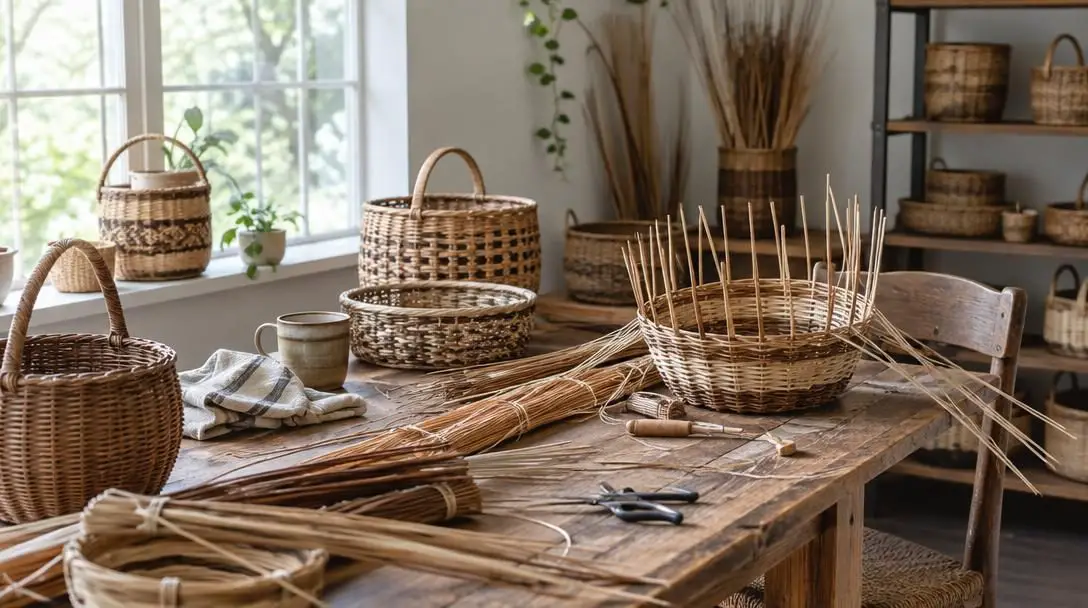
Embarking on a basketry project requires very little complex machinery. Instead, the craft relies on a small assortment of well-chosen natural fibers and basic manual hand tools designed to manipulate tension and maintain measurement accuracy.
Selecting the appropriate weaving medium dictates the stiffness, weight-bearing capability, and visual character of the finished container:
- Reed: Harvested from the inner pith of climbing palms or dense aquatic plants, reed is processed into standardized round, flat, or flat-oval profiles. Because it possesses uniform thickness and dependable flexibility when hydrated, reed is universally favored by beginners and experienced weavers alike.
- Wicker: A traditional classification that includes pliable woody branches, young willow rods, and hazel shoots. Wicker is renowned for its structural rigidity, extreme tensile durability, and rustic, organic aesthetic.
- Natural Fibers: Depending on local geography and ecological availability, weavers frequently incorporate wild grasses, palm fronds, long leaves, and cultivated plant fibers. These elements serve either as supple active weavers or as dense internal packing cores for coiled designs.
Alongside harvested fibers, artisans keep a concise toolkit within arm's reach on their work surface:
- Scissors: A pair of heavy shears or sharp craft scissors is critical for cutting structural stakes, trimming weavers to size, and snipping off excess fiber ends to ensure a tidy exterior surface.
- Tape Measure: Precision in basketry depends on symmetrical layouts. A flexible tape measure is used to map base grids, measure equal distances between vertical uprights, and verify that wall heights remain level around the entire perimeter.
- Weaving Needle: Also referred to as a packing tool or bodkin, this slender implement parts tight woven strands, allowing the artisan to tuck terminal fiber ends, lace thick rim sections, and feed accent cords through compact spaces without breaking the weave.
The Mechanics of Woven Structures: Friction, Geometry, and Water
A properly built basket is an architectural feat. Unlike carpentry or metal fabrication, traditional basketry joins elements without synthetic adhesives, mechanical fasteners, or metal hardware. The structural integrity of the vessel is sustained purely by interlocking passive and active elements held in equilibrium by mechanical friction and geometry.
The framework consists of passive structural members, historically termed stakes or spokes, which define the container's primary shape and dimensions. The flexible, moving strands that travel horizontally around and through these uprights are known as weavers. As weavers alternate over and under the stakes, they apply perpendicular pressure against the uprights. Simultaneously, the stakes push back against the weavers. This opposing resistance produces continuous surface friction that prevents strands from shifting or slipping out of alignment.
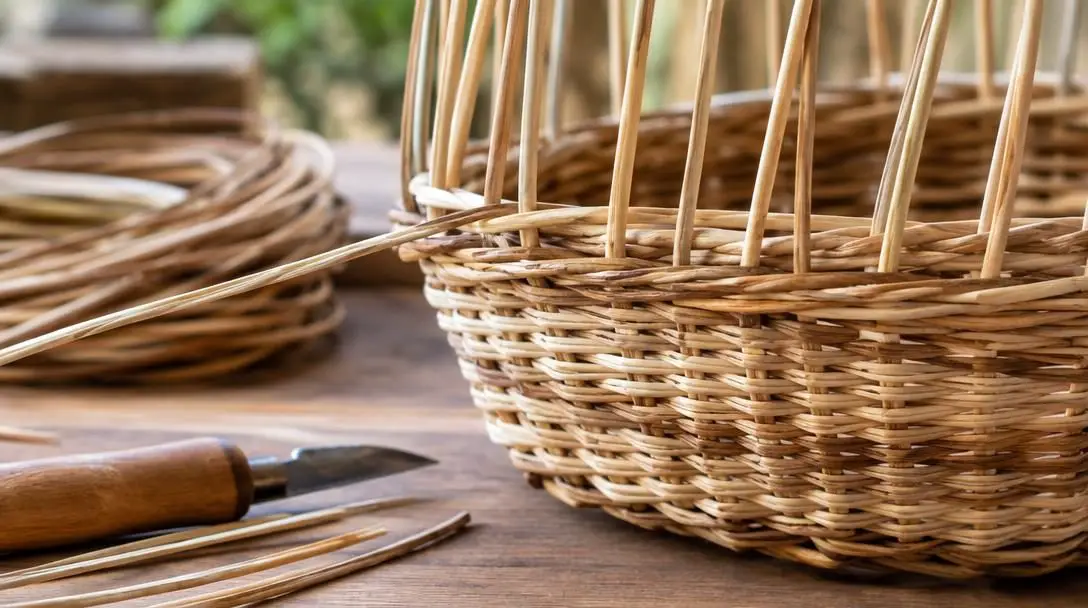
Water acts as the vital catalyst in this mechanical system. Plant matter in its cured, dry state is brittle and unforgiving; bending dry stalks causes their cellular walls to split, snap, or splinter. Submerging these materials in clean water relaxes their cellular matrix, restoring pliability and allowing the fibers to bend around sharp corners without breaking. As the artisan weaves the damp fibers tightly into place, water slowly evaporates from the vessel over the following hours. During this curing stage, the plant fibers contract slightly. This natural shrinkage tightens the entire geometry, locking the structural tension into the weave and leaving behind a rigid, self-supporting container.
Fundamental Weaving Configurations and Styles
The method an artisan uses to interlace the active weavers through the structural stakes determines not only the exterior visual pattern of the basket, but also its weight capacity, flexibility, and resistance to lateral deformation. Three structural configurations form the foundation of global basketry traditions.
The table below summarizes how these three structural styles compare across their core technical characteristics, visual aesthetics, and primary practical applications:
| Weaving Style | Mechanical Interlacing | Visual Texture | Primary Application |
|---|---|---|---|
| Over-Under Weaving | Alternates one weaver over one stake and under the next in sequence | Flat, checkered, uniform surface grid | Everyday utilitarian containers and sturdy domestic bases |
| Twill Weaving | Passes over two or more stakes and under one or more, staggered across rows | Distinct diagonal ridges and herringbone bands | High-stress containers needing superior lateral strength |
| Coiling | Wraps continuous fiber bundles into expanding tiers stitched together | Dense, rib-textured concentric rings or continuous spirals | Rigid heavy-duty vessels, shallow display trays, and thick bowls |
Each technique requires a distinct approach to tension management:
Over-Under Weaving: Often designated as plain weave, this configuration represents the most accessible entry point for new weavers. The artisan alternates a single flexible weaver over one vertical stake and under the following stake, reversing the order on subsequent passes. This simple rhythm creates a flat, uniform face that spreads structural stress evenly across all uprights, making it the standard choice for functional, everyday vessels.
Twill Weaving: Twill introduces visual and structural variation by altering the count of intersections. By guiding the active weaver over two or more structural stakes before ducking under one or more, and then offsetting the pattern by one stake on the next row, the weaver creates prominent diagonal lines across the vessel walls. Beyond its decorative appeal, twill provides exceptional resistance against lateral impact and outward pressure from heavy contents.
Coiled Construction: Distinct from stake-and-weaver mechanics, coiling relies on a central bundle of flexible plant materials or cordage wound into an expanding spiral. As the maker turns the core around itself to construct the base and build the walls, each new tier is sewn or bound to the tier directly below it using a flexible lacing strand. Coiling produces dense, thick-walled vessels capable of carrying substantial dry loads.
Step-by-Step Guide to Crafting a Woven Basket
Constructing a three-dimensional vessel from damp reed requires patience, methodical hand placement, and continuous observation of structural symmetry. Follow these systematic stages to build a durable, balanced container:
- Prepare the Workspace and Hydrate Fibers: Arrange your scissors, tape measure, and weaving needle on a clean, flat table. Fill a wide basin with room-temperature water and fully submerge your reeds or woody fibers. Allow them to soak until they bend cleanly around your finger without cracking, snapping, or shedding splinters.
- Construct the Base Grid: Measure and cut the designated base reeds to equal lengths according to your project dimensions. Lay half of the base stakes horizontally on your work surface and weave the remaining stakes perpendicularly across them. Ensure the intersections sit at exact ninety-degree angles to form a symmetrical square or rectangular grid.
- Secure the Base with Initial Weavers: Select a pliable, hydrated weaver and insert its tapered end into the center of the base grid. Weave around the intersecting stakes using an over-under pattern, holding the spokes completely flat against the table surface. Maintain consistent, moderate pull to bind the grid firmly without causing the flat base to bow upward.
- Upset the Stakes and Establish Side Walls: Once the woven base reaches its intended diameter or dimensions, perform the step known as upsetting. Carefully bend every base stake upward at a sharp ninety-degree angle toward yourself to establish the vertical side framework. Begin weaving around these newly formed uprights from the bottom upward, tilting the stakes slightly inward or outward to guide the container's final profile.
- Maintain Uniform Tension Across the Walls: As the basket gains height, continually check the gap between each vertical stake using your tape measure. Pull the active weaver snugly against each upright to avoid gaps in the weave, taking care not to pull so hard that the uprights buckle inward and deform the walls.
- Construct the Rim and Lock the Edges: After reaching your targeted wall height, taper the end of your final weaver. Fold down remaining vertical stakes, tucking them back down along the woven rows using your weaving needle to form a locked border. If your project includes an integrated carrying handle, secure its ends deep into the structural uprights before binding the rim securely. Trim all remaining fiber ends cleanly with sharp scissors.
Functional Baskets and Their Applications
Functional basketry prioritizes structural durability, ergonomics, and weight-bearing performance. The dimensions, weave density, and handles of these containers are engineered to withstand the rigors of manual transport and daily storage.
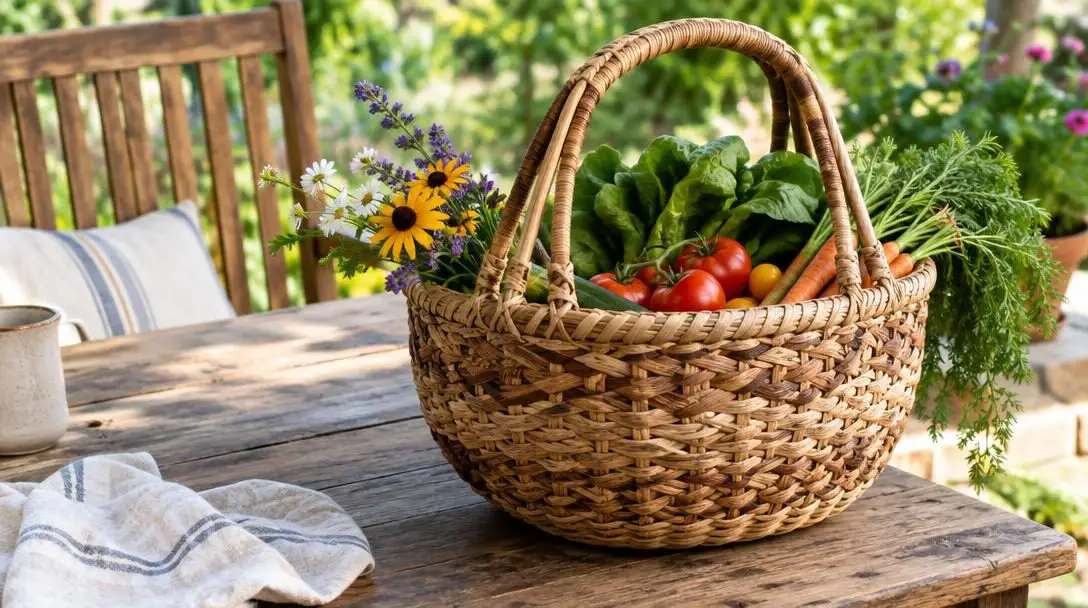
Market Baskets
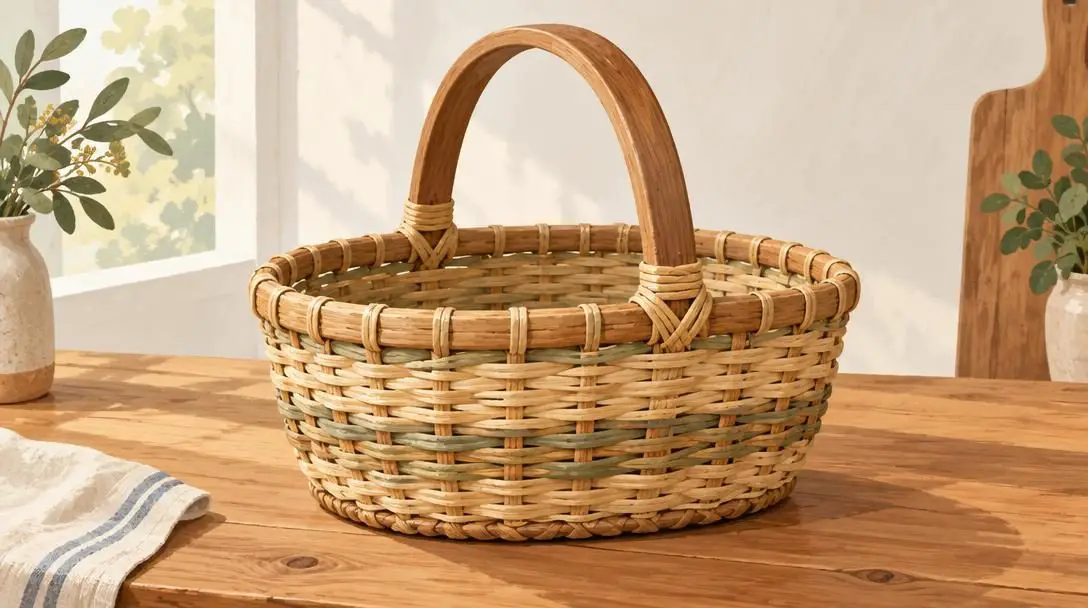
- Base Configuration: Reinforced flat rectangular or oval base
- Handle Structure: Arched overhead handle integrated into side stakes
- Primary Application: Transporting fresh produce, heavy tools, and provisions
Market baskets are purpose-built carriers designed to withstand heavy, unevenly distributed cargo. They feature reinforced, flat bases that remain stable when placed on uneven ground or flat vehicle beds. The dense, rigid side walls prevent contents from tumbling outward, while a thick, arched overhead handle is woven directly into the structural uprights of the body, allowing the carrier to support substantial weight without separating at the joints.
Laundry Baskets
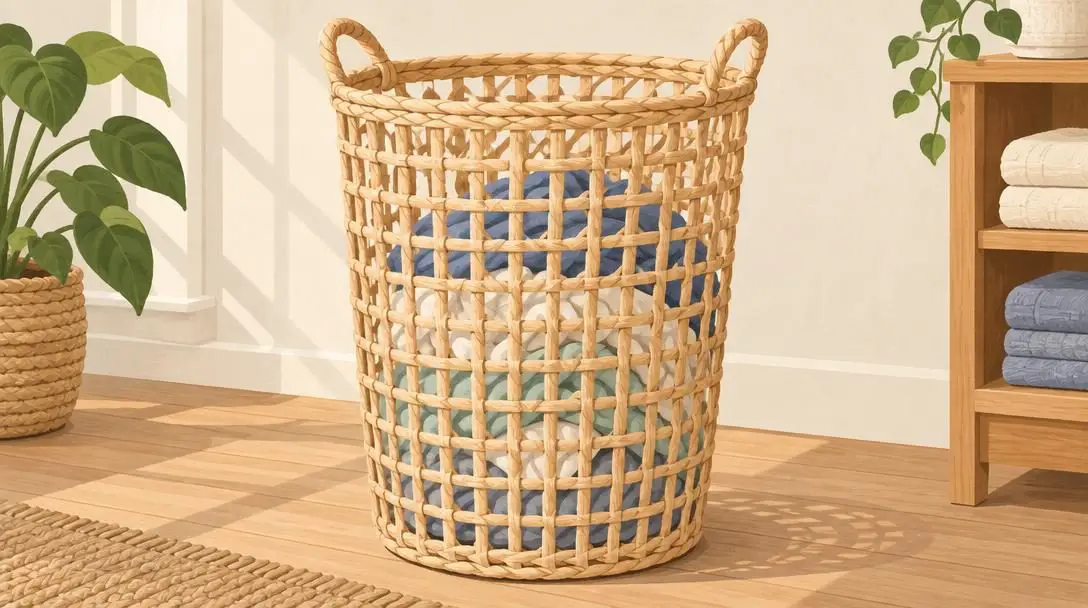
- Base Configuration: Wide, deep interior compartment
- Handle Structure: Integrated side finger-grips or low rim handles
- Primary Application: Transporting textiles and household linens
Laundry baskets maximize internal volume while keeping the overall container lightweight and manageable. Constructed with high walls and broad openings, these vessels accommodate bulky textiles with ease. Weavers utilize open weaving patterns that allow ambient air to circulate continuously through the walls, preventing the moisture accumulation and mildew growth that can occur when damp linens are kept in enclosed plastic tubs.
Picnic Baskets
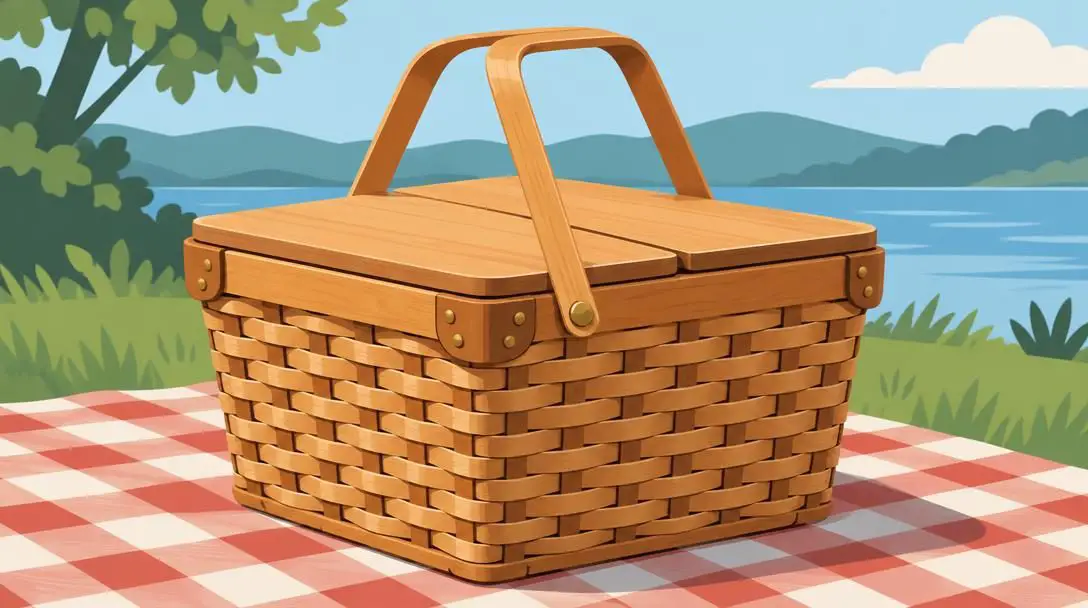
- Base Configuration: Deep, multi-compartment flat-bottom frame
- Handle Structure: Balanced double carrying handles
- Primary Application: Outdoor dining transit and meal protection
Picnic baskets are designed to safely carry dining ware, food containers, and drink vessels across outdoor terrain. They employ reinforced rims, rigid bases, and deep protective compartments that insulate delicate glassware from jostling. Traditional picnic designs often incorporate hinged, flat split lids that shield provisions from sunlight and insects while providing a level surface for serving meals in the field.
Decorative Baskets and Their Applications
When utility ceases to be the primary constraint, basketry becomes a canvas for sculptural balance, vibrant color play, and expressive spatial design. Decorative vessels highlight delicate fibers and intricate geometric motifs that would be impractical for heavy load-bearing tasks.
Wall Baskets
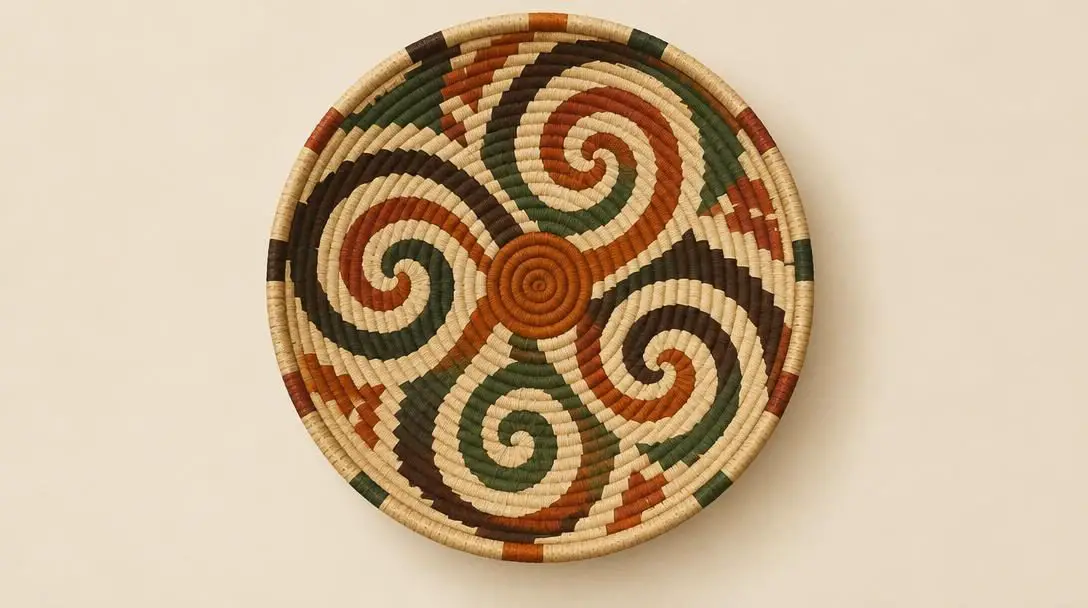
- Base Configuration: Flat or shallow concave disc
- Visual Focus: Radial geometric symmetry and natural dye contrast
- Primary Application: Vertical wall hanging and architectural display
Wall baskets, often referred to as plaques or trays, are woven as flat or gently concaved discs intended for vertical wall installation. Artisans incorporate contrasting natural fiber colors, dyed reeds, and complex coiled or twill patterns that radiate outward from the center. These pieces serve as tactile focal points in interior spaces, celebrating regional heritage and geometric balance.
Flower Baskets

- Base Configuration: Light, flared open basin
- Handle Structure: Slender, curved accent handle
- Primary Application: Displaying fresh flora and dried botanicals
Flower baskets feature light, airy construction designed to hold fresh seasonal stems, dried florals, or garden clippings. Rather than dense, heavy walls, these vessels feature delicate over-under or open-lattice weaving, slender rims, and graceful, curving handles that complement the organic lines of the botanical arrangements inside.
Woven Sculptures
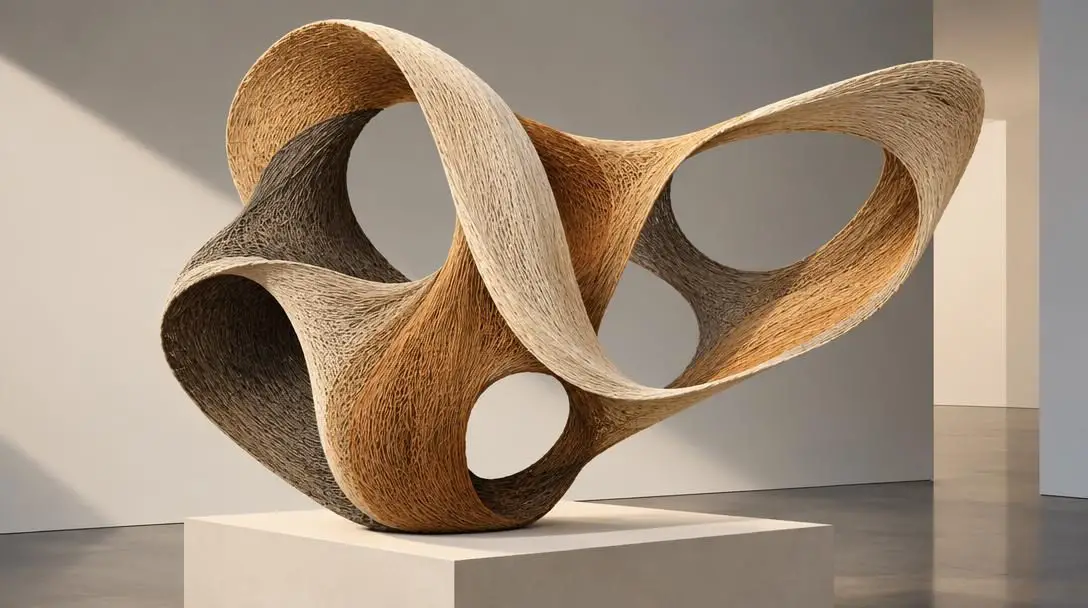
- Base Configuration: Asymmetrical or freeform foundation
- Visual Focus: Three-dimensional spatial curves and tension play
- Primary Application: Fine art gallery presentation and sculptural exhibition
Woven sculptures depart from functional container forms entirely, using the mechanical tension of plant fibers to create three-dimensional abstract art. Sculptural weavers twist, warp, and interlock stakes in unconventional directions, building undulating curves, open voids, and dramatic spires. These expressive works showcase basketry as a fine art medium capable of commanding gallery and museum spaces.
Common Basketry Mistakes and How to Avoid Them
Every novice basket maker encounters challenges with fiber manipulation, tension consistency, and structural alignment. Recognizing these common stumbling blocks early helps protect your raw materials and ensures a clean, symmetrical finish:
- Weaving with Insufficiently Hydrated Fibers: Attempting to weave reeds that are brittle or partially dry will inevitably cause the fibers to crack along their grain. Always test fibers before weaving by bending them across your finger; if they feel stiff or show surface micro-fractures, return them to the soaking basin for several minutes.
- Applying Inconsistent Hand Tension: Pulling the active weaver too tightly pulls the vertical stakes inward, causing the basket to taper prematurely. Conversely, pulling too loosely creates sloppy gaps and a weak frame. Strive for smooth, deliberate pressure, and regularly check the distance between uprights with your tape measure.
- Rushing the Base Construction: An uneven, loose, or out-of-square base grid undermines the structural stability of the entire basket. Dedicate adequate time to squaring the intersecting base reeds and securing the center weave flat against your work table before attempting to bend the side stakes upward.
- Neglecting Rim Anchoring: The rim secures the structural uprights of the basket. If you fail to anchor the folded stake ends deeply into the woven body with your weaving needle, the rim will pull loose when the container is lifted by its handle or filled with heavy cargo.
Frequently asked questions
How long should reeds be soaked before weaving?
Soaking times depend entirely on the thickness and species of the fiber. Most standard round and flat reeds become pliable after 10 to 15 minutes in room-temperature water. Thicker wicker rods or heavy handles may require 30 minutes or longer, while delicate grasses need only a brief dip. Test pliability by bending a strand around your finger; if it curves without splintering, it is ready.
Can a beginner weave a basket without specialized tools?
Yes. The basic toolset for basketry is minimal and relies heavily on common household items. A standard pair of sharp household shears, a flexible sewing tape measure, a bucket of water, and an improvised packing tool (such as a flathead screwdriver, knitting needle, or dull butter knife) are sufficient to complete a first project.
What is the difference between stakes and weavers?
Stakes (also called spokes) are the passive, heavier structural elements that form the base grid and vertical framework of the container. Weavers are the more flexible, active strands that wind continuously through and around the stakes to build the walls and lock the framework in place.
Why do basket fibers shrink after the project is completed?
Plant fibers absorb water into their cellular structures during the soaking phase, causing them to swell slightly. As the completed basket cures and dries over subsequent days, the water evaporates, causing the cellular walls of the fibers to contract. This natural shrinkage pulls the entire weave tighter, locking the tension into the container.
How can I prevent mold from developing on natural plant baskets?
Ensure that newly completed baskets are placed in a warm, well-ventilated area until all moisture has thoroughly evaporated from the deep layers of the weave. Store finished baskets in dry environments with steady airflow, and avoid leaving them in damp basements or sealed plastic storage bins.
The Bottom Line
Basket weaving serves as a vital bridge between human prehistory and contemporary craft. By mastering simple natural mechanics—balancing active weavers against passive stakes, understanding how water unlocks fiber pliability, and maintaining uniform tension across rows—anyone can transform raw botanical cuttings into resilient, functional works of art. Whether you construct a sturdy market basket for weekly produce, an airy laundry container, or an expressive woven wall sculpture, the craft offers a deeply rewarding creative discipline that connects modern makers directly to thousands of years of living human heritage.