The History of the Internet: From ARPANET to What Lies Ahead
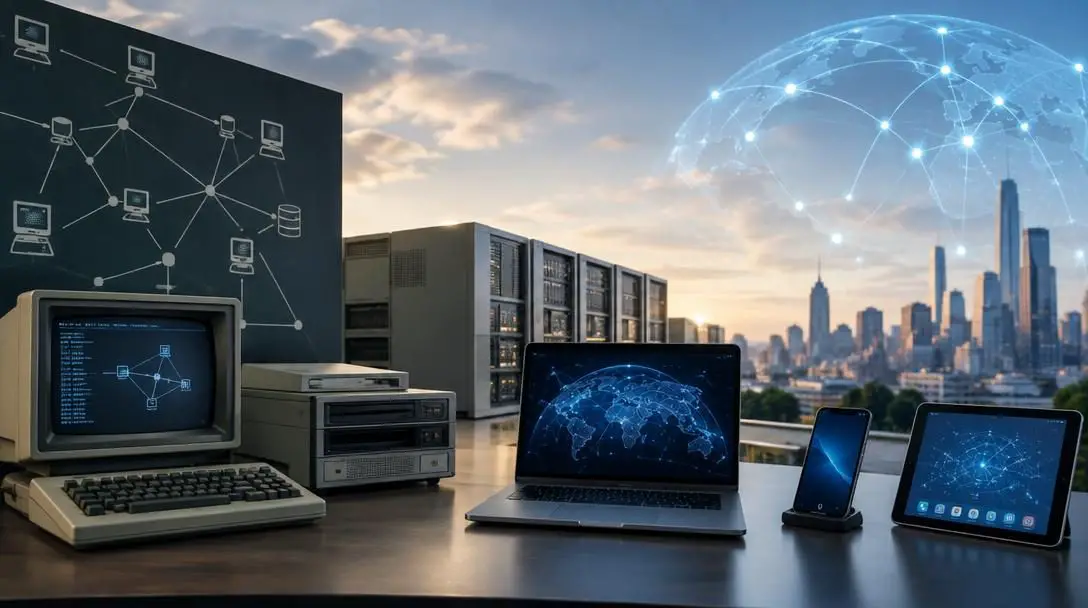
The internet in contemporary society is far more than a technical luxury; it has become an indispensable utility that underpins modern life. Across developed nations, well over 90 percent of people connect to the internet every single day to perform their jobs, complete schoolwork, gather late-breaking news, and consume digital entertainment. What began as an experimental framework for military resilience and academic file-sharing has steadily expanded into a global fabric connecting billions of individuals, handheld devices, and enterprise data centers around the clock.
Despite this near-total reliance on connected systems, the underlying story of how room-sized academic machinery transformed into a pervasive worldwide communications grid remains unfamiliar to many. Looking back across the decades reveals a technological continuum that began in mid-century research labs and continues to expand toward cutting-edge interfaces. From military-funded resource-sharing experiments to universal communications protocols and interactive social media platforms, the digital world was shaped by methodical breakthroughs in hardware, standards, and user-facing software.
Key takeaways
- The conceptual roots of networked computing trace back to central processing unit time-sharing breakthroughs pioneered by Christopher Strachey in the late 1950s.
- ARPANET achieved the first interconnected host transmission in 1969 between California research nodes before expanding internationally across the Atlantic during the 1970s.
- The formal standardization of the TCP/IP suite in the 1980s unified formerly incompatible computer architectures into a singular, scalable internetwork.
- Software engineers at CERN launched the World Wide Web in 1991 using HTML, establishing the hyperlinked presentation layer that operates on top of physical network routing.
- Modern network maintenance requires proactive router security, routine firmware patching, and multi-factor authentication to defend consumer endpoints.
The Origins of Networked Computing
In the 1950s, global telecommunications depended heavily on long-distance telephone lines, radio signals, and telegraph networks. Electronic computers existed, but there was no concept of a personal desktop workstation or handheld mobile device. Instead, computers were monolithic, room-sized mainframes housed in specialized university departments and military research centers. Linking these isolated supercomputers together across vast geographical distances seemed like an impossible theoretical ambition during the post-war era, largely because each machine operated on proprietary electrical standards and required physical punch cards or magnetic tapes to load instructions.
To overcome these physical limitations, computer scientists began investigating practical methods to distribute processing power among multiple operators simultaneously. A major breakthrough occurred when Christopher Strachey filed a patent for central processing unit time-sharing prior to his work at Oxford University. Strachey’s contribution established him as one of the conceptual godfathers of networked computing. Before time-sharing, a mainframe could execute only one sequential batch job at a time, leaving expensive hardware idle between processing cycles.
Time-sharing was an essential milestone because it allowed a single large computing system to handle tasks for multiple users at once, laying the conceptual groundwork for multiple systems to communicate. This core concept broke the paradigm of single-operator mainframes and demonstrated that computational capacity could be multiplexed across shared electronic pathways. Throughout the 1960s, theoretical network studies accelerated as institutional backing expanded, eventually turning experimental data transfer into an operational imperative for the United States military.
Major Milestones in Network Infrastructure
The architecture of modern digital communication was not built overnight. It emerged through distinct historical eras characterized by fundamental networking breakthroughs, new communications protocols, and public software interfaces developed between the late 1960s and the early twenty-first century.
| Milestone Era | Primary Development | Key Protocols or Entities | Significance |
|---|---|---|---|
| 1969–1970s | ARPANET Deployment | Packet-switching, initial research nodes | First operational inter-host network |
| 1980s | Protocol Standardization | TCP/IP, CSNET, DNS | Universal data format across hardware |
| 1991 | Public Web Launch | HTML, The World ISP, CERN | Residential access and hyperlinked documents |
| Late 1990s | Commercial Web Portals | AOL, Yahoo, Google, AltaVista | Algorithmic indexing and mass adoption |
| 2000s–Present | Social Web Era | Facebook, Twitter, Instagram | User-generated media and real-time community |
The digital world was shaped by methodical breakthroughs in hardware, standards, and user-facing software.
ARPANET
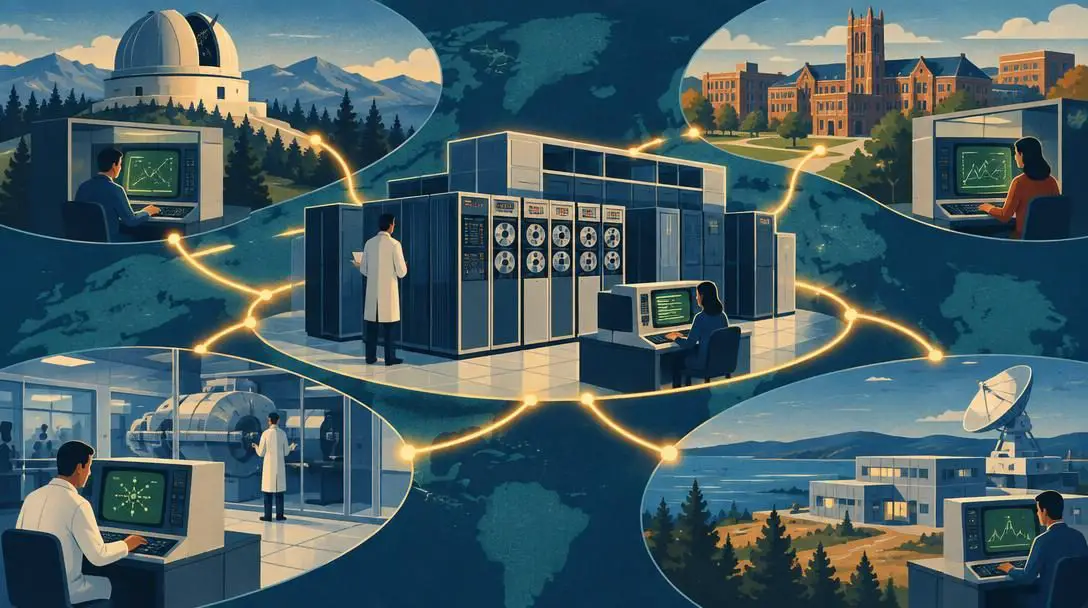
- Established: 1969
- First Nodes: Menlo Park and Los Angeles, California
- International Expansion: United Kingdom and Norway
- Host Scale by Late 1970s: Over 200 connected hosts
Established in 1969 through significant institutional funding, ARPANET served as the foundational operational network for resource sharing among institutional mainframes. Developed under the auspices of the Advanced Research Projects Agency, the project aimed to allow remote academic centers to utilize shared computing power. Initially bridging research nodes across the western United States, it later expanded its physical footprint across the Atlantic Ocean to incorporate advanced research facilities located in the United Kingdom and Norway.
The system's historic first operational transmission took place between two computer terminals located in Menlo Park and Los Angeles, California. The research team attempted to transmit the word "LOG", but the network experienced an unexpected crash immediately following the entry of the characters. While premature, this brief transmission verified that raw data packets could be transmitted across independent nodes without dedicated physical circuits. By the close of the 1970s, ARPANET had evolved into a dependable operational architecture supporting over 200 connected hosts across government and university labs.
Protocol Standardization and Academic Expansion
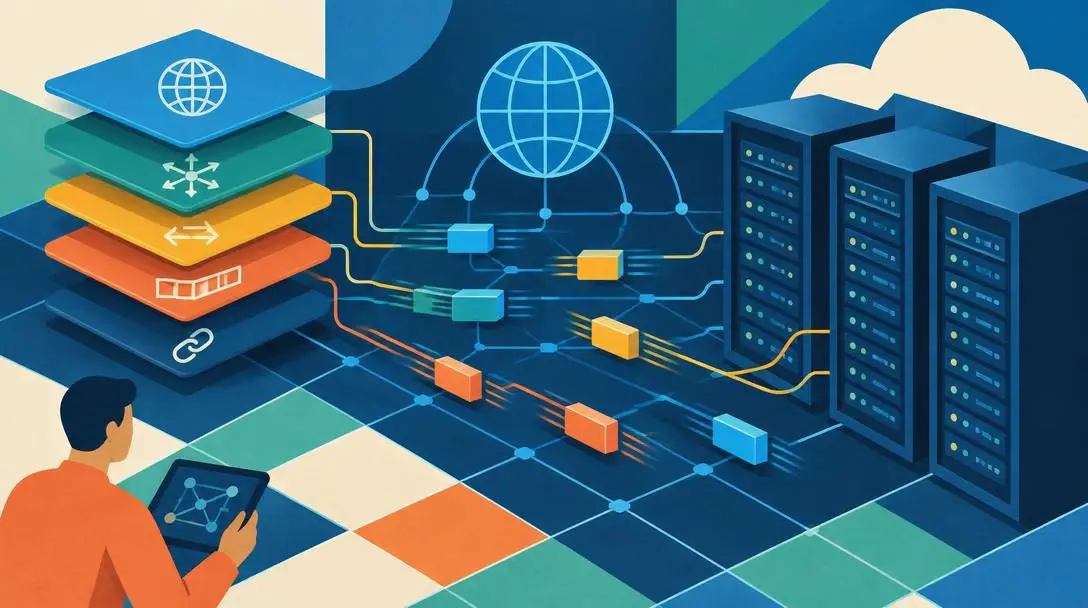
- Primary Era: 1980s
- Core Architecture: TCP/IP suite
- Academic Networks: CSNET, NSFNET
The 1980s marked a decade of rapid network diversification and standardization across higher education. As separate institutions began constructing their own local networks, computer science departments established dedicated systems like the Computer Science Network (CSNET) to share academic resources without relying strictly on military-funded backbones. However, because these disparate networks relied on distinct physical wiring and differing communication rules, exchanging messages across distinct institutional boundaries remained deeply problematic.
The watershed development of this era was the formal adoption of the TCP/IP protocol suite. These protocols introduced universal standards for addressing, packaging, routing, and reconstructing data fragments across diverse, heterogeneous computer hardware. Transmission Control Protocol ensured that data arrived intact and without loss, while Internet Protocol established universal logical addressing across diverse systems. By unifying technical rules across formerly incompatible local area networks, TCP/IP set the stage for academic internetworks to expand into consumer homes.
Domain Name Registration and The World
- First Domain Registered: Mid-1980s
- First Commercial Dial-up ISP: The World (1991)
- Infrastructure Backbone: NSFNET
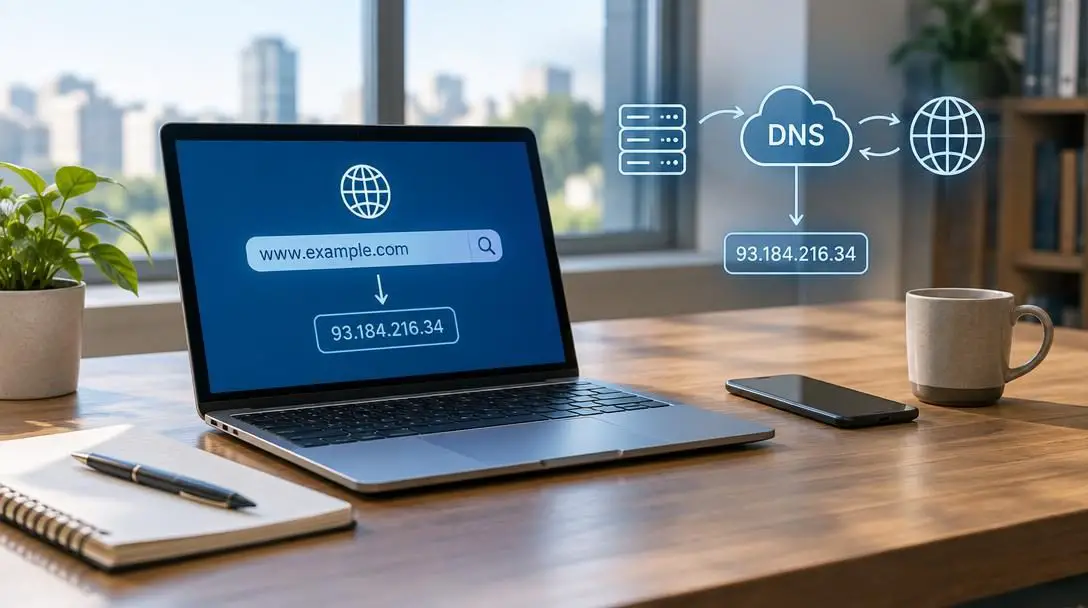
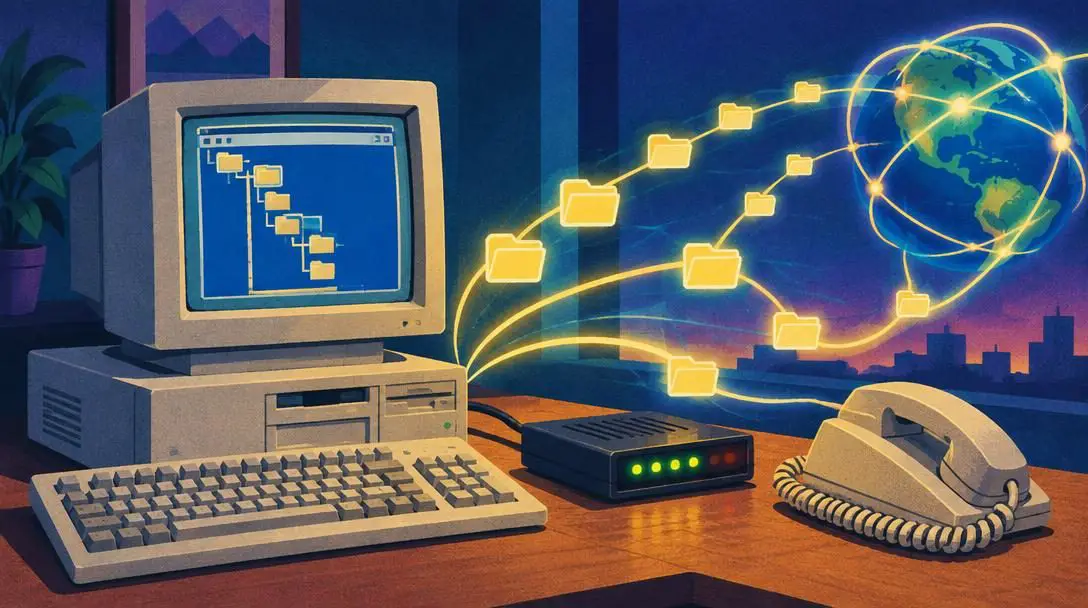
Midway through the 1980s, the operational complexity of numerical network addresses led to the registration of the very first domain name, introducing human-readable addressing to data routing. Rather than memorizing numeric strings to access specific host machines, system administrators could associate functional domain labels with remote network locations. Shortly thereafter, the establishment of the National Science Foundation Network (NSFNET) expanded academic infrastructure, establishing high-capacity backbones capable of handling national network traffic.
The network shifted irrevocably toward the general public in 1991 when The World debuted as the first commercial internet service provider. For the first time, residential users could acquire standalone commercial accounts outside military or academic affiliations. By connecting home telephone modems directly to digital routing facilities, commercial service providers eliminated the strict institutional prerequisites that had previously restricted network access to accredited university scientists and defense personnel.
CERN and the World Wide Web

- Year Introduced: 1991
- Development Organization: CERN
- Core Technology: Hypertext Markup Language (HTML)
Also in 1991, software engineers at CERN developed Hypertext Markup Language (HTML), inaugurating the World Wide Web. Prior to this milestone, accessing files across the internet required navigating arcane command-line protocols and navigating bare directory file trees. While the underlying internet provided the physical and network infrastructure of linked machines, HTML provided the universal software presentation layer.
This markup system allowed researchers—and soon the global public—to organize, link, and display formatted text, documents, and navigational links across heterogeneous hardware systems. Users no longer needed to know the physical architecture or operating environment of the host machine serving a file. By combining clickable hypertext with unified resource locators, CERN’s creation brought about the visual, hyperlinked medium that defines modern internet navigation.
Commercial Web Portals and Early Search Engines
- Dial-Up Providers: AOL, CompuServe
- Early Search Portals: AltaVista, Lycos, Ask Jeeves, Yahoo
- Market-Defining Engine: Google
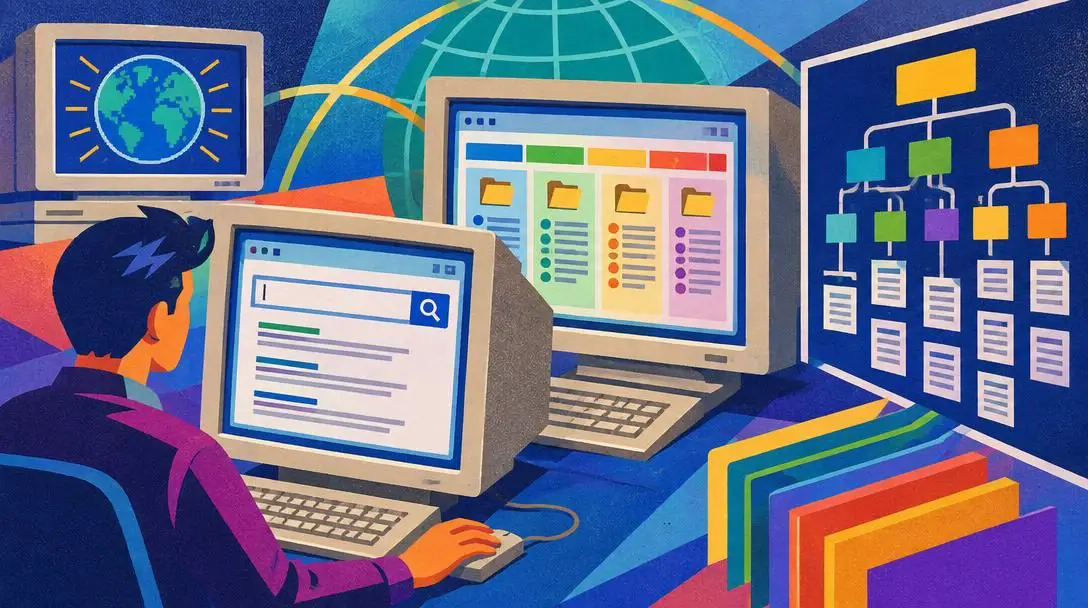
Throughout the 1990s, consumer web adoption exploded. Service providers like America Online (AOL) and CompuServe distributed dial-up installation disks and software packages to millions of residential households. The emergence of online marketplaces like eBay and real-time instant messaging services like MSN altered home life and personal commerce. Families who had previously relied on printed encyclopedias and postal mail suddenly gained immediate access to global storefronts and real-time messaging networks.
Navigating this vast influx of electronic pages by typing direct server IP addresses or complex directory paths quickly proved impractical. To address the problem, competitive search engines and discovery portals entered the market, including AltaVista, Lycos, Ask Jeeves, Yahoo, and Google. While early portals relied on manual directory trees, Google established itself through superior algorithmic indexing, cementing its position as one of the most critical websites in the history of the medium by organizing the chaotic expanse of the consumer web into instantaneous search results.
The Social Networking Era

- Era: Early 2000s to Present
- Key Platforms: Facebook, Twitter, Instagram
- Core Architecture: Interactive user-generated content
At the turn of the millennium, the internet evolved from an ecosystem of static web pages into an interactive, read-and-write social environment. Rather than simply reading published corporate or academic text, users actively created, distributed, and responded to user-generated media. Broadband connections replaced dial-up lines, allowing high-resolution photography, streaming audio, and real-time video feeds to flow between standard consumer devices.
The arrival of massive social platforms, including Facebook, Instagram, and Twitter, transformed the public web into an ongoing cultural forum. Digital networks were no longer just functional repositories of reference documents; they had become real-time reflections of daily life. This shift fundamentally altered how humanity organizes political events, shares creative media, and maintains personal relationships worldwide.
Best Practices for Modern Network Setup
Today’s digital landscape requires users to operate interconnected arrays of residential networking equipment, commercial subscriptions, and software layers. Interacting safely and reliably with global infrastructure requires following standard operational practices:
- Select an Internet Service Provider: Survey regional providers offering wireless, fiber-optic, or cable broadband. Evaluate bandwidth limits, operational uptime records, and data throughput speeds to support your work or educational needs.
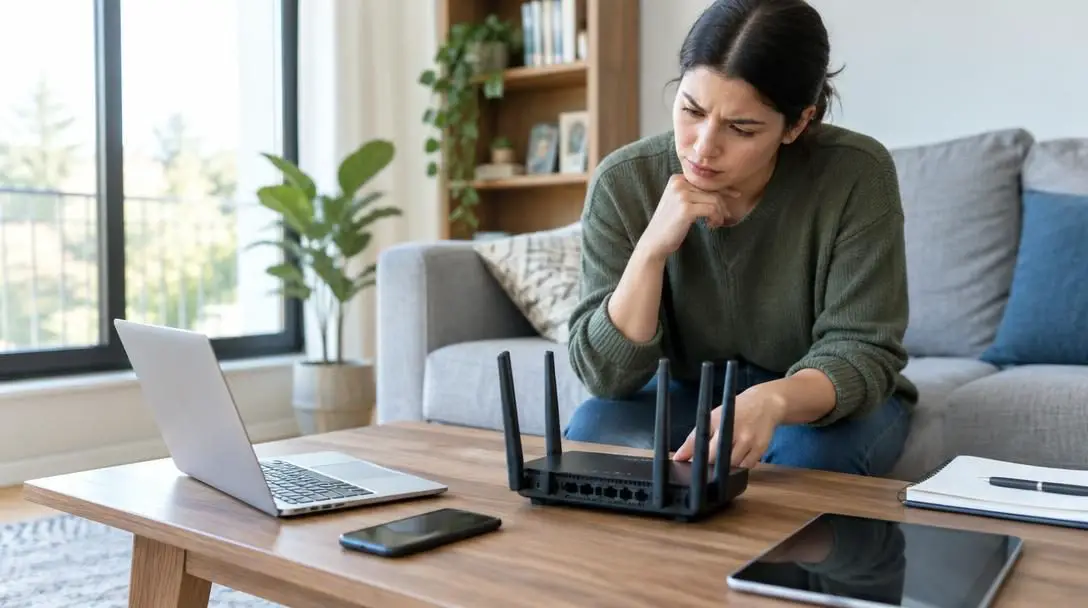
- Configure Core Network Equipment: Connect an authorized modem to translate signals from your service provider, paired with a router to manage local traffic and route wireless data to computers, mobile devices, and peripherals.
- Establish Secure Authentication: Immediately replace default administrative logins on your gateway router with complex passphrases. Apply modern wireless encryption standards to protect your local radio signals against unauthorized connections.
- Configure Browser and Navigation Tools: Use an updated web browser compatible with contemporary HTML standards. Set robust tracking protections, clear unnecessary storage cookies, and select trusted default search engines to safeguard personal searches.
- Implement Device-Level Protection: Turn on automated operating system updates, maintain active local firewalls, and patch internet-facing software tools to guard against discovered security vulnerabilities.
- Manage Digital Accounts: When registering for web utilities, commercial retailers, or social platforms, use strong passwords and configure multi-factor authentication to secure accounts against unauthorized sign-ins.
Common Mistakes in Internet Usage and Network Management
Because networked computing evolved rapidly from an experimental military project into a ubiquitous consumer utility, common user habits often lead to network degradation or security compromises. Below are typical pitfalls and misunderstandings observed in network deployment:
- Relying on Default Hardware Configurations: Neglecting to change default administrative passwords on commercial modems and wireless routers allows intruders to access local device settings, redirect DNS lookups, or siphon available bandwidth.
- Neglecting Software and Protocol Updates: Bypassing browser patches, network firmware updates, and operating system hotfixes leaves local machines exposed to documented exploits and malicious network activity.
- Overlooking Basic Local Network Security: Leaving local Wi-Fi networks open without encryption allows eavesdropping on unencrypted transmissions and permits unauthorized parties to route traffic through your residential IP address.
- Conflating the World Wide Web with the Underlying Internet: Misunderstanding the technical difference between the internet (the underlying physical network of linked nodes) and the World Wide Web (the application layer of hyperlinked documents) often causes users to confuse application-level disruptions with hardware outages.
- Overloading Bandwidth Without Infrastructure Upgrades: Running multi-stream video feeds, large file downloads, and intensive virtual reality sessions over aging routing hardware causes severe latency spikes, packet loss, and local hardware crashes.
Frequently asked questions
What was the first message ever sent over ARPANET?
The first transmission was intended to be the word "LOG" sent between terminals in Los Angeles and Menlo Park in 1969. However, the system experienced a technical crash immediately after typing the characters, making the abbreviated attempt the very first network transmission.
Who was Christopher Strachey and why was his work important?
Christopher Strachey was a pioneering computer scientist who filed a foundational patent for CPU time-sharing before working at Oxford University. Time-sharing allowed a single central mainframe to process tasks for multiple users at once, providing the conceptual framework for networked computers communicating over shared paths.
What is the difference between the internet and the World Wide Web?
The internet represents the physical and structural infrastructure of networked computers, routers, fiber lines, and data transmission protocols. The World Wide Web is an application layer developed at CERN in 1991 that utilizes HTML to format, link, and display multimedia pages across that physical network.
Why was the adoption of TCP/IP in the 1980s so critical?
Prior to TCP/IP, independent networks relied on incompatible communication formats that prevented seamless inter-system communication. The TCP/IP suite introduced universal standards for addressing, packaging, routing, and reconstructing data packets across diverse computer architectures, allowing academic networks to scale into a unified global system.
When did commercial internet access become available to residential users?
Commercial residential access began in 1991 with the launch of The World, the first commercial dial-up internet service provider. This development allowed individual consumers to obtain standalone internet connections independent of academic or military institutional affiliations.
The bottom line
The evolution of global digital networking illustrates how foundational academic research can reshape human civilization. What began as mid-century CPU time-sharing experiments and experimental packet-switching connections between California laboratories gradually matured through technical standardization into a universal medium for global commerce, interpersonal communication, and information distribution.
Understanding this trajectory from early mainframes and ARPANET terminals to high-speed fiber networks and social media platforms emphasizes the importance of preserving open protocols and practicing responsible digital hygiene. As society continues to build upon the TCP/IP foundation laid decades ago, maintaining strong authentication, patching network hardware, and recognizing the distinction between physical infrastructure and presentation software ensures that our connected world remains reliable, resilient, and secure.