Gain Insight Into Your Motivational Drivers With Personality Tests

Many professionals move through their daily routines without fully understanding why specific projects generate a surge of sustained focus while other responsibilities leave them drained. You might eagerly spend hours solving an intricate, solitary puzzle that a coworker vigorously avoids in favor of orchestrating a large team workshop. These divergent reactions are governed by motivational drivers—the underlying psychological forces, values, and beliefs that steer your actions, ambitions, and daily choices.
When your daily responsibilities harmonize with your internal drivers, work feels invigorating and purposeful. Conversely, sustained misalignment between your duties and your inner motivators can rapidly trigger frustration, disengagement, and burnout. Structured personality assessments offer a systematic method for decoding these internal forces, transforming subjective personal feelings into clear behavioral patterns that help you optimize your professional path and collaborative relationships.
Key takeaways
- Motivational drivers reflect core values and dictate whether specific activities energize or exhaust you.
- Recognizing the difference between achievement-oriented and socially oriented drivers improves personal decision-making and workplace dynamics.
- Established assessment tools such as the MBTI, DISC, Enneagram, and Big Five illuminate behavioral patterns from distinct psychological angles.
- Turning assessment insights into sustained growth requires honest self-reporting, routine audits, and deliberate lifestyle adjustments.
- Personality tests should serve as flexible guides for empathy and self-reflection rather than rigid, unchangeable labels.
The Psychology of Inner Drivers and Energy
At the center of personal productivity lies a simple dynamic: what revitalizes one person may completely deplete another. Motivational drivers represent your foundational needs and priorities. Rather than being mere fleeting interests, they dictate how you interpret demands, evaluate success, and allocate mental stamina. When you understand these internal currents, you no longer have to rely on guesswork to stay engaged.
Consider the contrast between achievement-driven and connection-driven professionals. An individual propelled by individual achievement naturally concentrates on hitting ambitious targets, monitoring concrete progress, and securing tangible results. In contrast, someone guided by social interaction derives stamina from cultivating relationships, facilitating consensus, and sharing experiences with a supportive group. Neither orientation is inherently superior, but confusing the two leads to mismatched assignments, strained communication, and misplaced career goals.
When an activity lines up with your inner drivers, engaging in it feels natural, satisfying, and revitalizing, but clashing tasks turn even routine efforts into chronic exhaustion.
Without conscious self-awareness, people often take on roles based on prestige, peer expectations, or habit, only to discover deep dissatisfaction. Identifying what genuinely sparks your engagement enables you to structure your environment deliberately, advocate for roles that fit your strengths, and navigate complex social dynamics with clarity.
The Evolution of Structured Self-Assessment
Human beings have long attempted to categorize behavior and explain why different people respond unpredictably to identical conditions. While casual self-reflection offers surface-level clues, it is easily distorted by momentary moods or wishful thinking. Formal personality testing emerged to provide an organized, objective framework for examining underlying psychological tendencies and interpersonal habits.
Modern assessments convert subjective daily experiences into recognizable, consistent trends. By presenting carefully calibrated questions about how you behave across varied settings, these instruments uncover the underlying priorities steering your problem-solving methods, collaboration styles, and long-range pursuits. As these tools moved from theoretical research into corporate environments, educational institutions, and coaching practices, researchers recognized that mapping a person's behavioral habits also reveals what provides them with energy and purpose.

Four Established Frameworks for Uncovering Motivation
Different personality models evaluate human psychology through distinct lenses. While their technical methodologies vary, each model organizes behavioral patterns to help individuals understand their operational style. The table below summarizes four of the most widely used instruments before we examine each in depth.
| Framework | Primary Diagnostic Focus | Core Categories or Scales | Key Motivational Insight |
|---|---|---|---|
| Myers-Briggs Type Indicator | Perception and decision-making preferences | 4 dichotomies (8 preference poles) | Identifies energy sources and operational structures |
| DISC Assessment | Observable workplace behavioral styles | 4 primary traits (D, I, S, C) | Clarifies task vs. relationship drive and pacing |
| Enneagram | Deep psychological needs, fears, and defenses | 9 interconnected personality types | Exposes unconscious core desires and motivations |
| Big Five Personality Traits | Empirical spectrums of human personality | 5 universal behavioral dimensions | Measures baseline tendencies across diverse domains |
Myers-Briggs Type Indicator (MBTI)

- Core Architecture: Four cognitive dichotomies yielding sixteen distinct profile types
- Evaluation Target: Information perception and judgment formation
- Primary Application: Communication style analysis and workplace collaboration
The Myers-Briggs Type Indicator examines how individuals perceive the world around them and arrive at conclusions. It analyzes four central dichotomies: extraversion versus introversion, sensing versus intuition, thinking versus feeling, and judging versus perceiving. By mapping where you fall across these spectrums, the MBTI illustrates whether you draw mental drive from external interaction or solitary contemplation, and whether you prefer methodical, systematic schedules over flexible, open-ended experimentation.
DISC Assessment
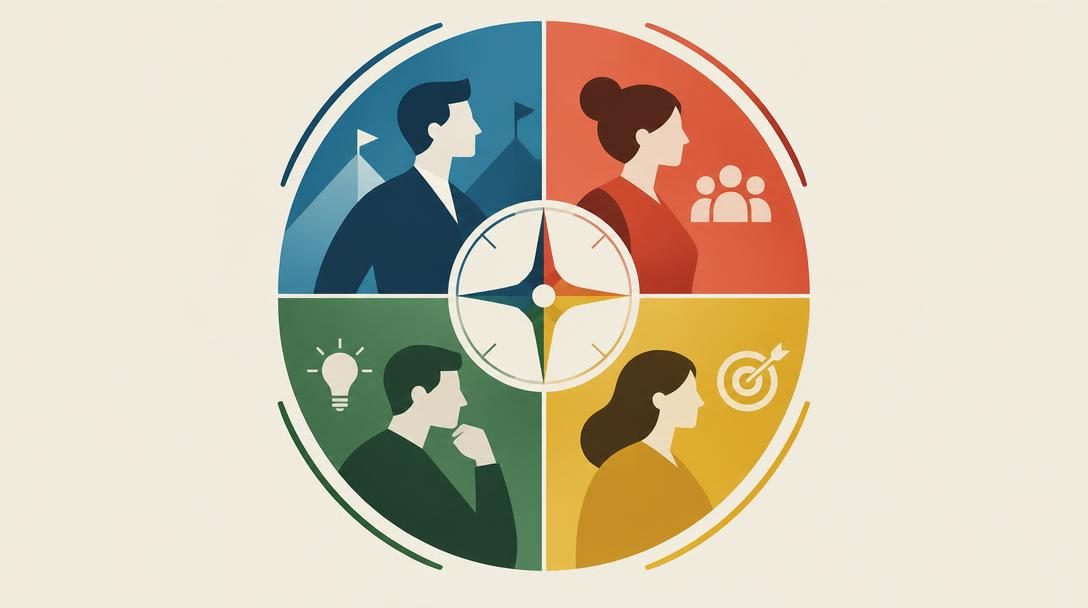
- Core Architecture: Four-quadrant behavioral model
- Evaluation Target: Environmental reaction and active communication habits
- Primary Application: Team performance, leadership development, and conflict mitigation
The DISC assessment categorizes behavioral expression into four primary dimensions: Dominance, Influence, Steadiness, and Conscientiousness. Individuals with high Dominance are naturally motivated by overcoming hurdles and achieving clear outcomes. Those exhibiting high Influence are energized by interpersonal persuasion, social recognition, and collaborative brainstorming. High Steadiness reveals a deep motivation for reliability, security, and sustained group cooperation, while high Conscientiousness indicates an internal drive toward precision, technical expertise, and rigorous quality standards.
Enneagram

- Core Architecture: Nine interconnected personality Archetypes
- Evaluation Target: Unconscious desires, emotional triggers, and core fears
- Primary Application: Personal growth, emotional intelligence, and self-awareness
Rather than merely categorizing observable outward actions, the Enneagram explores the underlying psychological motivations that provoke those actions. The system outlines nine distinct types, highlighting the fundamental fears and core desires driving each one. Depending on your primary Enneagram classification, your unconscious behavior might be organized around an urgent search for security, a compelling drive for professional success, a dedication to keeping the peace, or a relentless pursuit of knowledge and competence.
Big Five Personality Traits

- Core Architecture: Five dimensional continuum traits (OCEAN model)
- Evaluation Target: Broad, empirically validated personality dimensions
- Primary Application: Academic psychology research and organizational behavior
Widely considered the scientific standard within contemporary psychological research, the Big Five measures personality across five continuous dimensions: Openness to experience, Conscientiousness, Extraversion, Agreeableness, and Neuroticism. Rather than sorting participants into absolute archetypes, the Big Five scores individuals along a spectrum. This clarifies foundational inclinations, such as a strong appetite for creative exploration, disciplined task orientation, emotional reactivity, or an intrinsic preference for harmonious social compromise.
How Assessment Profiles Are Constructed
Understanding the diagnostic mechanics behind personality tools makes their insights far more useful. Most reputable evaluations rely on self-reported data gathered through standardized testing methods designed to identify trends across dozens of responses:

- Scenario Analysis: Tests present realistic everyday situations and ask you to pick the option that mirrors your customary behavior. These prompts reveal whether you naturally favor structured protocols over adaptable workflows, or independent research over group discussions.
- Preference Identification: Rather than evaluating answers as correct or incorrect, questions gauge the relative strength of your instincts. Statements are typically evaluated on Likert scales spanning from strongly agree to strongly disagree.
- Pattern Recognition: The evaluation engine consolidates your responses across targeted categories, looking past isolated answers to locate underlying behavioral consistency.
- Profile Generation: Once scoring finishes, the system outputs an analytical profile outlining your primary characteristics, environmental preferences, and central drivers.
A Step-by-Step Approach to Applying Your Drivers
Completing an assessment provides raw information, but turning that data into meaningful improvements requires deliberate implementation. You can optimize your daily routines and working environment by moving through a structured self-discovery process.
- Select an established assessment framework. Choose an instrument aligned with your immediate objectives, whether you want the workplace behavioral focus of DISC, the cognitive preference structure of the MBTI, the motivational depth of the Enneagram, or the empirical metrics of the Big Five.
- Provide authentic, unvarnished responses. Answer every prompt based strictly on who you are in your current reality, setting aside idealized expectations of who you wish to become or how you think supervisors expect you to act.
- Examine your comprehensive diagnostic report. Read beyond your headline archetype or top-level trait score. Pay close attention to sections describing how you process fatigue, handle interpersonal friction, and respond to repetitive, low-engagement tasks.
- Synthesize your recurring motivational themes. Extract the foundational requirements highlighted throughout your results, such as an appetite for measurable achievement, a need for structural stability, a desire for autonomy, or a priority on communal harmony.
- Audit your daily and weekly responsibilities. Compare your current calendar against your uncovered motivators. Categorize duties based on whether they energize your internal values or run counter to your natural inclinations.
- Execute deliberate operational adjustments. Start restructuring your schedule and commitments to reinforce your primary drivers. This may involve seeking collaborative initiatives, establishing personal milestones for solitary work, or setting boundaries around misaligned responsibilities.
Five Traps to Avoid When Evaluating Motivations
Personality tests provide valuable self-knowledge, but misinterpreting the results can hinder personal progress. Watch out for these widespread pitfalls when evaluating your drivers:
- Treating scores as permanent identities: Assessment outputs reflect baseline tendencies and current dispositions, not unyielding biological destinies. Viewing your results as unalterable limits personal experimentation and intellectual growth.
- Faking responses to present an idealized persona: Selecting answers you believe a high-performing professional or leader should select ruins the test's diagnostic validity, leaving you with an artificial profile that masks your actual drivers.
- Discounting the role of situational context: Behavioral habits adapt significantly between personal settings, highly structured corporate workplaces, and emergency scenarios. Evaluating test metrics in isolation from real environments yields skewed conclusions.
- Imposing labels and assumptions onto other people: Learning a peer's personality type should build empathy, not provoke quick stereotyping. Assuming you can predict a colleague's reactions based solely on their diagnostic profile overlooks their individual background and lived experience.
- Treating tests as an exclusive source of truth: A questionnaire offers a structured reference point, but it functions best when combined with disciplined self-reflection, honest peer feedback, and direct experimentation with varied responsibilities.
Enhancing Workplace Collaboration Through Shared Drivers
Beyond personal productivity, identifying motivational drivers serves as an effective mechanism for preventing interpersonal conflict. In organizational settings, workplace tension rarely stems from bad intentions; more often, it arises from clashing core priorities.
Consider a project team containing one professional primarily driven by communal harmony and another guided strictly by independent achievement. The relationship-driven team member naturally emphasizes group consensus, frequent check-ins, and shared milestones. Meanwhile, the achievement-driven professional often values rapid execution, isolated focus, and personal recognition. Left unaddressed, both individuals may misread each other's intentions—the first viewing the second as abrasive, and the second regarding the first as inefficient. When both colleagues recognize how their complementary drivers operate, they can establish work agreements that satisfy both perspectives without friction.
Frequently asked questions
Can a person's motivational drivers change significantly over time?
While core personality foundations tend to stay relatively steady throughout adulthood, life experiences, career transitions, and shifting environments can alter which drivers take priority. Periodically taking assessments every few years helps you capture these natural shifts in your values.
Which personality test is the most accurate for finding career motivators?
The best test depends on your primary goal. The Big Five offers the strongest empirical backing for understanding personality spectrums, the DISC model provides rapid, practical insights for workplace dynamics, the MBTI clarifies cognitive habits and communication styles, and the Enneagram explores emotional fears and core desires.
How can I identify my drivers if my job requires conflicting tasks?
Start by auditing your day to pinpoint which duties leave you exhausted and which give you energy. Once you identify that contrast, look for ways to adjust your routine, such as grouping misaligned administrative duties together or introducing independent goal markers to tasks that otherwise feel unrewarding.
Why do I get different results when taking the same assessment multiple times?
Varying results usually stem from shifts in context, acute stress, or answering based on an idealized self-image rather than current behavior. Inconsistent results can also occur when using abridged, non-standardized online quizzes rather than validated, full-length instruments.
Are personality tests reliable enough to base major career decisions on?
Personality tests provide a helpful starting point, but they should never dictate major career decisions on their own. They are best used alongside candid performance reviews, personal reflection, professional mentorship, and direct trial runs across diverse working environments.
The Bottom Line
Uncovering your motivational drivers turns self-awareness into practical personal agency. Rather than wondering why certain obligations generate sustained engagement while others produce swift mental fatigue, structured assessments give you a clear map of your psychological preferences. Tools like the MBTI, DISC, Enneagram, and Big Five help you understand your actions without confining your potential.
Integrating these insights into your long-term plans is an ongoing practice of observation, testing, and alignment. By regularly comparing your daily workload against your core values, you can set goals that match your wiring, collaborate effectively with diverse colleagues, and build the focused momentum required to achieve lasting professional and personal success.