Maximizing Your Productivity: How to Use the Lunar Calendar to Achieve Your Goals

For centuries, human communities measured the passage of time by tracking the changing face of the moon. Long before digital calendars and hourly time-blocking tools dictated the workday, traditional societies relied on celestial movements to govern their planting seasons, community gatherings, and collective rest. Modern productivity culture, by contrast, frequently expects individuals to function like machines, demanding an unwavering, flat line of maximum output every single day. This relentless pressure often yields chronic fatigue, creative stagnation, and burnout.
Adopting a lunar approach to productivity introduces an adaptable framework that honors natural cycles of beginning, expanding, culminating, and releasing. Instead of abandoning modern obligations or professional schedules, using the lunar calendar allows you to layer an intuitive cadence over your existing workflow. By synchronizing your energy, planning, and focus with the moon's approximately 29.5-day synodic cycle, you can pursue ambitious goals while preserving time for essential reflection and renewal.
Key takeaways
- The lunar calendar offers an approximately 29.5-day cycle that balances concentrated execution with necessary rest and evaluation.
- Each of the four primary lunar phases provides a distinct focus: setting intentions at the new moon, taking action during the waxing moon, celebrating and releasing at the full moon, and clearing loose ends during the waning moon.
- Productivity is a dynamic process of expansion and contraction rather than a demand for unyielding daily output.
- Failing to write down intentions, overloading the action phase, and skipping post-project reflection are the most common pitfalls in cyclical planning.
The Ancient Cadence of Lunar Timekeeping
Humanity’s relationship with lunar tracking represents one of our oldest methods for organizing labor and community life. Because the shift from darkness to bright illumination is readily visible to the naked eye, ancient civilizations and early agriculturalists recognized direct correspondences between lunar cycles, seasonal shifts, and the movement of ocean tides. Sowing crops, harvesting fields, organizing civic events, and entering periods of collective rest were traditionally scheduled around specific phases of the moon.
In modern professional life, the lunar cycle serves as a practical, built-in rhythm for personal development and project management. A full cycle takes roughly twenty-nine and a half days, progressing from total darkness to complete brightness before receding again. This timeframe forms a self-contained, monthly container that prevents projects from dragging on indefinitely. Rather than viewing time as a flat, artificial grid composed solely of deadlines, working with the moon frames achievement as a recurring arc that alternates between external effort and internal integration.
The Four Core Phases of the Lunar Cycle
To align your workflow with the moon, it helps to understand how each of the four primary phases shapes your mindset, stamina, and priorities. Dividing your labor according to these distinct intervals keeps motivation fresh and prevents the exhaustion caused by continuous striving.
| Phase | Sky Appearance | Energetic Focus | Core Work Activities |
|---|---|---|---|
| New Moon | Completely dark | Introspection and orientation | Setting intentions, journaling, prioritizing self-care |
| Waxing Moon | Growing sliver to half-lit | Momentum and outward growth | Task breakdown, focused execution, daily discipline |
| Full Moon | Fully illuminated disc | Culmination and awareness | Reviewing metrics, celebrating wins, community networking |
| Waning Moon | Shrinking from half-lit to dark | De-escalation and refinement | Administrative cleanup, completing tasks, reflective evaluation |
New Moon
The new moon occurs when the celestial body sits directly between Earth and the sun, rendering its visible surface completely dark. Symbolically and practically, this phase represents a clean slate. Because the sky is dark, the overarching direction of your attention shifts inward toward reflection, self-inquiry, and fresh beginnings.
During the new moon, avoid plunging straight into frantic activity. Instead, use this window to clarify what you intend to accomplish over the coming cycle. Take time to write down specific goals in a planner or journal and visualize what success looks like. Pair this mental planning with deliberate self-care, replenishing your reserves so you are physically and mentally equipped to act when the cycle's momentum picks up.
Waxing Moon
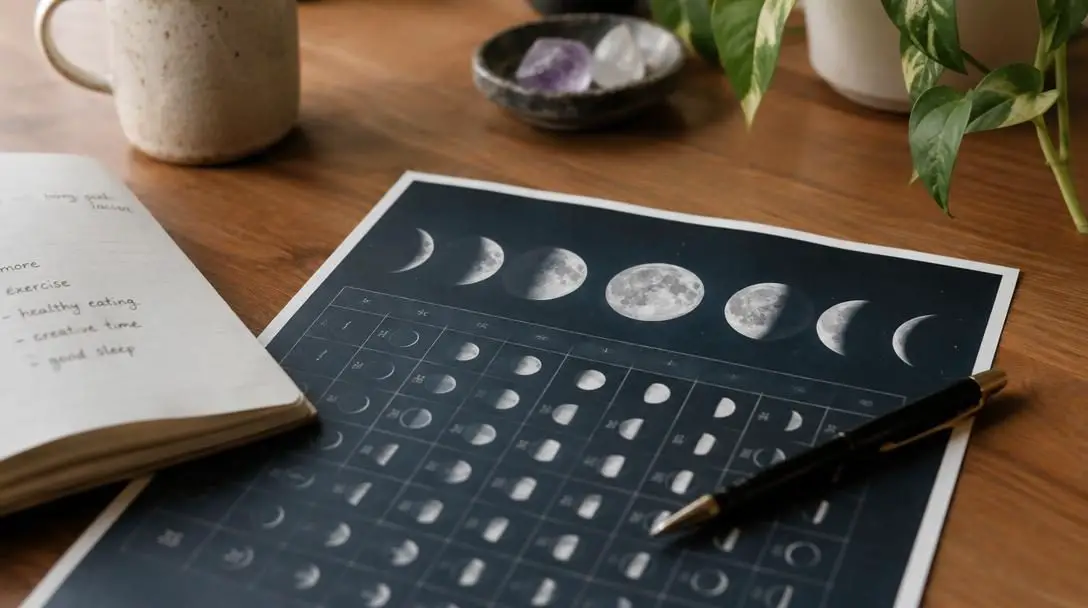
As the moon enters its waxing phase, a sliver of light emerges and broadens each evening until it reaches full illumination. This visual growth mirrors outward development, making it the primary execution window of the lunar cycle. As the moon gains light, your focus shifts from conceptualizing to building.
This is the time to translate broad intentions into concrete steps. Break down your monthly goals into bite-sized, practical milestones and assemble an organized action plan. The waxing moon demands commitment, steady discipline, and persistent work. Use this rising energy to write, code, pitch, design, or complete whatever tangible tasks are required to turn your intentions into reality.
Productivity becomes an evolving process that allows for both concentrated activity and necessary reflection.
Full Moon
The full moon marks the energetic peak of the cycle, when the lunar surface reflects the sun's light in its entirety. This maximum illumination represents visibility, fulfillment, and realization. In a traditional productivity system, people often rush past their victories onto the next crisis; the full moon asks you to pause and take stock of what has materialized.
Dedicate this phase to assessing your recent output and celebrating milestones. It is also an opportune time for collaboration, sharing your insights with colleagues or peers, and strengthening professional networks. Concurrently, the intense clarity of the full moon reveals what is not working. Identify unproductive habits, self-limiting beliefs, or inefficient processes that have introduced friction into your routine, and consciously decide to shed them.
Waning Moon
Following the full moon, the illuminated surface begins to diminish, moving steadily toward darkness. As the light recedes, natural momentum pivots away from outward expansion toward consolidation, tidying, and internal closure. Pushing forward with aggressive new launches during this window often feels like swimming against the current.
Take advantage of the waning moon by tying up administrative loose ends, organizing files, handling overdue correspondence, and completing ongoing assignments. This period is also suited for thoughtful introspection: analyze what the preceding weeks taught you, integrate the lessons, and clear physical and digital clutter so you can greet the next new moon unencumbered.

A Step-by-Step Guide to Lunar Planning
Implementing lunar productivity requires no esoteric equipment or complicated software. By following a structured monthly sequence, you can weave this natural rhythm directly into your existing calendars and workflow management tools.
- Track the monthly lunar dates: Consult an astronomical table or app to identify the calendar dates for the new moon, waxing phase, full moon, and waning phase. Record these four inflection points in your standard planner or digital calendar alongside your regular commitments.
- Clarify targets during the New Moon: When the night sky is dark, set aside an uninterrupted block of quiet time. Clarify your core targets for the upcoming month, write them explicitly in a notebook, visualize their realization, and invest in restorative self-care.
- Execute your plan during the Waxing Moon: Review your written intentions as the moon gains light. Deconstruct each objective into small, daily deliverables. Cultivate structured discipline and focus your working hours on production, outreach, and concrete problem-solving.
- Evaluate and celebrate during the Full Moon: When the moon reaches peak illumination, review the work completed so far. Acknowledge your progress, celebrate wins with colleagues or your support network, and pinpoint any counterproductive habits or emotional baggage you need to let go of.
- Tie up loose ends during the Waning Moon: As the moon wanes, steer clear of starting major new initiatives. Focus on closing pending tasks, completing paperwork, organizing workspaces, and assessing key takeaways so you enter the subsequent cycle prepared for a fresh start.
Common Mistakes to Avoid
While organizing your work around lunar cycles is fundamentally intuitive, adapting to a rhythmic workflow can pose challenges for those conditioned by modern work habits. Keeping these typical missteps in mind will help you maintain balance:
- Treating every phase as a sprint: The most frequent error is demanding non-stop execution across all four phases. Forcing intense outward output during the waning or new moon phases bypasses necessary rest, accelerating burnout.
- Leaving intentions unwritten: Holding goals loosely in your head during the new moon leads to vague execution. Without explicit, written targets in a journal or planner, you lose the clarity required to organize tasks when the waxing moon begins.
- Overcommitting during the action phase: While the waxing phase fosters momentum, attempting to overhaul your entire life or tackle too many complex projects at once fragments your energy. Select a few clear priorities.
- Skipping celebration and acknowledgment: Gliding past the full moon without pausing to recognize what you have built undermines morale. Celebrating wins reinforces motivation and provides psychological closure.
- Clinging to defunct systems: Failing to practice release during the full and waning phases clutters your schedule. When a tactic, commitment, or mindset proves ineffective, let it go to create room for better methods.
- Treating the waning phase as wasted time: Viewing the waning moon as dead time rather than a prime opportunity for administrative wrap-up, file organization, and review leads to messy project handoffs and carryover fatigue.
Cultivating Sustainable Achievement Beyond the Checklist
Working alongside the lunar calendar delivers practical productivity benefits, but its broader value lies in restructuring how you evaluate personal success. A life devoted entirely to checking off tasks without cultivating meaning, community, or self-awareness easily feels empty, regardless of how organized your digital boards appear.
True personal effectiveness balances rigorous, focused output with regular downtime, self-reflection, and authentic interpersonal connection. Nature functions through perpetual seasons of growth, harvest, dormancy, and renewal; human capacity mirrors those exact same shifts. Viewing yourself through this natural lens encourages realistic expectations and patience when objectives require several cycles to mature.
By synchronizing your ambitions with the moon, you step off the continuous treadmill of standard hustle culture. Work transitions from an unbroken, exhausting marathon into a steady, rhythmic cycle where you know exactly when to push forward, when to connect in gratitude, when to pare away excess, and when to pause in quiet preparation.
Frequently asked questions
Do I have to abandon my standard digital calendar to use lunar productivity?
No. Lunar productivity is designed to overlay your existing tools. You continue using your standard calendar for meetings, deadlines, and daily appointments, while noting the lunar phases to guide the strategic focus and intensity of your tasks.
How long does a complete lunar productivity cycle last?
A full lunar cycle lasts approximately 29.5 days, moving through the new moon, waxing phase, full moon, and waning phase before returning to total darkness.
What should I do if a rigid work deadline falls during the new moon or waning phase?
External professional obligations take precedence. When firm deadlines coincide with reflective phases, complete the required duties, but adjust your remaining discretionary time toward quieter tasks, administrative duties, and extra rest.
Why is writing down intentions during the new moon so important?
Writing down your goals in a notebook or planner solidifies abstract desires into specific targets. It provides the structured blueprint needed to break work down into actionable steps when the waxing phase begins.
What is the difference between the full moon and waning moon in terms of release?
The full moon is the moment of awareness where you recognize and consciously decide to release unproductive habits, beliefs, or roadblocks. The waning moon is the practical period where you follow through by organizing, clearing clutter, and tying up administrative loose ends.
The bottom line
The lunar calendar provides a time-tested alternative to the flat, mechanical pace of modern work culture. By honoring the distinct demands of the new moon, waxing moon, full moon, and waning moon, you transform productivity from an exhausting checklist into a rhythmic, sustainable process. Aligning your efforts with these celestial shifts allows you to pursue meaningful goals with focused energy, celebrate your achievements with peers, discard obsolete methods, and recharge for the cycles ahead.