The Secrets of Success: How Bill Gates Got Famous

Few figures in modern corporate history have left an imprint on global commerce, technology, and culture as profound as Bill Gates. As the co-founder of Microsoft, he helped orchestrate the shift away from monolithic enterprise mainframes toward an era where computational power was placed directly into the hands of ordinary consumers and small enterprises. Gates did not simply ride the crest of the personal computer wave; he actively engineered the operating software and business paradigms that accelerated its adoption across the globe.
Understanding his journey—from an intensely focused young programmer in Seattle to a global corporate titan and influential philanthropist—reveals valuable lessons in long-term strategic planning, aggressive market positioning, and organizational leadership. By examining the foundations of his early life, the operational principles that guided Microsoft, the regulatory hurdles he confronted, and his subsequent pivot to systemic global giving, one can chart the blueprint that propelled Bill Gates to worldwide prominence.
Key takeaways
- Early mastery of software programming convinced Gates that microprocessors would make consumer software far more valuable than computer hardware.
- Strategic non-exclusive licensing deals with hardware manufacturers allowed Microsoft to establish Windows as the universal computing platform.
- Relentless personal work habits, rigorous source code reviews, and rapid iteration enabled Microsoft to outpace entrenched corporate competitors.
- Navigating intense federal antitrust scrutiny compelled Gates and his executive leadership to mature their compliance, governance, and public engagement.
- In 2000, Gates channeled his systematic problem-solving methods into global philanthropy by co-founding the Bill & Melinda Gates Foundation.
Early life and the formation of Microsoft
Born and raised in Seattle, Washington, Gates exhibited an exceptional aptitude for analytical reasoning and complex systems at an early age. While attending school, he secured rare access to early computer terminals, spending days and nights deciphering code, testing system architectures, and learning machine logic. This early immersion gave him a level of practical fluency in software design that was virtually unmatched among his peers, well before computer science emerged as a standard academic discipline.
Gates brought this technical obsession with him to Harvard University. Yet while immersed in the rigorous academic environment of the Ivy League, his attention remained focused on the rapid evolution of microprocessors. Where traditional technology executives viewed microprocessors as modest novelties suited primarily for hobbyists, Gates foresaw an imminent future defined by exponentially climbing computational capability and plummeting manufacturing costs. That dynamic, he realized, would trigger an insatiable global demand for accessible, pre-packaged software.
Acting on this foresight, Gates left Harvard to launch Microsoft alongside his childhood friend Paul Allen. The partnership united deep technical fluency with an uncompromising commercial vision. Their immediate mission was to build the primary software foundation that would enable everyday individuals to operate personal microcomputers.
Landmark products and foundational entities
Microsoft’s rise to international preeminence was built upon distinct operational vehicles and breakthrough software suites that transformed computing from an elite specialty into a ubiquitous utility.
Microsoft

- Founders: Bill Gates and Paul Allen
- Origin: Seattle, Washington
- Foundational mission: A computer on every desk and in every home
Founded on the premise that software would be the primary driver of computing utility, Microsoft was engineered from its earliest days to capture the highest-margin segment of the technology value chain. By deliberately avoiding the heavy capital expenditures, inventory liabilities, and manufacturing overhead associated with building physical computer machinery, the enterprise channeled its capital directly into software engineering, developer tools, and global distribution agreements.
Windows Operating System
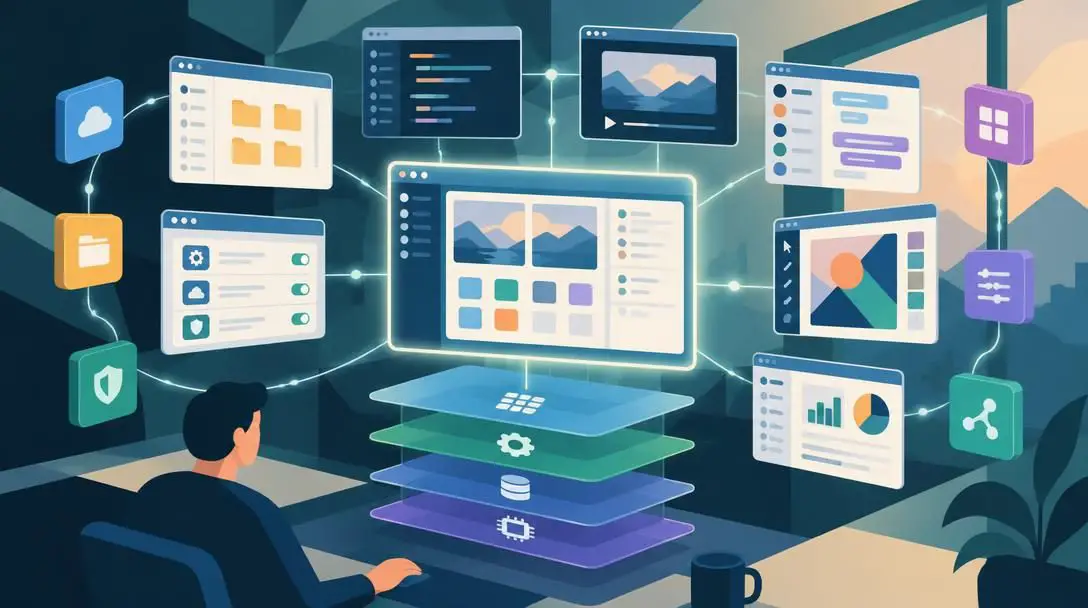
- Core architecture: Open platform for third-party developers
- Primary distribution model: Pre-installation licensing with hardware manufacturers
- Market role: Standard operating environment for consumer and enterprise computing
The release and ongoing development of the Windows operating system solidified Microsoft's position as the bedrock of modern digital commerce. Engineered as an open ecosystem, Windows incentivized outside software developers to create applications specifically for its environment. This dynamic produced a powerful network effect: as more third-party software was created for Windows, consumer demand for the operating system increased, cementing it as the default computational interface worldwide.

Microsoft Office

- Category: Desktop productivity suite
- Primary market: Global corporate, educational, and governmental organizations
- Key operational mechanism: Routine service packs and iterative software upgrades
While Windows captured the underlying platform layer, the Microsoft Office suite captured the application layer of day-to-day productivity. By bundling word processing, spreadsheet modeling, and business presentations into an integrated software package, Microsoft created an indispensable operational environment for global enterprise. The continual rollout of diagnostic patches, service packs, and full version updates preserved client utility while locking in multi-year corporate loyalty.
Bill & Melinda Gates Foundation

- Year established: 2000
- Co-founders: Bill Gates and Melinda Gates
- Core priority areas: Global health, education, and poverty alleviation
Formed in 2000 by Bill Gates and his wife, Melinda Gates, the Bill & Melinda Gates Foundation represents one of the largest philanthropic organizations in history. Applying the same data-driven rigor, scalability requirements, and structural roadmaps that shaped Microsoft, the foundation targets systemic global inequities. Its interventions span infectious disease eradication, maternal health delivery, public educational equality, and agricultural modernization across underdeveloped economies.
True long-term legacy is measured not merely by the commercial wealth an individual accumulates, but by the tangible impact made when applying those resources toward the betterment of human society.
Core strategic drivers of Bill Gates' success
The preeminence achieved by Gates was the direct result of deliberate operational disciplines, intellectual habits, and commercial maneuvers developed during Microsoft's formative years.
- Audacious long-term foresight: While legacy competitors focused on maintaining lucrative contracts for enterprise mainframes, Gates formulated an expansive guiding ambition: to place a personal computer on every desk and in every home. This orientation meant every capital investment, product line, and corporate acquisition was judged by its capacity to advance that long-range reality.
- Uncompromising work ethic: During the company's early chapters, Gates set a grueling standard for operational intensity. He frequently slept in the office, spent weekends personally inspecting critical lines of source code, and demanded that development deadlines be met without compromise, setting a high-output precedent across the engineering staff.
- Proactive adaptation: Technology markets are notoriously unforgiving to organizations that cling to static achievements. Gates continually pushed Microsoft through internal transitions, prioritizing product evolution over institutional complacency to avoid becoming vulnerable to newer market entrants.
- Commercial acumen and dealmaking: Beyond technical engineering, Gates possessed an instinct for commercial leverage. By crafting non-exclusive licensing agreements with leading personal computer manufacturers, he secured preferred placement on retail hardware, effectively turning his software into an industry standard before competitors could organize an effective response.
The operational framework behind Microsoft's global scale
Microsoft’s transition from a regional software boutique into a multinational powerhouse rested on an operational framework designed to build defensible economic moats while preserving rapid deployment capabilities.
| Strategic Pillar | Operational Focus | Competitive Advantage |
|---|---|---|
| Platform Architecture | Engineering open software for external developers | Generates self-reinforcing developer ecosystems and high customer switching costs |
| OEM Licensing | Partnering with original equipment manufacturers | Secures mass distribution globally without capital-intensive hardware manufacturing |
| Iterative Maintenance | Deploying real-world diagnostic patches and updates | Sustains product utility, enhances user retention, and extends software lifecycle |
| Executive Delegation | Shifting from micro-level code audits to macro strategy | Permits efficient corporate governance across international markets and subsidiaries |
Gates recognized that managing a global enterprise required an entirely different operational skill set than writing software. Early in Microsoft’s development, he served as a hands-on technical gatekeeper, reviewing virtually every line of commercial code that left the building. As the company grew, however, he modified his leadership methodology, delegating technical oversight to trusted lieutenants while focusing his own energy on enterprise strategy, major commercial negotiations, and long-range product positioning.
Navigating antitrust scrutiny and corporate adversity
Microsoft's aggressive business tactics and dominant market share in personal computer operating systems and web browsers eventually provoked severe resistance from corporate rivals and regulatory authorities. The company was subjected to high-profile federal antitrust investigations and legal battles that scrutinized its competitive conduct, licensing constraints, and platform bundling practices.
These legal proceedings placed Microsoft under immense corporate strain and thrust Gates’ managerial philosophies and corporate demeanor directly into the global media spotlight. The courtroom battles challenged the firm’s operational assumptions and presented an existential threat to its unified corporate structure.

Rather than permitting these challenges to dismantle the organization, Gates and Microsoft’s executive leadership chose resilience and tactical adaptation. The enterprise refined its compliance standards, revisited its relationships with industry partners, and adjusted its operational practices while maintaining momentum on long-range development roadmaps. For Gates, the crucible of antitrust litigation served as an intensive lesson in corporate governance, public responsibility, and executive maturity.
Philanthropic focus: The Bill & Melinda Gates Foundation
Following decades of fierce corporate competition, Gates applied his capital, organizational acumen, and analytical methodologies to global development challenges. Established in 2000, the Bill & Melinda Gates Foundation operates with an emphasis on data-driven metrics, measurable outcomes, and scalable delivery mechanisms.
- Global Health: The foundation directs substantial funding toward the eradication of life-threatening infectious diseases, the broad distribution of critical vaccines to remote populations, the reduction of maternal and neonatal mortality, and the reinforcement of primary public healthcare systems in developing countries.
- Public Education: In domestic educational environments, the foundation invests in research-backed digital learning infrastructure, curriculum refinement, and targeted scholarship initiatives designed to narrow academic achievement disparities for students from underserved communities.
- Poverty Alleviation: The organization finances programs that support sustainable agricultural techniques for smallholder farmers, facilitate access to mobile banking and digital financial tools for rural households, and foster microeconomic development projects in historically impoverished regions.
Practical steps to apply Gates' principles to your career
The operational systems and strategic disciplines that characterized Gates' career provide actionable lessons for founders, executives, and ambitious professionals seeking to create significant value in their respective industries.
- Identify structural technological shifts: Study macroeconomic indicators, technical advancements, and shifting consumer behaviors to identify emerging transformations before they enter mainstream commercial awareness. Determine what underlying infrastructure will be indispensable a decade from now.
- Acquire deep domain literacy: Build comprehensive, granular competence in your chosen field. Gates commanded respect and made sound strategic decisions because he understood computing down to the machine code level. Strong leadership decisions are anchored in genuine technical fluency.
- Cultivate demanding execution standards: Breakthrough results require disciplined, concentrated effort. Carve out uninterrupted blocks of focus for complex problem-solving, and hold both yourself and your team to rigorous benchmarks of work quality.
- Form complementary professional partnerships: Large-scale enterprises cannot be erected in isolation. Gates collaborated with Paul Allen to marry visionary technical development with strategic operational execution. Align with colleagues whose skills, perspectives, and strengths offset your weaknesses.
- Design for scalable distribution: Even an exceptional product will fail if it cannot reach its audience cost-effectively. Construct formal alliances, explore distribution ecosystems, and partner with established channels that can scale your solutions rapidly.
- Commit to systematic, lifelong education: Protect time for deep reading, evaluate industry case studies, and conduct honest post-mortems of your missteps so you can iterate your operational plans before market changes force your hand.
Common strategic traps to avoid
When studying high-profile business leaders, professionals frequently draw the wrong conclusions from their achievements, falling into strategic traps that undermine long-term success.
- Prioritizing ideas over operational execution: An inspired business concept has minimal economic value without meticulous implementation. Relying on vision while neglecting day-to-day project management, rigorous product testing, and client fulfillment regularly results in failure.
- Ignoring changing market realities: Market forces evolve without sentimentality. Organizations that cling stubbornly to legacy revenue streams while failing to accommodate new technological advancements risk swift obsolescence.
- Attempting to control the entire value chain: Trying to own every stage of product creation, hardware manufacturing, and end-user retail requires massive capital and slows organizational speed. Failing to leverage distribution partners limits a company to slow, linear growth.
- Neglecting interpersonal leadership skills: Technical competence may be sufficient to construct an initial prototype, but scaling an enterprise demands clear communication, the ability to delegate responsibility, and the capacity to align diverse teams behind common objectives.
- Overlooking compliance and legal exposure: Fast-growing enterprises inevitably draw regulatory interest. Failing to integrate compliance frameworks, risk audits, and strong legal governance early leaves an organization exposed to sudden disruptions.
Frequently asked questions
Why did Bill Gates decide to leave Harvard University?
Bill Gates left Harvard after recognizing that the advent of low-cost microprocessors would create an unprecedented, time-sensitive demand for personal computer software. Believing the window to establish the industry's default software standard was brief, he departed to co-found Microsoft with Paul Allen.
How did Microsoft achieve dominance over the personal computer market?
Microsoft achieved dominance by focusing strictly on software rather than capital-heavy hardware manufacturing. Through non-exclusive licensing agreements, Gates arranged for Microsoft’s operating systems to be pre-installed on computers produced by leading manufacturers, creating strong network effects that cemented Windows as the standard platform.
What caused the high-profile antitrust legal battles involving Microsoft?
Federal regulators and antitrust authorities scrutinized Microsoft over allegations of anti-competitive practices, specifically regarding its overwhelming market share in personal computer operating systems and the packaging of software such as its web browser alongside Windows. These legal battles forced Microsoft to adjust its operational compliance and business partnerships.
What are the primary focus areas of the Bill & Melinda Gates Foundation?
Established in 2000 by Bill and Melinda Gates, the foundation concentrates its resources on three primary domains: global health initiatives (such as eradicating infectious diseases and expanding vaccine access), educational improvement (including digital learning and scholarship programs), and poverty alleviation (such as sustainable agriculture and mobile banking).
Who co-founded Microsoft alongside Bill Gates?
Microsoft was co-founded by Bill Gates and his childhood friend Paul Allen. Together, they combined deep technical programming fluency with a focused business model to develop software for the emerging personal computing sector.
The bottom line
The trajectory of Bill Gates demonstrates that sustained corporate impact is rarely the result of fortunate timing alone. It requires the capacity to identify structural economic shifts before they are widely recognized, the technical fluency to engineer dependable solutions, and the operational rigor to distribute those products at scale. While his aggressive competitive practices brought significant legal scrutiny, Gates' ability to adapt his executive leadership and later direct his wealth toward addressing severe global health and educational disparities highlights the multifaceted nature of his career.
For entrepreneurs, executives, and students of commerce, Gates’ legacy offers a clear blueprint: identify foundational trends, build scalable platform ecosystems, maintain strict operational discipline, and deliberately align your long-term success with solving meaningful, real-world problems.