The Secrets of Success: How Martha Stewart Got Famous

Martha Stewart stands as one of the most prominent entrepreneurs of our time, having built a sweeping commercial empire that achieved a net worth of over $400 million. Through dedication, vision, and an exacting eye for domestic elegance, she constructed an expansive lifestyle enterprise spanning media, publishing, television, and diversified retail merchandising. Her journey from a passionate home cook to a corporate powerhouse offers an enduring blueprint for modern business building, brand identity, and executive resilience in the face of public adversity.
By translating everyday domestic tasks into elevated creative pursuits, Stewart altered how the world approaches hosting, home decor, and culinary presentation. Her multi-decade trajectory proves that mastering practical domestic craftsmanship, when paired with sharp financial acumen and systematic cross-media marketing, can create an entirely new category in global commerce.
Key takeaways
- Stewart transformed hands-on domestic hospitality into a diversified commercial empire worth more than $400 million.
- Her early career as a Wall Street stockbroker and boutique caterer provided the operational rigor needed to scale her enterprise.
- She pioneered an integrated business model where print books, a flagship magazine, television broadcasting, and department store retail lines cross-promoted one another.
- After serving a five-month prison sentence in 2004 related to ImClone Systems stock, she staged a textbook brand rehabilitation by embracing digital channels and younger demographics.
Early life, education, and the shift from Wall Street to catering
To grasp the foundational instincts behind Stewart's enterprise, it is necessary to examine her formative years and initial professional trajectory. Martha Stewart was born in New Jersey in 1941, growing up as the second of six children. Her childhood household served as the original testing ground for the domestic arts that would later define her global brand. Her father worked as a salesman, while her mother worked as a teacher. During these early years, Stewart spent countless hours in the kitchen alongside her mother, mastering cooking techniques, household organization, and domestic crafts that laid the groundwork for her future authority.
Stewart pursued higher education in New York City, enrolling at Barnard College. There, she completed her studies with an academic focus on history and architectural history. These disciplines refined her keen appreciation for structural aesthetics, balance, and spatial proportion, attributes that later distinguished her visual styling. Following college, she entered the financial sector, working as a licensed stockbroker on Wall Street. While the financial industry provided crucial insight into corporate mechanics, capital markets, and investment structures, Stewart realized that the traditional corporate landscape did not satisfy her long-term creative and entrepreneurial ambitions.
Departing Wall Street to follow her passion for domestic hospitality, she launched a home-based catering enterprise. Operating a catering service demanded relentless physical labor, meticulous organization, and ongoing culinary innovation. The business quickly found success, giving her direct, hands-on commercial experience and revealing the high value clients placed on beautifully curated food and presentation. This venture reinforced the necessity of an intense work ethic, taught her the nuances of client expectations, and gave her the confidence to pursue broader commercial dreams.
The five landmark media projects that launched her lifestyle empire
The stellar reputation of Stewart's catering operation created an avenue into traditional media and commercial publishing, launching what would become a synchronized multimedia network. Rather than relying on third-party channels alone, she systematically rolled out publishing and broadcast properties that reinforced her authority across home entertaining, everyday cooking, home design, and lifestyle arts.
Entertaining

- Debut year: 1982
- Format: Hardcover book
- Subject matter: Hosting guidance, recipes, and tablescapes
In 1982, Stewart released her debut book, "Entertaining." The groundbreaking publication captured widespread public interest, transforming domestic hospitality from a standard household obligation into a recognized creative art form. The book presented elegant tablescapes, detailed recipes, and structured hosting guidance that quickly established her as a major authority in the lifestyle sector, serving as the launching pad for her media career.

Martha Stewart's Quick Cook

- Format: Instructional cookbook
- Target audience: Time-conscious home cooks and busy hosts
- Core focus: Efficient culinary preparation without sacrificing quality
Building upon the popularity of her first volume, Stewart followed with "Martha Stewart's Quick Cook." This title addressed the practical realities of busy hosts who sought high culinary standards without spending entire days in the kitchen. By simplifying preparation steps while maintaining elevated aesthetic standards, the book further solidified her voice as an accessible yet refined domestic educator.
Martha Stewart Living: A Handbook for Homeowners

- Format: Reference guide and book
- Subject matter: Home maintenance, restoration, and interior design
- Strategic purpose: Expanding her authority beyond food into full domestic management
Expanding her scope beyond food preparation and table hosting, Stewart released "Martha Stewart Living: A Handbook for Homeowners." The publication extended her instructional reach into the broader domestic space, covering home maintenance, renovation logic, interior design, and organizational principles. It established that her expertise covered the entirety of home stewardship, from the physical structure to the decor inside.
Martha Stewart Living Magazine
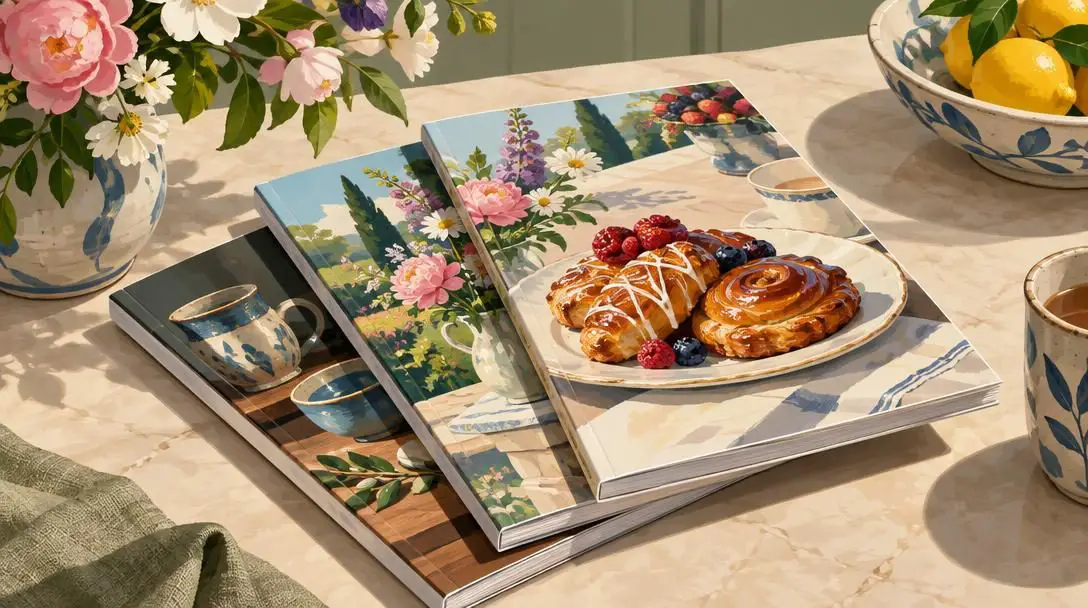
- Launch year: 1990
- Format: Periodic print publication
- Core content: Gardening advice, food styling, home restoration, crafts
In 1990, Stewart transformed periodic lifestyle journalism by introducing her signature print publication, "Martha Stewart Living." The magazine resonated deeply with audiences and rapidly climbed to the top of sales charts. It featured aspirational yet practical content focused on gardening advice, refined food styling, home restoration, and sophisticated decorative crafts, serving as the monthly visual standard for American home life.
Martha Stewart Living Television Program

- Broadcast run: 1993 to 2004
- Format: Nationally syndicated television show
- Key feature: Daily instructional segments filmed in studio kitchens and gardens
In 1993, Stewart took her domestic expertise to the screen with the debut of the television program "Martha Stewart Living." The show ran for over a decade, broadcasting until 2004. Daily broadcasts invited millions of viewers into her studio kitchens and gardens, transforming Stewart into a trusted household name across the nation. She capitalized on this immense media footprint by placing branded merchandise lines—including kitchenware, home furnishings, and bedding—into major retail department stores.
At a glance: The foundational media properties
| Property | Primary Format | Initial Launch | Core Focus Area |
|---|---|---|---|
| Entertaining | Hardcover Book | 1982 | Hosting, table design, and formal culinary arts |
| Martha Stewart's Quick Cook | Cookbook | Follow-up release | Time-efficient gourmet meal preparation |
| A Handbook for Homeowners | Reference Book | Intermediate release | Home renovation, repair, and interior design |
| Martha Stewart Living (Magazine) | Monthly Print Periodical | 1990 | Gardening, food styling, crafts, and decor |
| Martha Stewart Living (Television) | Broadcast Series | 1993 | Hands-on domestic education and retail showcase |
Legal turmoil, conviction, and strategic brand rehabilitation
At the height of her commercial influence, Stewart encountered a severe crisis that tested the foundation of her organization. In 2004, she was indicted on legal charges connected to a federal insider trading investigation. The core accusation centered on her sale of stock in a biotechnology enterprise named ImClone Systems, which federal prosecutors asserted was executed based on non-public inside information.
Stewart consistently maintained her innocence throughout the investigation and subsequent trial. Nevertheless, she was ultimately convicted and sentenced to serve five months in prison. The conviction and incarceration inflicted a significant blow to her public standing, prompting industry analysts to openly question whether her commercial brand could ever recover from such an intense reputational crisis.

Stewart refused to allow the prison sentence to mark the conclusion of her career, initiating a deliberate and methodical brand rehabilitation immediately upon her release.
Following her release, she took decisive, calculated measures to rebuild consumer trust, re-engage her core audience, and reactivate commercial relationships. She returned to television screens, continued producing books and magazine issues, and renewed her merchandise partnerships with major department stores. In addition, Stewart embraced modern digital communication tools, utilizing social media platforms to introduce her brand to a younger demographic. Her focused persistence demonstrated remarkable adaptability, cementing her enduring position as an authority in culinary, domestic, and home design spaces.
The four operational pillars of the Stewart business engine
The commercial architecture Stewart designed relies on multiple intersecting pillars that continuously reinforce one another, allowing a personal brand to scale into a long-lasting enterprise that generated an empire worth over $400 million:
- Content-Driven Authority: Stewart established widespread trust by delivering authentic, high-grade instructional knowledge through books and periodicals before attempting to sell physical products. Consumer loyalty was rooted in practical education first.
- Cross-Media Promotion: Her books, magazine issues, and broadcast television series operated as an integrated network. A technique presented in a book was featured in her monthly magazine and demonstrated step-by-step on her television program for maximum reach.
- Merchandising Integration: Viewers inspired by her culinary preparations or home renovations were able to purchase branded kitchen tools, bedding, and decorative goods in retail stores to replicate that aesthetic in their own households.
- Personal Brand Alignment: Every licensed property, printed article, and retail product reflected her personal standards of quality, precision, and tasteful execution, ensuring consistent customer expectations across all formats.
How to build a lifestyle brand from your expertise
Entrepreneurs looking to replicate aspects of Stewart's expansive business model can adopt a systematic approach to establishing and scaling their own platform:
- Master a core skill: Focus deeply on a single domain—such as culinary arts or interior design—and build real proficiency before pursuing wide commercial expansion.
- Test ideas locally: Use a localized, hands-on venture, such as a boutique catering or consultation operation, to validate your methods, refine service quality, and directly observe client reactions.
- Document and share your knowledge: Convert day-to-day expertise into structured instructional material, using books, digital content, or publications to reach audiences beyond your geographic limits.
- Maintain uncompromising quality standards: Establish a recognizable visual and operational aesthetic that remains consistent across all customer touchpoints, building enduring consumer trust.
- Diversify your commercial output: Once credibility is secured in one format, branch out into adjacencies such as product licensing, television broadcasts, retail lines, and digital media channels.
Strategic hazards and brand pitfalls to avoid
While Stewart's achievements are historic, analyzing her commercial trajectory reveals critical pitfalls that founders, creators, and business leaders must navigate carefully when building personality-driven enterprises:
- Neglecting risk management: When a commercial entity is tightly linked to an individual's identity, personal vulnerabilities and legal entanglements can directly threaten corporate revenue and consumer loyalty.
- Over-relying on a single medium: Depending exclusively on print, a single television network, or one online platform leaves a business vulnerable to structural industry shifts and media consolidation.
- Failing to evolve with changing audiences: Clinging stubbornly to legacy styles or older distribution methods risks alienating emerging generations of consumers who discover content through alternate platforms.
- Giving up during public crises: Disappearing or abandoning operations during professional adversity damages brand longevity; addressing setbacks through high-quality work is crucial for recovery.
Frequently asked questions
How did Martha Stewart get her initial start in business?
After working as a stockbroker on Wall Street, Stewart left the financial industry to launch a home-based catering business. The enterprise allowed her to refine her cooking skills, master presentation aesthetics, and build the client base that led directly to her debut book publishing contract.
What was Martha Stewart's first published book?
Her debut book was "Entertaining," released in 1982. It showcased elaborate hosting techniques, recipes, and table decor, transforming domestic entertaining into an acknowledged creative discipline and launching her publishing career.
Why did Martha Stewart serve a prison sentence in 2004?
Stewart was indicted and convicted on federal charges related to an insider trading investigation involving her sale of stock in the biotechnology company ImClone Systems. She maintained her innocence throughout the proceedings but served five months in prison.
How did Stewart recover her brand after her incarceration?
Upon her release, Stewart returned to television broadcasting, continued publishing books and issues of her signature magazine, restored retail merchandising partnerships, and actively adopted social media platforms to connect with a younger generation of consumers.
What is Martha Stewart's estimated net worth?
Through her interconnected publishing, television, licensing, and merchandising businesses, Martha Stewart built a commercial empire that achieved an estimated net worth of over $400 million.
The bottom line
The arc of Stewart's career demonstrates that building an enterprise capable of generating a net worth exceeding $400 million requires far more than aesthetic talent. Tireless work ethic and meticulous execution are mandatory across every stage of growth, from the early catering kitchen to the television studio. A well-articulated brand identity creates powerful customer loyalty that survives across varied retail formats, while genuine resilience makes it possible to overcome high-profile controversies that would permanently derail a lesser organization.
Above all, her legacy illustrates the power of adaptability. By shifting seamlessly across publishing, television production, retail merchandising, and contemporary social media platforms, Stewart preserved her influence through cultural and technological transformations. For modern entrepreneurs, her career remains an enduring case study in turning personal skill into an institutional brand, surviving existential disruption, and defining the standards of domestic elegance for generations.