The Art Of Group Discussion: How To Inspire, Engage, And Include

While a good majority of people have little trouble conversing with one or two individuals at a time, stepping into a large group discussion presents a completely different challenge. Many individuals experience intense nervousness when expected to speak before a crowd, and this social anxiety is both natural and common. Moving from a private conversation to an open forum introduces complex, fluid dynamics that can make even self-assured communicators hesitate. Others feel comfortable sitting before their peers, yet struggle to pinpoint the right moments to chime in, remaining unwillingly silent while the conversation rushes past them.
Mastering group discussion is a vital competency across professional workplaces, academic seminars, and civic community meetings. When conversations become uncoordinated, louder participants tend to dominate the airtime while thoughtful contributors are pushed to the sidelines. By understanding the interplay of physical presence, active listening, turn-taking, and diplomatic boundary-setting, any participant can transform these gatherings into inclusive, productive exchanges that elevate every voice in the room.
Key takeaways
- Group turn-taking relies on rapid nonverbal cues and physical presence rather than the predictable back-and-forth rhythm of one-on-one chats.
- Active listening through head nods, supportive vocal cues, and eye contact positions you as an informal leader through whom the dialogue naturally flows.
- Commanding attention while speaking requires purposeful physical movement, hand gestures, and an elevated vocal volume to prevent being talked over.
- Treating conversation like a team sport by intentionally passing the floor to quiet participants prevents resentment and builds group cohesion.
- Maintaining civility requires swift intervention using humor, firm boundary enforcement, or topic realignment before personal friction derails the agenda.
The Hidden Mechanics of Group Dynamics
Group conversations operate under fundamentally different rules than one-on-one dialogues. In a private chat between two peers, conversational turns alternate in a predictable cadence: one person speaks, pauses, and the other person responds. In a larger circle, turn-taking is competitive, fluid, and largely governed by unwritten social signals. The speed of the interaction increases dramatically, leaving participants to rely on visual cues, vocal volume, and micro-timing to claim and hold the floor.
Without conscious facilitation, human groups naturally skew toward imbalance. Aggressive or naturally vocal members capture the floor early and hold it indefinitely, while reflective, cautious, or quiet participants search in vain for an opening. Over time, this dynamic damages team morale, as valuable perspectives are lost and silent members walk away feeling unappreciated. The solution is not to silence outgoing speakers, but to establish a shared momentum built around attention, physical presence, civility, and turn-sharing.
Mastering Attentive Listening and Body Language
One of the most damaging mistakes a participant can make during a group conversation is projecting an aura of disinterest. Slouching back, letting your eyes wander around the room, or adopting a passive posture signals to the group that you do not take the matter seriously. Even if you are mentally tracking every word being spoken, poor nonverbal signals lead others to dismiss you. When you eventually try to speak, you are far more likely to be talked over or ignored because you failed to invest energy into the group dynamic.
Conversely, active physical presence turns an ordinary participant into a conversational anchor. When you demonstrate focused, unwavering attention to the current speaker, dialogue naturally begins to flow through you. The entire room perceives an attentive listener as a trustworthy pillar of the meeting. To signal real-time engagement and build conversational credibility, lean on these foundational listening behaviors:
- Keep your eyes and head oriented directly toward whoever currently holds the floor, avoiding distractions across the table or in the room.
- Nod your head affirmatively as speakers deliver key arguments to show immediate comprehension and shared focus.
- Use short, supportive vocal affirmations to confirm that their message is registering clearly and positively.
- Maintain an open physical posture facing inward toward the center of the circle rather than hunching shoulders or turning away.
These subtle behaviors offer immediate positive reinforcement to whoever is speaking. More importantly, they demonstrate that you are fully immersed in the room's collective work, laying the social groundwork for everyone to grant you their complete attention when your turn arrives.
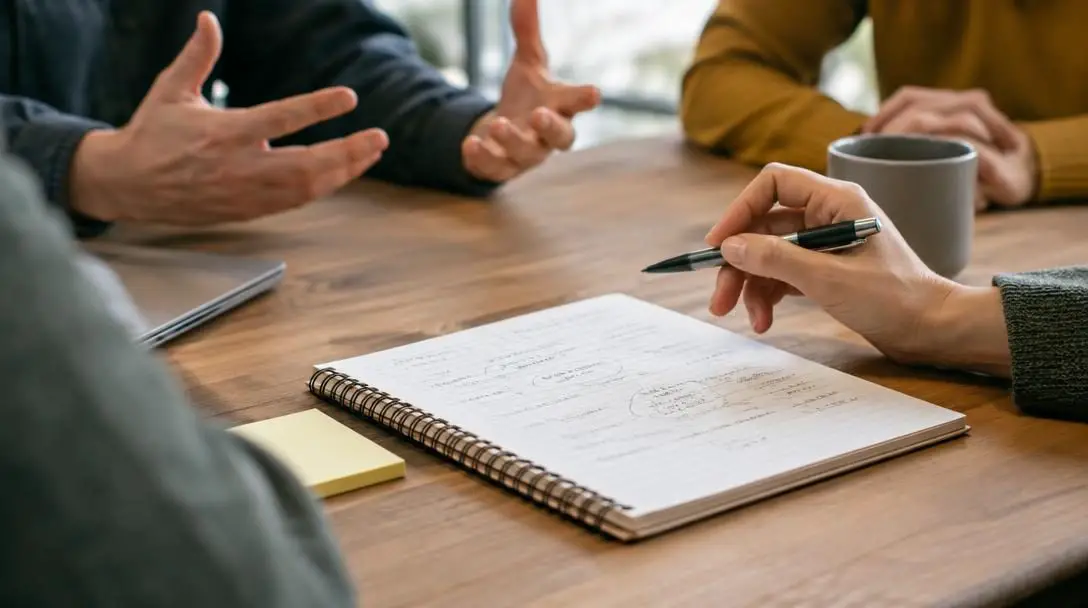
When you are being truly attentive, a significant portion of the conversation will end up flowing through you.
Commanding Attention When Speaking
Projecting the right body language is just as critical when you are speaking as when you are listening. When your window to speak arrives, you must actively command the room's focus. Many people become self-conscious when thrust into the spotlight, inadvertently raising their shoulders, pulling their bodies inward, and dropping their vocal projection down to a mousy or monotone murmur. This subdued delivery invites interruptions and causes listeners to tune out before the core point is ever made.
To overcome this trap, speak with physical energy and deliberate movement. Elevate your speaking volume so it carries cleanly across the entire room, cutting through ambient noise and conversational drift. Using your hands to emphasize key ideas is a proven technique used by public communicators at all levels of leadership, from corporate executives to the President of the United States. While wild or erratic gesturing can be distracting, controlled hand movements act as a visual anchor that keeps the eyes of every participant locked firmly onto you.
Creating an Inclusive Environment for Everyone
Guiding a group discussion requires far more than merely capturing the spotlight for yourself; true conversational leadership is defined by how effectively you include others. Almost everyone has endured the frustration of attending an important meeting with well-developed ideas, waiting politely for an appropriate lull in the conversation, only to watch the meeting adjourn without ever receiving an opportunity to contribute. This dynamic creates deep resentment and deprives the group of valuable problem-solving input.
The most effective participants treat group dialogue like a competitive team sport, similar to a basketball squad passing the ball across the court to locate the open shot. When you finish articulating your perspective, avoid letting the conversational floor fall back into an open, chaotic scramble. Instead, consciously scan the room, locate a peer who has been quiet, and deliberately pass the conversational momentum to them by asking how they feel about the issue being discussed. This deliberate distribution of speaking opportunities ensures that no one leaves feeling ignored or cheated out of sharing their insights.
Maintaining Civility and Directing Focus
Group discussions can quickly deteriorate when individuals hold conflicting viewpoints. Left unmanaged, healthy intellectual disagreements can spiral into personal insults, sarcastic commentary, and off-topic arguments. When participants begin trading verbal barbs, the collective focus evaporates and the productive value of the meeting is lost. Stepping in promptly to preserve civility is essential to maintaining psychological safety for the entire room.
De-escalating friction and steering the conversation back toward productive territory requires flexibility. Depending on how tense the atmosphere has become, several distinct intervention strategies can restore order:

- Inject a lighthearted or comedic remark to defuse high emotional tension and soften personal friction between clashing participants.
- Intervene with calm firmness to state directly that personal attacks, insulting language, and off-topic tangents are strictly prohibited.
- Re-anchor the room by restating the core agenda item, original question, or problem the team initially convened to solve.
- As a necessary last resort, remove or dismiss persistently disruptive individuals who refuse to cooperate, demonstrating that the integrity of the discussion takes precedence over bad behavior.
Step-by-Step Guide to Leading and Participating
Successfully navigating a group exchange requires balancing observation, physical poise, vocal clarity, and boundary enforcement. Follow this sequential process to navigate any meeting effectively:
- Prepare your mental frame before stepping into the room by reviewing the core subject matter so you can focus on reading interpersonal cues rather than scrambling for facts.
- Adopt an open seating posture from the moment you sit down, squaring your shoulders toward the center of the gathering rather than folding inward.
- Track the participation flow across the room, noting who has dominated the discussion and who has been waiting quietly on the margins.
- Anchor your visual focus on whoever is speaking, validating their remarks through rhythmic nods and brief vocal affirmations.
- Claim the floor when a natural opening emerges by projecting your voice at an elevated volume and using deliberate hand gestures to command visual attention.
- Toss the conversational ball to a quiet participant at the conclusion of your point by looking directly at them and posing an open-ended question.
- Intervene immediately if tension turns hostile, utilizing humor, explicit rules of conduct, or thematic refocusing to keep the group grounded.
Common Interpersonal Pitfalls in Group Discussions
Conversations typically fail not because participants lack knowledge, but because they stumble into predictable interpersonal traps. Avoiding these common mistakes will preserve your credibility and keep the meeting running smoothly:
- Monopolizing the floor: Launching into uninterrupted speeches turns an open forum into an alienating lecture and encourages others to disengage.
- Appearing detached or distracted: Failing to maintain eye contact, slumping in your seat, or staring blankly signals indifference, guaranteeing that others will ignore your points later.
- Speaking too quietly: Using a hesitant, mousy vocal delivery allows louder, more aggressive personalities to talk over your contributions without pushback.
- Ignoring silent members: Permitting the loudest voices to capture one hundred percent of the time limits the quality of group decisions and isolates quieter colleagues.
- Tolerating personal attacks: Permitting side arguments and snide insults to continue unchecked destroys mutual respect and paralyzes open collaboration.
Long-Term Practice and Self-Evaluation
Refining group communication skills is an ongoing endeavor that requires continuous personal reflection. As you attend subsequent gatherings, examine how varying room layouts and audience sizes influence your delivery. A compact boardroom gathering of five people requires subtler physical cues and moderated volume compared to a wide town hall forum, yet active listening and clear vocal projection remain essential across both environments.
Pay close attention to how experienced leaders handle moments of friction. Notice how skilled mediators deploy well-timed humor to neutralize passive-aggressive remarks, or how they assertively steer off-topic debates back to the agenda without humiliating the offenders. After every significant discussion, evaluate your own performance: determine whether your body language supported others, whether you helped draw out quieter perspectives, and whether you held the floor with poise and authority when speaking.
Frequently asked questions
Why do people get nervous in group discussions compared to one-on-one chats?
Private conversations feature predictable turn-taking where speech alternates naturally between two people. In larger groups, turn-taking is competitive, fluid, and unspoken, forcing participants to navigate rapid interpersonal timing, nonverbal signals, and social pressure that can easily trigger anxiety.
How can I make sure people actually listen when it is my turn to speak?
Command the room by elevating your vocal volume above your normal conversational level and incorporating purposeful hand gestures. Maintaining dynamic movement and avoiding a mousy, monotone delivery draws the room's visual and auditory focus onto your message.
What is the best way to bring a shy or quiet person into the conversation?
Treat the conversation like passing a basketball. When you finish making your point, look directly at the quiet participant and deliberately invite their thoughts on the matter, creating an explicit opening so they do not have to fight for airtime.
What should you do if two participants start arguing personally during a meeting?
Intervene promptly rather than letting hostility fester. You can diffuse the tension using a light touch of humor, explicitly state that personal attacks and off-topic debates are not permitted, or firmly restate the core question the group gathered to solve.
Can poor body language cause other participants to ignore your points?
Yes. Slumping, looking away, or appearing disengaged while others talk signals disrespect or boredom. When an inattentive listener finally attempts to speak, the group is far more likely to interrupt, talk over, or disregard them.
The bottom line
Transforming group discussions from chaotic shouting matches into productive exchanges requires a deliberate blend of active listening, physical command, and inclusive turn-sharing. When you show genuine interest through supportive body language, speak with energetic vocal projection, and actively pull quieter peers into the dialogue, you establish yourself as a natural conversational leader. By shutting down hostility early and focusing on shared objectives, any participant can inspire collaboration, engage peers deeply, and ensure that every voice is respected and heard.