What is Killer Sudoku?

For decades, classic Sudoku has maintained an iron grip on the daily routines of puzzle fans worldwide. Commuters pore over newsprint grids on morning trains, casual players unwind with digital apps before bed, and dedicated hobbyists work through hefty paperback volumes filled with hundreds of number-placement grids. Yet despite the immense popularity of the original format, very few spin-offs have managed to capture the public imagination in a meaningful, lasting way. The standout exception to that rule is Killer Sudoku, an ingenious hybrid that injects arithmetic constraints directly into the familiar logic puzzle framework.
While the moniker sounds intimidating to uninitiated players, the puzzle is far more approachable than its fierce name implies. Because the extra arithmetic sums provide immediate, concrete footholds across the board, easy-level Killer Sudoku puzzles can actually prove more accessible than standard Sudoku puzzles on equivalent settings. Whether you are searching for a fresh mental exercise or hoping to elevate your deductive powers, this variant delivers an extraordinarily satisfying blend of classic spatial deduction and basic arithmetic.
Key takeaways
- Killer Sudoku blends standard Sudoku placement rules with arithmetic cages that demand specific sums.
- Invented by Japanese puzzle master Tetsuya Nishio, the game was originally known as samunamupure, meaning "sum number place."
- Digits cannot repeat within an individual cage, regardless of whether the cage shares a row, column, or block.
- Applying the Rule of 45 allows solvers to calculate missing values along boundaries by comparing house totals to cage sums.
- Introductory grids are often easier than traditional Sudoku because cage totals eliminate guessing right from the start.
The Origins and History of Sum Number Place
Classic Sudoku had already evolved through decades of regional formats before establishing its globally recognized structure in the 1990s. As its popularity grew in Japan, dedicated designers experimented with creative variations to challenge veteran solvers. Among these innovators was Tetsuya Nishio, a prominent Japanese puzzle master who sought to combine classic spatial elimination with elementary addition. Nishio envisioned a puzzle format that could scale from gentle introductory warm-ups to staggering intellectual tests.
When the game debuted in Japan, it was christened samunamupure, a portmanteau translating directly to sum number place. This descriptive title clearly communicated the central mechanic: filling number places while satisfying distinct mathematical sums. However, when the puzzle was introduced outside of Japan in the mid-2000s—coinciding with the explosive mainstream rise of standard Sudoku across the Western world—it received the dramatic title "Killer Sudoku."
Because arithmetic sums provide immediate footholds, introductory Killer Sudoku grids can often be easier to unravel than traditional puzzles.
The transition into international publications was not entirely smooth. Solvers outside Japan were initially bewildered by the dual layers of arithmetic cages and standard 9x9 constraints. In England, The Times had to print dedicated rule clarifications after readers spent weeks attempting to complete grids using incorrect assumptions. Once solvers understood the interplay between cage values and traditional grid lines, however, the format quickly gained an enduring global following.
How Killer Sudoku Works: Rules and Mechanics
At first glance, a Killer Sudoku puzzle resembles an ordinary 9x9 grid. It contains eighty-one individual cells divided into nine distinct 3x3 subgrids, commonly known to puzzle enthusiasts as houses, regions, or blocks. The baseline objective of classic Sudoku remains fully intact: every horizontal row, vertical column, and 3x3 block must contain the digits 1 through 9 exactly once, without any omission or repetition.
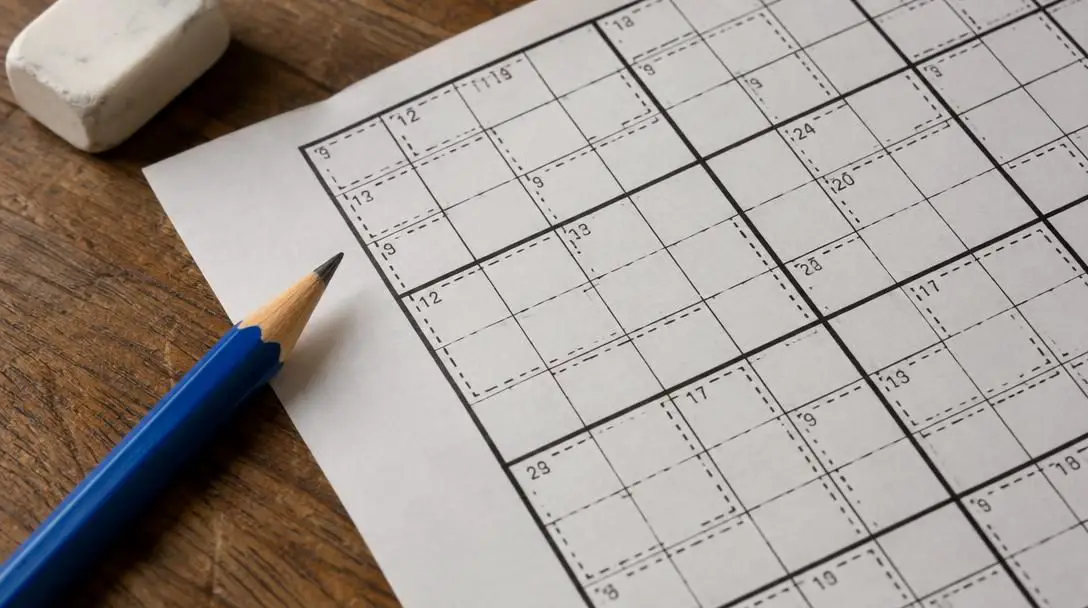
The defining twist lies in the visual partitions overlaid across the board. The grid is broken into groupings of cells delineated by dashed borders or contrasting pastel colors. These groupings are called cages. In the top corner of each cage, a small clue number indicates the exact mathematical sum that the contained digits must produce when added together. Solvers must deduce the contents of these cells while satisfying both the local cage sum and the broader orthogonal rules of the board.
Crucially, digits cannot repeat within a single cage. This constraint holds true even if a cage snakes across different rows or columns where repetition might otherwise seem plausible under classic rules. For instance, if a two-cell cage requires a sum of 4, the only permissible combination is 1 and 3; placing a pair of 2s is strictly forbidden. Furthermore, many Killer Sudoku grids begin entirely blank, offering zero pre-filled starting digits. Solvers rely exclusively on arithmetic clues to establish their initial deductions.
Exploring Key Variants of the Grid
Logic puzzle publishers offer several distinct iterations of number-placement games. Understanding how each variant alters your problem-solving process is essential for selecting the right challenge level.
| Variant | Primary Clue Source | Arithmetic Required | Key Structural Rule |
|---|---|---|---|
| Classic Sudoku | Pre-filled starting digits | None | Unique digits 1–9 in rows, columns, and 3x3 houses |
| Killer Sudoku | Corner cage sums | Basic addition within cages | No duplicate digits within any outlined cage |
| Killer X | Corner cage sums and diagonals | Basic addition within cages | Main diagonal lines must also contain unique digits 1–9 |
Classic Sudoku
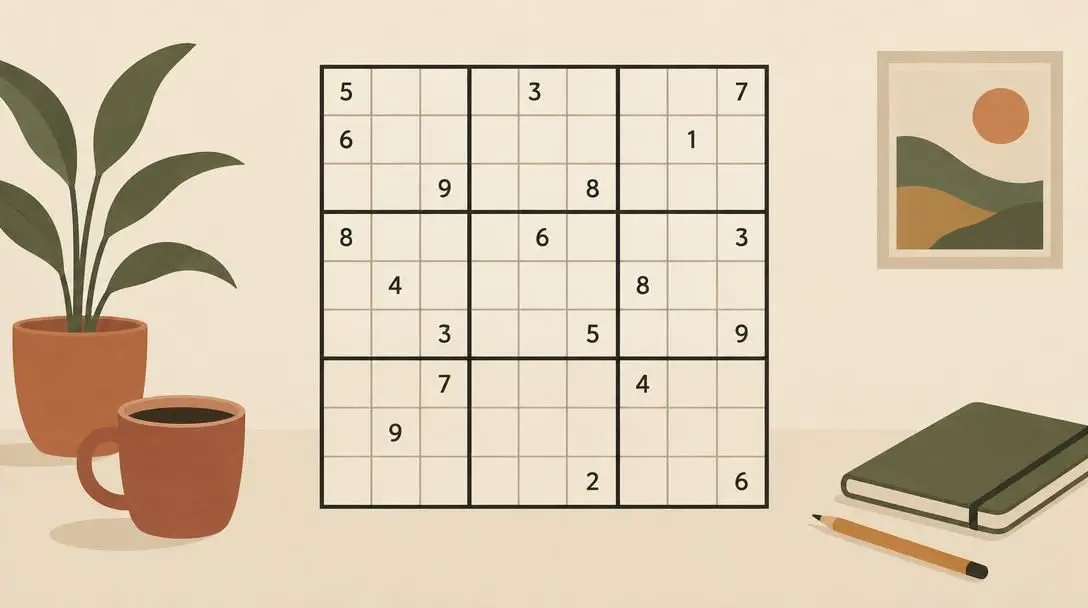
The standard format relies entirely on fixed starting digits distributed across an otherwise empty 81-cell matrix. Solvers use pure visual elimination, scanning rows, columns, and 3x3 blocks to isolate missing numbers. No arithmetic calculation is needed, making it an exercise strictly focused on pattern recognition and spatial logic.
Killer Sudoku
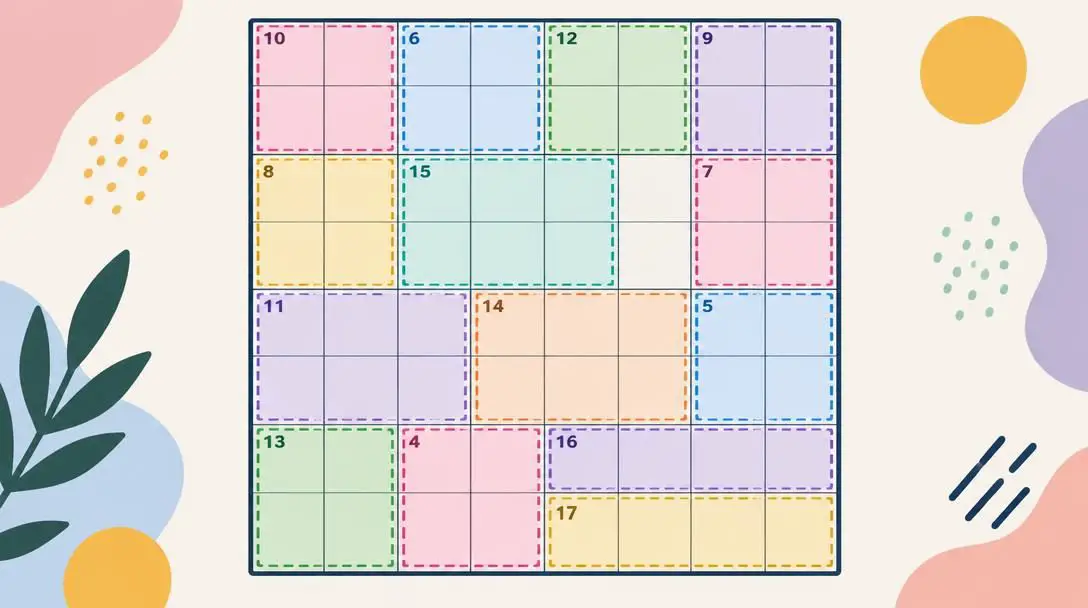
This hybrid variant strips away most or all pre-filled single numbers, replacing them with outlined, multi-cell cages that display a required sum in the corner. Solvers must balance standard non-repetition rules across rows, columns, and blocks while finding unique digit combinations that equal each cage's prescribed total.
Killer X
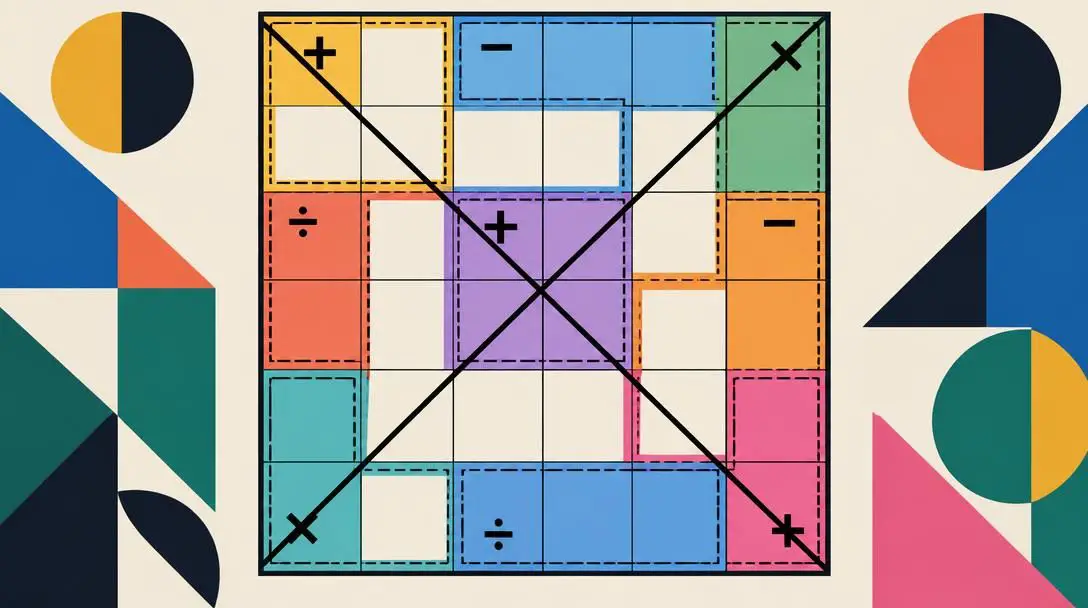
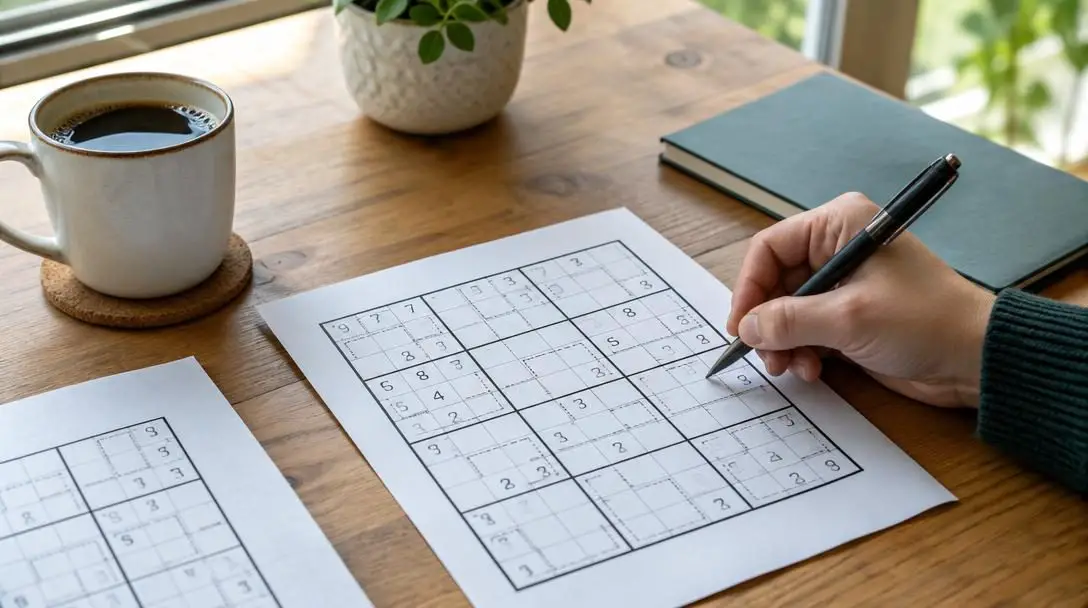
A sophisticated offshoot of the cage-sum format, Killer X incorporates an additional geometric constraint. In addition to satisfying every standard rule and cage sum, the puzzle designates the two long diagonal paths across the grid as active playing zones. Each diagonal must contain the numbers 1 through 9 without duplication, substantially limiting candidate choices across the center of the board.
Step-by-Step Solving Strategies
Tackling a fresh Killer Sudoku board requires a methodical progression. Rather than guessing numerical combinations, successful solvers move through standardized deductive phases to systematically unlock the grid.
- Target the extreme cages first: Examine the board for cages that feature unusually high or low sums relative to their size. These extreme cages have the fewest possible mathematical permutations. A two-cell cage summing to 3 can only ever contain 1 and 2, while a two-cell cage summing to 17 must contain 8 and 9. Similarly, a three-cell cage totaling 6 must always be 1, 2, and 3, whereas a three-cell cage totaling 24 can only contain 7, 8, and 9. Identifying these narrow sets establishes immediate candidate pools.
- Resolve local 3x3 regions: Once the values inside extreme cages are identified, turn your attention to the remaining cells in those same 3x3 houses. Because you have already accounted for specific high or low numbers, the unassigned cells in that regional box will have far fewer candidate possibilities remaining.
- Apply the Rule of 45: Every complete row, column, and 3x3 block in a standard Sudoku puzzle contains the numbers 1 through 9 exactly once. The sum of these nine digits is always 45 (1 + 2 + 3 + 4 + 5 + 6 + 7 + 8 + 9 = 45). You can use this constant sum to deduce unknown cell values across entire houses.
- Calculate boundary overlaps with the Rule of 45: Look for a 3x3 house where almost all the cages are fully contained inside, save for a single cell protruding into an adjacent block. Add together the target sums of all the cages located within that house. If the combined cage total exceeds 45, the excess amount represents the exact value of the cell sticking out. Conversely, if a cage extends outward leaving one cell empty inside the block, comparing the internal cages to 45 will instantly reveal the value of that missing internal square.
- Cross-reference standard Sudoku constraints: As you discover valid arithmetic pairings for individual cages, always verify them against intersecting rows and columns. Even if a specific pair of digits perfectly matches a cage's arithmetic requirement, an identical number sitting elsewhere in that same column or row will instantly invalidate that combination.
Frequent Mistakes and How to Avoid Them
Because Killer Sudoku demands simultaneous attention to arithmetic sums and spatial restrictions, solvers frequently fall prey to predictable oversights. Keeping these common errors in mind will keep your deductions clean:
- Duplicating digits within a cage: A common slip for beginners is attempting to fulfill a sum using duplicate numbers, such as writing two 3s inside a two-cell cage that requires a sum of 6. The non-repetition rule applies universally to every individual cage.
- Ignoring cage borders that cross regions: Solvers often mistake irregular cages for standard blocks. Cages frequently snake across the thick grid lines dividing separate 3x3 houses, meaning their numbers affect multiple regions simultaneously.
- Making simple addition slips: The Rule of 45 is infallible, but human arithmetic is not. A single addition error when totaling cages will propagate incorrect digits across surrounding rows, eventually corrupting the entire puzzle.
- Searching solely for classic pre-filled clues: Expecting traditional given numbers will stall your progress. In Killer Sudoku, the cage numbers are your primary clues, and you must rely on combination arithmetic to make initial headway.
- Failing to take notes on candidates: Trying to track multi-cell sums and line eliminations entirely in your head causes cognitive overload. Writing down small candidate notes helps systematically eliminate unworkable pairs.
Frequently asked questions
Is Killer Sudoku harder than regular Sudoku?
Not necessarily. While advanced Killer Sudoku puzzles can be exceptionally difficult, introductory puzzles on easy difficulty settings are often simpler than classic Sudoku. The arithmetic cage clues provide narrow mathematical combinations that give beginners clear starting points without requiring advanced line-scanning techniques.
Can numbers repeat inside a Killer Sudoku cage?
No. Under official Killer Sudoku rules, numbers cannot repeat within any individual cage. For example, a two-cell cage totaling 8 can never contain two 4s; it must be solved using pairs like 1 and 7, 2 and 6, or 3 and 5.
What is the Rule of 45 in Killer Sudoku?
The Rule of 45 relies on the mathematical fact that the digits 1 through 9 add up to exactly 45. Because every complete row, column, and 3x3 block must contain each digit once, the sum of all cells in any complete house must equal 45. Solvers use this constant to deduce cell values that extend beyond regional cage boundaries.
Who invented Killer Sudoku?
Killer Sudoku was created by Japanese puzzle master Tetsuya Nishio. It was originally titled samunamupure (sum number place) in Japan before being introduced internationally in the mid-2000s under its modern Western name.
What is the difference between Killer Sudoku and Killer X?
Killer Sudoku applies arithmetic cages and standard 9x9 constraints across rows, columns, and 3x3 regions. Killer X retains all of these core mechanics while adding an extra rule: the two main diagonal lines spanning corner to corner must also contain the numbers 1 through 9 without repetition.
The Bottom Line
Killer Sudoku transforms the familiar 9x9 grid from a test of pure visual scanning into a dynamic numbers game that engages both sides of the brain. By fusing arithmetic cage totals with the elegant deduction of classic Sudoku, the format delivers a richer, more layered problem-solving experience. Though master-level grids can certainly live up to the "dreadful challenge" envisioned by Tetsuya Nishio, introductory layouts welcome newcomers with intuitive clues and satisfying breakthroughs.
Beginning with extreme cages, writing neat candidate notes, and utilizing the mathematical certainty of the Rule of 45 will quickly demystify the board. As your confidence grows, navigating intricate cage overlaps and tackling complex variants like Killer X will feel less like an impossible chore and more like an exhilarating mental workout. If you have grown tired of standard grids or simply crave a fresh intellectual pastime, Killer Sudoku offers an endlessly rewarding next step.