5 Best Players in Manchester City History
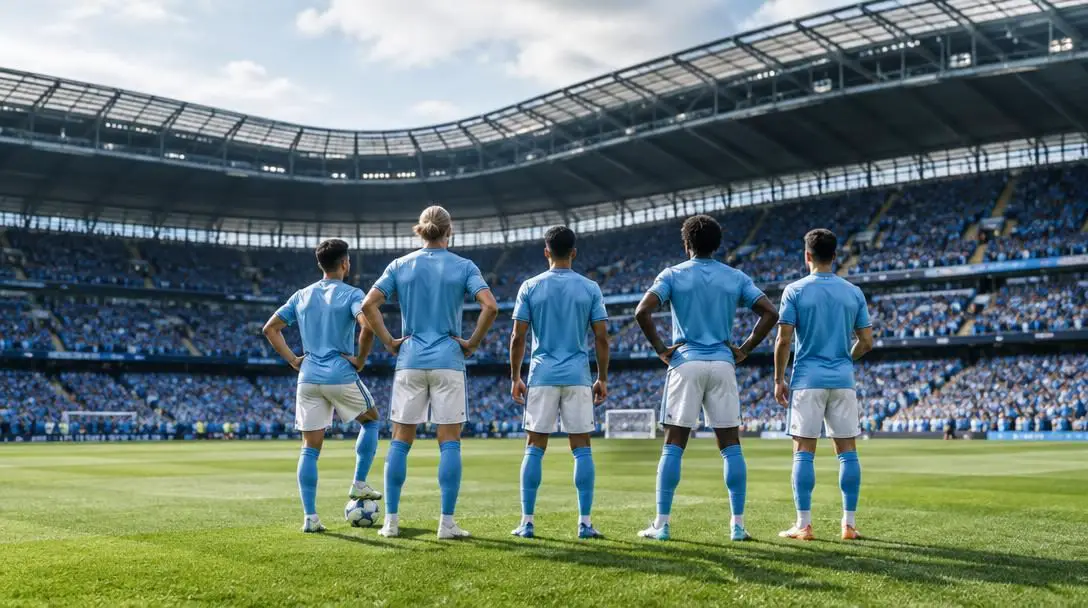
Manchester City has firmly established itself at the pinnacle of English and international football. While modern spectators readily associate the club with its explosive surge in the early 2010s—a golden period that yielded five league championships in a single decade—the club's tradition and pedigree stretch across many generations. Decades prior to its recent domestic supremacy, celebrated athletes wore the sky-blue shirt, driving the team to historic triumphs across both domestic competitions and European tournaments.
Assessing the finest footballers in Manchester City history reveals a dynamic blend of mid-twentieth-century stalwarts and modern icons. While legendary contributors like goalkeeper Joe Corrigan, defensive pillar Mike Doyle, heroic German keeper Bert Trautmann, visionary creator Kevin De Bruyne, prolific inside forward Peter Doherty, and dynamic winger Mike Summerbee remain immortalized as honorable mentions, five transcendent figures stand above the rest. Spanning various positions, tactical eras, and origins, these elite athletes defined the team's greatest eras.
Key takeaways
- Manchester City's historical elite spans both foundational mid-twentieth-century champions and defining figures from the modern era.
- Sergio Aguero leads the club in all-time goalscoring with a commanding total of 260 goals across a decorated decade.
- Longevity anchors the club's legacy, highlighted by Alan Oakes's 17-year tenure and Colin Bell's 493 appearances.
- Transformative modern leaders like Vincent Kompany and David Silva earned numerous domestic trophies alongside Premier League Hall of Fame recognition.
At a glance: Manchester City's greatest players
To understand the breadth of Manchester City's history, it is essential to look at the different positions, eras, and honors accumulated by its top performers. The table below summarizes the key milestones of the five greatest players to don the club's colors.
| Player | Primary position | Club tenure | Key club honors |
|---|---|---|---|
| Alan Oakes | Midfielder | 1959–1976 | First Division, European Winners' Cup, FA Cup, 2 Charity Shields |
| Vincent Kompany | Center-back | 2008–2019 | 4 Premier Leagues, 2 FA Cups, 4 EFL Cups, 2 Community Shields |
| David Silva | Attacking midfielder | 2010–2020 | 4 Premier Leagues, 2 FA Cups, 5 EFL Cups |
| Colin Bell | Midfielder | 1966–1979 | First Division, European Winners' Cup, FA Cup |
| Sergio Aguero | Striker | 2011–2021 | 5 Premier Leagues, 2019 FA Cup |
The five greatest players in club history
Selecting the top five players requires weighing individual distinction, match volume, leadership qualities, and overall silverware. These five legends set the benchmark for football excellence throughout Manchester City's existence.
Alan Oakes

- Position: Midfielder
- First-team tenure: 1959–1976 (17 years)
- Individual honor: 1975 Manchester City Player of the Year
- Later club: Chester
Born during the upheaval of World War II, Alan Oakes devoted his early youth to mastering football during the reconstruction years. His journey with Manchester City began when he signed on with the youth setup in 1958. Just one year later, in 1959, he made his professional first-team debut. That match commenced an astonishing seventeen-year stretch as an irreplaceable defensive and central midfield anchor for the squad.
Operating from deep midfield positions, Oakes combined rugged durability with intelligent distribution, even chipping in with more than two dozen goals across his tenure. His unwavering steadiness across multiple tactical eras culminated in his selection as the club's Player of the Year in 1975. Across his extended career at Maine Road, Oakes collected an enviable assortment of major honors, including the First Division title, the European Winners' Cup, the FA Cup, and two Charity Shields. Following his seventeen-season run in Manchester, he carried his career well into the 1980s with Chester.
Vincent Kompany

- Position: Center-back
- Tenure: 2008–2019
- Individual accolade: Premier League Player of the Season
- Hall of Fame: Inducted into Premier League Hall of Fame (2022)
Hailing from Uccle, Belgium, Vincent Kompany honed his craft at Anderlecht before continuing his European progression in the German Bundesliga with Hamburger SV. In 2008, shortly before the club embarked on an unprecedented period of investment and international focus, Kompany arrived in Manchester. Over the course of more than a decade, he established himself as the team's defensive bedrock and inspirational captain.

Though primarily tasked with stopping opposing attackers, Kompany possessed an uncanny knack for timely offensive contributions, finishing his City career with nearly 20 goals. As the defensive commander, he marshaled the squad to four Premier League titles, four EFL Cups, two FA Cups, and two Community Shields. His commanding performances earned him the Premier League Player of the Season award a full ten years before his 2022 induction into the Premier League Hall of Fame. After concluding his playing days at City, Kompany returned to Anderlecht for a final campaign spanning 2019 to 2020.
Manchester City's modern global supremacy stands firmly upon a foundation laid by generational leaders across more than half a century.
David Silva

- Position: Creative midfielder
- Appearances: 390 matches
- Goal tally: Over five dozen goals
- Individual honors: 2016–17 Player of the Season, Premier League Player of the Month
Spanish playmaker David Silva spent the 2000s ascending through the ranks of Valencia, establishing an international reputation for visionary passing and technical grace. In 2010, he made the decisive switch to England. Over the subsequent ten seasons, Silva dictated the tempo of Manchester City's attacking machinery, compiling 390 appearances to settle just outside the club's all-time top ten match list.
Silva was the primary creative spark during a decade of relentless domestic success. In addition to orchestrating scoring chances for his teammates, he found the back of the net more than sixty times. His decade in sky blue yielded four Premier League trophies, five EFL Cups, and two FA Cups. His artistry was recognized through individual hardware as well, earning a Premier League Player of the Month award and being crowned Manchester City's Player of the Season for 2016–17. Upon concluding his English chapter, Silva returned to his native Spain with Real Sociedad.
Colin Bell

- All-time club rank: 5th in appearances (493), 4th in goals (153)
- Tenure: 1966–1979 (13 years)
- Scoring distinction: Club's leading scorer in 4 separate campaigns
- Hall of Fame: English Football Hall of Fame (2005)
Born in Hesleden, England, Colin Bell launched his professional football journey by playing three seasons with Bury. In 1966, Manchester City secured his signature, initiating a thirteen-year partnership that defined the club's golden mid-century era. Nicknamed for his limitless stamina and elegance across the pitch, Bell became an absolute cornerstone, finishing fifth in all-time club appearances with 493 matches.
Bell was an astonishingly versatile midfielder whose attacking output rivaled elite strikers. He stands fourth on the club's all-time scoring list with 153 goals, having led the team in scoring across four distinct campaigns. His dynamism propelled Manchester City to victories in the First Division championship, the FA Cup, and the UEFA Winners' Cup. After concluding his domestic career, Bell logged a five-game stint in the United States with the San Jose Earthquakes. His immense footprint on the English game led to his induction into the English Football Hall of Fame in 2005.
Sergio Aguero

- Position: Striker
- All-time record: 260 goals (all-time club record)
- Major honors: 5 Premier League titles, 2019 FA Cup
- Individual accolades: Premier League Golden Boot, Premier League Hall of Fame (2022)
Taking the top spot on the list is Argentine forward Sergio Aguero, arguably the most devastating pure finisher in English football history. Aguero originally announced his world-class ability in European competition with Atletico Madrid between 2006 and 2011. Following his high-profile transfer to Manchester City, he spent a decade shattering scoring benchmarks and delivering the club's most iconic moments.

Aguero remains Manchester City's undisputed all-time leading scorer, accumulating 260 goals—a staggering figure that places him more than 80 goals clear of every other player in club history. His lethal finishing powered the team to five Premier League championships and the 2019 FA Cup. Along the way, he claimed a Premier League Golden Boot and earned the league's Player of the Month award on multiple occasions. Aguero concluded his playing career in 2021 with Barcelona before his celebrated induction into the Premier League Hall of Fame in 2022.
Framework for evaluating historical football greatness
Comparing athletes across widely divergent football eras presents unique challenges. Shifts in match officiating, tactical systems, equipment, and match scheduling demand that analysts employ consistent, objective criteria. When ranking historical icons, football historians balance four interrelated pillars:
- Longevity and match volume: Enduring reliability serves as a baseline indicator of quality. Surviving managerial transitions and maintaining elite form over hundreds of fixtures—such as Alan Oakes over 17 seasons or Colin Bell across 493 matches—proves long-term value.
- Trophy accumulation: Individual greatness must translate into collective success. Analysts evaluate major league championships (First Division and Premier League), traditional domestic cups (the FA Cup and EFL Cup), and continental silverware like the European Winners' Cup.
- Individual accolades: League-wide awards highlight players who outperformed peers across the sport. Distinctions like the Premier League Golden Boot, Player of the Season titles, and inductions into the English Football or Premier League Halls of Fame provide broad historical context.
- Positional and tactical impact: Goal tallies inherently favor strikers like Sergio Aguero. Historians must counterbalance raw scoring numbers by evaluating defensive organization from a center-back like Vincent Kompany or the tempo regulation offered by creative midfielders like David Silva and Alan Oakes.
Practical steps for researching football legends
Whether analyzing Manchester City or assessing historical rosters across world football, using a structured research methodology prevents errors and delivers accurate player evaluations. You can apply this step-by-step process when investigating legendary athletes:
- Consult official club archives: Review direct team records and internal hall-of-fame rolls to establish verified baselines for appearances, goals, and internal honors like Oakes's and Silva's Player of the Year awards.
- Verify league-wide recognition: Investigate broader competitive honors, such as Premier League Player of the Month selections, league-wide Player of the Season awards, and official Hall of Fame inductions.
- Trace comprehensive career trajectories: Map out where athletes developed and completed their careers. Studying stops prior to or following their time in Manchester—such as Aguero's stints at Atletico Madrid and Barcelona, Kompany's periods at Anderlecht and Hamburg, or Silva's years with Valencia—clarifies their overall pedigree.
- Evaluate numbers within positional context: Compare raw statistics against positional benchmarks. Weighing Aguero's 260 goals against Bell's 153 midfield goals or Oakes's defensive contributions paints a complete picture of on-pitch responsibility.
Common mistakes when comparing football eras
Direct comparisons between modern Premier League athletes and mid-century players frequently suffer from analytical flaws. Avoid these common pitfalls when studying the history of the sport:
- Succumbing to recency bias: The widespread availability of high-definition broadcast footage and global social media can artificially elevate players from the 2010s while causing observers to overlook the achievements of stars from the 1960s and 1970s like Colin Bell and Alan Oakes.
- Relying exclusively on goal totals: Measuring a defensive stopper like Vincent Kompany against an out-and-out striker like Sergio Aguero using only scoring output ignores backline leadership, positional discipline, and defensive organization.
- Dismissing older tournament structures: Equating modern terminology with superior competition can mislead researchers. Winning the First Division prior to 1992 carried the exact same domestic championship weight that a Premier League title carries today.
- Disregarding single-club longevity: Fleeting peaks of exceptional form do not necessarily eclipse a decade or more of unwavering dedication. Sustaining a high standard across ten to seventeen years at one club demonstrates extraordinary mental and physical resilience.
Frequently asked questions
Who is Manchester City's all-time leading goalscorer?
Sergio Aguero is the all-time leading scorer in Manchester City history with 260 goals, which leaves him more than 80 goals ahead of any other player in the club's record books.
Which player spent the longest first-team career at Manchester City?
Alan Oakes spent 17 seasons anchoring the Manchester City squad, debuting in 1959 after joining the youth setup in 1958 and remaining an active first-team mainstay until 1976.
Why is Colin Bell considered one of the club's greatest midfielders?
Colin Bell combined remarkable match longevity with exceptional scoring. He ranks fifth in all-time club appearances with 493 games, sits fourth in all-time goals with 153, and led the team in scoring across four separate seasons from midfield.
What major honors did Vincent Kompany win as captain and defender?
During his decade-long tenure, Vincent Kompany led the club to four Premier League titles, four EFL Cups, two FA Cups, and two Community Shields, while also earning Premier League Player of the Season honors.
Which notable Manchester City players narrowly missed the top five?
Honorable mentions who narrowly missed the top five include goalkeeper Joe Corrigan, defender Mike Doyle, iconic goalkeeper Bert Trautmann, modern playmaker Kevin De Bruyne, attacker Peter Doherty, and winger Mike Summerbee.
The bottom line
The history of Manchester City is defined by an enduring tradition of resilience, tactical evolution, and match-winning talent. While the modern success of the 2010s brought unprecedented domestic dominance, the foundation of the club was forged by loyal legends who gave decades of service across the mid-twentieth century. By evaluating historical icons through a balanced framework of longevity, silverware, and individual honors, supporters can fully appreciate how figures from Alan Oakes to Sergio Aguero collectively shaped one of football's greatest institutions.