5 Worst Moments For Atletico Madrid Fans
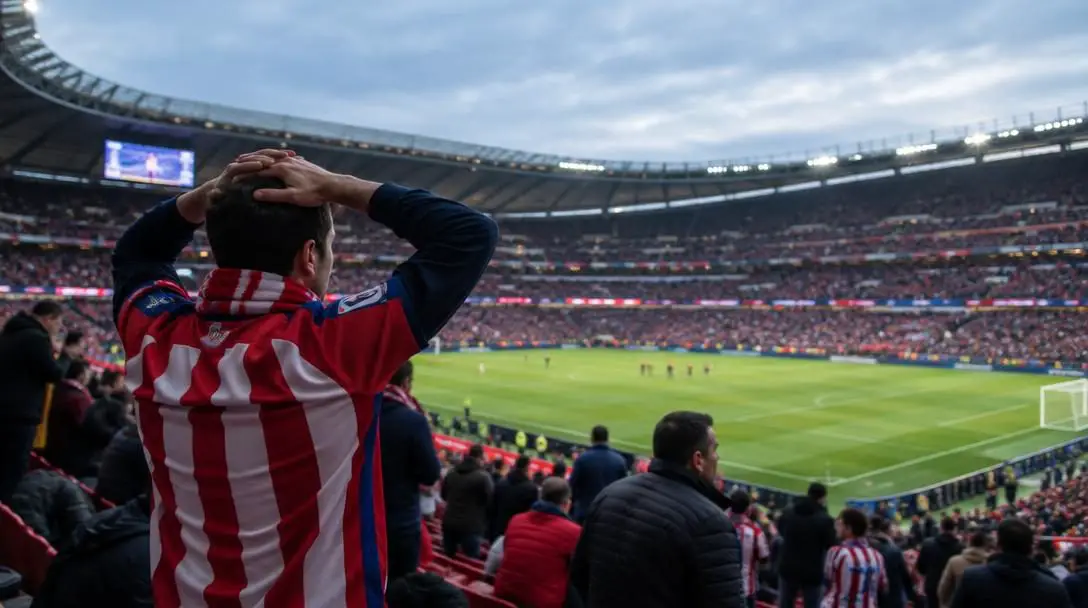
Founded in 1903, Atlético Madrid has grown into one of the most prominent football institutions in the world, backed by an intensely dedicated global fanbase. Over more than a century of competitive football, the club has celebrated major domestic and international triumphs, carving out a distinct identity rooted in grit, perseverance, and passion.
Yet the history of the club is defined just as much by its endurance in the face of despair as it is by silverware. From agonizing continental cup finals against their fiercest rival to devastating domestic drops and profound off-pitch tragedies, the club and its supporters have endured moments of deep sporting sorrow.
Key takeaways
- Stoppage-time and penalty heartbreak against Real Madrid denied Atlético Madrid European glory in both the 2014 and 2016 Champions League finals.
- The tragic 2020 passing of 14-year-old academy striker Christian Minchola profoundly impacted the entire club hierarchy and squad.
- A steep competitive decline in the 1999–2000 season saw the club relegated from La Liga after a brutal 15-match winless slide.
- Atlético's bid for immediate top-flight return in 2000–01 fell agonisingly short on goal difference to Tenerife.
At a glance: Atlético Madrid's darkest milestones
While the club's trophy cabinet contains notable honors, these five distinct events represent the most painful challenges faced by supporters across different eras of competition and tragedy.
| Event | Year | Competition / Setting | Deciding Factor or Outcome |
|---|---|---|---|
| Champions League Final (Lisbon) | 2014 | UEFA Champions League | Stoppage-time equalizer; 4-1 extra-time defeat |
| Champions League Final (Milan) | 2016 | UEFA Champions League | Penalty shootout defeat after a 1-1 draw |
| Passing of Christian Minchola | 2020 | Youth Academy | Tragic death of rising 14-year-old striker |
| La Liga Relegation | 1999–2000 | La Liga | Relegation confirmed before final-day win |
| Failed Promotion Campaign | 2000–01 | Segunda División | Tied on points with Tenerife; missed on goal differential |
The five worst moments in Atlético Madrid history
Examining these five defining low points offers an unvarnished look at how fine the margins are between historic triumph and lasting sorrow in top-level sport.
The 2014 Champions League Final

- Opponent: Real Madrid
- Venue: Lisbon, Portugal
- Key Goalscorers: Diego Godín (36'), Sergio Ramos (90+3')
The 2014 Champions League final in Lisbon offered Atlético Madrid a historic opportunity to claim the continental crown that had eluded the club since its founding in 1903. Facing arch-rival Real Madrid, the squad executed an airtight defensive performance for the vast majority of the contest. Central defender Diego Godín opened the scoring in the 36th minute, looping a header over the goalkeeper to give Atlético an advantage that held firm throughout standard regulation.
With supporters counting down the seconds to European immortality, disaster struck in the third minute of stoppage time. Real Madrid's Sergio Ramos rose to head home a corner kick, erasing Atlético's lead with virtually the last action of the 90 minutes. Physically drained and emotionally shattered by the sudden equalizer, Atlético collapsed during extra time, conceding three additional goals—including a 120th-minute penalty kick from Cristiano Ronaldo—to seal an agonizing 4-1 defeat.
The 2016 Champions League Final

- Venue: San Siro, Milan
- Match Result: 1-1 after extra time
- Deciding Stage: Penalty shootout (5-3)
Just two years after Lisbon, history repeated itself in brutal fashion. In May 2016, Atlético Madrid met Real Madrid once again in the Champions League final, this time staged in Milan. Real Madrid gained the upper hand early when Sergio Ramos found the net in the 15th minute. Atlético mounted a persistent fightback and finally restored parity in the 79th minute through a close-range finish by Yannick Carrasco.
Neither side could break the deadlock across the remaining minutes or the grueling 30 minutes of extra time, pushing the ultimate prize to a penalty shootout. Both teams converted their opening three kicks with precision. Real Madrid made it 4-3, leaving full-back Juanfran with the responsibility for Atlético's fourth attempt. His strike hit the base of the upright, leaving Cristiano Ronaldo to step forward and convert the clincher, inflicting another heartbreaking European defeat on the red-and-white faithful.
A missed penalty in a European final represents the ultimate cruelty of athletic margins, turning a season of relentless determination into instant heartbreak.
The Tragic Passing of Christian Minchola

- Year Joined Academy: 2013
- Year of Passing: 2020
- Age: 14
Sporting pain faded into perspective in 2020 when the club suffered an incomprehensible loss within its academy ranks. Christian Minchola, a dynamic young striker who joined Atlético Madrid's youth setup in 2013, passed away at just 14 years old without a public cause of death listed. Minchola had established himself as a prolific goalscorer within the developmental squads, netting dozens of goals every season and demonstrating the talent necessary to climb toward the senior team.
The tragedy resonated across the organization. Club president Enrique Cerezo shared his profound shock, while star midfielder Koke delivered a moving tribute acknowledging the cruelty and unfairness of the young player's loss. Minchola's death reminded the football world of the profound human bonds that underpin a sporting community beyond competitive results.
Relegation from La Liga in 1999–2000
- Final Stretch: 15-match winless drought
- Preceding Finish: 13th place (1998–99)
- Historic Milestone: First relegation in several decades
The late 1990s had initially been a golden era for the club, highlighted by a domestic league title in the 1995–96 campaign and back-to-back top-seven finishes over the next two years. However, institutional instability took hold in 1998–99, dropping the team to 13th. The subsequent 1999–2000 season began disastrously with three consecutive defeats. While brief recoveries offered temporary hope, the campaign unraveled completely following a victory over Celta de Vigo on matchday 22.
From that moment forward, Atlético Madrid failed to win a single match until the final day of the season. The team endured a crushing 15-game slide featuring eight defeats and seven draws. By the time they secured a win in the 38th round, their fate had already been sealed, sending the giant club into the Segunda División for the first time in several decades.
The Failed Immediate Promotion in 2000–01
- Early Form: 2 wins in first 11 matches
- Final Match: 1-0 win against Getafe CF
- Margin of Elimination: Tied with Tenerife; missed on goal differential
Conventional wisdom in Spanish football held that a club of Atlético Madrid's stature and resource base would dominate the Segunda División and secure immediate promotion back to La Liga. Reality proved far harsher. The team stumbled out of the gate in the 2000–01 season, claiming victory in just two of their opening 11 fixtures and finding themselves completely unprepared for the physical demands of the second tier.
A round-20 defeat against Sporting Gijón finally sparked a resurgence. Atlético mounted a furious charge, recording 15 victories, four draws, and only three losses over their remaining fixtures. Entering the final round against Getafe CF, Atlético secured a 1-0 victory. However, they finished deadlocked on points with Tenerife for third place, and their inferior goal differential left them stranded in the second tier for an agonizing second consecutive season.
The anatomy of club crises: how sporting and personal shocks hit
A club crisis rarely happens in a vacuum. By analyzing Atlético Madrid's history, it becomes evident that severe disruptions fall into distinct operational and psychological categories:
- Championship-level pressure: Cup finals require immense psychological equilibrium. When a lead slips away in stoppage time or a penalty hits the post, the mental toll often accelerates physical deterioration in extra time.
- Systemic institutional decline: Relegation is almost never an isolated bad bounce. As shown in the late 1990s, sliding from championship heights down to 13th and then into the drop zone illustrates how systemic complacency leads to sporting collapse.
- Underestimating lower-tier competition: Rebuilding immediately after relegation fails when squads believe reputation alone wins games. Grinding through a 42-match second-tier schedule requires tactical adjustment and humility.
- Grief and human vulnerability: Off-pitch tragedy transcends match preparation, placing immediate emotional strain on players, staff, and families that no athletic success can remediate.
Steps for supporters: navigating sports heartbreak
Enduring tough campaigns and painful defeats is an unavoidable reality of dedicated fandom. Adopting a constructive mindset helps supporters process these difficulties without losing perspective.
- Acknowledge the immediate emotional reaction: Suppressing frustration or grief after a heartbreaking loss only prolongs the sting; accepting disappointment as part of competitive sports is the first step toward moving past it.
- Anchor results in broader historical context: Single matches or down seasons do not erase a club's identity. Remembering that the club has persevered through decades of highs and lows provides valuable equilibrium.
- Take pride in the underlying competitive effort: Evaluating matches based on resilience rather than purely the final scoreline—such as battling through 120 minutes against elite European competition—preserves dignity in defeat.
- Lean on the broader fan community: Sharing reactions with fellow supporters, attending memorials, or participating in club tributes creates solidarity during difficult chapters.
- Implement a temporary media break: Stepping away from sports talk, social commentary, and match highlights for several weeks following a painful result offers a necessary mental reset.
Common analytical mistakes to avoid
When analyzing or processing painful sporting chapters, fans and commentators frequently fall prey to flawed narratives that skew reality:
- Assuming instant rebounds are guaranteed: Presuming that elite pedigree guarantees rapid return from sporting setbacks overlooks how difficult rebuilding truly is.
- Singling out an individual scapegoat: Focusing exclusively on one missed penalty or an individual mistake ignores the dozens of preceding moments that shaped the collective outcome.
- Conflating competitive losses with human tragedy: While losing a final produces acute athletic disappointment, it must never be equated with genuine off-field loss, such as the bereavement of a young athlete.
- Ignoring long-term structural warning signs: Attributing a major failure like relegation to simple bad luck blinds organizations to the operational and tactical issues that developed over multiple seasons.
Frequently asked questions
Who scored Atlético Madrid's goals in the 2014 and 2016 Champions League finals?
Diego Godín scored Atlético's lone goal in the 36th minute of the 2014 final, while Yannick Carrasco netted the 79th-minute equalizer during the 2016 final in Milan.
How many consecutive matches did Atlético go without a win before relegation in 2000?
The club went 15 consecutive matches without a league victory between matchday 22 and the final week of the season, suffering eight losses and seven draws during that span.
Why did Atlético Madrid fail to gain promotion in the 2000–01 season?
Despite finishing level on points with Tenerife for third place, Atlético missed out on the final promotion spot due to an inferior goal differential, requiring another year in the Segunda División.
Who was Christian Minchola?
Christian Minchola was a 14-year-old rising striker in Atlético Madrid's youth academy who joined in 2013 and scored dozens of goals each season before his tragic death in 2020.
Which player missed the decisive penalty in the 2016 Champions League shootout?
Full-back Juanfran struck the post on Atlético Madrid's fourth penalty attempt, allowing Cristiano Ronaldo to convert the winning kick for Real Madrid.
The bottom line
The history of Atlético Madrid demonstrates that athletic prestige is forged through trial and perseverance. From the heartbreak of Lisbon and Milan to the grueling years in the Segunda División and the tragic loss of Christian Minchola, the club's lowest moments have tested the resolve of everyone involved. Understanding these painful chapters is essential to appreciating the enduring spirit, loyalty, and passion that continue to define the club's global community.