5 Best Managers In Chelsea History
In modern football, elite clubs frequently operate with a notoriously short memory when assessing the performance of their managers. Even after delivering prestigious silverware, head coaches can find themselves dismissed rapidly if results show the slightest signs of stagnation or decline. Chelsea Football Club stands out as one of the most demanding technical environments in the global game, holding managers to uncompromising benchmarks within the competitive landscape of the English Premier League.
Because Chelsea sits near the pinnacle of domestic and European football, the club maintains an appetite for immediate returns rather than prolonged rebuilding phases. Yet across various ownership eras, tactical movements, and club reorganizations, a select group of coaches managed not only to survive the intense spotlight but to fundamentally reshape the club's record books. The following five managers represent the finest leaders in Chelsea history, distinguished by remarkable win rates, historic silverware, and lasting tactical legacies.
Key takeaways
- Jose Mourinho remains Chelsea's most decorated manager, claiming three Premier League crowns and maintaining the club's all-time highest winning percentage during his opening stint.
- Antonio Conte and Carlo Ancelotti achieved the highest modern winning percentages among managers with over a century of fixtures, registering 65 percent and 61 percent respectively.
- Dave Sexton represents Chelsea's pinnacle of managerial endurance, directing 371 matches over seven continuous seasons while capturing historic domestic and European honours.
- Claudio Ranieri provided vital organizational stability across nearly two hundred matches, maintaining a 54 percent win rate that laid foundational groundwork for modern success.
At a glance: Chelsea's top five managers compared
Evaluating managers across multiple decades requires analyzing their fixture volume, consistency in securing victories, and the prestigious trophies they collected during their tenures in West London.
| Manager | Tenure | Matches | Win Rate | Key Honours |
|---|---|---|---|---|
| Jose Mourinho | 2004–2007, 2013–2015 | 320+ | Stint 1: #1 All-time / Stint 2: 59% | 3 Premier Leagues, 3 League Cups, 1 FA Cup, 1 Community Shield |
| Antonio Conte | 2016–2018 | 106 | 65% | 1 Premier League (2017), 1 FA Cup (2018) |
| Carlo Ancelotti | 2009–2011 | 109 | 61% | 1 Premier League (2010), 1 FA Cup (2010), 1 Community Shield (2009) |
| Dave Sexton | 1967–1974 | 371 | 44.2% (164 wins) | 1 FA Cup (1970), 1 European Cup Winners' Cup (1971) |
| Claudio Ranieri | 2000–2004 | 199 | 54% | Consistent foundation across nearly 200 matches |
The 5 best managers in Chelsea history
Each of the top five tacticians in club history approached the Stamford Bridge dugout with distinct backgrounds, philosophies, and game plans. While their tenures varied widely in duration, every individual on this list permanently altered Chelsea's standing in English and European football.
Jose Mourinho

- Tenure: 2004–2007, 2013–2015
- Total matches: Over 320 fixtures
- Career wins: Over 200 victories
- Major honours: 3 Premier Leagues, 3 Football League Cups, 1 FA Cup, 1 FA Community Shield
The only Portuguese coach on this list is also widely recognized as the preeminent manager in Chelsea history. Jose Mourinho arrived at Stamford Bridge in 2004 following successful stints at Benfica, Uniao de Leiria, and Porto, immediately transforming Chelsea into an uncompromising defensive powerhouse and relentless winning machine.
Across his two separate spells in London—first from 2004 to 2007, and later from 2013 to 2015—Mourinho oversaw more than 320 competitive matches, securing over 200 victories. His initial spell was historic, establishing the record for the highest win percentage in Chelsea history. When he returned in 2013, he reinforced that legacy by producing a 59 percent win rate and delivering a third league title in 2015 alongside three Football League Cups, the 2007 FA Cup, and an FA Community Shield.
Antonio Conte

- Tenure: 2016–2018
- Total matches: 106 fixtures
- Win percentage: 65 percent
- Major honours: 1 Premier League (2017), 1 FA Cup (2018)
Before his arrival at Chelsea, Antonio Conte spent more than a decade as a combative midfielder with Juventus until his playing retirement in 2004, establishing himself as one of Serie A's defining talents of the 1990s. He then honed his coaching credentials across Italian club football with Arezzo, Bari, and Juventus, followed by a demanding period leading the Italian national team.
Upon taking the reins at Stamford Bridge, Conte generated immediate tactical dividends. By winning 69 of his 106 matches in charge, Conte produced an astonishing 65 percent win rate. That figure ranks him second all-time among Chelsea managers with at least 100 matches under their belt, sitting just ahead of Carlo Ancelotti. His relentless intensity translated directly into silverware, guiding the Blues to the Premier League championship in 2017 and clinching the FA Cup in 2018.
Carlo Ancelotti

- Tenure: 2009–2011
- Total matches: 109 fixtures
- Win percentage: 61 percent
- Major honours: 1 Premier League (2010), 1 FA Cup (2010), 1 FA Community Shield (2009)
Following a distinguished 16-year playing career representing Parma, Roma, and AC Milan, Carlo Ancelotti stepped into coaching in 1995 with Reggiana. Notable appointments followed at Parma, Juventus, and an illustrious decade with AC Milan before he agreed to lead Chelsea in 2009. Managing the squad across three calendar years, Ancelotti instituted an expansive, fluid attacking philosophy that delighted supporters.
Despite managing just 109 matches during his tenure, Ancelotti's record was exemplary. His 61 percent win rate places him third all-time in club history among managers who reached the 100-match milestone. His tenure was highlighted by an iconic double in 2010, winning both the Premier League and the FA Cup after having already claimed the FA Community Shield in 2009.
Dave Sexton
- Tenure: 1967–1974
- Total matches: 371 fixtures
- Record: 164 wins, 100 losses
- Major honours: 1 FA Cup (1970), 1 European Cup Winners' Cup (1971)
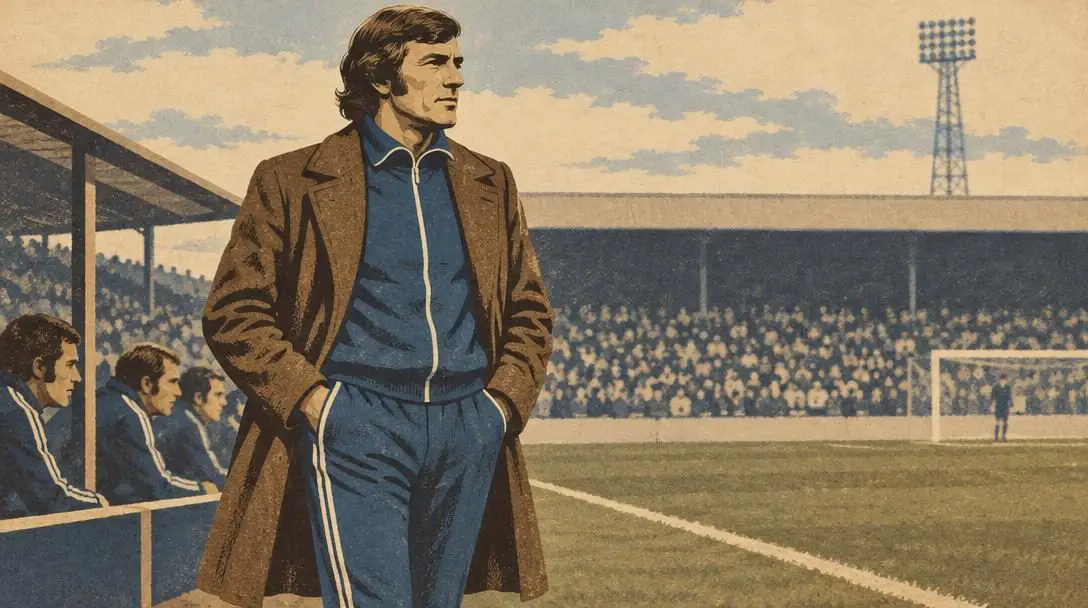
While the contemporary game often witnesses managers rotating in and out after two or three seasons, Dave Sexton stands out for his extraordinary endurance. Having played professionally throughout the 1950s and managed Leyton Orient for a single campaign, Sexton took over Chelsea in 1967 and steered the club through seven demanding seasons.
Sexton broke the mold of earlier eras where coaches frequently stayed on despite mediocre outcomes. Over his 371 matches in charge, Sexton compiled 164 victories while suffering exactly 100 defeats. More importantly, he delivered landmark silverware to the club's cabinet, capturing the legendary 1970 FA Cup against Leeds United and securing continental glory the following season by lifting the 1971 European Cup Winners' Cup.
Claudio Ranieri

- Tenure: 2000–2004
- Total matches: 199 fixtures
- Record: 107 wins, 54 percent win rate
- Major honours: Foundational squad construction and Champions League qualification
Few football figures boast a career resume as vast as Claudio Ranieri. The Roman defender represented four clubs during his playing days and accumulated roughly two dozen managerial positions across Europe, including celebrated stints with Leicester City, Inter Milan, Roma, and Chelsea. Appointed in 2000, Ranieri managed the club through 2004, serving as a critical bridge during a period of massive organizational transformation.
Ranieri finished just one match short of the 200-game milestone, yet his 199 fixtures still place him eighth all-time in total matches managed for Chelsea. While he struggled to push the squad over the final hurdle to claim major domestic trophies, Ranieri established remarkable baseline consistency, securing 107 victories and maintaining a commendable 54 percent win rate that helped attract elite talent to West London.
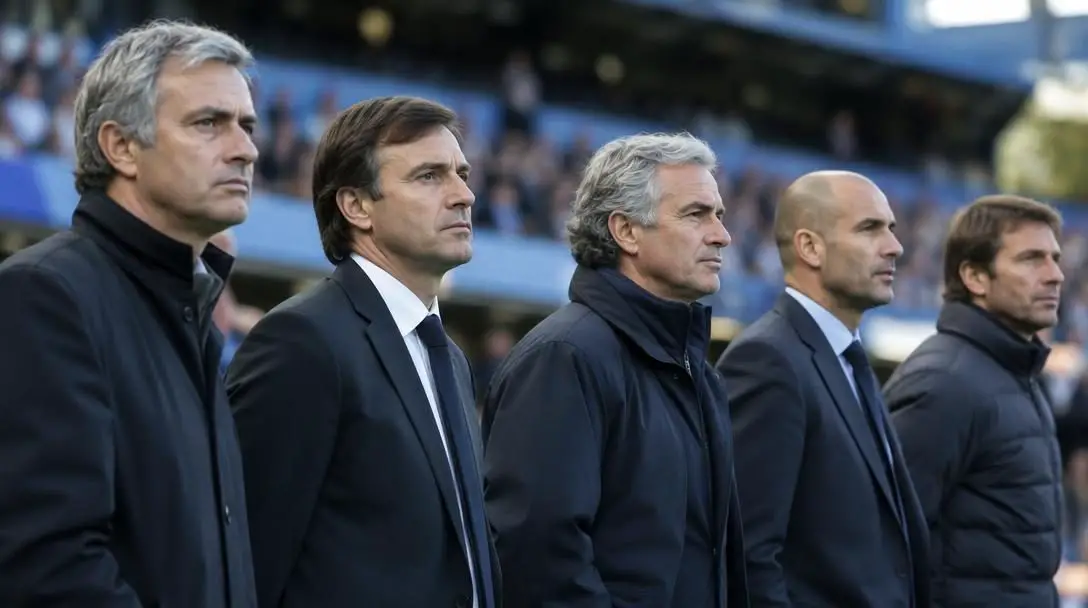
Surviving for hundreds of fixtures while sustaining a win rate above 60 percent is a rare achievement inside a club culture that demands immediate and continuous dominance.
The Chelsea technical area: Turnover and expectations
To truly appreciate the accomplishments of these five tacticians, one must examine the high-stakes environment governing Stamford Bridge. While all European powerhouses operate under intense public scrutiny, Chelsea built a distinct reputation for maintaining an uncompromising standard. Long-term developmental patience has historically taken a back seat to tangible, immediate silverware.
Because Chelsea competes for the Premier League and continental honours on an annual basis, every competition carries the expectation of a deep tournament run. Whenever squad form falters, ownership has routinely acted with swift executive decisiveness. This rapid-turnover atmosphere makes the consistency of Mourinho, Conte, Ancelotti, Sexton, and Ranieri even more remarkable, as each managed to construct tactical identities that withstood the immense pressures of the dugout.
Deconstructing managerial success at the elite level
Assessing what separates good coaches from legendary managers requires balancing statistical output against tangible silverware and cultural impact. The five leaders highlighted here excelled across distinct dimensions of managerial performance:
- Win rate and statistical dominance: Maintaining high winning percentages confirms a manager's ability to dispatch weaker opposition while taking points off direct title contenders. Conte's 65 percent, Ancelotti's 61 percent, and Mourinho's opening tenure reflect the absolute pinnacle of performance.
- Silverware conversion: Turning league victories into trophies separates great tacticians from historic champions. Premier League titles, FA Cups, and European Cup Winners' Cups permanently define a coach's legacy.
- Squad longevity under pressure: Handling relentless fixtures across multiple competitions tests a manager's tactical adaptability. Dave Sexton overseeing 371 matches across seven continuous years represents a standard of durability unlikely to be matched in the modern era.
- Structural foundation building: Certain managers leave behind rosters capable of sustained dominance. Claudio Ranieri’s steady hand across 199 fixtures stabilized the club's sporting infrastructure during a pivotal period of expansion.
How to objectively compare football managers across eras
Comparing tactical performance across different decades requires a structured, multi-step analytical methodology rather than relying on gut feelings or recency bias. Analysts can apply the following framework to assess managers systematically:
- Establish a meaningful fixture threshold: Filter out temporary caretakers or short-term interim managers by establishing a baseline, such as a minimum of 100 matches, to guarantee statistical validity.
- Calculate win, draw, and loss distributions: Examine raw match totals alongside victories and defeats. Evaluating how often a coach avoided defeat provides a clearer view of defensive resilience than evaluating wins alone.
- Weight trophy significance: Classify titles into tiers, distinguishing between elite domestic league titles, primary domestic knockout cups like the FA Cup, continental competitions, and one-off matches like the FA Community Shield.
- Contextualize historical resources: Recognize that tactical, financial, and organizational conditions in the late 1960s under Dave Sexton differed radically from the global commercial environment of the 21st century.
- Evaluate multi-stint tenures independently: When an individual manages a club across multiple separate eras—as Jose Mourinho did—analyze each spell individually before evaluating their combined contribution.
Common pitfalls when evaluating historic managers
Supporters and media commentators frequently fall victim to common evaluation traps when ranking historical managers. Avoiding these recurring errors ensures a balanced historical assessment:
- Dismissing prior eras: Assuming modern managers are fundamentally superior to historic figures ignores the resource limitations of earlier decades. Dave Sexton’s triumphs in the 1970 FA Cup and 1971 European Cup Winners' Cup were groundbreaking feats achieved under vastly different conditions.
- Equating win percentage directly with ranking: A higher winning rate does not automatically eclipse historic silverware. While Antonio Conte recorded a superior win rate of 65 percent compared to Mourinho's career average, Mourinho's collection of three Premier League trophies reflects greater sustained dominance.
- Underestimating trophy-free consistency: Overlooking Claudio Ranieri simply because his tenure lacked major honours ignores the stability provided by his 107 victories and 54 percent win rate over nearly 200 matches.
- Disregarding match volume: Comparing a coach with approximately 100 fixtures directly against one with close to 400 fixtures without qualification can distort reality, as maintaining an elite winning percentage becomes increasingly difficult over extended tenures.
- Fixating on the departure: Because Chelsea leadership has historically parted ways with managers at early signs of regression, it is easy to remember tacticians by their final weeks rather than the championship runs that defined their stay.
Frequently asked questions
Who is the most successful manager in Chelsea history?
Jose Mourinho is widely regarded as the most successful manager in club history, having won three Premier League titles across two stints, alongside three League Cups, the 2007 FA Cup, and an FA Community Shield.
Which Chelsea manager has the highest winning percentage?
Among managers with at least 100 fixtures in charge, Antonio Conte holds the top mark with a 65 percent win rate, followed closely by Carlo Ancelotti at 61 percent, while Jose Mourinho's first spell represents the all-time peak for any individual tenure.
How many matches did Dave Sexton manage for Chelsea?
Dave Sexton directed 371 matches across seven continuous years between 1967 and 1974, recording 164 victories and capturing both the 1970 FA Cup and the 1971 European Cup Winners' Cup.
Did Claudio Ranieri win any major trophies at Chelsea?
No, Claudio Ranieri did not claim major honours during his tenure from 2000 to 2004, but he won 107 of his 199 matches, providing crucial stability and a 54 percent win rate during a key transition era for the club.
What major titles did Carlo Ancelotti win with Chelsea?
Carlo Ancelotti won the 2009 FA Community Shield followed by a historic domestic double in 2010, securing both the Premier League title and the FA Cup in the same season.
The bottom line
Chelsea's rich managerial history illustrates the delicate balance between short-term executive urgency and historic greatness. While the Stamford Bridge technical area has witnessed regular turnover over the decades, managers like Jose Mourinho, Antonio Conte, Carlo Ancelotti, Dave Sexton, and Claudio Ranieri proved that world-class tacticians can leave a permanent footprint on English football. Whether through Sexton's remarkable seven-year stamina, Mourinho's trophy-laden reigns, or the rapid championship triumphs of Ancelotti and Conte, these five leaders set the benchmark against which all future Chelsea managers will inevitably be measured.