5 Best Moments For Real Madrid Fans
Real Madrid stands out as one of the most successful football clubs in all of Europe, defined by decades of elite domestic and continental competition. A massive collection of silverware, unforgettable rivalries, and dramatic matches have cemented the club's reputation on the world stage. Because of this continued dominance, supporters enjoy a deep catalog of historic highlights that span distinct generations, from foundational triumphs to modern masterclasses.
Narrowing down this vast archive into the most defining moments reveals what truly powers the club: ferocious rivalries, record-breaking ambition, an obsession with continental dominance, dazzling individual brilliance, and historic scorelines. These five milestones capture the soul of the club across different eras, highlighting why Real Madrid remains a peerless powerhouse in global football.
Key takeaways
- Real Madrid established early continental dominance in the 1950s and 1960s before embarking on major modern revival periods.
- Iconic El Clásico fixtures against FC Barcelona have provided both massive psychological turning points and record-setting blowout victories.
- Historic acquisitions, headlined by Cristiano Ronaldo in 2009, transformed record transfer fees into unparalleled silverware and individual accolades.
- Championship breakthroughs like La Décima in 2014 and Zinedine Zidane's 2002 volley demonstrate the club's relentless pursuit of the European Cup.
At a glance: Five landmark moments
Each milestone highlights a different facet of the club's identity, from historic transfers and tactical turnarounds to breathtaking goals and lopsided scorelines.
| Moment | Year | Key figures | Significance |
|---|---|---|---|
| Raúl silences the Camp Nou | 1999 | Raúl, Rivaldo, Luís Figo | Ended a three-year winless drought against Barcelona with an iconic 2-2 draw. |
| The signing of Cristiano Ronaldo | 2009 | Cristiano Ronaldo | A world-record €94 million deal that yielded four Champions League trophies and four Ballon d'Or awards. |
| The triumph of La Décima | 2014 | Marcelo, Cristiano Ronaldo | Ended a 12-year European title drought with an emphatic 4-1 extra-time final victory. |
| Zinedine Zidane's 2002 volley | 2002 | Zinedine Zidane, Raúl | Secured the club's ninth European title courtesy of one of football's greatest goals. |
| The historic 11-1 Clásico rout | 1943 | Sabino Barinaga, Pruden, Chus Alonso | The largest margin of victory ever recorded in the history of the El Clásico rivalry. |
The historical foundation of a continental titan
To understand the weight of these peak moments, one must view them through the timeline of Real Madrid's European trajectory. When the European Cup was originally formed in the mid-1950s, it established the benchmark for continental supremacy. Real Madrid took full control right from the start, utterly dominating European football throughout the 1950s before adding further continental crowns during the 1960s.
Following that initial golden age, the team encountered an extended dry spell. Throughout the 1970s and 1980s, Real Madrid failed to capture the European crown. The long-awaited revival arrived in the late 1990s and early 2000s, when the club captured Champions League titles in 1998, 2000, and 2002. That quick succession of trophies ignited a single-minded obsession among supporters and executives: the chase for an elusive tenth European Cup, universally celebrated as La Décima. Alongside this European quest, the club engaged in an unrelenting domestic battle with FC Barcelona in El Clásico, a fixture that has long dictated the emotional pulse of Spanish football.
Real Madrid's identity has always been forged in the balance between domestic pride in El Clásico and an obsession with European dominance.
The five greatest moments for Real Madrid supporters
Raúl Silences the Camp Nou

- Date: October 13, 1999
- Opponent: FC Barcelona
- Venue: Camp Nou
- Final outcome: 2-2 draw
Matches against Barcelona carry an intense significance that transcends routine league standings, and on October 13, 1999, the stakes were extraordinarily high. Real Madrid arrived at the Camp Nou mired in a grim stretch of form against their primary rivals, having failed to defeat Barcelona in nearly three full years. Their prior encounter had ended in an embarrassing 3-0 defeat, leaving Madridistas desperate for a show of resolve.
Real Madrid drew first blood when Raúl struck in the 26th minute to seize a 1-0 advantage. Barcelona responded immediately, with Rivaldo equalizing just two minutes later in the 28th minute. In the second half, Luís Figo scored in the 49th minute to put the home team ahead, forcing Real Madrid to scramble for an answer as the clock ticked away in front of a hostile Catalan crowd.
The turning point arrived in the 86th minute. Raúl broke through Barcelona's defense to score his second goal of the evening, bringing the score to 2-2. Instead of celebrating conventionally, Raúl pressed his index finger to his lips, instantly silencing the stunned stadium. While the match finished in a draw, the gesture signaled a massive psychological shift. The newfound momentum carried forward into their very next encounter, where Real Madrid soundly beat Barcelona 3-0.
The Landmark Signing of Cristiano Ronaldo
- Year: 2009
- Transfer fee: €94 million
- Contract value: €11 million per year
- Major trophies won: Four Champions League titles, two La Liga titles
As one of the richest football institutions on the planet, Real Madrid has always had the resources to lure elite players. Yet acquiring Portuguese forward Cristiano Ronaldo in the summer of 2009 went beyond standard transfer business. Ronaldo had made his professional debut for Sporting CP in 2002 before joining Manchester United in 2003, spending six years in England evolving from an exciting prospect into a world-class superstar.
Real Madrid committed an unprecedented world-record transfer fee of €94 million to sign him, pairing it with an annual contract worth €11 million. While critics questioned the colossal financial commitment, Ronaldo repaid the club by anchoring one of the most prolific eras in sporting history. Over the course of his stay, he delivered:
- Two La Liga championships
- Two Copa del Rey titles
- Four UEFA Champions League trophies within a five-year span
- Four individual Ballon d'Or awards as a Madrid player
Rather than an overpriced gamble, the purchase established a blueprint for high-return superstar acquisitions and permanently reshaped the modern football landscape.
The Long Pursuit and Triumph of La Décima
- Year: 2014
- Final score: 4-1 (after extra time)
- Opponent: Atlético Madrid
- Key knockout wins: Schalke 04, Borussia Dortmund, Bayern Munich
Ever since the European Cup began in the 1950s, winning the trophy ten times stood as an almost mythical milestone. Following continental titles in 1998, 2000, and 2002, Real Madrid spent over a decade chasing that tenth star. A grueling twelve-year wait ensued before the club finally broke through back to the tournament final during the 2013-14 campaign.
The road to Lisbon was intensely demanding. Real Madrid navigated a brutal German gauntlet during the knockout phase, systematically dispatching Schalke 04, Borussia Dortmund, and reigning champions Bayern Munich in consecutive rounds. The final itself stretched the team to its absolute physical limits, pushing the contest into extra time after a grueling ninety minutes.
In extra time, Real Madrid found another gear. A go-ahead strike in the 110th minute broke the deadlock to make it 2-1, unleashing irresistible momentum. Marcelo sealed the result with a clinical goal in the 118th minute to extend the lead to 3-1, and Cristiano Ronaldo punctuated the victory by converting a penalty kick in that very same 118th minute. The 4-1 extra-time win finally delivered the long-coveted La Décima, lifting an enormous psychological weight off the entire organization.
Zinedine Zidane's Masterpiece in 2002
- Year: 2002
- Opponent: Bayer Leverkusen
- Final score: 2-1
- Venue: Hampden Park, Glasgow
Before the heroics of 2014, the 2001-02 European campaign served as Real Madrid's crowning modern achievement. The team cruised through the competition's group stages, brushing past Roma, Lokomotiv Moscow, and Anderlecht with ease before navigating the second group phase just as comfortably. The knockout rounds brought immense tests against continental heavyweights Bayern Munich and domestic rivals Barcelona, but Madrid eliminated both to punch their ticket to Glasgow against German side Bayer Leverkusen.
The final exploded into action early. Raúl slipped a goal past the goalkeeper in the eighth minute to give Real Madrid an initial 1-0 advantage. However, Bayer Leverkusen struck back just six minutes later to tie the match at 1-1. With the German club playing with high energy, the contest hung precariously in the balance as halftime approached.
On the stroke of the interval, Zinedine Zidane produced an immortal piece of athletic artistry. Tracking an awkward, looping cross as it fell out of the sky, the French playmaker swiveled his body and struck a left-footed volley flush into the upper corner of the net. The breathtaking strike deflated Bayer Leverkusen entirely. Real Madrid defended their 2-1 advantage throughout a scoreless second half, sealing the club's ninth European Cup.
The Historic 11-1 Clásico Victory
- Year: 1943
- Tournament: Copa del Generalísimo semifinals
- Venue: Estadio Chamartín
- Scorers: Barinaga (4), Pruden (3), Alonso (2), Alsua (1), Botella (1)
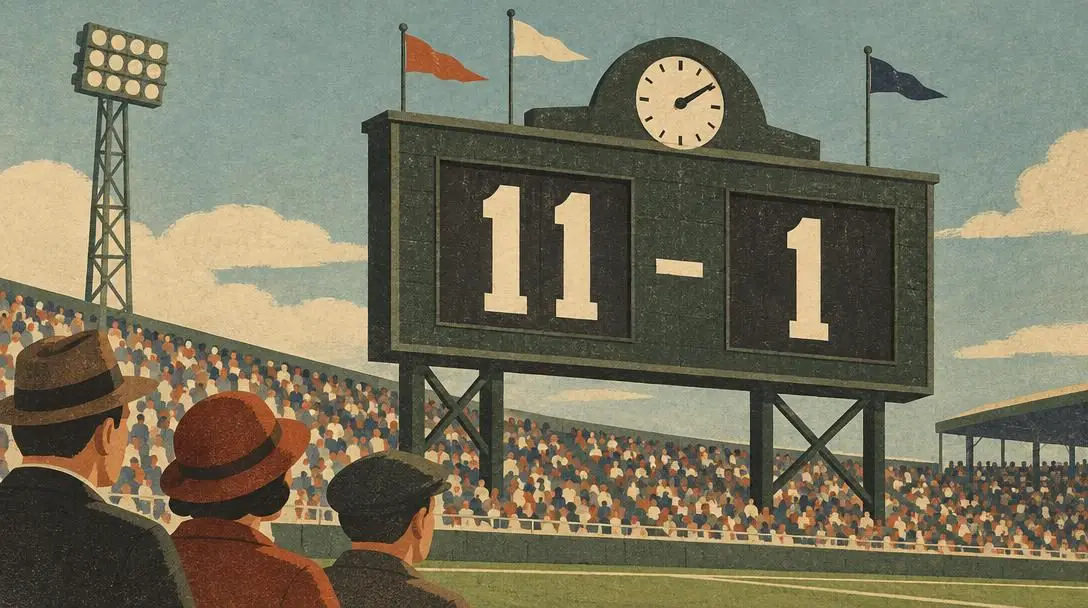
The most statistically shocking chapter in the Real Madrid-Barcelona rivalry occurred during the 1943 Copa del Generalísimo semifinals. Hosted at the Estadio Chamartín, the match produced a ten-goal differential that remains completely untouched in the history of Spanish football. Real Madrid overwhelmed their rivals from the opening kick, while Barcelona failed to register a response until an 89th-minute consolation goal.
Real Madrid's forward line delivered a relentless display of finishing. Sabino Barinaga spearheaded the rout by finding the back of the net four separate times. Striker Pruden tore through the Catalan defense with a first-half hattrick, while Chus Alonso added two goals to balloon the scoreline. Antonio Alsua and Pascual Botella scored one goal apiece to round out the historic tally. The final 11-1 result stands as the largest margin of victory in El Clásico history, giving Madridistas an untouchable historical record.
How to study and understand Real Madrid's history
Navigating nearly a century of elite sporting achievements can feel overwhelming for newcomers. To truly grasp the club's evolution, follow these systematic steps:
- Review the European milestones: Map out the early European Cup triumphs in the 1950s and 1960s, followed by the modern titles in 1998, 2000, 2002, and 2014. Tracking this trajectory explains why continental glory carries sacred status among fans.
- Examine the El Clásico timeline: Investigate pivotal clashes against Barcelona. Studying fixtures like the 1943 11-1 rout and Raúl's 1999 Camp Nou equalizer illustrates how domestic momentum ebbs and flows between the two Spanish titans.
- Analyze key individual careers: Trace the tenures of transformative figures such as Raúl, Zinedine Zidane, and Cristiano Ronaldo to see how individual greatness matched club ambitions.
- Track distinct trophy eras: Organize Real Madrid's background into defined blocks: the mid-century dynasty, the domestic lull of the 1970s and 1980s, the turn-of-the-century revival, and the dominant Champions League runs of the 2010s.
Common mistakes when evaluating Real Madrid's past
Because Real Madrid commands massive international media attention, casual discussions often fall victim to recurring misconceptions. Enthusiasts should avoid these common analytical errors:
- Overlooking the significance of draws: Assuming only victories count as historic moments ignores tactical and psychological reality. Raúl's 1999 celebration at the Camp Nou earned a 2-2 draw, yet it broke a three-year mental barrier and paved the way for an immediate 3-0 win in their next fixture.
- Assuming continuous continental dominance: Real Madrid has won more European titles than any peer, but their dominance was not uninterrupted. They endured severe continental droughts through the 1970s and 1980s, making the titles in 1998, 2000, and 2002 all the more essential to rebuilding their brand.
- Viewing high transfer fees strictly as overpayments: Critics initially questioned the €94 million outlay for Cristiano Ronaldo in 2009. However, evaluating elite transfers purely on upfront cost overlooks the subsequent return: four Champions League titles, two league championships, and four Ballon d'Or awards.
- Neglecting early domestic milestones: Modern supporters frequently focus only on Champions League footage from the color broadcast era. Forgetting mid-century domestic clashes like the 1943 11-1 victory strips away the historic foundation of Spanish football.
Frequently asked questions
Why is Raúl's goal celebration against Barcelona in 1999 so famous?
Raúl's 86th-minute equalizer secured a 2-2 draw after Real Madrid had gone nearly three full years without beating Barcelona. Putting his finger to his lips directly silenced a hostile Camp Nou crowd and shifted the competitive momentum in Madrid's favor ahead of a 3-0 victory in their next meeting.
How many Champions League titles did Cristiano Ronaldo win with Real Madrid?
Cristiano Ronaldo won four UEFA Champions League trophies during his tenure with Real Madrid, all secured within an extraordinary five-year span following his record transfer from Manchester United.
What made Real Madrid's 2014 Champions League victory, La Décima, so special?
Winning La Décima represented Real Madrid's tenth European Cup title, an achievement the club had pursued through a twelve-year drought following their 2002 victory. The triumph culminated in a dramatic 4-1 extra-time win over rivals Atlético Madrid.
Who scored Real Madrid's winning goal in the 2002 Champions League final?
Zinedine Zidane scored the winning goal against Bayer Leverkusen just before halftime, striking an airborne volley from the edge of the penalty box that is widely regarded as one of the greatest goals ever scored in a football final.
What was the largest margin of victory in El Clásico history?
The largest margin of victory belongs to Real Madrid's 11-1 demolition of Barcelona during the 1943 Copa del Generalísimo semifinals, featuring four goals from Sabino Barinaga and a first-half hattrick from Pruden.
The bottom line
Real Madrid's storied legacy is not built on routine victories; it is constructed on dramatic, high-leverage statements delivered across generations. From Sabino Barinaga's four goals in 1943 to Raúl's silencing of the Camp Nou in 1999, Zinedine Zidane's sublime volley in Glasgow, Cristiano Ronaldo's generational transfer, and the cathartic glory of La Décima in 2014, these milestones reflect the standard of excellence that continues to define the world's most decorated football club.