5 Best Players In Real Madrid History
Real Madrid stands apart as an institution defined by relentless triumph, accumulating an overwhelming collection of silverware across more than a century of top-flight football. Because world-class competitors have donned the iconic white kit in virtually every decade, isolating the single most influential figures in the club's history is an extraordinarily demanding undertaking.
Generations of fans have witnessed monumental icons drive the team to domestic and European supremacy. While legendary contributors like Zinedine Zidane, Ferenc Puskas, Paco Gento, Manuel Sanchis, and Amancio built immortal legacies in the Spanish capital, an elite top five represents the pinnacle of sustained individual mastery, longevity, and championship impact.
Key takeaways
- Cristiano Ronaldo remains Real Madrid's all-time leading goalscorer with 450 goals, averaging more than one goal per match.
- Raul holds the absolute club record for appearances with 741 total fixtures, followed closely by goalkeeper Iker Casillas at 725.
- Alfredo Di Stefano established the team's global pedigree during its initial golden age, winning five consecutive European Cups and eight domestic league titles.
- Karim Benzema evolved into the club's second-highest scorer in history, capturing five Champions League trophies and the 2022 Ballon d'Or at age 34.
- Narrowing down historic talent requires balancing individual statistics, era-specific competition formats, silverware collections, and overall longevity.
The five greatest footballers in Real Madrid history
Evaluating players across different football eras requires looking past surface-level changes in tactics and training. The five players below did more than accumulate statistics; they defined eras, altered expectations, and secured the most celebrated trophies in world sport.
| Player | Madrid Era | Record Appearances | Total Goals | Signature Achievements |
|---|---|---|---|---|
| Cristiano Ronaldo | 2009–2018 | 438 matches | 450 goals | 4 Ballon d'Or wins at Madrid, all-time scoring leader |
| Alfredo Di Stefano | 1953–1964 | 11 seasons | Cornerstone scorer | 5 European Cups, 8 league titles, Super Ballon d'Or |
| Iker Casillas | 1999–2015 | 725 matches | N/A (Goalkeeper) | 3 Champions League titles, 2x La Liga Best Goalkeeper |
| Raul | 1994–2010 | 741 matches | 323 goals | Club record appearances, 3rd all-time top scorer |
| Karim Benzema | 2009–2020s | Over a decade | Second all-time | 5 Champions League titles, 2022 Ballon d'Or winner |
Karim Benzema

- Tenure: 2009 to 2023
- Major Trophies: 5 Champions Leagues, 4 La Ligas, 2 Copas del Rey
- Club Goal Rank: Second all-time
- Top Individual Accolade: 2022 Ballon d'Or
French striker Karim Benzema arrived at the Santiago Bernabeu in the summer of 2009 following an impressive start with Lyon in his native country. Over an extraordinary stay lasting well over a decade, Benzema transitioned from an unselfish supporting forward into the focal point of the club's devastating frontline attack. Rather than declining with age, his creative vision and finishing instincts noticeably sharpened after he turned 30.
During his lengthy tenure, Benzema collected an immense list of club honours, headlined by five UEFA Champions League trophies, four La Liga championships, and two Copa del Rey titles. His personal pinnacle came in 2022 when he was awarded the prestigious Ballon d'Or at 34 years of age. That historic win established him as one of the oldest recipients ever to claim the honour, trailing only Stanley Matthews, who secured the trophy at 41. By the time he completed his Madrid journey, Benzema sat firmly at second on the club's all-time scoring list.
Raul
- Tenure: 1994 to 2010
- Club Appearance Record: 741 matches
- La Liga Appearances: 550 matches
- Career Club Goals: 323 goals
Known universally as simply Raul, Raul Gonzalez Blanco served as the standard-bearer for Real Madrid across two unforgettable decades. Entering the club's youth academy in the early 1990s, he advanced through the ranks at a blistering pace and earned his senior debut in 1994. From that initial breakthrough until his departure in 2010, Raul embodied the determination, work ethic, and leadership demanded by the Madrid faithful.
Raul sits atop the team's historical ledger with an astonishing 741 total competitive matches played, including 550 appearances in domestic league competition. Beyond his unmatched presence on matchday sheets, he was a ruthless attacker in front of goal, finding the net 323 times in white. That scoring total places him third on the club's historic scoring leaderboard. Following his iconic spell in Spain, Raul continued his career with Schalke 04, Al Sadd, and the New York Cosmos before hanging up his boots in 2015.
Iker Casillas

- Tenure: 1999 to 2015
- Club Appearance Record: 725 matches (second all-time)
- Major Trophies: 5 La Ligas, 3 Champions Leagues, 2 Copas del Rey
- Individual Honours: Two-time La Liga Best Goalkeeper
Born and raised in the Spanish capital, Iker Casillas stands as the undisputed greatest goalkeeper in Real Madrid history. After spending almost ten years honing his reflexes within the club's youth pipeline, Casillas stepped into the senior spotlight in 1999. He remained the team's primary goalkeeper for 16 consecutive seasons, protecting the net during multiple eras of domestic and European reinvention before closing his playing days with five campaigns at Porto.
Casillas anchored squads that claimed five La Liga championships, two Copa del Rey titles, and three UEFA Champions League trophies. Renowned for acrobatic shot-stopping in sudden, high-leverage moments, he twice claimed the award for La Liga Best Goalkeeper. His remarkable durability saw him take the pitch 725 times across all competitions, a mark that trails only his long-time teammate Raul on the club's historical leaderboard.
Alfredo Di Stefano
- Tenure: 1953 to 1964
- European Honours: 5 European Cups
- Domestic Honours: 8 league championships
- Unique Honour: 1989 Super Ballon d'Or
While modern audiences often emphasize recent stars, Alfredo Di Stefano laid the concrete foundation upon which the club's global stature was built. After competing for eight seasons across South America following World War II, the Argentine maestro moved to Spain to sign with Madrid in 1953. Over the next 11 seasons, Di Stefano operated as the complete tactical engine of the squad, dictating tempos from deep while scoring prolifically up front before finishing his career at Espanyol.
With Di Stefano directing the pitch, the team captured eight domestic league championships between 1954 and 1964, alongside five consecutive European Cup victories. His individual dominance earned him two standard Ballon d'Or awards. Decades later, in 1989, football authorities awarded him the Super Ballon d'Or—a one-of-a-kind trophy minted to celebrate the single best player across the combined span of the 1960s, 1970s, and 1980s.
Cristiano Ronaldo

- Tenure: 2009 to 2018
- Club Record Goals: 450 goals
- Scoring Rate: Greater than 1.0 goals per match
- Madrid Ballon d'Or Trophies: 4 awards
Occupying the peak of the ranking is Portuguese phenomenon Cristiano Ronaldo, whose stay in Madrid established unprecedented benchmarks for athletic efficiency. After developing at Sporting CP and competing for six campaigns at Manchester United, Ronaldo signed with Real Madrid in 2009. Over the subsequent nine years, he spent his physical prime breaking scoring barriers before embarking on a new challenge with Juventus in 2018.
Ronaldo's numbers defy conventional football logic: he amassed 450 competitive goals in Madrid, finishing more than 100 goals clear of every other player in the team's century-long ledger. Crucially, he sustained a scoring average exceeding one goal per game throughout his entire Madrid career. While capturing two La Liga crowns alongside multiple continental titles, Ronaldo won four of his Ballon d'Or trophies wearing the Madrid shirt, cementing his place as the ultimate offensive weapon in club history.
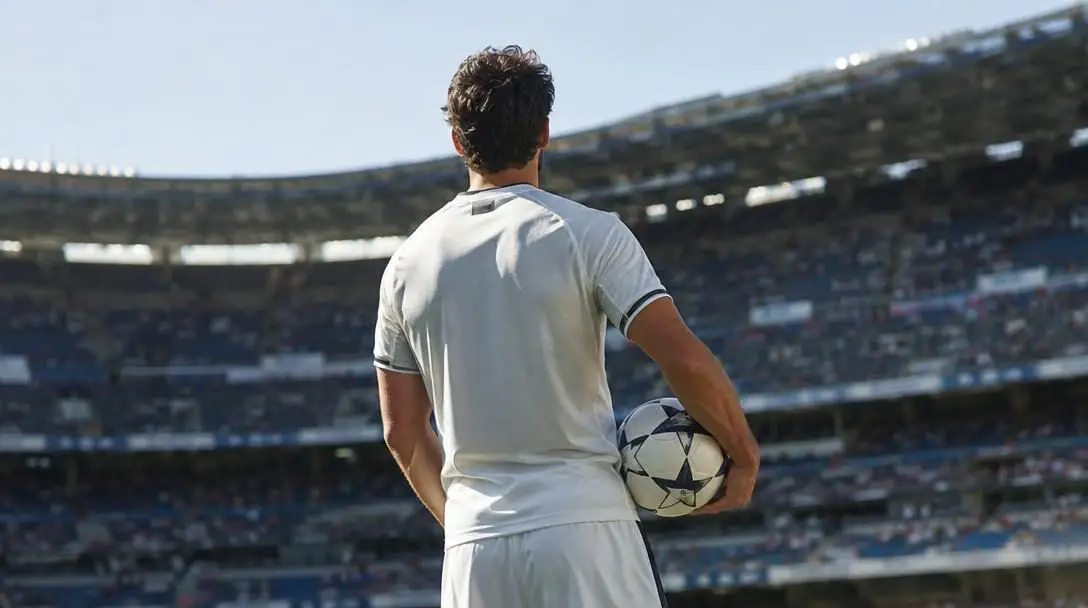
Sustaining a goal-per-game scoring average over nearly a decade elevated Cristiano Ronaldo to an uncontested position at the summit of modern football history.
How historical player rankings are calculated
Building an objective hierarchy across disparate decades requires balancing four crucial pillars. Without comparing players across these distinct areas, comparisons quickly dissolve into subjective preference.
- Longevity and appearance milestones: Remaining first-choice at an elite institution over ten to fifteen seasons requires exceptional fitness, mental toughness, and adaptability through managerial changes.
- Scoring and defensive metrics: Strikers are judged by raw output and scoring efficiency per minute, whereas defensive players and goalkeepers are weighed by clean sheets, stability, and crucial match-winning interventions.
- Silverware volume: The primary purpose of elite football is lifting silverware; continental tournaments like the European Cup or Champions League carry the highest degree of difficulty.
- Individual global accolades: Trophies such as the Ballon d'Or, continental golden boots, and domestic positional awards verify how an athlete was judged by his contemporaries.
Practical steps for researching historical footballers
Supporters and students of the game seeking to verify the historic contributions of football legends can follow a structured research pathway to avoid common historical misunderstandings.
- Examine official club record books: Check authentic team registries to determine baseline numbers for overall match appearances, total goals scored, and championship rosters.
- Contextualize different eras: Adjust for shifting formats, noting that the modern UEFA Champions League features far more group matches than the straight knockout rounds of the original European Cup.
- Trace entire career trajectories: Review where players developed before arriving in Madrid and where they competed after leaving, clarifying how their peak seasons aligned with their Spanish tenure.
- Compare individual vs. team success: Determine whether an athlete put up impressive statistical figures during barren periods or actively drove their squad to continuous domestic and international dominance.
Common mistakes when comparing football eras
When sports debates turn to all-time lists, analysts frequently commit systematic errors that distort historical reality. Avoiding these pitfalls produces a far more rigorous evaluation.
- Falling victim to recency bias: Modern fans have access to instantaneous, crystal-clear video highlights, which can cause them to dismiss early pioneers like Alfredo Di Stefano whose full matches were rarely preserved on high-definition film.
- Ignoring positional value: Forwards naturally generate the most eye-catching statistics, but evaluating a goalkeeper like Iker Casillas strictly against goalscorers overlooks the defensive discipline necessary to win championships.
- Overlooking late-career development: Conventional wisdom suggests players hit a steep decline at age thirty, but veterans like Karim Benzema demonstrate that tactical understanding can lead to career-best form well into an athlete's mid-thirties.
- Dismissing players due to their departures: Great players routinely conclude their playing careers at other organizations; seeing legends wear different colours late in life does not diminish their defining contributions in Madrid.
What to consider next when studying Real Madrid
Examining the top five footballers provides an entry point into the deeper historical fabric of the world's most successful club. Those interested in broadening their understanding should investigate several adjacent topics.
Foremost among these is the cohort of legends who narrowly missed the top tier. Players like Paco Gento—the only player to win six European Cups—alongside Ferenc Puskas, Zinedine Zidane, Manuel Sanchis, and Amancio, all captained or transformed championship squads. Exploring how the youth academy operates offers another vital perspective, showing how domestic players like Raul and Casillas were nurtured to balance the big-money international signings typified by Ronaldo and Benzema.
Frequently asked questions
Who is the all-time leading goalscorer in Real Madrid history?
Cristiano Ronaldo holds the all-time scoring record for Real Madrid, having scored 450 goals in 438 competitive matches between 2009 and 2018, averaging more than one goal per appearance.
Which player has made the most appearances for Real Madrid?
Raul holds the record for the most appearances in club history, taking the pitch 741 times across all competitions between 1994 and 2010, including 550 appearances in La Liga.
What is the Super Ballon d'Or won by Alfredo Di Stefano?
The Super Ballon d'Or was a special award presented only once, in 1989, to honour Alfredo Di Stefano as the single greatest European-based footballer across the combined span of the 1960s, 1970s, and 1980s.
How old was Karim Benzema when he won the Ballon d'Or?
Karim Benzema was 34 years old when he won the Ballon d'Or in 2022, making him one of the oldest recipients in the award's history, second only to Stanley Matthews, who won it at age 41.
Did Iker Casillas spend his entire professional career at Real Madrid?
No, while Casillas spent 16 years as Madrid's primary goalkeeper after coming through the youth academy, he concluded his professional career by playing five seasons for the Portuguese club Porto.
The bottom line
Establishing the definitive top five players in Real Madrid history requires honouring distinct eras of greatness. From Alfredo Di Stefano's foundational leadership in the 1950s to the homegrown loyalty of Raul and Iker Casillas, and onward to the record-shattering scoring feats of Karim Benzema and Cristiano Ronaldo, these icons set the standard for football excellence that continues to define the club today.