5 Best Scorers in Football History
Football is fundamentally a low-scoring sport that functions like a high-stakes tactical chess match. Across ninety minutes of intense competition, defensive structures, strategic positioning, and physical endurance work in harmony to minimize mistakes and deny space. Because genuine scoring opportunities are so rare, a single converted chance routinely dictates the outcome of an entire fixture. A squad can command possession, dictate tempo, and control territory, yet still walk away without a result if they lack an attacker who can finish reliably inside the penalty area.
Because finding the back of the net is such a demanding feat, amassing hundreds of goals across a professional career stands as one of the hardest achievements in world athletics. An elite finisher alters an opponent's entire tactical preparation, forces defensive lines to drop deeper, and can snatch victory even when their team is thoroughly outplayed. Determining the greatest goal scorers in football history means looking beyond raw numbers to weigh technical quality, adaptability across domestic and international play, and sustained dominance across different eras.
Key takeaways
- Consistent goal scorers are football's most decisive asset because individual conversions frequently outweigh broad statistical advantages like possession and territory.
- Cristiano Ronaldo and Lionel Messi lead the modern era in total career goals, combining unprecedented longevity with high-efficiency finishing across top-flight leagues and international play.
- Historical icons like Ferenc Puskas, Josef Bican, and Pele established scoring rates exceeding a goal per match despite shorter schedules and different competitive structures.
- Elite goal scoring relies on a synchronized balance of off-the-ball anticipation, mechanical versatility with both feet and the head, and psychological composure under extreme defensive pressure.
At a glance: Comparing the greatest goal scorers
Comparing attacking output across disparate generations requires tracking both domestic dominance and international consistency. The table below outlines how the game's top five finishers compare based on their recorded career milestones and key club tenures.
| Player | Primary Clubs | Career Goal Milestones | Distinctive Scoring Profile |
|---|---|---|---|
| Ferenc Puskas | Budapest Honved, Real Madrid | 729 career goals; 84 international goals in 85 caps | Unmatched conversion rate across Hungary and Spain with over a goal per game for Honved |
| Josef Bican | Slavia Prague, FC Vitkovice, Dynamo Prague | 427 goals in 221 games for Slavia Prague | Blistering sprinting speed coupled with an average approaching two goals per match in Prague |
| Pele | Santos, New York Cosmos | 762 official career goals; 606 league goals in 647 matches | Remarkable efficiency across a compressed 20-year career with 77 goals in 92 Brazil caps |
| Cristiano Ronaldo | Manchester United, Real Madrid, Juventus | More than 820 career goals; nearly 120 international goals | All-time leader in world career goals and continental competition with exceptional physical versatility |
| Lionel Messi | FC Barcelona, Paris Saint-Germain | 474 league goals for Barcelona; approximately 100 international goals | Second all-time in career goals with superior match-to-goal efficiency, balance, and deceptive dribbling |
Profiles of the top 5 goal scorers
These five forwards set the benchmark for attacking excellence in world football. Through prolonged excellence at both domestic and international levels, they elevated goal scoring from a tactical duty into an art form.
Ferenc Puskas
- Career Goals: 729 across all competitions
- Key Clubs: Budapest Honved, Real Madrid
- International Record: 84 goals in 85 matches for Hungary
Ferenc Puskas was the driving force behind Hungary's emergence as an international football power following World War II, captivating global audiences with his extraordinary technique. Puskas spent the first 13 seasons of his senior career with Budapest Honved, where he recorded a staggering 358 goals in just 350 domestic appearances. His production established a pace of more than one goal per match that seemed impossible to replicate abroad.
However, when he transitioned to Spanish football to join Real Madrid for an eight-year stint, Puskas proved that his attacking instincts were universal. Facing the premier defenders on the European continent, he registered 156 goals in 180 matches for the Spanish giants. When combined with his international record of 84 goals in 85 caps for Hungary, Puskas concluded his career with 729 goals across all official competitions—a total achieved despite participating in far fewer continental games than modern players enjoy today.
Josef Bican
- Slavia Prague Record: 427 goals in 221 league matches
- Debut Year: 1931 with Farbenlutz
- Key Clubs: Slavia Prague, FC Vitkovice, Dynamo Prague
Born in Vienna, Josef Bican entered senior professional football in 1931 with Farbenlutz before playing for several Austrian sides and ultimately joining Slavia Prague, where he spent roughly a decade. Bican's scoring rate in the Czechoslovakian league remains one of the most remarkable statistical anomalies in sporting history. In league play for Slavia Prague, he scored 427 goals in just 221 games, producing a scoring rate that hovered near two goals per contest.
Even after leaving Slavia Prague in 1948, Bican continued to outclass back lines while representing FC Vitkovice and Dynamo Prague, routinely averaging well beyond a goal per appearance. Renowned as the fastest footballer of his generation, his pace allowed him to run behind defensive lines before defenders could react. While he ranks just outside the top five in total career volume due to the restricted calendar of his era, had he played the fixture density of modern football, his overall tally might sit atop the record books.
Pele
- Official Career Goals: 762 goals (third all-time)
- League Production: 606 goals in 647 appearances
- International Tally: 77 goals in 92 caps for Brazil
Widely regarded as a global ambassador for the sport, Brazilian attacker Pele transformed how attacking play was perceived worldwide. He spent the vast majority of his playing days leading Santos in Brazil, turning the club into an international touring powerhouse, before finishing his competitive career in the United States with the New York Cosmos. Across his domestic league career, Pele found the back of the net 606 times in 647 competitive outings.

On the international stage, Pele was equally lethal, recording 77 goals in 92 caps for Brazil. With 762 official goals across his career, he holds third place on the all-time scoring list. What makes Pele's statistical footprint especially remarkable is his rate of accumulation: while other historical contemporaries required 23 to 25 seasons to compile their career records, Pele completed his entire haul within an intense 20-year span.
A single converted chance often decides the outcome of a match, making an elite finisher the most decisive element a squad can possess.
Cristiano Ronaldo
- Career Goals: Over 820 (all-time world leader)
- Key Clubs: Manchester United, Real Madrid, Juventus
- International Record: Nearly 120 goals for Portugal
In the modern era, Portuguese forward Cristiano Ronaldo has come to represent ultimate physical preparation, athletic durability, and ruthless conversion efficiency. Ronaldo forged his club standing across legendary runs with Manchester United, Real Madrid, and Juventus, while serving as the focal point of the Portuguese national team for two decades. During his time in Spain with Real Madrid, he maintained a strike rate higher than a goal per match across all competitions.
Ronaldo occupies first place on the all-time scoring charts with more than 820 career goals, alongside holding the scoring record in continental club competitions and amassing nearly 120 senior goals for Portugal. His scoring style is defined by versatility. Rather than relying on a single method, Ronaldo beats goalkeepers with driven strikes from either foot, sudden changes of pace, direct set-pieces, and an extraordinary aerial leap that allows him to out-jump central defenders inside the six-yard box.
Lionel Messi
- Barcelona League Record: 474 goals
- All-Time Position: Second all-time in career goals
- International Tally: Approximately 100 goals for Argentina
Argentine forward Lionel Messi provides a contrasting, highly technical model of goal-scoring perfection. Messi spent the overwhelming majority of his senior career operating at FC Barcelona, where he notched an astonishing 474 domestic league goals before signing with Paris Saint-Germain. For the Argentine national side, he has reached approximately 100 goals across competitive and friendly fixtures.
Holding the second spot on the all-time career list just behind Cristiano Ronaldo, Messi has maintained close proximity to the summit despite playing in fewer overall matches throughout his career. Rather than overpowering defenders, Messi relies on low center of gravity, rapid deceleration, and pinpoint spatial awareness. He unbalances defenders and goalkeepers alike with subtle changes of direction, delicate chip finishes, and curling efforts placed out of reach of diving keepers.
Honorable mentions across eras
Beyond the top five, several historic finishers achieved extraordinary scoring records that served as templates for future generations. These players compiled legendary totals across varied leagues and eras:
- Romario: The Brazilian master of the penalty area whose rapid toe-pokes and quick touches inside tight spaces yielded hundreds of top-tier goals.
- Ferenc Deak: A prolific Hungarian forward of the 1940s who registered astonishing per-game scoring ratios in Central European domestic football.
- Gerd Muller: West Germany's premier penalty-box predator, renowned for his unmatched short-range turning ability and predatory instinct for loose rebounds.
- Jimmy Jones: The Northern Irish striker who dominated his domestic league through relentless scoring consistency over multiple decades.
- Robert Lewandowski: A contemporary Polish center-forward whose positioning, penalty expertise, and two-footed execution have made him a prolific modern striker in European league play.
How elite goal scoring works
Consistent conversion at the highest level of professional football is never an accident. It requires an interplay of cognitive, mechanical, and tactical proficiencies that function simultaneously under severe pressure.
Tactical anticipation forms the foundation of regular finishing. Top-tier goal scorers rarely chase the ball; instead, they read the passing angles and body posture of their midfielders before the ball is kicked. By anticipating where a cross will land or recognizing where an opposing goalkeeper is prone to parrying a save, they reach dangerous spaces seconds before defenders recognize the threat. They continually manipulate the blind spots of opposing center-backs, timing runs to break the offside trap without sacrificing momentum.
Mechanical efficiency ensures that hard-won scoring opportunities are converted into goals. In the penalty area, attackers rarely receive the ball in ideal conditions. Elite finishers can strike cleanly with minimal backlift, which prevents defenders from lunging in to block the shot. They possess the coordination to redirect off-target crosses with their head, chests, or volleys, choosing curling finesse, low driven power, or chipped finishes based on the goalkeeper's positioning.
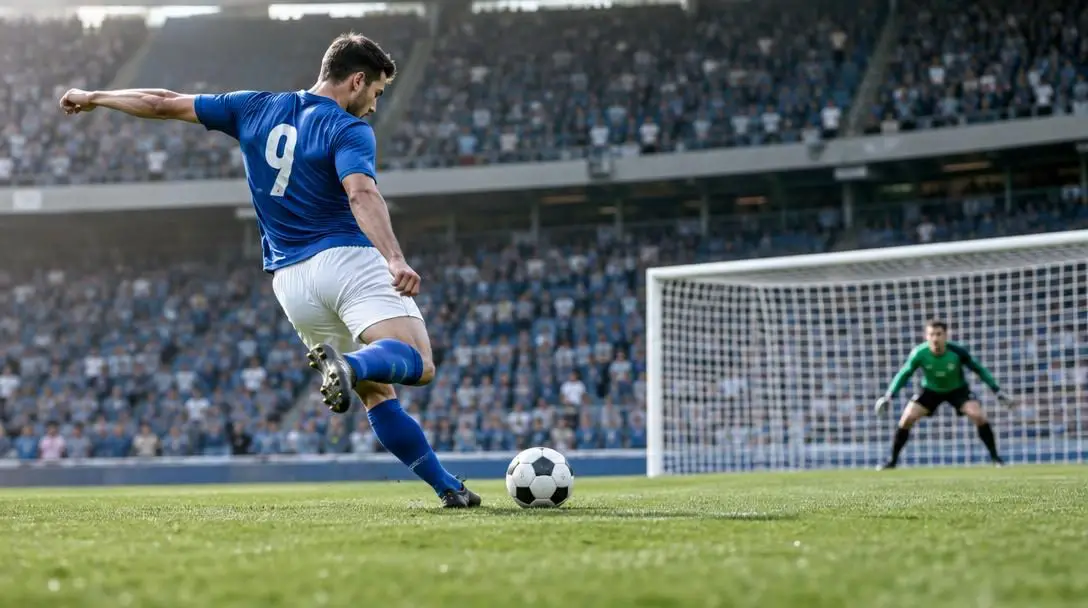
Cognitive composure governs how forwards handle high-stress moments. The eighteen-yard box is crowded and chaotic, with defensive pressure arriving from every angle. Average players rush their shots due to panic, hitting attempts directly at the keeper or off-target. Elite scorers process sensory cues in fractions of a second, remaining relaxed enough to place their shots deliberately into the corners of the net.
Practical steps to develop clinical finishing
Refining attacking technique and instinct requires deliberate, structured repetition. Aspiring forwards can develop their scoring abilities by adopting specific training methods on the practice field:
- Master multi-surface striking: Train extensively to shoot using every surface of both feet, including the laces, instep, and outside of the boot. Eliminating the need to adjust the ball onto a favored foot removes wasted seconds in the box.
- Replicate defensive pressure: Conduct finishing drills with active defenders applying real contact. Uncontested shooting drills create a false sense of security; practicing under physical duress prepares forwards for authentic match conditions.
- Prioritize placement over shot power: Target the side netting and bottom corners during training. Goalkeepers struggle most with low, accurate attempts placed away from their reach, regardless of the ball's travel speed.
- Drill dynamic near-post and far-post runs: Practice varied entry angles into the box. Darting across a center-back toward the near post cuts off defensive clearances, while pulling off toward the back post opens up space for cutback passes.
- Develop a short-term memory: Cultivate psychological resilience after missed chances. High-volume goal scorers miss frequently; maintaining focus ensures an attacker is mentally ready to capitalize on the next opportunity.
Common mistakes in finishing and attacking play
Both developing players and experienced professionals can fall into unproductive habits that lower their goal return. Avoiding these errors is critical for maintaining consistency in front of goal:
- Telegraphing shooting intentions: Taking exaggerated wind-ups or visibly opening up the hips too early gives goalkeepers and sliding defenders ample time to read the shot and make a block.
- Over-relying on brute force: Forwards who try to blast every chance often struggle against disciplined, low-block defenses. Failing to incorporate chips, side-foot placements, and redirected touches limits scoring avenues.
- Remaining stationary in the box: Standing still and waiting for the ball to arrive directly at the feet makes an attacker easy to mark. Stagnant forwards allow central defenders to establish physical dominance.
- Shooting without scanning the goalkeeper: Striking with the head down prevents the forward from noticing whether the goalkeeper has leaned to one side, stepped off their line, or left an entire corner unguarded.
- Forcing low-percentage attempts: Firing speculative shots from wide angles or extreme distances wastes possession. Elite scorers recognize when to shoot and when to recycle the ball to a teammate in a superior scoring position.
How to evaluate historical scoring greats
When analyzing historical goal scorers, comparing career totals alone does not provide a complete picture. Analysts and supporters must weigh several contextual factors to fairly assess players from different generations:
Eras and tactical systems significantly altered the difficulty of scoring. The 1930s through the 1950s featured formations with heavy forward lines and less structured defensive pressing, which led to higher-scoring fixtures. Conversely, modern forwards encounter intensely organized defensive blocks, advanced athletic conditioning, and video scouting tailored to neutralize their specific habits.
Minutes per goal versus absolute volume balances longevity against peak performance. Looking solely at aggregate totals favors modern players who participate in expanded league calendars, continental tournaments, and expanded international windows over two decades. Calculating minutes-per-goal ratios highlights the sheer dominance of historical figures who played far fewer total matches per year.
Competition strength and player roles provide final context. Modern attackers like Ronaldo and Messi often score at high rates while simultaneously tracking back, pressing opponents, and initiating build-up play from wide positions. In contrast, classic forwards operated almost exclusively as traditional penalty-box targets. Assessing the standard of domestic cup competitions, continental tournaments, and international fixtures ensures an objective reading of every goal scored.
Frequently asked questions
Who holds the record for the most official goals in football history?
Cristiano Ronaldo holds the record for the most official career goals in football history, having scored more than 820 goals across his time with Manchester United, Real Madrid, Juventus, and the Portuguese national team.
Why are Josef Bican's total match counts lower than modern players?
Josef Bican competed during an era with significantly fewer organized continental matches and shorter domestic schedules per season. Despite his limited annual match volume, his strike rate—including scoring 427 goals in just 221 games for Slavia Prague—was exceptionally high.
How many official career goals did Pele score?
Pele scored 762 official goals across his professional career, placing him third on the all-time list. This total includes 606 league goals in 647 appearances and 77 international goals for Brazil, all achieved across a 20-year playing career.
Did Ferenc Puskas maintain his high scoring rate after leaving Hungary?
Yes. After scoring 358 goals in 350 matches for Budapest Honved, Puskas moved to Real Madrid, where he scored 156 goals in 180 appearances against elite European opposition, proving his finishing ability transitioned seamlessly across domestic leagues.
How does Lionel Messi's scoring approach differ from Cristiano Ronaldo's?
While Cristiano Ronaldo frequently relies on explosive power, physical dominance, and aerial ability, Lionel Messi's scoring style centers on technical subtlety, balance, rapid deceleration, and deceptive dribbling that wrong-foots goalkeepers in tight spaces.
The bottom line
Football's greatest goal scorers have defined the sport's most memorable moments by conquering its hardest objective: consistently putting the ball into the back of the net. From historical icons like Ferenc Puskas, Josef Bican, and Pele—who produced incredible per-game averages in mid-century football—to contemporary legends Cristiano Ronaldo and Lionel Messi, who sustained world-class conversion rates over hundreds of matches, elite finishing remains the ultimate differentiator on the pitch. While tactical trends and defensive schemes will continue to evolve, the combination of spatial awareness, composure under pressure, and clinical ball-striking will always separate legendary goal scorers from the rest of the field.