5 Best Single-Game Fantasy Football Performances Ever By a Wide Receiver
Watching an elite NFL wide receiver take complete control of a football game is one of the most thrilling spectacles in professional sports. In standard fantasy football leagues, wide receivers often serve as high-variance assets whose weekly totals fluctuate heavily based on explosive plays and red-zone opportunities. While reliable weekly contributors form the foundation of any competitive fantasy roster, rare historic afternoons occur where a receiver finds the end zone three, four, or five times while shattering yardage totals.
When an offensive game script aligns with precise downfield execution, wide receivers can surpass the 40-point and even 50-point barriers. Because traditional scoring formats reward only yardage and touchdowns rather than rewarding receptions, compiling an all-time fantasy performance requires sheer offensive dominance. These legendary outings not only decided head-to-head fantasy matchups of their eras but also etched the names of their authors into the National Football League record books.
Key takeaways
- Jerry Rice holds the all-time single-game standard fantasy scoring record for a wide receiver with 52.5 points in 1990.
- Reaching 45 or more standard fantasy points requires an extraordinary combination of multiple touchdowns and multi-hundred-yard games.
- Standard fantasy formats place complete emphasis on touchdowns and yardage rather than volume-based reception totals.
- Two of the five greatest fantasy games by a wide receiver took place during the 1970s prior to the modern pass-heavy era.
The mechanics of standard fantasy football scoring
To fully grasp the magnitude of the highest-scoring wide receiver performances in league history, fantasy managers must understand how standard scoring rules measure value. Modern fantasy leagues frequently adopt points-per-reception (PPR) or half-PPR formats to increase weekly scoring baselines, but traditional standard scoring remains the purest test of raw yardage and scoring production.
Under traditional rules, points are awarded based on physical progression and scoring:
- Rushing and receiving yards: Players receive one point for every 10 yards gained (0.1 points per individual yard).
- Touchdowns: Every rushing or receiving touchdown adds six points to the player's total.
- Receptions: Catching a pass awards zero points.
- Turnovers: Any fumble lost to the opposing defense deducts two points.
Because receptions do not inflate a player's fantasy score, breaking into the 40-to-50-point range requires a staggering combination of end-zone efficiency and game-breaking yardage. A wide receiver cannot rely on short underneath routes to build a sturdy floor; they must take the top off the defense repeatedly or score multiple times inside the red zone.
Without the artificial boost of reception points, standard fantasy greatness demands relentless downfield yardage and repeated visits to the end zone.
Historic wide receiver days at a glance
The following table outlines the five highest-scoring single-game performances by wide receivers in standard fantasy football history, ordered from fifth to first.
| Rank | Player | Season | Opponent | Stat Line | Fantasy Points |
|---|---|---|---|---|---|
| 5 | Jimmy Smith | 2000 | Baltimore Ravens | 15 rec, 291 yds, 3 TD | 47.1 |
| 4 | Harold Jackson | 1973 | Dallas Cowboys | 238 yds, 4 TD | 47.8 |
| 3 | Jerry Rice | 1995 | Minnesota Vikings | 14 rec, 289 yds, 3 TD, 10 rush yds | 47.9 |
| 2 | Jerry Butler | 1979 | New York Jets | 10 rec, 255 yds, 4 TD, 12 rush yds | 50.7 |
| 1 | Jerry Rice | 1990 | Atlanta Falcons | 13 rec, 225 yds, 5 TD | 52.5 |
The top 5 single-game wide receiver performances
Jimmy Smith

- Season: 2000
- Opponent: Baltimore Ravens
- Total yardage: 291 receiving yards
- Standard fantasy points: 47.1
In most instances, a historic fantasy day unfolds for a player on the winning side of a blowout. For Jacksonville Jaguars wideout Jimmy Smith during the 2000 NFL season, his record-setting performance arrived in a heartbreaking 39-36 loss against the Baltimore Ravens. Despite the defensive reputation of the 2000 Ravens, Smith single-handedly dismantled their secondary from the opening whistle.
Smith kickstarted his afternoon in the first quarter with separate touchdown receptions of 45 yards and 43 yards. The two AFC Central rivals traded blows for sixty minutes, and Smith struck once more with under two minutes remaining in the fourth quarter, catching his third touchdown to temporarily hand Jacksonville the lead. Although Baltimore answered with a game-winning play by tight end Shannon Sharpe, Smith finished with 15 catches for 291 receiving yards and three scores, locking down 47.1 standard points.

Harold Jackson
- Season: 1973
- Opponent: Dallas Cowboys
- Total yardage: 238 receiving yards
- Standard fantasy points: 47.8
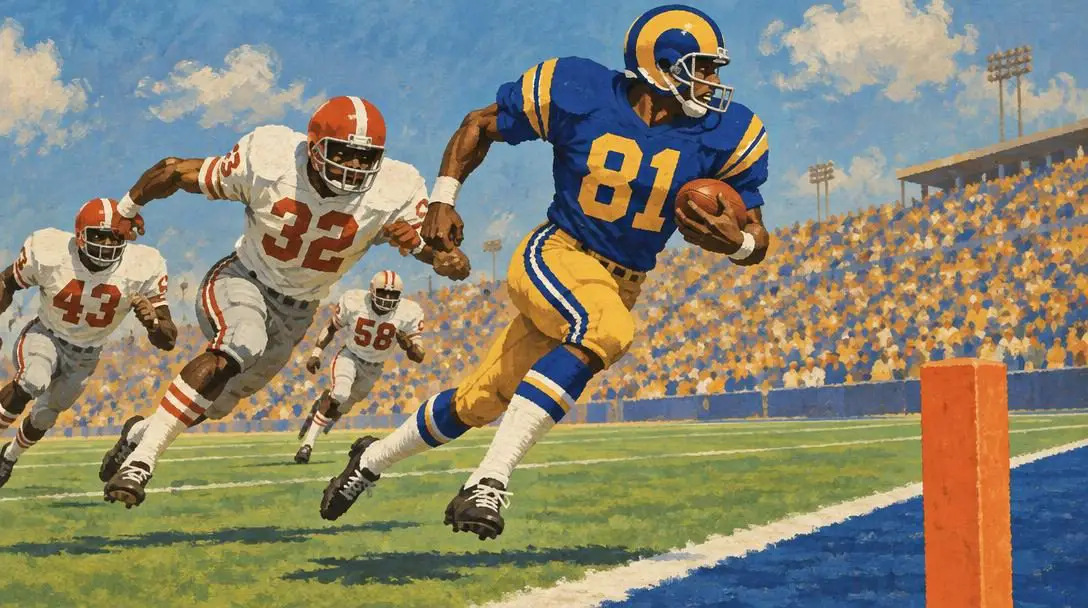
Long before pass-heavy offensive schemes took over professional football, Los Angeles Rams receiver Harold Jackson authored an unrivaled first-half clinic in 1973. Entering the game with an undefeated 4-0 record, the Rams looked to prove their dominance against the visiting Dallas Cowboys. Jackson put the contest completely out of reach before both squads retreated to their locker rooms at halftime.
In the opening quarter, Jackson scored on explosive receptions of 63 yards and 16 yards. He continued his assault in the second quarter, finding the end zone on deep strikes of 67 yards and 36 yards. Jackson accumulated all four of his touchdowns and nearly all of his 238 receiving yards in the first two quarters alone. His dominance accounted for almost the entirety of the Rams' aerial output, as quarterback John Hadl threw for just 41 passing yards to all other receivers combined.
Jerry Rice

- Matchup: vs. Minnesota Vikings
- Total yardage: 289 receiving yards, 10 rushing yards
- Total touchdowns: 3
- Standard fantasy points: 47.9
Widely recognized as the greatest wide receiver to ever play the game, Jerry Rice holds multiple spots across historic fantasy scoring lists. One of his finest afternoons occurred late in the regular season when the 10-4 San Francisco 49ers faced the Minnesota Vikings in a pivotal matchup with playoff implications on the line. The game quickly shifted into a high-scoring shootout, concluding in a 37-30 San Francisco triumph.
Rice dominated the Vikings' defensive backs, pulling down 14 of his 16 targets and misconnecting on only two passes all day. Those 14 receptions generated 289 receiving yards and three touchdowns, bolstered by a long catch of 52 yards. Rice also contributed 10 rushing yards on the ground to elevate his standard fantasy total to 47.9 points. Quarterback Steve Young complemented Rice's day with 425 passing yards, three throwing scores, and a rushing touchdown of his own.
Jerry Butler

- Season: 1979
- Opponent: New York Jets
- Total yardage: 255 receiving yards, 12 rushing yards
- Standard fantasy points: 50.7
Early in the 1979 season, Buffalo Bills wide receiver Jerry Butler became the first player in modern league history to cross the 50-point standard fantasy threshold. Hosting the division rival New York Jets, the Bills capitalized on a porous secondary as quarterback Joe Ferguson consistently attacked downfield.
Ferguson completed 19 passes throughout the contest, with 10 of those completions landing squarely in Butler's hands. Butler turned those 10 receptions into 255 yards and four touchdowns, punctuated by a 75-yard breakaway score. Adding 12 rushing yards on an end-around carry, Butler finished with 50.7 standard points and powered Buffalo to a high-scoring 46-31 win that leveled their season record at 2-2.
Jerry Rice
- Season: 1990
- Opponent: Atlanta Falcons
- Total yardage: 225 receiving yards
- Total touchdowns: 5 receiving touchdowns
- Standard fantasy points: 52.5
At the apex of single-game fantasy history stands Jerry Rice once again, delivering the greatest standard performance ever recorded during a 1990 clash with the Atlanta Falcons. The division showdown turned into a 45-35 shootout as San Francisco fought to maintain its perfect, undefeated record behind head coach George Seifert and Hall of Fame quarterback Joe Montana.

Rice caught 13 passes for 225 receiving yards and hauled in a breathtaking five touchdown receptions. What makes his 52.5-point total unmatched is that he achieved it without a single rushing yard and without logging a catch exceeding 30 yards. Rice dissected the Atlanta coverage through intermediate routes and sharp red-zone separation, while Montana ended his own historic day with 476 passing yards and six touchdown passes.
How to handle historic performance spikes
When a player on your roster—or one belonging to an opponent—explodes for a historic week, fantasy managers must make calculated moves rather than acting on raw emotion. Navigating the aftermath of a massive scoring week requires a disciplined, analytical approach.
- Evaluate target volume and air yards: Dig beneath the final box score to verify whether the receiver earned an elite share of passes. A receiver who catches four passes for three 60-yard scores represents a volatile asset, whereas double-digit targets point to steady involvement.
- Assess quarterback performance and game script: Determine whether the offensive outburst was dictated by a unique shootout environment. Unusually high passing attempts by the quarterback can artificially elevate a pass-catcher's weekly output.
- Identify sell-high trade windows: If an inconsistent or secondary wideout posts 35 or more standard points, their perceived market value peaks immediately. Use this leverage to offer trades that net dependable, top-tier starters at thinner positions.
- Reinforce roster depth: Never assume an explosive wide receiver will single-handedly carry a team to a league title. Channel waiver wire claims and bench space into high-upside running backs and solid flex options.
Frequent pitfalls when managing fantasy outliers
Overreacting to a single game is one of the most common reasons fantasy managers derail competitive rosters. Steering clear of these strategic mistakes preserves long-term flexibility:
- Chasing past touchdown production: Touchdowns remain the most unpredictable statistic in fantasy football. Starting a player solely because they scored three touchdowns the previous week often yields an immediate scoring bust.
- Expecting routine repeat performances: Outings of 40 or 50 fantasy points are historical anomalies. Even legendary pass-catchers like Jerry Rice and Harold Jackson reached those heights only once or twice over entire careers.
- Depleting waiver priority or FAAB budget: Spending all available budget or waiver priority on a receiver who benefited from blown coverages leaves managers empty-handed when high-volume workhorse running backs emerge later.
- Confusing standard and PPR valuation: Slot receivers who rely heavily on five-yard underneath catches hold genuine value in PPR formats but provide low floors and low ceilings in standard scoring.
Strategic focus for long-term fantasy success
Understanding the common characteristics of historic wide receiver games allows fantasy managers to project future ceiling matchups across the NFL schedule. High-scoring shootouts between high-paced offenses create the ideal breeding ground for record-breaking fantasy performances.
When evaluating starting lineups each week, prioritize wide receivers who command both high red-zone target rates and significant downfield air yards. Players who consistently win one-on-one battles near the goal line possess the greatest mathematical chance of delivering multi-touchdown weeks. By pairing those dynamic ceiling receivers with high-floor running backs, fantasy managers can assemble a championship-caliber roster designed to win in both the regular season and the playoffs.
Frequently asked questions
What is the highest standard fantasy score ever by a wide receiver?
Jerry Rice holds the all-time record with 52.5 standard fantasy points, which he set in 1990 against the Atlanta Falcons by catching 13 passes for 225 yards and five touchdowns.
How does standard fantasy scoring differ from PPR scoring?
Standard scoring awards points solely for yardage (one point per 10 yards) and touchdowns (six points), granting zero points for a reception. Points-per-reception (PPR) leagues award an additional half-point or full point for every catch made, regardless of yardage.
Has any wide receiver scored 50 standard fantasy points in a single game?
Yes. Both Jerry Rice (52.5 points in 1990) and Jerry Butler (50.7 points in 1979) have eclipsed the 50-point mark in standard fantasy football leagues.
Can a wide receiver have an all-time fantasy day in a losing effort?
Yes. Jimmy Smith accumulated 47.1 standard fantasy points in a 2000 matchup against the Baltimore Ravens, catching 15 passes for 291 yards and three scores despite the Jacksonville Jaguars losing 39-36.
The bottom line
The greatest wide receiver performances in standard fantasy football history require a convergence of precision passing, downfield efficiency, and multiple touchdowns. From Harold Jackson and Jerry Butler in the 1970s to Jimmy Smith and Jerry Rice in the 1990s and 2000s, crossing the 45-point threshold remains one of the rarest achievements in fantasy sports. While watching a pass-catcher dominate a matchup can define a season, smart managers recognize the volatility of touchdowns and build well-rounded rosters that do not rely on historical outliers to secure weekly victories.