5 Greatest Nebraska Sports Stars
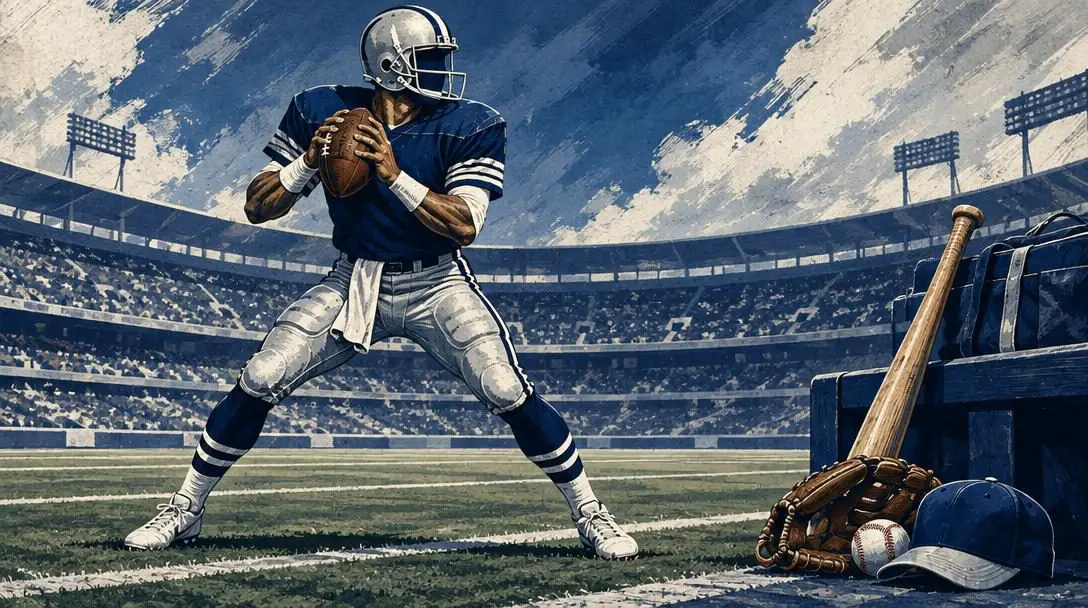
When sports enthusiasts turn their attention toward Nebraska, one sport universally captures their focus: college football. The Nebraska Cornhuskers represent one of the most storied traditions in college sports history, having claimed multiple national championships on the gridiron. Along the way, the program has developed premier collegiate athletes, celebrated Heisman Trophy recipients, and certified stars who took their talents to the professional level.
Choosing the top figures from such a deep pool of legendary talent is a challenge, but certain individuals left a permanent mark on the program through their sheer dominance, historical achievements, and extraordinary moments on the field. From unstoppable option quarterbacks to record-breaking tailbacks and overpowering defensive forces, these icons set the gold standard for college football excellence in Lincoln.
Key takeaways
- Nebraska's football legacy is highlighted by championship-winning option offenses, prolific running backs, and game-wrecking defensive interior linemen.
- Quarterback Tommie Frazier earned the top ranking by guiding the Cornhuskers to back-to-back national titles while throwing just 11 career interceptions.
- Heisman Trophy winners Mike Rozier and Eric Crouch established historic yardage standards in rushing production and dual-threat versatility.
- Defensive tackle Ndamukong Suh mounted one of the most disruptive individual campaigns in college football history during his dominant 2009 senior season.
- Assessing historical collegiate stars requires evaluating on-field efficiency, team championships, and scheme context rather than relying strictly on professional draft outcomes.
At a glance: Nebraska's top five gridiron legends
Over several decades of national prominence, the Cornhuskers produced some of the most decorated players in collegiate history. The table below outlines how these five luminaries compare across their individual honors, key milestones, and historic contributions.
| Player | Position | Key Accolades | Signature Collegiate Statistic | Championship Impact |
|---|---|---|---|---|
| Tommie Frazier | Quarterback | Two-time National Champion | 11 career interceptions across 4 seasons | Led back-to-back national championship teams |
| Eric Crouch | Quarterback | Heisman Trophy, Walter Camp, Davey O’Brien | 3,434 rush yards, 4,481 pass yards | Two-time Big 12 Offensive Player of the Year |
| Ndamukong Suh | Defensive Tackle | Heisman Finalist (4th place), 2nd Overall NFL Draft pick | 85 tackles, 12 sacks in 2009 senior season | Anchored dominant 2009 defensive front |
| Mike Rozier | Running Back | 1983 Heisman Trophy, 2-time Pro Bowl selection | 4,780 rushing yards, 49 rushing touchdowns | Key force of historic 1983 scoring offense |
| Lawrence Phillips | Running Back | National Champion | 1,722 rushing yards in sophomore season | Key performance in Fiesta Bowl national title win |
The top five Cornhusker legends
Each of the following five athletes represents a distinct peak in Nebraska's football history. Their career trajectories reveal how individual talent combined with the program's signature systems to create indelible moments on the gridiron.
5. Lawrence Phillips
- Position: Running Back
- Career highlight: 1,722 rushing yards and 16 touchdowns as a sophomore
- Championship victory: Fiesta Bowl national title victory
The athletic journey of running back Lawrence Phillips is undeniably tragic, yet his talent when playing between the lines was unmistakable. Phillips was widely recognized as the best player on the field during his peak. Arriving as a dynamic athlete, he made an instant impression as a freshman by gaining 508 rushing yards on only 92 carries, showing glimpses of the sheer physical running style that would soon overwhelm top defenses.
His breakthrough campaign followed in his sophomore season, where he completely dismantled opposing defenses. During that standout year, Phillips accumulated 1,722 rushing yards and scored 16 touchdowns on the ground, while adding 172 receiving yards to demonstrate his versatility as an offensive weapon. By 1995, Phillips had established himself as a leading frontrunner for the Heisman Trophy. However, his college campaign took a sharp detour when he was suspended from the team following a victory over Michigan State.
Despite missing significant action, Phillips rejoined the Cornhuskers in time for the Fiesta Bowl, where he delivered a key performance to help Nebraska win a national championship. Following that triumph, he chose to declare for the NFL Draft. Unfortunately, serious off-the-field problems severely shortened his professional career. Phillips was later imprisoned and tragically took his own life in 2016, leaving behind a complex legacy defined by unbelievable athletic ability alongside deeply unfortunate life circumstances.
4. Mike Rozier
- Position: Running Back
- Major award: 1983 Heisman Trophy winner
- Collegiate total: 4,780 rushing yards and 49 rushing touchdowns
- Professional milestone: Two-time Pro Bowl selection
Another iconic running back who left an undeniable legacy in Lincoln is Mike Rozier. Before establishing himself as a household name with the Cornhuskers, Rozier honed his skills by spending a year playing junior college football. He arrived on campus in 1981 and secured substantial playing time during his sophomore season, recording 943 rushing yards and crossing the goal line for five touchdowns.
Taking over the primary starting role the following season, Rozier took his production to new heights. He compiled 1,689 rushing yards and 15 touchdowns, a spectacular showing that earned him a top-10 finish in national Heisman voting. That junior campaign set the stage for one of the most prolific individual seasons in college football history.
Rozier put together an extraordinary final season at Nebraska in 1983. Bludgeoning defenses on a weekly basis, he rushed for an astounding 2,148 yards and notched 29 touchdowns. His dominant campaign earned him the prestigious 1983 Heisman Trophy, capping off a collegiate career in which he amassed 4,780 total rushing yards and 49 rushing touchdowns. Rozier transitioned to professional football with stints in both the United States Football League (USFL) and the National Football League (NFL), where his sustained ability earned him two Pro Bowl selections.
3. Ndamukong Suh
- Position: Defensive Tackle
- Senior season stat line: 85 tackles, 12 sacks, over 20 tackles for loss
- Heisman vote: Fourth-place finish in 2009
- NFL Draft: Selected 2nd overall in 2010 by Detroit Lions
While defensive athletes rarely secure the highest individual accolades in college football, Ndamukong Suh built a resume that many historians and fans view as worthy of the ultimate honor. The fact that Suh did not win the Heisman Trophy is widely remembered as one of the biggest snubs in the history of college sports.
Suh spent five seasons with Nebraska, an endurance that started with a redshirt freshman campaign where he recorded just a single tackle. Through consistent development, his explosive physical tools emerged year after year, until 2009 when he indisputably stood as the premier defensive player in the country. During that phenomenal senior campaign, Suh delivered overwhelming production from the defensive interior, finishing with 85 total tackles, more than 20 tackles for loss, and 12 sacks.
His disruption at the line of scrimmage routinely altered game plans, yet he finished in fourth place in the 2009 Heisman voting. Over the course of his entire tenure in Lincoln, Suh produced 24 career sacks and grabbed four interceptions, displaying unprecedented athletic agility for an interior lineman. His collegiate dominance solidified his draft profile, leading the Detroit Lions to select him second overall in the 2010 NFL Draft.
2. Eric Crouch
- Position: Quarterback
- Major sweep: 2001 Heisman Trophy, Walter Camp, Davey O’Brien
- Conference honors: Two-time Big 12 Offensive Player of the Year
- Career production: 3,434 rush yards, 4,481 pass yards, 88 total touchdowns
Nebraska's storied quarterback history features extraordinary individual athletes, and Eric Crouch ranks near the pinnacle. An Omaha native, Crouch opted to stay in his home state to represent the Cornhuskers. Following an initial redshirt year, his impact on the field was instantaneous. As a freshman, he exhibited his dual-threat skill set by gathering 459 rushing yards along with 601 passing yards, signaling the dawn of an unstoppable offensive era.
With each season, Crouch expanded his understanding of the game and his athletic effectiveness, eventually maturing into the most impactful individual player across the entire college landscape. His speed as a runner challenged defensive containments, while his arm strength punished teams that crowded the line of scrimmage.
Crouch's senior season in 2001 proved to be historic. His command of the offense brought him his second Big 12 Offensive Player of the Year Award, alongside a sweep of college football's major individual honors: the Walter Camp Award, the Davey O’Brien Award, and the Heisman Trophy. Crouch concluded his time in Lincoln with staggering numbers on both sides of the offensive ledger, registering 3,434 rushing yards and 59 rushing touchdowns while throwing for 4,481 yards and 29 passing touchdowns.
1. Tommie Frazier
- Position: Quarterback
- Team honors: Led Nebraska to two national championships
- Ball security mark: Only 11 interceptions thrown across four seasons
- Career totals: 1,955 rushing yards, 3,521 passing yards, 79 total touchdowns
Holding the top spot on this list is Tommie Frazier, a dynamic signal-caller whose trajectory resembled that of Crouch in his steady progression year after year. Frazier journeyed to Lincoln from Bradenton, Florida, joining the team in the 1990s. After seeing limited playing time during his freshman season, he developed into an unstoppable dual-threat quarterback and led Nebraska during a golden era of college football, capturing two national titles for the program.

Though the Heisman Trophy eluded him during his collegiate journey, Frazier cemented his reputation as an all-time legend through his poise, leadership, and production. Across his four-year career, Frazier generated 1,955 rushing yards and scored 36 touchdowns on the ground. Through the air, he contributed 3,521 passing yards and 43 passing touchdowns.
Perhaps most remarkably for a four-year starter at any competitive level, Frazier threw only 11 interceptions in his entire collegiate tenure. In contrast to the other celebrated players featured on this list, Frazier went undrafted upon entering the NFL, but his achievements in Lincoln remain unmatched in program lore.
True collegiate greatness is measured by championship grit and sustained dominance between the lines rather than subsequent professional longevity.
Nebraska's football tradition and the Cornhusker machine
Nebraska’s sports culture is uniquely centered around its college football program. Unlike states with multiple major professional sports franchises competing for fan attention, Nebraska is anchored by the University of Nebraska-Lincoln. The Cornhuskers represent the primary sporting identity of the state, resulting in a loyal following that has supported the team across generations.
The program reached legendary status thanks to distinct strategic eras. During the 1980s and 1990s, Nebraska football became famous for its powerful offensive identities, dominant physical conditioning, and innovative tactical designs. This period yielded multiple national championships and established the university as a regular developer of national award candidates. The success enjoyed by the program's biggest stars was driven by specific systemic principles:
- The dual-threat option architecture: Rather than relying strictly on conventional drop-back passing, Nebraska utilized offensive schemes that forced opposing defenses to account for the quarterback as an explosive ball carrier. Signal-callers like Eric Crouch and Tommie Frazier thrived because they possessed the agility, discipline, and instinct required to read defensive ends, pitch to trailing backs, or keep the football themselves.
- Power running superiority: The offensive philosophy placed a premier value on physical endurance and high-volume running. Running backs like Mike Rozier and Lawrence Phillips benefited from game plans designed to wear down opponents across four quarters, resulting in massive rushing yardage totals and scoring outputs.
- Defensive disruption at the line: Defensive coordinators at Nebraska gave interior linemen the freedom and leverage to penetrate backfields directly rather than merely absorbing blocks. Ndamukong Suh took full advantage of this philosophy, using an unmatched mix of power and quickness to disrupt both run fits and pass protections before plays could develop.
- Developmental redshirting: A key strategic element in Nebraska’s team building was allowing players time to physically mature. Athletes like Ndamukong Suh and Eric Crouch spent their initial collegiate seasons adjusting to the speed of college football and training in the program's weight system before stepping into heavy action.
Practical steps for evaluating college football stars
Determining who deserves a spot among the greatest players in a program's history requires a structured evaluation method. For analysts seeking to measure collegiate sports legacies objectively, the following steps offer a dependable framework:
- Assess production over longevity: Look at total output across an entire career, such as Rozier’s 4,780 rushing yards, alongside single-season high-water marks like his 2,148-yard senior campaign. High sustained production separates short-lived flashes from true program greats.
- Evaluate ball security and efficiency: High counting numbers can sometimes hide inefficiency. Evaluating metrics like Frazier’s 11 career interceptions over four full seasons highlights exceptional decision-making and operational reliability.
- Measure championship impact: Great individual statistics become even more significant when they translate to team success. Achieving multiple national titles, as Frazier did in the 1990s or Phillips did during his championship bowl run, heavily influences a player's place in history.
- Examine major accolades and voting records: Consider whether the player was formally recognized on the national stage. Winning awards like the Heisman, Walter Camp, or Davey O’Brien, or securing high placement in national voting, demonstrates how the player was perceived by national media and opposing coaches during their career.
- Weigh defensive dominance carefully: Because defensive players inherently record fewer counting stats than quarterbacks or running backs, evaluate defensive impact through disruption metrics, including sacks, tackles for loss, and rare achievements like Suh’s four interceptions from the interior line.
Common mistakes when comparing eras
When analyzing historical sports icons, readers and analysts frequently run into recurring pitfalls that skew perspective. Avoiding these common mistakes helps preserve an accurate view of sports history:
- Ignoring positional bias in award voting: A frequent error is assuming that award voting tells the complete story of a player's value. Defensive players like Ndamukong Suh rarely claim the Heisman Trophy, not due to a lack of dominance, but because individual defensive contributions are harder to compare against high-scoring offensive players.
- Equating professional careers with college greatness: A player's professional outcome in the NFL or other leagues does not diminish what they achieved on the collegiate field. Tommie Frazier went undrafted, yet he remains an elite collegiate legend who led his team to two national championships.
- Overlooking rule and style differences: Football has evolved considerably in its rules regarding passing protections, substitutions, and scheduling. Comparing modern spread passing statistics directly against Nebraska’s run-heavy option offenses fails to capture the true efficiency of quarterbacks like Crouch or Frazier within their respective systems.
- Dismissing character complexities: Overlooking off-the-field complications can lead to an incomplete historical account. The life of Lawrence Phillips includes extraordinary athletic performances alongside serious difficulties that cut his professional career short, both of which are part of his overall story.
Frequently asked questions
Why is Tommie Frazier ranked ahead of Heisman winners like Mike Rozier and Eric Crouch?
Tommie Frazier holds the top spot primarily due to his championship resume and remarkable ball security. While Rozier and Crouch earned Heisman Trophies, Frazier led Nebraska to two national championships during a dominant 1990s era, compiling 79 total touchdowns and throwing a mere 11 interceptions across his entire four-year collegiate career.
How close did Ndamukong Suh come to winning the Heisman Trophy?
Ndamukong Suh finished in fourth place in the 2009 Heisman Trophy balloting. Despite delivering one of the most dominant individual seasons in college history—recording 85 tackles, 12 sacks, and over 20 tackles for loss from the interior defensive line—the award went to an offensive player, making Suh's fourth-place finish one of the most debated outcomes in voting history.
What made Mike Rozier's 1983 Heisman campaign so remarkable?
In his 1983 senior campaign, Rozier produced an astounding 2,148 rushing yards and scored 29 touchdowns. His dominant rushing output anchored Nebraska's historic scoring offense and elevated his three-year collegiate rushing total to 4,780 yards and 49 touchdowns before he went on to play in the USFL and NFL.
How did Lawrence Phillips impact Nebraska's 1995 national championship season?
After a standout sophomore season of 1,722 rushing yards, Phillips was a leading Heisman frontrunner entering 1995. Despite serving a suspension following the Michigan State game that cost him significant playing time, he returned to deliver a key performance in the Fiesta Bowl to help the Cornhuskers capture the national title.
Why was developmental redshirting so crucial to Nebraska's player development?
Redshirting allowed incoming athletes to adjust to the physical speed of college football and gain strength through Nebraska's renowned strength and conditioning program. Standouts like Eric Crouch and Ndamukong Suh redshirted early in their careers, giving them the physical maturity needed to eventually become dominant national award winners.
The bottom line
The history of Nebraska football is built on relentless physical execution, groundbreaking offensive concepts, and singular athletic performers. Across different decades, stars like Tommie Frazier, Eric Crouch, Ndamukong Suh, Mike Rozier, and Lawrence Phillips demonstrated how talent flourished within the Cornhusker system. Whether through Rozier's 2,148-yard senior masterpiece, Suh's line-of-scrimmage terror, or Frazier's unflappable leadership in title-winning runs, these five legends established a standard of gridiron excellence that continues to define the sports heritage of the Cornhusker State.