5 Most Ethical Sports Franchises
For generations, the prestige and value of a professional sports team were measured almost entirely by its win-loss record, ticket sales, and television ratings. Today, the modern sports landscape operates under a wider set of expectations. While fans remain deeply invested in championship pursuits, they increasingly expect athletic organizations to leverage their visibility, cultural influence, and financial resources to generate constructive environmental and social outcomes.
This paradigm shift has brought corporate social responsibility to the forefront of professional athletics. Operating major sports organizations requires vast resources, from powering expansive arenas to managing thousands of game-day visitors and extensive transit logistics. By treating ethical governance, environmental stewardship, and community advocacy as central operational priorities rather than peripheral marketing campaigns, forward-thinking franchises are demonstrating that athletic performance and social integrity can successfully coexist.
Key takeaways
- Modern sports corporate social responsibility evaluates teams on environmental conservation, energy efficiency, local neighborhood investment, and civic advocacy.
- Groundbreaking venues like Atlanta's Mercedes-Benz Stadium and Seattle's Climate Pledge Arena illustrate how architectural design can significantly minimize carbon and resource footprints.
- Franchises are expanding their impact beyond facility walls by directly funding vital community services, advancing racial justice initiatives, and championing local economic development.
- Genuine sports ethics requires transparent carbon accounting, continuous community investment, and active participation from players, front-office staff, and game-day supporters.
Ethical Franchises at a Glance
Professional clubs across different leagues have established distinct models for executing sustainable and socially conscious operations. The table below outlines how these five organizations turn corporate responsibility into measurable actions across their facilities and local markets.
| Organization | Primary Arena or Base | Key Environmental Focus | Community and Social Initiatives |
|---|---|---|---|
| The Atlanta Falcons | Mercedes-Benz Stadium | Resource-efficient building design and alternative transit access | Regional eco-friendly leadership in professional football |
| The Milwaukee Bucks | Fiserv Forum | Facility energy management and operational efficiency | Voting rights advocacy, correctional facility outreach, and Black-owned business funds |
| The Forest Green Rovers | The New Lawn | 100% vegan dining, renewable energy, and organic pitch management | Pioneering clean-tech sport culture and community environmental education |
| The Philadelphia Phillies and Eagles | South Philadelphia Sports Complex | Comprehensive recycling and renewable energy operations | Children's eye care, autism research support, and anti-gun-violence programs |
| The Seattle Kraken | Climate Pledge Arena | Zero single-use plastics, electric infrastructure, and rain-to-rink ice conversion | Rigorous carbon accounting and public transit integration |
Five Sports Franchises Excelling in Corporate Social Responsibility
While many athletic teams incorporate occasional charity events into their public relations calendars, select franchises have fundamentally reorganized their business models around ethical stewardship. From zero-waste stadium designs to dedicated social justice leadership, these five organizations represent benchmark models within international sports.
The Atlanta Falcons
- Home Venue: Mercedes-Benz Stadium
- Recognition: Top eco-friendly NFL team ranking by 24/7 Wall St.
- Transit Innovation: On-site bike valet and direct public transit access
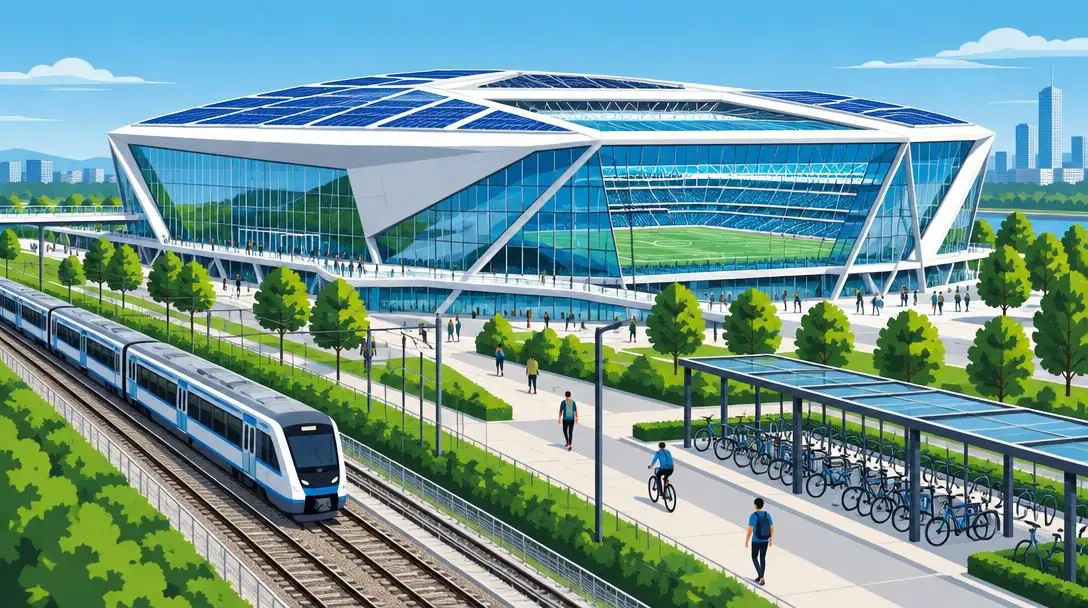
With the 2017 debut of Mercedes-Benz Stadium, the Atlanta Falcons established a new paradigm for ecological construction in North American sports. Rather than addressing environmental impacts as an afterthought, the organization integrated sustainable resource management directly into the architectural layout of the venue. The physical plant leverages high-efficiency energy systems and structured water conservation techniques to lower daily operational strain on municipal utilities.
Beyond the stadium walls, the Falcons have concentrated heavily on mitigating game-day traffic pollution. The venue sits adjacent to regional public transit connections, allowing tens of thousands of ticket holders to bypass personal car travel entirely. To further reduce emissions, the stadium introduced an organized bike valet program, incentivizing fans to use non-motorized transport. These integrated solutions secured the Falcons the top spot on 24/7 Wall St.'s ranking of the most eco-friendly NFL teams, sharing the honors in a five-way tie with the Baltimore Ravens, Chicago Bears, Philadelphia Eagles, and San Francisco 49ers.
The Milwaukee Bucks

- CSR Leadership: Arvind Gopalratnam, Vice President for Corporate Social Responsibility
- Core Partnerships: American Civil Liberties Union (ACLU)
- Player Programs: Elementary coat distributions and Black-owned business funds
While compiling an impressive basketball record, the Milwaukee Bucks have distinguished themselves through sustained leadership in social justice and civil rights advocacy. The team established a dedicated executive office for these initiatives, overseen by Arvind Gopalratnam. As Vice President for Corporate Social Responsibility, Gopalratnam is recognized as the only South Asian executive holding this specialized role across the National Basketball Association.
Under this guidance, the franchise has addressed critical societal issues through direct community interventions. Front-office staff and team members have partnered with civic groups, conducted outreach inside correctional facilities, and teamed up with the American Civil Liberties Union to champion voting access and civil liberties. On an individual level, athletes like Khris Middleton and Jrue Holiday have reinforced this organizational philosophy by distributing winter clothing at local elementary schools and creating focused financial funds to assist Black-owned small businesses across the region.

Sports teams command passionate, multi-generational fan loyalty that allows ethical practices to resonate across entire regional markets.
The Forest Green Rovers

- Governing Body Distinction: Named the "world's greenest football club" by FIFA
- Club Leadership: Dale Vince, green energy entrepreneur
- Material Innovations: Uniforms crafted from recycled coffee bean waste
Few professional sports franchises have woven environmentalism into their operational identity quite like the Forest Green Rovers. Headquartered in Gloucestershire, England, the soccer club achieved international renown when FIFA formally recognized it as "the world's greenest football club." This fundamental transformation was spearheaded by club owner and green energy entrepreneur Dale Vince, who set out to prove that competitive athletics could thrive without ecological harm.
The Rovers overhauled every aspect of their match-day operations. The club introduced team kits manufactured using recycled coffee grounds, established an entirely organic grass playing surface free of synthetic pesticides, and transitioned stadium concessions to an exclusively vegan menu. Power across the grounds is supplied via renewable energy installations. Looking ahead, the club continues to innovate with forward-looking concepts, including the construction of a fully wooden stadium design and the adoption of an electric team bus.
The Philadelphia Phillies and Philadelphia Eagles

- Foundation Entity: Eagles Charitable Foundation
- Key Health Initiatives: Pediatric vision care and clinical autism research
- Public Safety Focus: Regional anti-gun-violence coalition support
The sports culture of Philadelphia is renowned for its competitive intensity, but the city's major sports organizations are equally recognized for their civic impact. Both the Philadelphia Phillies and the Philadelphia Eagles maintain expansive community relations programs that operate continuously throughout the calendar year, providing direct financial assistance, volunteer labor, and equipment to hundreds of regional charitable groups.
The Eagles have channeled substantial philanthropic backing through the Eagles Charitable Foundation. This organization directs funding toward vital community health priorities, including comprehensive mobile eye-care clinics for school-aged children and scientific investigations into autism spectrum disorders. Furthermore, the franchise has used its public visibility to champion public safety, partnering with civic leaders and neighborhood advocates to support coordinated initiatives aimed at reducing gun violence across the urban core.
The Seattle Kraken

- Home Venue: Climate Pledge Arena
- League Framework: NHL Green Initiative
- Water Innovation: Rain-to-rink atmospheric harvesting system
Ice hockey presents unique environmental dilemmas, as maintaining massive sheets of indoor ice demands enormous energy, mechanical refrigeration, and constant climate conditioning. Working within the broader NHL Green Initiative, the Seattle Kraken addressed this operational friction directly when designing their home venue, Climate Pledge Arena. The venue was constructed from the ground up to achieve strict carbon-neutral benchmarks across all team operations.
To back up its environmental pledges with measurable data, the franchise enacted an arena-wide ban on all single-use plastics and converted the venue's mechanical plants to run entirely on electricity, including electric cooking kitchens and high-efficiency dehumidifiers. Most remarkably, the Kraken engineered a closed-loop "rain-to-rink" system that collects regional rainwater from the facility roof, filters it into holding tanks, and freezes it into the home ice surface. Comprehensive carbon accounting protocols are deployed to audit and disclose these energy expenditures publicly.
The Operational Blueprint Behind Sustainable Arenas
High-performing ethical sports programs are built upon coordinated operational frameworks that integrate facility managers, concession suppliers, and community liaisons. Transitioning from traditional venue management to a sustainable model requires addressing the physical, logistical, and social dimensions of event hosting.

At the facility level, modern architectural planning centers on whole-lifecycle efficiency. Structural engineers prioritize natural ventilation systems to lessen mechanical air conditioning loads, install automated LED illumination networks, and secure power purchase agreements tied directly to regional solar and wind farms. By taking advantage of on-site solar canopies, modern venues generate clean power on non-game days to feed back into regional municipal grids.
Concessions and waste management represent another critical operational front. A single professional match can generate thousands of pounds of discarded packaging, uneaten food, and beverage containers. Forward-thinking organizations replace single-use petroleum plastics with industrially compostable packaging, install clear multi-stream sorting receptacles across stadium concourses, and partner with local agriculture networks to process organic waste into compost. When combined with advanced plumbing systems that harvest gray water or natural rainfall, venues dramatically diminish their municipal water dependency.
How Fans Can Drive Ethical Accountability in Sports
Ticket buyers, television viewers, and merchandise consumers possess substantial leverage over front-office decisions. When supporters demonstrate that ethical stewardship influences their loyalty and spending habits, sports franchises respond by investing more resources into sustainable practices. Supporters can make a practical difference through several key actions:
- Select low-emission transportation on game day: Skip personal vehicle traffic by utilizing light rail networks, municipal buses, or stadium-sponsored bike valets to reduce congestion and urban air emissions.
- Practice strict concourse waste sorting: Take time to read arena disposal signage, ensuring that compostable food containers and recyclable beverage packaging are directed into proper streams rather than municipal landfills.
- Contribute to team-sponsored community drives: Participate in seasonal clothing drives, charitable auctions, and player-led foundation collections that route aid directly to underfunded local neighborhoods.
- Support civic and voting initiatives: Join athlete-led coalitions and non-profit partners during stadium civic events, voter registration drives, and neighborhood cleanup projects.
- Communicate ethical priorities to team ownership: Complete fan feedback surveys and utilize ticketing communications to inform executive leadership that environmental metrics and social accountability guide your consumer choices.
Pitfalls and Hazards in Sports Corporate Social Responsibility
As corporate responsibility becomes standard practice in professional athletics, sports organizations must navigate several operational pitfalls that can undermine their credibility and impact:
- Greenwashing and unsubstantiated claims: Marketing an organization as environmentally friendly while maintaining carbon-intensive, high-waste internal operations breeds public skepticism. Organizations must rely on third-party audits and verified data.
- Over-reliance on symbolic marketing: Wearing customized warm-up gear or producing social media clips for designated awareness nights does not substitute for structural philanthropy, community legal support, or educational funding.
- Neglect of immediate host neighborhoods: Franchises that concentrate entirely on international branding while overlooking the immediate municipal neighborhoods surrounding their arenas risk isolating their core local fan base.
- Top-down corporate disconnection: CSR campaigns constructed purely within corporate boardrooms without the input of players, athletic trainers, and frontline stadium workers often fail to build authentic traction.
- Abandoning ethics during losing seasons: Treating sustainability and community engagement as optional discretionary perks rather than permanent operating standards leaves programs vulnerable to budget cuts during competitive slumps.
Frequently Asked Questions
What does corporate social responsibility mean in professional sports?
In professional sports, corporate social responsibility refers to an organization using its business resources, brand equity, and public platform to generate positive social, environmental, and civic impacts. This includes sustainable stadium construction, renewable power adoption, multi-year philanthropic commitments, and public advocacy on vital community issues.
How does the Seattle Kraken's rain-to-rink system work?
The Seattle Kraken's home venue, Climate Pledge Arena, utilizes a specialized architectural drainage and filtration system that captures natural precipitation from the facility's roof. The collected rainwater is routed into dedicated retention tanks, purified through advanced mechanical filters, and subsequently frozen into the regulation ice sheet used for team games.
Why did FIFA recognize the Forest Green Rovers as the world's greenest club?
FIFA awarded the Forest Green Rovers this recognition due to the club's comprehensive ecological operational model. Under owner Dale Vince, the team implemented 100% vegan stadium concessions, powered its grounds with clean energy, instituted organic pitch maintenance, and introduced uniforms constructed from recycled coffee grounds.
Which NFL franchises rank among the most environmentally friendly?
According to an assessment published by 24/7 Wall St., the Atlanta Falcons earned the top spot among the NFL's most eco-friendly franchises, sharing the premier ranking in a five-way tie with the Baltimore Ravens, Chicago Bears, Philadelphia Eagles, and San Francisco 49ers.
What specific social justice initiatives have the Milwaukee Bucks supported?
Led by executive Arvind Gopalratnam, the Milwaukee Bucks have partnered directly with the ACLU to defend voting rights, conducted outreach inside regional correctional facilities, and supported initiatives led by players such as Jrue Holiday and Khris Middleton to fund Black-owned businesses and supply educational resources.
The Bottom Line
The standard of excellence in professional sports is no longer confined to scoreboards and championship banners. Today's most respected athletic franchises recognize that their commercial viability and cultural standing are intimately connected to how they treat their workers, their home cities, and the natural environment.
By investing in carbon-neutral venue architecture, implementing closed-loop resource management, and dedicating executive power to civil rights and community health, franchises like the Atlanta Falcons, Milwaukee Bucks, Forest Green Rovers, Philadelphia Eagles, and Seattle Kraken are setting a new baseline. As environmental challenges intensify and fan bases demand greater accountability, athletic organizations that place ethics at the core of their daily operations will lead the next era of sports entertainment.