5 Surprising Facts About the Science of Hearing

Every day, human beings navigate a dynamic acoustic environment, seamlessly decoding spoken sentences, identifying subtle safety hazards, and savoring the emotional nuances of music. Because the sense of hearing operates continuously and with seemingly little conscious effort, the elaborate biological and neurological systems that make it possible are easily taken for granted. We tend to think of listening as a passive reception of noise, yet the journey from an ambient atmospheric vibration to an intelligible thought is among the most sophisticated processes in the human body.
The ears operate as sensitive acoustic antennas, but it is the central nervous system that deciphers, analyzes, and contextualizes every incoming signal. A closer investigation into the science of audition reveals unexpected truths about how auditory development begins long before birth, how our brains manage sensory vigilance while we sleep, how auditory decline damages psychological health, and how the mind occasionally fabricates sounds to make sense of the world.
Key takeaways
- The human auditory system begins functioning in the womb by the 18th week of pregnancy, stimulating early neural wiring and cognitive development.
- Ears never cease receiving environmental sounds during sleep, allowing the brain to maintain an unconscious surveillance system that can trigger physical wakefulness.
- Unaddressed hearing loss places severe compensatory strain on cognitive bandwidth, substantially increasing the risks of social withdrawal, anxiety, and depression.
- Through a neurological phenomenon called auditory closure, the brain automatically fills in missing syllables and masked sounds using context and expectation.
- Auditory illusions such as the Shepard tone and the McGurk effect demonstrate that hearing is an active perceptual synthesis rather than a direct recording of external reality.
The Biological Chain: How Sound Waves Become Conscious Perception
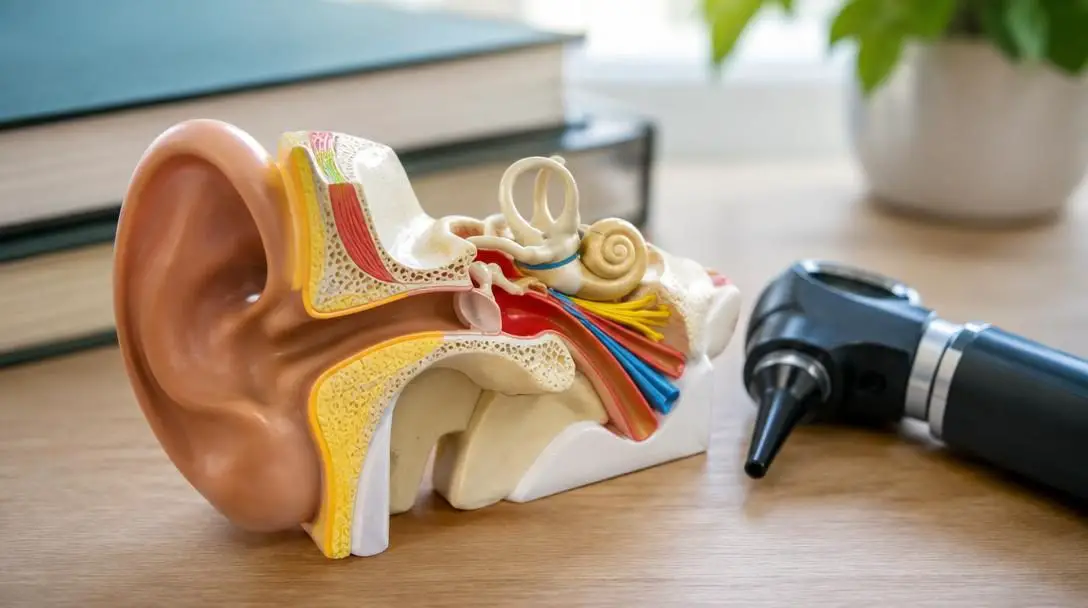
To appreciate the quirks and complexities of human audition, it is essential to trace how acoustic energy moves through physical anatomy. Sound begins as mechanical pressure waves rippling through an elastic medium, usually air. The human body channels these waves through three discrete anatomical zones—the outer, middle, and inner ear—before sending electrical signals along neural pathways to the auditory cortex.
- Acoustic gathering: The outer ear, including the visible pinna and the ear canal, funnels ambient atmospheric waves inward, focusing their energy onto the tympanic membrane, commonly known as the eardrum.
- Mechanical amplification: The vibrating eardrum drives three miniature bones in the air-filled middle ear cavity, which amplify the kinetic energy and transfer it efficiently into the denser fluid environment of the inner ear.
- Hydraulic stimulation: The amplified mechanical force enters the cochlea, a snail-shaped, fluid-filled organ, creating traveling fluid waves that sweep along the basilar membrane.
- Sensory transduction: Microscopic, specialized sensory receptors known as hair cells bend in response to the fluid movement, converting physical displacement into electrochemical impulses.
- Neural interpretation: The auditory nerve delivers these electrical impulses directly to the brainstem and the auditory cortex, where neural networks decode frequency, volume, directional origin, and emotional meaning.
Five Surprising Realities of Auditory Science
While the mechanical progression from sound wave to electrical impulse is impressive on its own, the functional realities of human audition are stranger and far more dynamic than most realize. The following five discoveries demonstrate the reach of hearing into fetal development, nighttime neurology, psychological health, and sensory deception.
| Auditory Phenomenon | Primary Mechanism | Sensory or Neurological Impact |
|---|---|---|
| Prenatal Sound Processing | Amniotic acoustic conduction through maternal tissue to early hair cells | Fosters baseline auditory pathways and enhances early cognitive capabilities |
| Nocturnal Vigilance | Unbroken inner ear transduction paired with background brainstem filtering | Maintains survival awareness but leaves sleep cycles vulnerable to noise disruption |
| Auditory-Cognitive Strain | Resource reallocation in the brain due to degraded sensory input | Elevates risks for mental exhaustion, social isolation, depression, and anxiety |
| Auditory Closure | Context-driven neural interpolation of masked or missing sound fragments | Enables fluid speech comprehension in noisy settings, risking misperceptions |
| Perceptual Illusions | Frequency manipulation and audiovisual cue integration conflicts | Generates perceived sounds or pitch shifts that do not exist in acoustic reality |
Prenatal Hearing in the Womb
Audition is among the earliest sensory systems to mature in human beings. By the 18th week of pregnancy, the fundamental structures of the inner ear are sufficiently developed to allow a growing fetus to detect sounds originating inside and outside the mother's body. Rather than developing inside a silent sanctuary, the fetus listens continuously to internal rhythms—such as maternal blood flow and heartbeats—alongside external voices, ambient background noise, and musical rhythms traveling through amniotic fluid.
This early sensory exposure is far from incidental. The auditory system requires environmental stimulation to guide structural neural development. Studies show that infants exposed to structured music while still in the womb display superior memory capabilities and advanced cognitive performance compared to peers who did not receive comparable prenatal auditory stimulation. Hearing acts as an early bridge between the external world and the nascent brain, laying neurological groundwork before birth occurs.
Continuous Auditory Vigilance During Sleep
While consciousness disengages during sleep, your ears never shut off. The mechanical components of the ear and the sensory hair cells inside the cochlea continue to convert environmental vibrations into electrical impulses uninterrupted through the night. The sensory apparatus does not possess a physiological power switch; instead, the sleeping brain acts as a selective gatekeeper, deciding which auditory signals warrant awakening the conscious mind.
This perpetual monitoring represents a vital survival adaptation. The sleeping brain processes acoustic stimuli in the background, allowing urgent auditory cues—such as a sharp alarm clock, a shattering window, or a crying child—to trigger immediate physiological arousal and conscious alertness. However, this non-stop sensory vigilance comes with an inherent vulnerability. Intrusive ambient sounds, such as passing traffic, sudden sirens, or noisy neighbors, can destabilize sleep architecture and elevate stress responses even when they do not wake a person completely.
The Mental Health Repercussions of Hearing Loss
Public discourse frequently categorizes hearing loss as an inconvenient mechanical nuisance characterized by turning up television volumes or asking speakers to repeat themselves. Neurologists and audiologists recognize that unmanaged hearing loss exerts a deep, corrosive toll on mental health, emotional stability, and overall neurological function.
When sensory signals from the inner ear become degraded, the brain must redirect precious cognitive reserves merely to decode muffled speech. This diversion of mental processing power leaves fewer neurological resources available for working memory, critical thinking, and emotional resilience. Studies consistently link untreated auditory degradation to higher rates of clinical depression, persistent anxiety, and accelerated cognitive decline. Furthermore, because following conversations in noisy rooms becomes mentally exhausting and socially embarrassing, many individuals progressively withdraw from social settings. This ensuing isolation eliminates vital relational engagement, worsening mental health challenges.
The brain does not merely register acoustic information; it actively negotiates and invents perception based on context, expectation, and sensory fragments.
Auditory Closure and the Brain’s Predictive Fill-In Mechanism
Human listening is an interpretive craft rather than an unvarnished recording of raw acoustic input. In real-world environments, conversations are continually splintered by extraneous sounds: slamming doors, passing cars, coughing, or gusts of wind. In theory, these acoustic dropouts should render spoken language fragmented and unintelligible. The brain solves this problem through a cognitive capacity known as auditory closure.
Auditory closure allows the central nervous system to identify gaps in an acoustic signal and automatically reconstruct the missing syllables or sounds. To accomplish this, the brain draws upon linguistic context, historical memory, and probabilities to invent the acoustic material that was physically absent. While this cognitive interpolation allows conversations to flow seamlessly across chaotic environments, it can occasionally malfunction. When the brain miscalculates context, it fills in words that were never spoken, resulting in humorous misunderstandings or persistent auditory misperceptions.
Auditory Illusions and Cross-Modal Deceptions
Just as optical illusions trick the visual cortex, the auditory system can be deceived by carefully structured sonic patterns. Auditory illusions expose the neurological shortcuts the brain relies on when organizing conflicting or incomplete sound information. These perceptual anomalies are generated by precisely manipulating sound frequency, volume, and timing.

A classic auditory illusion is the Shepard tone, which creates the convincing sensation of a musical tone that scales higher and higher in pitch indefinitely without ever moving out of hearing range. In reality, the phenomenon relies on an acoustic loop of layered sinusoidal waves; as upper frequencies fade into silence, lower octaves gradually swell underneath, tricking the brain into perceiving continuous upward motion.
Even more dramatic is the McGurk effect, an illusion that reveals the profound neurological link between hearing and vision. When an individual watches a video of a person mouthing one syllable (such as "ga-ga") while listening to an audio track playing a different syllable (such as "ba-ba"), the brain blends the conflicting sensory inputs and forces the listener to hear an entirely new, third syllable (typically "da-da"). This cross-modal illusion proves that conscious listening is a combined perceptual construction rather than an isolated function of the ears.
Actionable Habits to Preserve Hearing Health
Because the delicate hair cells within the cochlea cannot regenerate once damaged, preserving your auditory system requires conscious, lifelong habits. Protecting these structures safeguards both your hearing acuity and the neurological pathways that support cognitive stamina.
- Moderate your listening volume: Maintain personal listening devices at moderate output levels, and follow the practice of taking regular listening breaks during prolonged headphone use.
- Deploy acoustic protection: Wear sound-dampening earmuffs or high-fidelity earplugs whenever entering elevated noise environments, such as construction zones, industrial workspaces, or live music venues.
- Schedule baseline evaluations: Obtain periodic comprehensive hearing assessments from an audiologist to detect minor threshold shifts before functional communication suffers.
- Design a low-stress acoustic sanctuary: Minimize disruptive nighttime soundscapes using soundproofing strategies, heavy curtains, or steady white noise generators to support uninterrupted restorative sleep.
- Respond rapidly to perceptual changes: Consult a medical professional immediately if you experience persistent ringing, muffled voices, or persistent strain when conversing in routine environments.
Common Pitfalls and Misconceptions in Hearing Health
A widespread lack of public awareness concerning auditory biology leads to habitual mistakes that compromise long-term sensory function. Correcting these assumptions is vital for protecting auditory pathways over a lifetime.
- Assuming hearing loss only affects older demographics: Acoustic damage accumulates cumulatively across all age groups through recreational noise exposure, headphone abuse, and occupational sound hazards.
- Using invasive cleaning implements inside the ear canal: Ears are self-cleaning organs; aggressive probing with cotton swabs risks perforating delicate internal membranes and irritating skin linings.
- Dismissing transient auditory distress: Brushing aside temporary ringing (tinnitus) or muffled perception following a loud event ignores early warnings of physiological trauma to cochlear hair cells.
- Overlooking the emotional fallout of sensory decline: Neglecting early signs of hearing degradation risks unmanaged cognitive fatigue, social isolation, and heightened susceptibility to mood disorders.
- Viewing hearing as an ear-only mechanism: Treating hearing as solely an ear issue ignores the profound cognitive role the auditory cortex plays in organizing, repairing, and clarifying incoming signals.
Frequently asked questions
At what point during fetal development does hearing become functional?
A developing fetus can detect sounds by the 18th week of pregnancy. At this developmental milestone, the structural components of the inner ear are formed well enough to register internal biological sounds from the mother alongside external voices, ambient noise, and music traveling through the amniotic fluid.
Why do sudden noises wake you up if your brain is resting during sleep?
The sensory apparatus of the ear operates continuously without pause, feeding acoustic data into the brainstem throughout all sleep cycles. While higher-level consciousness is disengaged, the brain maintains an active background monitoring system that evaluates incoming sounds, triggering neurological arousal when an auditory cue indicates a potential threat or urgency.
What is auditory closure, and how can it cause miscommunications?
Auditory closure is a cognitive mechanism where the brain fills in missing or masked syllables using surrounding context, grammatical probability, and stored memory. While it enables smooth comprehension in noisy rooms, the brain's predictive guesses can occasionally be incorrect, leading you to hear a word that the speaker never actually uttered.
How does the McGurk effect prove that vision influences listening?
The McGurk effect demonstrates that when the brain receives contradictory visual and auditory cues—such as watching lips form "ga-ga" while hearing "ba-ba"—it does not isolate the audio. Instead, the central nervous system synthesizes the conflicting inputs and forces conscious perception to register an entirely distinct sound, like "da-da."
Why is untreated hearing loss strongly connected to mental health decline?
When the brain receives compromised auditory signals, it must expend excessive cognitive bandwidth simply to parse spoken words, leaving fewer mental reserves for other tasks. The resulting cognitive fatigue, combined with the social withdrawal caused by embarrassing or exhausting interactions, significantly raises the likelihood of anxiety, depression, and cognitive deterioration.
The bottom line
Human hearing is far more than a set of mechanical receptors taking in sound waves. It is an intricate, active partnership between the anatomy of the ear and the predictive processing power of the human brain. Auditory pathways stimulate early cognitive development before birth, maintain vigilance over our safety while we sleep, and shape our psychological connection to the communities around us.
Because hair cells and auditory pathways are vulnerable to irreversible noise damage and lifestyle strain, proactive auditory care is essential. By lowering listening volumes, using ear protection in high-noise environments, avoiding invasive cleaning tools, and scheduling regular assessments, you safeguard both your hearing and your broader cognitive health for decades to come.