Inside the War Room: Best Football General Managers Ever
Being the general manager of a professional football team is often a thankless endeavor. When a franchise reaches the mountaintop, public accolades almost exclusively shower the players and coaching staff on the sideline, leaving the architect in the shadows. Yet, the moment a team begins to slide and a head coach is dismissed, all eyes inevitably turn to the front office executive who assembled the roster.
While the modern executive seat suffers from notorious turnover, an elite tier of decision-makers has demonstrated the rare ability to command the war room across multiple decades. By balancing financial constraints, collegiate talent evaluation, and organizational alignment, these visionary architects turned volatile rosters into perennial powerhouses.
Key takeaways
- The role of the football general manager evolved from basic contract negotiations into an intricate science of salary cap management, scouting logistics, and multi-year roster planning.
- Hall of Fame executives like Bill Polian and George Young dominated their respective eras by collecting a combined eleven Executive of the Year honors.
- Modern success hinges on disciplined draft capital accumulation, finding value outside high-priced bidding wars, and matching personnel to coaching schemes.
- Franchise collapse frequently stems from short-term panic trades, overpaying mediocre quarterbacks, and neglecting second-string depth across the roster.
The Evolution of the Modern Front Office
The architecture of a football front office has undergone massive structural transformations since the dawn of the professional game. In early eras, operational boundaries were loosely defined; team owners and head coaches routinely handled player transactions directly, scribbling contract details onto paper napkins and evaluating incoming talent through basic, word-of-mouth networks. A single individual could comfortably oversee game preparation while simultaneously managing player personnel.
As the sport expanded into a multi-billion-dollar enterprise, the complexity of day-to-day operations outgrew the sideline. The modern general manager position emerged out of necessity to establish an overarching franchise philosophy. Rather than focusing exclusively on the tactical challenges of the upcoming Sunday matchup, front office leaders took on the responsibility of steering an organization three to five years into the future.
Over several decades, the introduction of national scouting combines, complex player personnel departments, advanced analytics, and the hard salary cap fundamentally revolutionized the job. Today, the general manager serves as the commander of an intricate administrative apparatus, where long-term strategic vision must co-exist with split-second decision-making.
Inside the War Room: How Modern Front Offices Operate
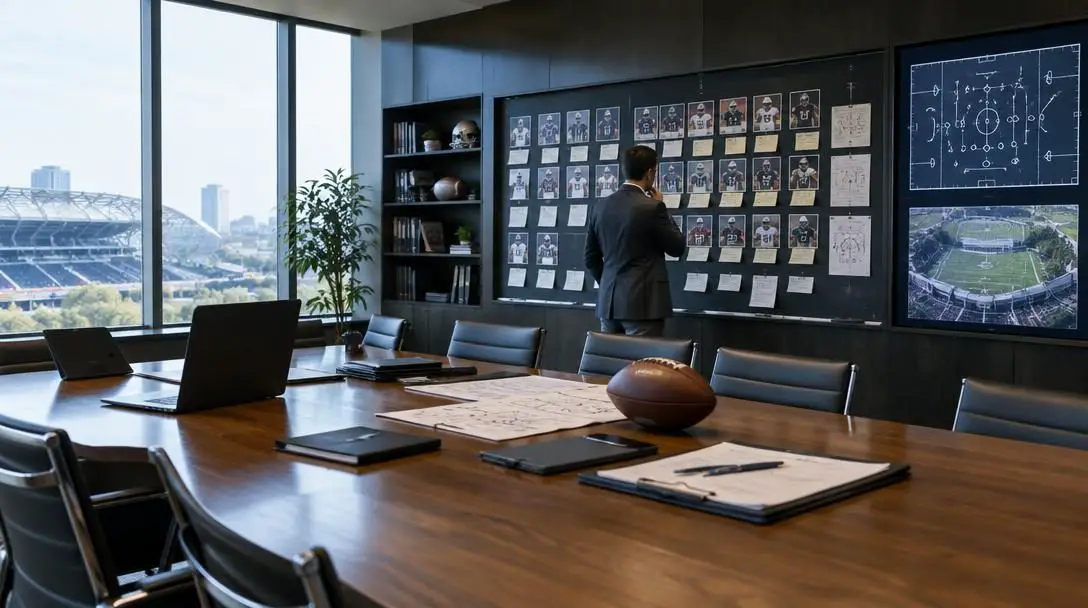
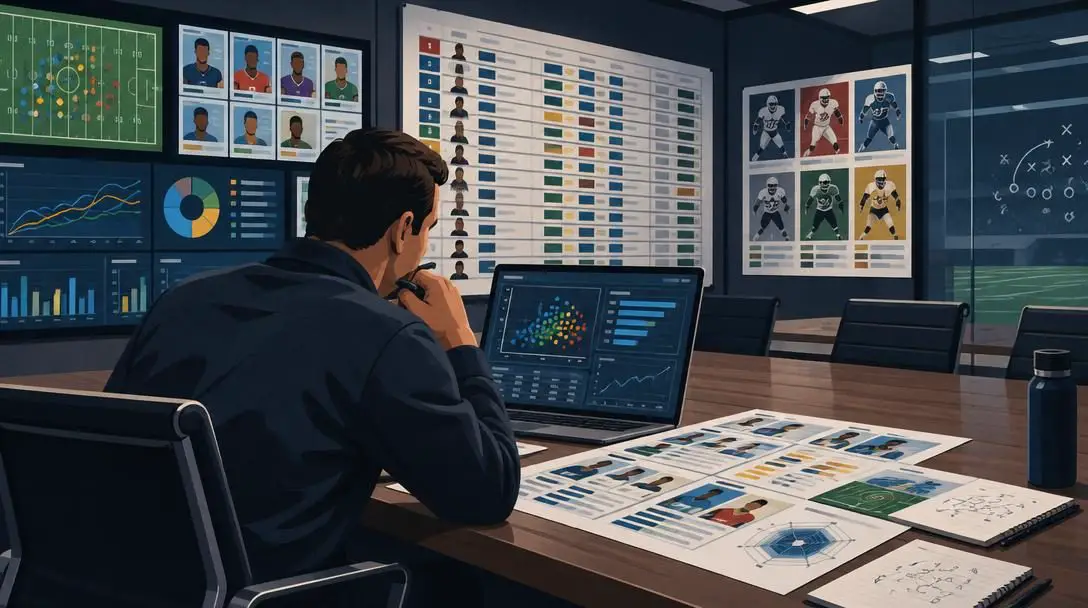
At the center of an executive's universe lies the war room—a secured nerve center where scouts, personnel directors, video staff, and coaches converge to build the franchise. The operations that unfold within this room dictate the long-term health of the entire organization.
Roster construction begins at the top. The general manager is fundamentally responsible for assembling the coaching staff, deploying the scouting department, and signing off on every transaction. Whether an acquisition takes the form of a blockbuster trade, a late-summer free-agent signing, or an outright release, the ultimate responsibility rests with the executive desk.
Throughout the calendar year, scouting directors and regional scouts travel nationwide to assess collegiate talent. They synthesize game film, physical measurements, medical evaluations, and psychological profiles into extensive databases. When draft season arrives, the general manager chairs the room to distill thousands of data points into a single, cohesive draft board.
Since the introduction of financial parity measures, roster building has become as much an accounting discipline as a football one. Executives must seamlessly weave together market-rate superstar veteran contracts with cost-controlled rookie deals, ensuring the team remains competitive without mortgaging its future cap flexibility.
Commanding an NFL war room requires balancing immediate weekly pressure against multi-year strategic visions.
The Top Five General Managers in Football History
Throughout league history, only a select group of executives have demonstrated the sustained vision required to build championship contenders across multiple eras. The following five leaders stand out as the definitive masters of the war room.
| Executive | Primary Franchises | Executive of the Year Wins | Championships / Milestones |
|---|---|---|---|
| Bill Polian | Bills, Panthers, Colts | 6 | 4 Super Bowl berths (Bills), 1 Super Bowl title (Colts) |
| George Young | Giants | 5 | 2 Super Bowl championships |
| Kevin Colbert | Steelers | 0 | 20+ years of cap-era franchise stability |
| Ozzie Newsome | Ravens | 0 | 2 Super Bowl championships |
| Bill Belichick | Patriots | 0 | Full roster authority beginning in 2000 |
Bill Polian

- Executive Honors: 6-time NFL Executive of the Year
- Organizations Built: Buffalo Bills, Carolina Panthers, Indianapolis Colts
- Front Office Tenure: 13 years directing the Indianapolis Colts
While some debate his ultimate standing among front-office greats, Bill Polian assembled a resume that is virtually impossible to challenge. Polian initially broke into the professional scouting ranks with the Kansas City Chiefs before gathering vital experience as an executive in both the Canadian Football League and the United States Football League (USFL).

Upon his return to the NFL, Polian engineered the golden era of the Buffalo Bills front office, assembling the powerhouse roster that made four consecutive Super Bowl appearances. He subsequently became the first general manager in the history of the expansion Carolina Panthers, orchestrating one of the fastest turnarounds in league history by driving the second-year franchise to an NFC Championship appearance.
Polian cemented his legacy over 13 years with the Indianapolis Colts. His decision to select quarterback Peyton Manning with the number one overall pick laid the foundation for an era of sustained dominance, a roster that captured a Super Bowl victory, and an unprecedented six Executive of the Year awards for Polian.
George Young
- Executive Honors: 5-time NFL Executive of the Year
- Primary Franchise: New York Giants
- Front Office Tenure: 18 years as Giants General Manager
Alongside Polian, George Young ranks as one of the most decorated personnel chiefs in history, taking home the Executive of the Year Award five times. Young took an uncommon path to the front office, having spent time on the field as an NFL player and on the sidelines as a coach before transitioning to executive work with the Miami Dolphins in 1975.
During the latter portion of the 1970s, Young played an influential role in shaping the Dolphins' roster before being recruited to steady a tumultuous New York Giants franchise. Over an 18-year tenure as the Giants' general manager, Young transformed the identity of the team, emphasizing physical defense and disciplined roster construction.
Under his leadership, the Giants captured two Super Bowl championships. Following a roster decline in the mid-1990s, Young stepped away from team management to serve as a high-ranking executive within the league office until his death in 2001.
Kevin Colbert
- Role: Director of Football Operations (and later GM) for Pittsburgh
- Early Career: Scouting departments in Miami and Detroit
- Retirement: Retired following the 2022 NFL Draft
Operating a competitive front office after the implementation of the salary cap has humbled countless executives, but for more than two decades, Kevin Colbert set the standard for stability. Colbert earned his stripes throughout the 1980s and 1990s as a dedicated scout for both the Miami Dolphins and the Detroit Lions.
In 2000, the Pittsburgh Steelers brought Colbert back to his hometown as the Director of Football Operations. Rather than seeking the media spotlight, Colbert focused on quiet, relentless execution in the war room, navigating cap constraints with remarkable precision.
His drafting record remains legendary for its late-round hits and franchise anchors. Over his tenure, Colbert identified and drafted cornerstone talents such as Troy Polamalu, Antonio Brown, T.J. Watt, and James Conner. Colbert officially retired following the 2022 NFL Draft, leaving behind a blueprint for long-term consistency.
Ozzie Newsome
- Playing Career: Hall of Fame tight end for the Cleveland Browns
- Executive Promotion: Named Baltimore Ravens General Manager in 2002
- Retirement: Retired from the GM position in 2018
After compiling a legendary career as an NFL tight end with the Cleveland Browns, Ozzie Newsome made a seamless transition into personnel management by joining the team's front office in 1991. When the franchise relocated to Baltimore to become the Ravens, Newsome stayed at the helm, eventually earning an official promotion to general manager in 2002.
Newsome possessed an extraordinary eye for collegiate talent, establishing a physical, defensively dominant culture in Baltimore. His rosters captured two Super Bowl titles prior to his retirement in 2018, built largely through masterclasses on draft day.

His draft selections yielded multiple first-ballot Hall of Famers, including defensive pillars Ray Lewis and Ed Reed, as well as offensive tackle Jonathan Ogden. In his final act as general manager during the 2018 draft, Newsome traded back into the first round to select future MVP quarterback Lamar Jackson.
Bill Belichick

- Primary Franchise: New England Patriots
- Roster Control: Granted complete personnel authority in 2000
- Key Acquisitions: Randy Moss, Rodney Harrison, Stephon Gilmore
When Bill Belichick abruptly resigned from the New York Jets head coaching position after just one day, his decision was motivated in large part by the New England Patriots offering him total roster control in 2000. Operating as both the head coach and de facto general manager, Belichick embarked on the most successful dynasty in league history.
While critics have occasionally argued that his personnel achievements were overshadowed by the presence of Tom Brady, Belichick consistently demonstrated an elite ability to extract unmatched value from the open market. He famously engineered a trade to revive the career of wide receiver Randy Moss when many across the league believed Moss was washed up after his tenure with the Oakland Raiders.
Belichick complemented his offensive additions with shrewd free-agent signings like safety Rodney Harrison, linebacker Mike Vrabel, and cornerback Stephon Gilmore. His draft board produced generational contributors including Rob Gronkowski, Asante Samuel, and Devin McCourty, proving his prowess in war room talent identification.
A Blueprint for Long-Term Roster Construction
Championship rosters rarely happen by accident. Sustainable success requires general managers to adhere to a structured, repeatable philosophy that withstands the natural turnover of the league.
- Establish a Core Philosophy: Align the front office and coaching staff on an organizational identity before pursuing personnel. Every acquisition must fit specific schematic demands.
- Prioritize Premium Positions: Funnel the franchise's highest financial and draft resources into foundational spots: franchise quarterbacks, offensive tackles, perimeter pass rushers, and shutdown cornerbacks.
- Accumulate and Value Draft Capital: Treat draft picks as high-value assets. Cost-controlled rookie contracts serve as the essential financial counterweight to top-market veteran salaries.
- Maintain Discipline in Free Agency: Avoid emotional bidding wars on day one of open agency. Target scheme-specific, high-value contributors who patch immediate weaknesses without damaging future flexibility.
- Plan Roster Cycles Three Years Ahead: Project contract expirations, aging veteran decline, and impending salary cap crunches multiple seasons in advance to prevent sudden roster collapse.
Common Traps That Derail NFL Front Offices
The staggering turnover rate among NFL decision-makers underscores how easily an offseason strategy can fall apart. Unsuccessful front offices routinely make several critical errors:
- Short-Term Panicking: Succumbing to owner or fan pressure by trading away future draft capital for aging, high-priced veterans in a desperate bid to save an executive's job.
- Misjudging the Quarterback Position: Overpaying a middling quarterback or improperly evaluating a collegiate passer, which inevitably paralyzes the organization financially and strategically for half a decade.
- Drafting for Need Over Talent: Reaching for a player to plug an immediate starting vacancy rather than selecting the best player available on the board, resulting in missed elite talent.
- Failing to Align with the Coaching Staff: Acquiring talented athletes whose skill sets directly conflict with the coordinator's playbook, causing expensive assets to underperform.
- Ignoring Second-Tier Depth: Top-heavy spending that leaves the roster completely unprepared to absorb the normal injury rate that occurs over a grueling season.
Evaluating Front Office Success Moving Forward
When assessing whether an organization is positioned for a sustained championship window, casual observers frequently place too much weight on a single game's outcome. Instead, proper evaluation requires measuring several multi-year structural markers.
First, examine the team's cap health. A well-run organization retains the internal financial elasticity to reward its own homegrown core with second contracts, rather than watching premier talent walk out the door in free agency. Second, track the draft hit rate over rolling three-year windows to see if late-round prospects develop into viable starters.
Finally, look for genuine coaching stability and deliberate succession planning. If a front office routinely drafts replacements a year before veteran contracts expire, the team can absorb natural attrition without suffering catastrophic losing seasons.
Frequently asked questions
Which NFL general manager has won the most Executive of the Year awards?
Bill Polian holds the record, having won the NFL Executive of the Year Award six times across his decorated career with the Buffalo Bills, Carolina Panthers, and Indianapolis Colts.
Why did Bill Belichick leave the New York Jets for the New England Patriots?
Belichick stepped down almost immediately from his post with the Jets because the New England Patriots were willing to grant him complete roster control when they hired him in 2000.
How many Super Bowls did the New York Giants win under George Young?
During his 18-year tenure as the general manager of the New York Giants, George Young built rosters that captured two Super Bowl championships.
Who was Ozzie Newsome's final first-round draft selection as Ravens GM?
In his final draft at the helm of the Baltimore Ravens front office in 2018, Ozzie Newsome selected quarterback and future league MVP Lamar Jackson.
What notable players did Kevin Colbert draft for the Pittsburgh Steelers?
During his long tenure directing the Steelers' personnel department, Colbert drafted key franchise cornerstones including Troy Polamalu, Antonio Brown, T.J. Watt, and James Conner.
The Bottom Line
Mastering the modern war room is a delicate balance of player evaluation, cap management, and organizational patience. While coaches and players inevitably take center stage on Sundays, the architect in the executive suite ultimately dictates the franchise's trajectory. As the careers of Polian, Young, Colbert, Newsome, and Belichick demonstrate, long-term football dynasties are not born on the gridiron—they are meticulously built in the front office.