The Benefits of Using a Random Address Generator

Modern internet navigation frequently demands an unnecessary volume of personal details. Everyday digital actions—such as registering for an informal forum, downloading an informational whitepaper, or testing a digital service—often present users with rigid web forms that insist upon a full street name, apartment number, municipality, region, and postal code. In the vast majority of these situations, physical correspondence is never delivered to the user. Nevertheless, centralized databases continuously compile immense volumes of sensitive records that tie real individuals to their domestic neighborhoods and doorsteps.
At the same time, software professionals, site developers, database administrators, and creative professionals need realistic geographic data on a regular basis. Whether setting up an e-commerce checkout flow, verifying database constraints, or scripting a fictional narrative, relying on genuine personal records compromises privacy and creates significant compliance risks. Manually inventing plausible locations by hand is slow, repetitive, and often results in low-quality samples that fail basic form verification. Random address generators bridge this divide by delivering structured, synthetic address records with a single click, satisfying automated input checks while keeping genuine human identities fully protected.
Key takeaways
- Random address generators supply synthetic, syntactically correct location records to prevent unneeded physical data collection on the web.
- Software engineers and quality assurance specialists rely on mock locations to test input fields and database constraints without exposing actual customer files.
- Utilizing placeholder street information prevents commercial marketing brokers from flooding domestic mailboxes with unsolicited advertisements and print catalogs.
- Fabricated addresses should never be used for physical deliveries, banking institutions, government forms, or legal documentation.
The Growing Need for Synthetic Location Data
Every time an individual enters their home address into an unverified digital form, they create a persistent record that outlives their direct interaction with the site. Many casual web services enforce address fields simply because their default templates mandate them, not because their operational model requires dispatching mail. When these platforms suffer security compromises or monetize user information through commercial brokers, domestic addresses become exposed to data scrapers, telemarketers, and threat actors.
From an engineering perspective, developing robust applications requires expansive datasets that mimic real-world distributions. If an engineering team populates experimental builds with genuine user entries, they risk violating privacy standards and inadvertently disclosing confidential data during testing phases. Manually drafting fake streets and codes often produces homogenous data that fails to catch boundary bugs, such as unusual street abbreviations, multi-line unit designations, or regional postal formats. Automated address generation resolves both ends of this dilemma by supplying structurally authentic yet personally unlinked data.
Keeping your domestic location detached from unverified web forms stops data scrapers from connecting your name to a physical residence.
Primary Benefits of Using an Address Generator
Deploying synthetic address records delivers tangible advantages across personal security, technical verification, and creative production. These tools provide instant, well-formatted entries that fulfill input requirements without disclosing personal identifiers.
Protect Your Privacy
Safeguarding physical privacy remains the most compelling reason to adopt a placeholder address tool. By providing a synthetic location rather than your domestic home, you ensure that external organizations cannot map your digital activity to your physical front door. Websites with weak cybersecurity standards frequently expose user databases through breaches and administrative oversights. Keeping your home coordinates out of these secondary repositories guarantees that a leak at an informal web service cannot be used to pinpoint where you and your family reside.
Test Applications and Websites
Software developers and quality assurance engineers require diverse, realistic inputs to validate form fields, database constraints, and checkout workflows. Feeding synthetic address records into developmental environments allows teams to test edge cases, visual interfaces, and validation routines without importing sensitive customer tables. Testing with structured mock data confirms that database columns accommodate varying character lengths, regional postal syntaxes, and international character sets while keeping real user identities safe from developmental errors.
Avoid Junk Mail
Direct-mail advertisers regularly purchase registration registries and scrapings from online forms to expand their promotional networks. If an individual supplies a genuine home address merely to bypass a content barrier, access a software trial, or comment on a digital board, that physical residence often ends up on targeted mailing rosters. Employing an artificial address ensures that catalogs, credit card promotions, marketing circulars, and unsolicited flyers are never routed to your physical mailbox.
Generate Realistic Data
Address generators do not produce illegible gibberish; they create outputs that mirror authentic postal structures. This realism is vital for authors, screenwriters, and creative designers who require believable settings without inadvertently directing audience attention to a living person's private home. Similarly, user-interface designers and graphic specialists depend on lifelike address fields to build realistic application mockups, website wireframes, and presentation decks that look polished and professional to prospective clients.
Appropriate Contexts for Real vs. Synthetic Addresses
Knowing when to deploy an artificial address and when to provide genuine records is essential for avoiding service disruptions and compliance failures. The table below outlines how generated addresses compare to actual addresses across common digital scenarios.
| Scenario | Recommended Address Type | Primary Reason |
|---|---|---|
| Digital Whitepaper Downloads | Random Address | Prevents unsolicited marketing contact without affecting delivery. |
| Physical E-Commerce Orders | Real Address | Guarantees courier delivery of physical goods to your door. |
| Software Interface Prototyping | Random Address | Produces realistic layouts without exposing proprietary user records. |
| Financial and Tax Portals | Real Address | Complies with statutory identity verification and regulatory mandates. |
| Informal Community Forums | Random Address | Shields domestic home coordinates from public user databases. |
How Address Generators Work Behind the Scenes
While an address generator provides instant results on the front end, the underlying system executes a multi-step synthesis process to assemble convincing outputs. The utility relies on an organized database of legitimate geographic building blocks rather than assembling random sequences of characters.
The system first references curated libraries containing authentic street names, regional naming conventions, approved municipality designations, territorial subdivisions, and standardized postal structures. When a user requests a record, an internal algorithm generates an acceptable premise number and couples it with a recognized street name. It then adds appropriate directional indicators—such as North, South, East, or West—and appends a standard road type, including Boulevard, Avenue, Road, or Lane.
Finally, the synthesis engine pairs the generated thoroughfare with a compatible city, state or province, and postal code. Some advanced generators combine entirely synthetic components that mimic localized patterns, while others pull public points of interest or existing coordinate intersections. In either format, the completed entry satisfies strict form validation filters while concealing the actual location of the user operating the tool.
Step-by-Step Guide to Deploying Mock Addresses
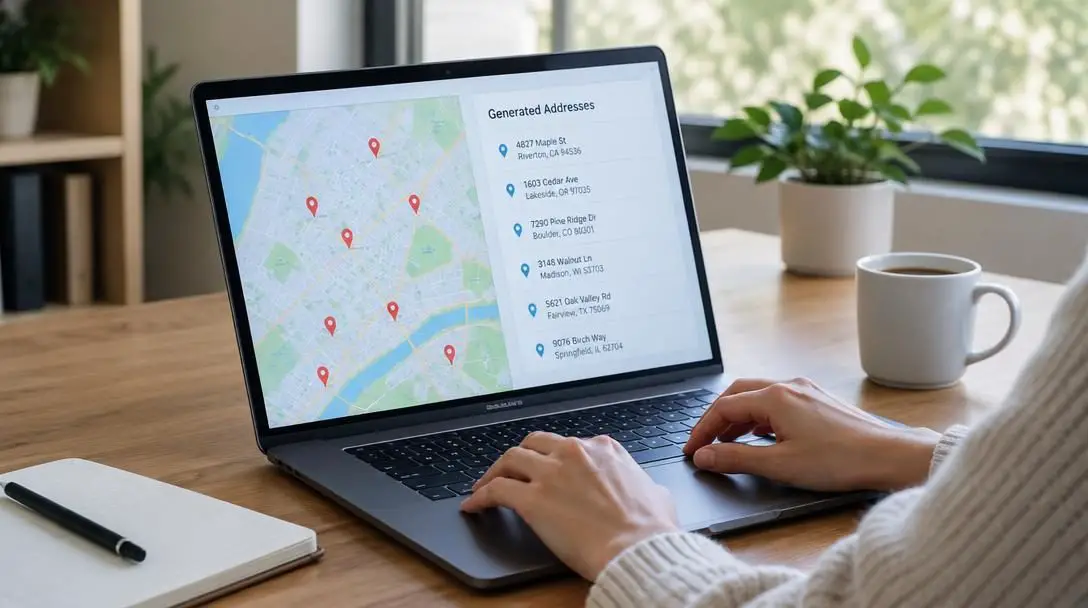
Implementing generated address data safely requires an intentional approach. Following a structured procedure prevents administrative mistakes and ensures smooth digital submissions.
- Assess the purpose of the form: Determine whether physical fulfillment or identity verification is required. If the transaction involves courier shipments, banking, or tax documents, use genuine information. If the site merely requires an address to access digital material, proceed with synthetic data.
- Select an appropriate address generator: Choose a generation tool that supports the exact country and regional structure required by the target platform to satisfy domestic postal format rules.
- Configure generation parameters: Set specific regional constraints, such as a designated province, state, or county, if you are conducting targeted software testing or need to mirror a specific setting.
- Generate and inspect the record: Trigger the generation tool and verify that all essential fields—including street line, suite or unit numbers, municipality, state, and postal code—are properly populated and logically consistent.
- Input the data into the form fields: Copy the synthetic elements into their corresponding inputs on the destination website, ensuring that automated form checks accept the syntax without throwing an error.
- Document test entries: If working within a software development or quality assurance context, log the generated records in your tracking framework to facilitate bug reproduction and environment cleanups.
Common Mistakes to Avoid
Although address generation tools are accessible and straightforward, misusing them can lead to financial losses, technical roadblocks, or legal issues. Avoiding widespread errors ensures that your use of synthetic information remains responsible and effective.
- Ordering physical products to a dummy location: Submitting a generated address during a physical purchase causes the carrier to deliver your package to a stranger or an invalid address, resulting in lost funds and undeliverable merchandise.
- Entering synthetic data on legal or financial portals: Government agencies, credit issuers, insurance providers, and banking portals are legally mandated to verify your true identity. Entering placeholder details on these platforms constitutes fraudulent misrepresentation and can trigger account termination.
- Mismatched geographic elements: Web forms frequently deploy validation scripts that cross-check postal codes against the entered city and state. Altering a generated record by hand or using an inferior tool with mismatched geographic data will cause the form to reject your submission.
- Polluting production databases during testing: Developers who insert unflagged mock addresses directly into live software environments risk triggering automated emails, disrupting customer analytics, and corrupting commercial reporting pipelines.
Broadening Digital Hygiene and Workflow Management
Protecting your physical street location is one component of a broader privacy strategy. When navigating sites that request non-essential personal identifiers, consider coupling random addresses with secondary email aliases and temporary phone forwarding numbers. Combining these measures prevents advertising networks from piecing together your behavioral profile across platforms.
For technical teams, manual address generation should eventually transition into automated data pipelines. Software engineering workflows benefit from integrating programmatic mock data libraries directly into continuous integration environments. Automated generation frameworks can populate staging environments with thousands of unique international records in seconds, confirming that an application correctly accommodates diacritics, localized postal structures, and variable line counts before moving to production.
Finally, engineering leaders and site administrators should evaluate their own collection practices. Demanding full geographic locations for software downloads or member boards introduces unnecessary regulatory liability and creates friction for prospective users. Trimming address fields down to bare essentials minimizes security exposure for the host enterprise while respecting user boundaries.
Frequently asked questions
Is it legal to use a random address generator?
Using a random address generator is legal when bypassing non-essential form fields on private websites, downloading digital assets, or conducting software testing. However, using fabricated location data on government forms, tax filings, credit applications, or financial contracts is illegal and can be treated as fraud.
Why do online forms ask for an address if nothing is being shipped?
Many websites use off-the-shelf software templates that include address fields by default, while others collect location information to build marketing profiles, track demographic data, or sell contact rosters to third-party advertising brokers.
Can a website tell that an address was generated by a tool?
Most basic forms only check whether the input matches typical postal formatting rules, such as checking that the state matches the postal code. Advanced platforms that cross-reference credit bureaus or official postal delivery databases may detect that the address does not match your name, but simple content portals cannot tell the difference.
What happens if I accidentally use a random address for an online order?
If you purchase a physical product using a random address, the merchant will ship the order to that artificial or arbitrary location. You will likely lose your money and the package, as the courier will either deliver it to whoever lives there or return it to the sender as undeliverable.
How do developers use random addresses in testing?
Developers use generated addresses to verify that database tables store location components correctly, that user interfaces display multi-line addresses properly, and that input forms handle various postal formats without crashing or exposing real customer files.
The bottom line
The indiscriminate collection of domestic addresses across the internet represents an unnecessary risk to personal privacy. A random address generator serves as an effective, practical countermeasure, giving everyday internet users the ability to satisfy invasive digital forms without compromising their physical security or inviting junk mail. For technical professionals, these utilities provide an indispensable source of structured, believable mock data that keeps staging builds compliant, safe, and bug-free.
By applying generated addresses thoughtfully—and recognizing the strict boundary between casual digital access and official legal interactions—users and engineers alike can streamline their online activities while keeping their true domestic whereabouts strictly private.