The Use of Computing in Space Exploration and Astronomy
Humanity spent thousands of years studying the heavens through manual observation and theoretical mathematics, yet physically crossing the threshold into outer space remained impossible until the mid-twentieth century. While early rocketry pioneers mastered the fundamentals of physics, chemistry, and aerodynamics, the extreme velocities of orbital spaceflight demanded instantaneous calculations and real-time operational responses that exceeded human biological capabilities. The ultimate leap beyond Earth required a profound technological transformation driven by computer science.
Today, advanced computational architectures form the operational foundation of astronautical engineering and astronomical discovery. Digital systems have evolved from the heavy, low-memory novelties of the early space race into autonomous, fault-tolerant platforms. Whether governing suborbital hops, tracking complex orbital rendezvous, or directing autonomous rovers across the Martian surface, computing makes exploration in the unforgiving void of space possible.
Key takeaways
- Early human spaceflight transitioned rapidly from analog sequencing and ground tracking to onboard digital flight assistance during the Gemini and Apollo missions.
- The 70-pound Apollo Guidance Computer established that onboard digital logic could manage real-time guidance loops, directly helping save Apollo 13 and Apollo 14 during critical anomalies.
- Modern aerospace software architectures handle continuous vehicle health diagnostics, orbital trajectory maneuvers, automated telescope targeting, and interplanetary rover operations.
- Designing deep-space computing requires physical radiation hardening, deterministic real-time operating systems, and strict software isolation between mission-critical tasks and secondary routines.
- Communication latency across interplanetary distances makes direct Earth-based piloting unfeasible, driving modern exploration craft toward onboard machine intelligence and high-efficiency power budgets.
Milestones in the evolution of spaceflight computing
The history of computing in space exploration illustrates humanity's shift from basic survival in low Earth orbit to precise interplanetary travel. While the earliest launch vehicles in the 1940s and 1950s reached space without digital processors onboard, navigating complex orbits required dedicated, miniaturized digital logic. Across four landmark programs, aerospace engineers steadily transferred operational authority from ground-based human calculators to onboard machines.
| Mission / Program | Primary Computing Mode | Key Technical Milestones | Human Pilot Authority |
|---|---|---|---|
| Vostok 1 | Ground control and rudimentary onboard sequencing | First human in outer space; orbital survival proof | Minimal intervention allowed |
| Project Mercury | Ground-based mainframes; manual spacecraft control | Evaluated human performance in orbital environments | Manual attitude control via stick and switches |
| Project Gemini | Rudimentary onboard digital computing assistance | First spacecraft orbital rendezvous and docking maneuvers | Manual piloting supported by digital calculation |
| Apollo Program (AGC) | Dedicated onboard digital computer (Apollo Guidance Computer) | Autonomous guidance, navigation; real-time abort recovery | Supervised automation with manual override capability |
Vostok 1
- First flight: April 12, 1961
- Crew member: Yuri Gagarin
- Control architecture: Automated ground systems and basic sequencing
- Onboard digital computer: None
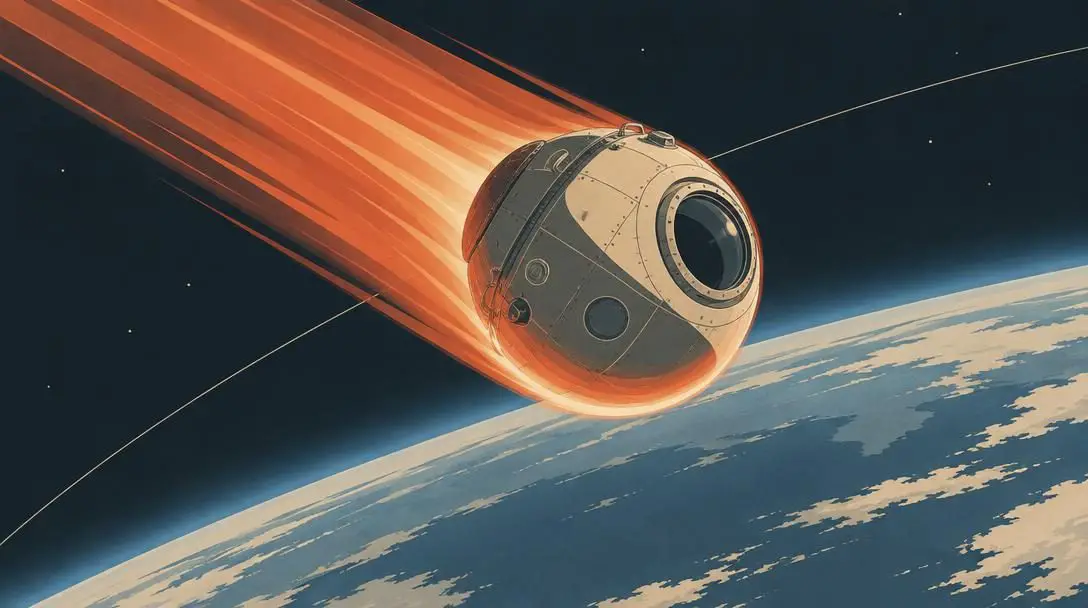
The dawn of human spaceflight arrived when the Soviet Union launched Vostok 1, placing cosmonaut Yuri Gagarin into Earth orbit. The vehicle relied on automated sequencing equipment and ground-based tracking rather than onboard microprocessors. Because medical experts and engineers were unsure how the disorientation of microgravity and extreme g-forces would affect human cognition, Gagarin's manual piloting controls were locked behind combination codes. The mission proved that a biological organism could survive the rigors of launch, zero gravity, and atmospheric reentry, but the guidance burden rested squarely on pre-programmed analog devices and Earth-based radar installations.
Project Mercury
- Operating nation: United States
- Target environment: Suborbital and low Earth orbit
- Primary flight interface: Manual control sticks and mechanical switches
- Trajectory computation: Earth-based computing centers
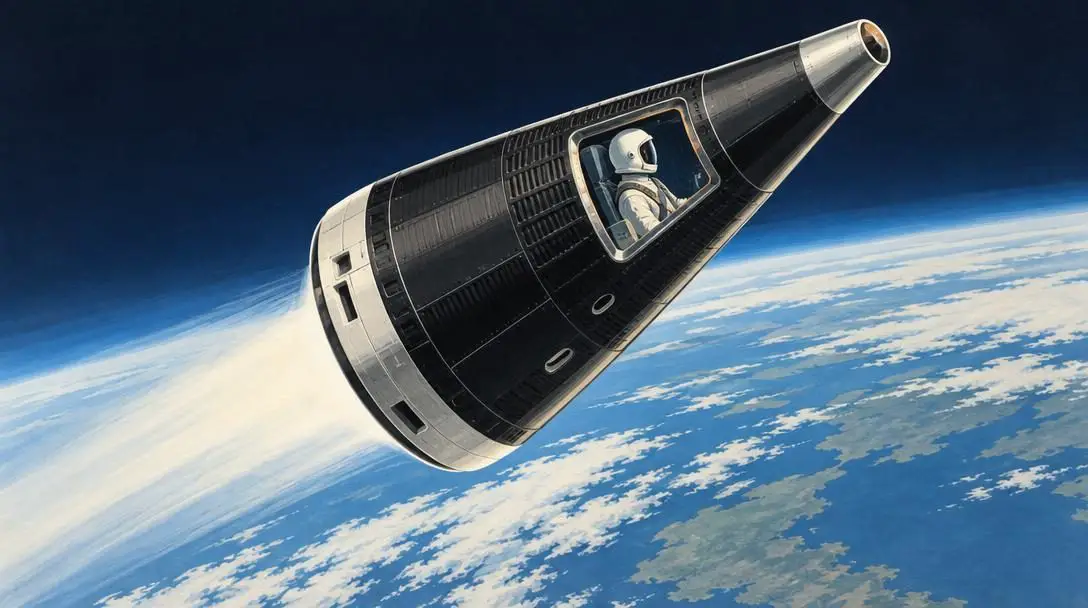
Running concurrently with the earliest Soviet successes, the American Project Mercury program evaluated human physiological and operational performance in microgravity. Mercury capsules contained no onboard digital computers. Astronauts held three-axis control sticks and flipped mechanical switches to manage the spacecraft's attitude during retrorocket burns and reentry. Trajectory mathematics and orbital path projections were calculated remotely using massive, room-sized computing mainframes located on Earth. While this setup proved that trained pilots could manually orient a craft in space, human reflexes alone lacked the rapid calculation speeds needed to execute intricate orbital transfers.
Project Gemini
- Core objectives: Orbital rendezvous, docking, and extravehicular activity
- Computational innovation: First onboard digital flight guidance support
- Operational bridge: Stepping stone between Mercury and Apollo
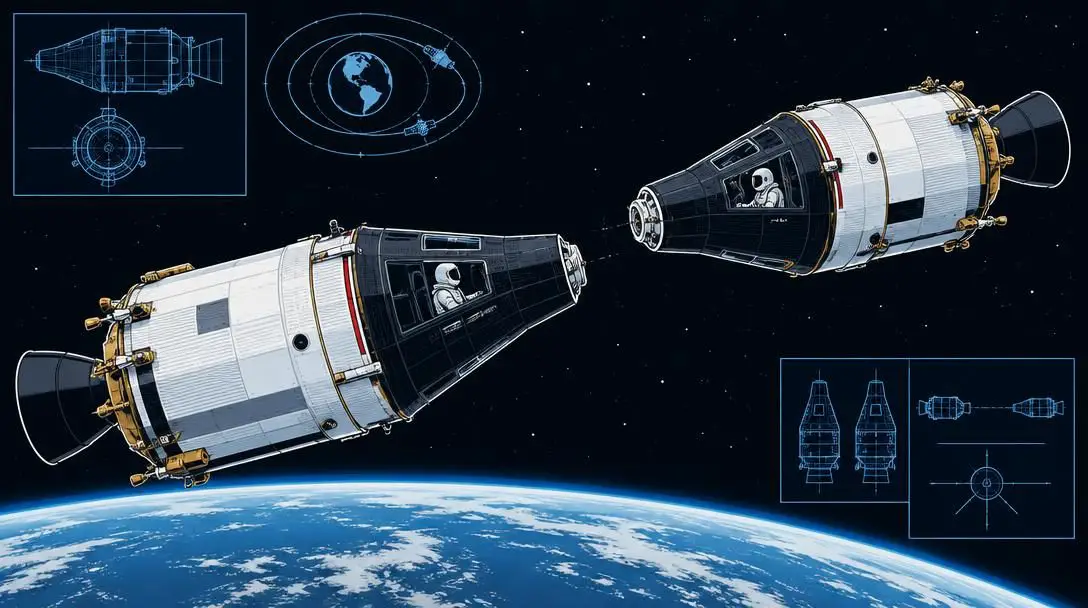
As flight profiles expanded to include orbital rendezvous, spacewalks, and docking with target vehicles, manual piloting supported purely by ground telemetry proved inadequate. Project Gemini marked the transition from stick-and-rudder maneuvering to computerized flight assistance. By introducing a rudimentary onboard digital computing system, Gemini allowed astronauts to calculate burns and trajectory shifts in real time. This breakthrough allowed two spacecraft moving at thousands of miles per hour to successfully locate and dock with one another in low Earth orbit, validating the navigational architecture required for a journey to the Moon.
Apollo Guidance Computer
- Hardware weight: Approximately 70 pounds
- Design role: Autonomous navigation and real-time guidance
- Mission impact: Aided recovery during Apollo 13 and Apollo 14 anomalies
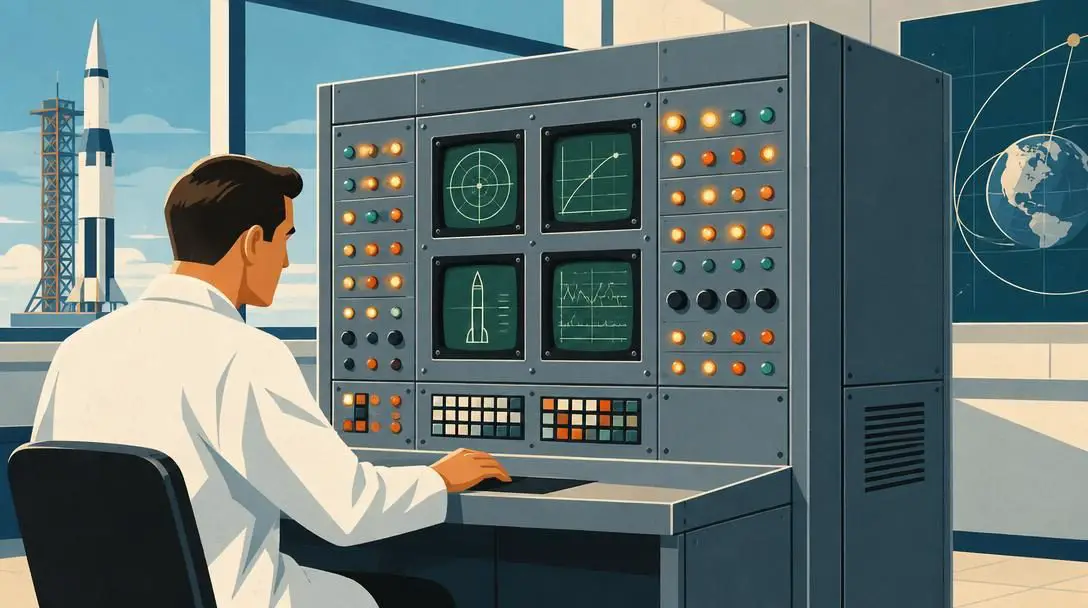
The introduction of the Apollo Guidance Computer (AGC) was a watershed moment in computer engineering. It represented the first space program to integrate digital computers into primary, real-time flight controls. Despite its 70-pound frame and microscopic memory capacity by today's standards, the AGC processed sensor data, ran guidance loops, and managed prioritized tasks through cooperative multi-tasking. When unexpected hardware failures and radar data overflows struck during lunar expeditions—most notably during the Apollo 13 system crisis and Apollo 14 radar anomalies—the robust design and automated fault recovery of the AGC played a direct role in saving the vehicles and bringing their crews safely home.
Guidance computers serve as the functional brains of a spacecraft, operating far beyond the capabilities of consumer hardware to ensure survival in the deep-space void.
Core pillars of modern spacecraft and astronomical computing
Modern spaceflight hardware operates in an entirely different league than its historic ancestors. As shuttle flight software engineer Roscoe Ferguson explained, guidance computers serve as the functional brains of an orbiter. Today's aerospace systems run lightyears ahead of early models and far outstrip the computing setups found inside commercial passenger aircraft. These processing cores handle four broad operational domains.
Spacecraft health and safety monitoring forms the initial pillar. Without continuous systems oversight, scientific missions cannot survive the harsh space environment. Onboard computers run real-time checks across three integrated layers:
- Continuous sensor tracking: Sensor networks measure minute variations in system temperatures, electrical currents, tank pressures, and structural loads to uncover defects before physical hardware fails.
- Automated alert generation: Operating systems flag anomalies immediately, broadcasting alarms to crew displays and ground controllers when readings drift outside safe thresholds.
- Preemptive redundancies: Software architectures isolate malfunctioning subsystems and instantly shift operations to secondary hardware without waiting for human intervention.
Orbital navigation and trajectory control converts mathematical astrophysics into safe flight corridors. Computers calculate atmospheric profiles to identify optimal launch windows, fire steering thrusters with millisecond accuracy, and adjust flight paths to intercept planets and moons millions of miles away.
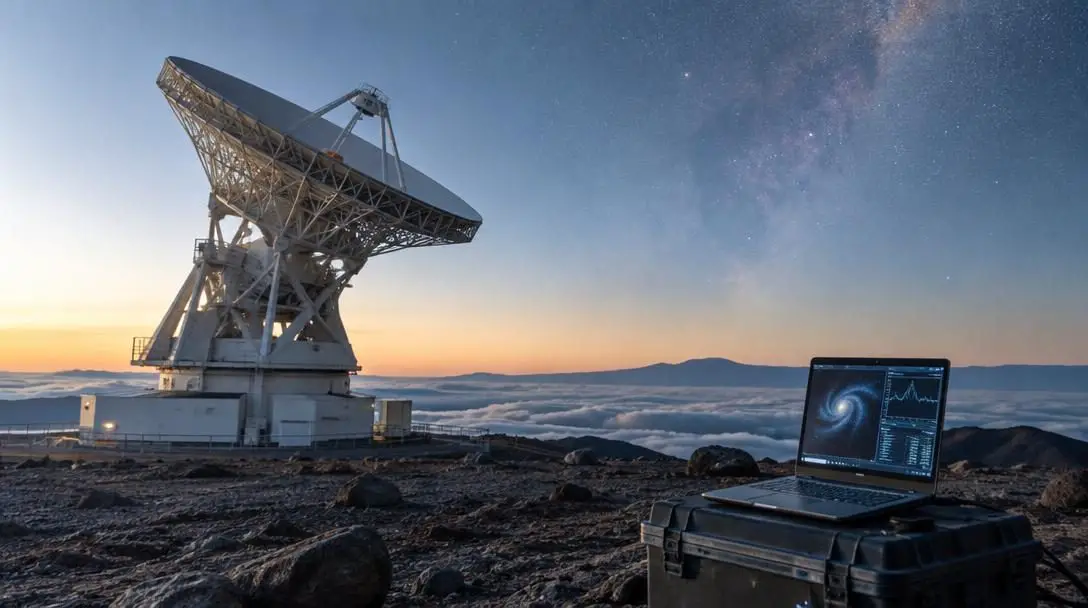
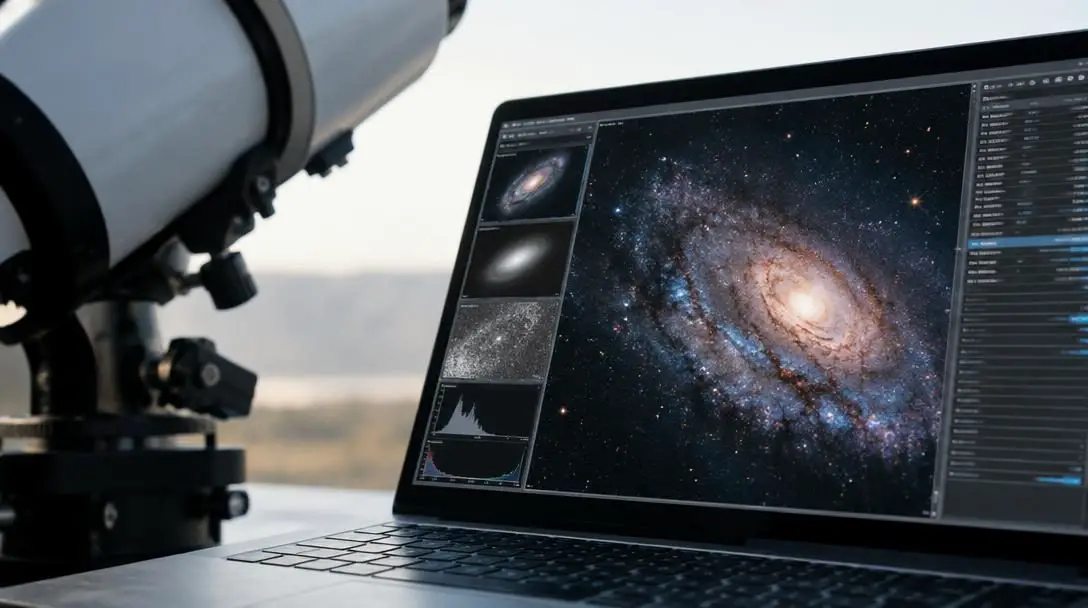
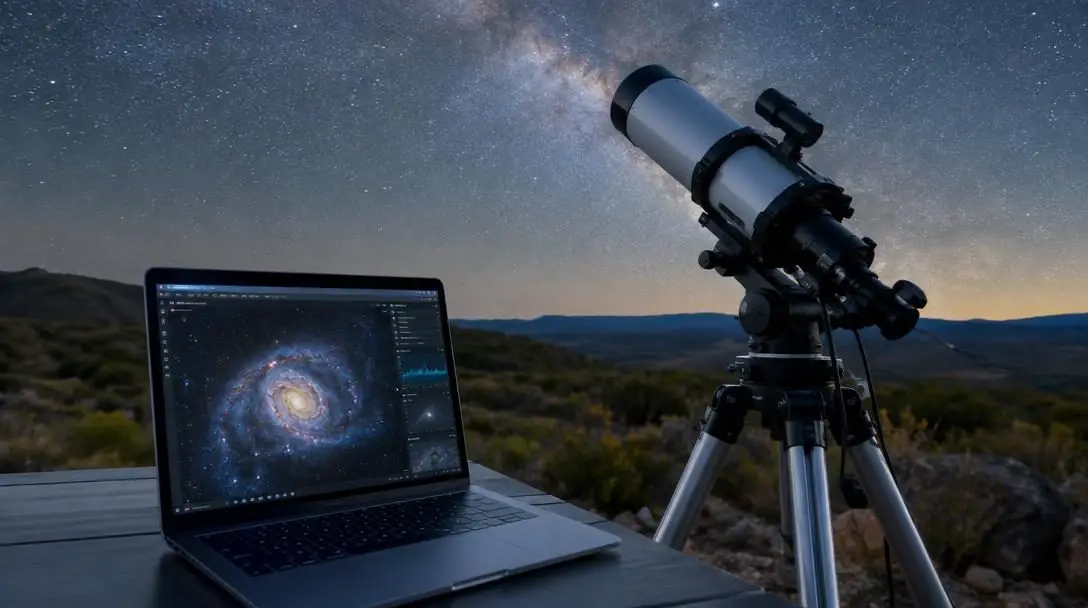
Astronomical data gathering and astrophysical simulation expands our reach beyond biological limits. Onboard algorithms automate space-based optical and radio telescopes, locking onto cosmic targets across prolonged exposures. Simultaneously, dynamic environmental scanning routines detect incoming space debris, while terrestrial supercomputers ingest raw telemetry to simulate complex phenomena like black hole accretion disks and galaxy formation.
Robotic surface exploration and telemetry networks allow sustained science on other worlds. Surface rovers on the Moon and Mars use dedicated computers to run laboratory instruments over months and years. These computers prioritize, compress, and packetize telemetry data, ensuring that high-gain and low-gain radio antennas transmit findings cleanly back to Earth across millions of miles.
Engineering mission-critical space computing systems
Designing aerospace hardware demands rigorous engineering cycles. Terrestrial consumer electronics are not built to survive launch acoustics, vacuum conditions, and cosmic radiation. Engineers apply a methodical workflow to construct space-grade computing stacks.
- Define environmental constraints: Calculate the launch vehicle's mechanical vibration spectrum and estimate the total ionizing radiation dosage expected across the flight trajectory.
- Implement hardware hardening: Build physical enclosures using shock-absorbing mounts and select silicon components treated for radiation tolerance to stop latch-up events and bit-flips.
- Develop deterministic software: Write guidance and propulsion code on real-time operating systems that enforce strict execution timing, eliminating thread deadlocks and memory leaks.
- Integrate vehicle sensor feeds: Connect fuel valve sensors, optical tracking cameras, star trackers, and structural strain gauges directly into the primary flight controller's monitoring architecture.
- Conduct environmental testing: Test assembled computing systems within thermal vacuum chambers, on high-g shake tables, and through simulated abort fault-injection routines.
- Program autonomous failover logic: Build self-monitoring watchdog circuits that allow auxiliary computers to assume command in milliseconds if the primary computer hangs.
- Optimize telemetry compression: Implement lossless compression algorithms to maximize the data throughput of radio transceivers communicating with ground stations.
Critical failure modes and design mistakes in aerospace computing
Space offers no second chances. A single architectural oversight can lead to the loss of a multi-million-dollar spacecraft. The aerospace sector has identified several critical mistakes that system designers must avoid:
- Relying on unhardened consumer hardware: Deploying standard commercial processors without structural dampening or radiation shielding leads to rapid failure under launch stress and solar particle bombardment.
- Skipping integrated failover validation: Assuming redundant computers will take over without conducting physical fault-injection tests leaves dangerous switching bugs hidden until an in-flight abort occurs.
- Overlooking throughput limitations: Pairing ultra-high-resolution observational cameras with narrow-bandwidth transmitters creates data bottlenecks that strand scientific observations in local storage.
- Failing to isolate safety-critical loops: Running background telemetry logging alongside primary guidance software risks crashing life-support and trajectory controls during a minor software fault.
- Tolerating scan latency in debris detection: Processing external radar and optical sensors at low refresh rates prevents the guidance system from executing evasive maneuvers around high-speed space junk.
- Underestimating cumulative radiation damage: Using microprocessors rated only for short missions on multi-year exploration flights guarantees component breakdown from total ionizing dose effects.
The future of deep-space computing and computational autonomy
As exploration pushes past Mars into the outer solar system, communication latency makes direct control from Earth impractical. Radio signals traveling at the speed of light take minutes to reach Mars and hours to reach the outer gas giants. Future deep-space probes cannot pause operations to ask ground controllers for guidance during sudden emergencies. To overcome this challenge, upcoming spacecraft rely on onboard machine intelligence to autonomously survey terrain, select scientific targets, and perform high-risk landings.
Furthermore, engineers must address strict electrical power budgets. Exploration vessels operate on limited electricity supplied by solar panels or radioisotope thermoelectric generators (RTGs). These systems must deliver high computational performance per watt while rejecting heat purely through radiation, as vacuum environments lack air to support convective cooling. Balancing real-time cognitive capability with strict thermal and energetic boundaries defines the next frontier of space hardware design.
Frequently asked questions
Why did the earliest spacecraft launch without digital computers?
Early digital computers in the 1950s and early 1960s were too massive, fragile, and power-hungry to be integrated into lightweight rocket capsules. Programs like Vostok 1 and Project Mercury used mechanical relays, analog sequencing circuits, and manual piloting while ground-based mainframe computers calculated trajectories.
How did the Apollo Guidance Computer help save missions?
The Apollo Guidance Computer featured an innovative real-time architecture that prioritized critical guidance tasks over secondary operations. During unexpected operational crises and radar anomalies on Apollo 13 and Apollo 14, its automated system oversight and deterministic task scheduling allowed crews and ground operators to maintain vehicle control and navigate safely.
Why do space computers prioritize deterministic execution over clock speed?
In deep-space operations, software crashes or unpredictable processing delays during thruster burns can destroy a vehicle. A deterministic real-time operating system ensures that safety-critical flight commands execute within precise, guaranteed timeframes, making reliability and predictable timing vastly more important than raw gigahertz processing speed.
How do computing systems cool down in the vacuum of space?
Because outer space is a vacuum, computers cannot use fans or convective air cooling to dissipate heat. Instead, aerospace engineers conduct heat away from microprocessors via physical heat pipes and conductive mounting plates, dissipating excess thermal energy out into space through thermal radiators using infrared radiation.
What causes single-event upsets like bit-flips in space electronics?
Single-event upsets occur when high-energy cosmic rays or solar particles penetrate a spacecraft and strike the silicon circuits of a microchip. The ionized charge deposits electrical energy, flipping a binary state from a 0 to a 1 or vice versa, which can corrupt critical flight data unless the hardware is radiation-hardened.
The bottom line
The progression of space exploration has mirrored the evolution of modern computing. What began with manual dials, analog timers, and ground-based mainframes has evolved into self-contained, radiation-hardened computational engines capable of independent decision-making millions of miles from Earth. As future missions voyage deeper into the cosmos, the survival and success of interplanetary explorers will rest on the resilience, autonomy, and speed of onboard computational architectures.