The Most Common Tarot Card Decks
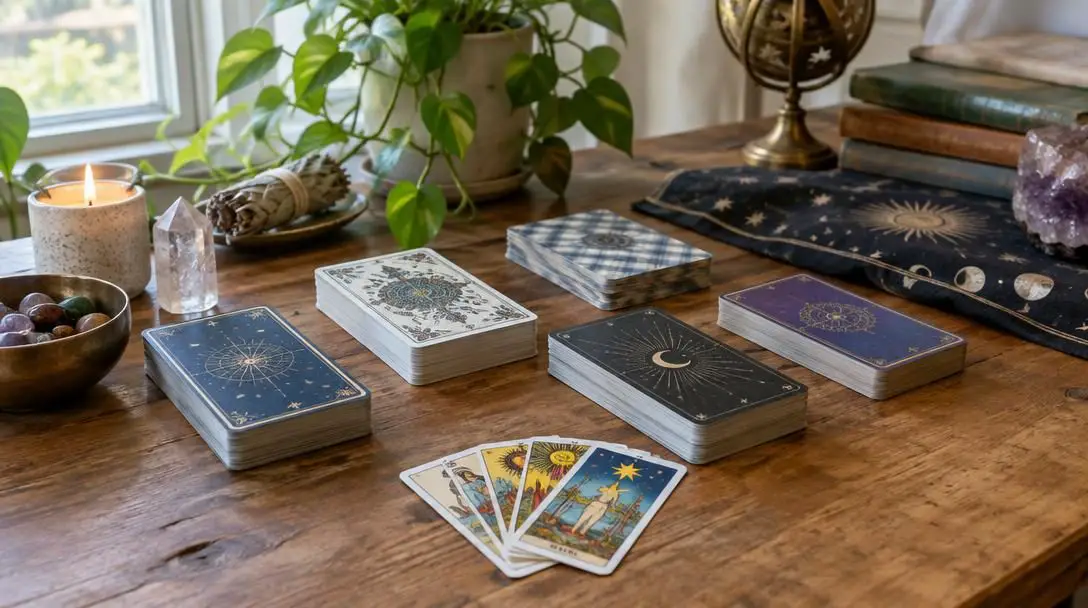
For centuries, seekers, scholars, and curious individuals have turned to tarot cards to inspect the past, navigate the present, and contemplate what lies ahead. While countless practitioners have drafted bespoke, hand-crafted decks strictly for private contemplation that never ventured beyond their personal chambers, a small collection of iconic systems has withstood the test of time. Evolving from early card games and illustrated allegories into intricate engines of esoteric study, these time-tested traditions continue to anchor the modern world of card reading.
Today, three distinct decks represent the primary foundations of Western tarot: the historic Tarot of Marseilles, the universally recognized Rider-Waite Tarot, and the philosophically dense Thoth Tarot Deck. Each system mirrors the distinct era in which it rose to prominence, the artistic sensibilities of its illustrators, and the philosophical frameworks of its architects. Exploring their distinctive structures and visual languages reveals how a simple deck of illustrated cards transformed into an enduring instrument for introspection, creative analysis, and personal transformation.
Key takeaways
- Three foundational deck traditions—the Tarot of Marseilles, the Rider-Waite Tarot, and the Thoth Tarot Deck—form the basis for modern tarot practice worldwide.
- While publishers and esoteric thinkers often gave these decks their famous titles, female artists Pamela Colman Smith and Lady Frieda Harris were the primary creative visionaries responsible for rendering the imagery.
- Tarot decks generally contain 78 cards divided into the Major and Minor Arcana, though individual traditions diverge significantly in suit labels and court card hierarchies.
- Rather than functioning merely as fortune-telling tools, historical tarot traditions are widely applied as reflective systems for reinterpreting the present and cultivating personal honesty.
- The Rider-Waite deck currently resides in the public domain, encouraging widespread reproduction and adaptation across contemporary culture.
At a glance: Comparing the three foundational decks
Each foundational deck approaches symbolism, art styles, and card organization from a distinct philosophical angle. The following comparison highlights the core attributes and historical origins of these three classic traditions.
| Deck Tradition | Historical Origin | Key Contributors | Minor Arcana Suits | Distinctive Court Cards |
|---|---|---|---|---|
| Tarot of Marseilles | Milan, Italy (speculated); popularized in France during the 1600s | Anonymous early artisans, woodcut printmakers | Swords, Cups, Coins, Clubs | Traditional Page, Knight, Queen, King |
| Rider-Waite Tarot | England, early 20th century (published by Rider) | A.E. Waite, Pamela Colman Smith | Swords, Cups, Pentacles, Wands | Traditional Page, Knight, Queen, King |
| Thoth Tarot Deck | England, mid-20th century (developed through 1947) | Aleister Crowley, Lady Frieda Harris | Swords, Cups, Disks (Pentacles), Wands | Princess, Prince, Queen, Knight |
The three most common tarot card decks
Understanding modern cartomancy begins with the three iconic systems that established the visual conventions, occult correspondences, and interpretive methods used today.
The Tarot of Marseilles
- Estimated origins: Speculated to have originated in Milan, Italy; flourished in 1600s France
- Card count: 78 cards
- Core suits: Swords, Cups, Coins, and Clubs
- Original medium: Early woodcuts, later stenciled and hand-drawn
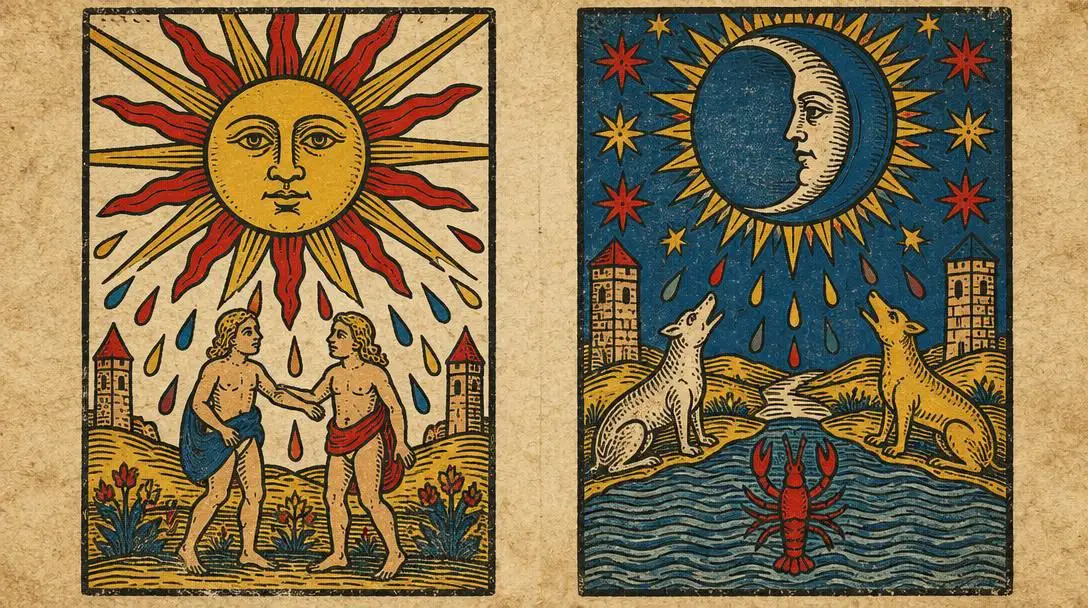
The exact birthplace of the Tarot of Marseilles remains a historical mystery. Although its enduring name links it directly to southern France, historical evidence points toward northern Italian origins, specifically the printing centers of Milan. By the 1600s, however, the 78-card pattern gained immense popularity across France, solidifying its identity and reputation. It is broadly celebrated as the earliest standardized pattern adopted for formal occult and divinatory exploration.
The structure of the Marseilles deck uses four classical suits: Swords, Cups, Coins, and Clubs. Its trump cards are traditionally lettered with French titles, showcasing iconic archetypes such as Le Diable (The Devil), Le Soleil (The Sun), and Le Monde (The World). Visually, these cards reflect early printmaking technology; early runs were stamped from carved woodblocks and subsequently colored using stencils or hand-applied washes. Countless print shops issued regional variations over the centuries, and modern pressings remain in print due to the deck's historical prestige.
While early practitioners approached the Marseilles deck through formal esoteric ritual, modern readers frequently turn to its stark, primary-colored geometries for creative inquiry, psychological study, and entertainment. Many commentators have cited the deck's capacity for triggering radical personal shifts. Author Armando Amaya shared that sustained study of the Marseilles cards motivated him to abandon patterns of dishonesty with family and friends, helping him leave behind laziness, aimlessness, drugs, and alcohol. As journalist Beth Daley highlighted, the imagery was never an engine for deterministic prediction, but rather a flexible framework for examining and resolving the stresses of an uncertain present.
The Rider-Waite Tarot
- First publication: Early 20th century (Rider company)
- Principal creators: A.E. Waite and Pamela Colman Smith
- Core suits: Wands, Cups, Swords, and Pentacles
- Current legal status: Public domain
The Rider-Waite Tarot stands as the most recognized deck on the planet, boasting well over 100 million copies printed and distributed globally. The deck derived its commercial title from its publishing house, Rider, alongside Arthur Edward Waite. Waite was an accomplished scholar, occultist, and poet who approached mystic traditions with open-minded seriousness rather than moralizing judgment, dedicating decades of his adult life to the systematic study of esoteric lore.
To give tangible form to his ideas, Waite commissioned British artist Pamela Colman Smith. Although Smith received no naming credit in the initial publication, she was a prolific creator who had already authored her own books and illustrated dozens of literary works. Working at an astonishing pace, Smith completed all seventy-eight illustrated compositions in roughly six months. She drew heavy creative cues from the writings and symbolic diagrams of French ceremonial magician Eliphas Levi, embedding layered esoteric metaphors within approachable figurative scenes.
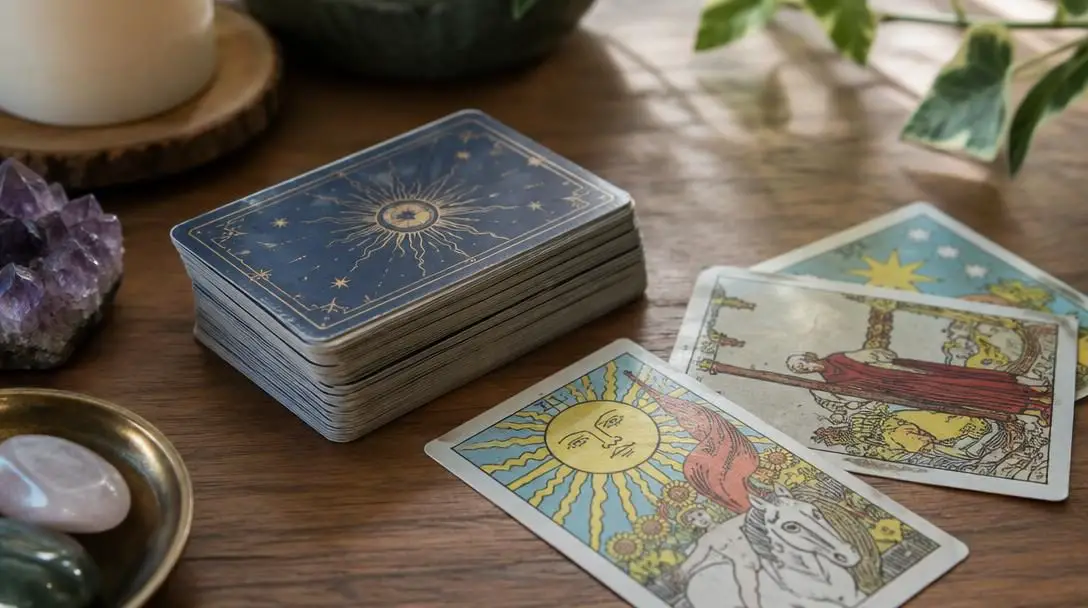
Smith’s contribution completely reshaped modern tarot by illustrating every single Minor Arcana pip card with full narrative scenes rather than mere collections of suit icons. Her composition for card XV, The Devil, has become one of the most recognized visual tropes in Western media, repeatedly copied across cinema, literature, and album art. Because the original Rider-Waite images now reside in the public domain, creators worldwide are free to reprint, recolor, and reinvent the deck without legal restraint, ensuring its permanent status as the universal baseline for contemporary cartomancy.
The Thoth Tarot Deck
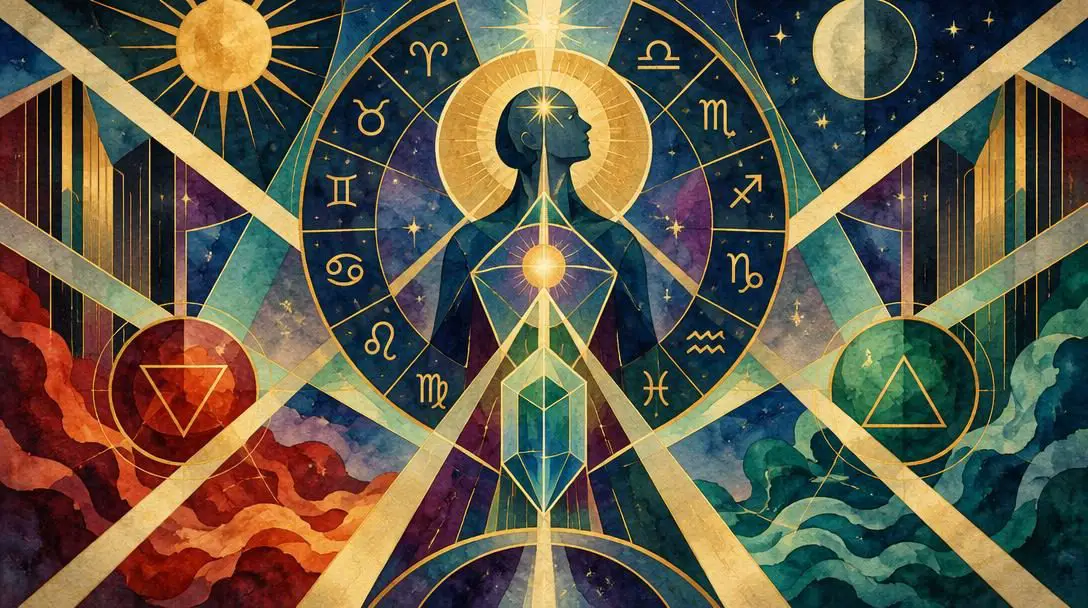
- Conception period: Mid-20th century (collaborative project concluding in 1947)
- Principal creators: Aleister Crowley and Lady Frieda Harris
- Central philosophy: Thelema and zodiacal correspondences
- Core court hierarchy: Princess, Prince, Queen, and Knight
The third towering tradition within modern practice is the Thoth Tarot Deck, masterminded by Aleister Crowley, one of the twentieth century’s most talked-about esoteric figures. Crowley established the spiritual philosophy of Thelema, designing the Thoth system to act as a definitive symbolic guide and doctrinal foundation for this mystical movement. To turn his complex cosmological visions into physical paintings, Crowley turned to Lady Frieda Harris, an accomplished fine artist who had established her reputation long before encountering his teachings.
The collaboration proved transformative. While Crowley initially envisioned a modest project simply updating classical tropes, Harris pushed him to plunge deeper into intense occult abstraction. Over years of rigorous drafting, Harris executed vibrant, Art Deco-influenced watercolor panels incorporating Egyptian mythology, alchemy, and sacred geometry. Crowley frequently praised Harris’s visual genius, and their creative dialogue remained active until Crowley’s death in 1947.
The Thoth deck departs sharply from traditional tarot conventions. Astrological associations and the zodiac are integrated directly into the artistic composition of every card. Crowley and Harris also extensively reorganized the court cards: the traditional page was renamed the princess, the knight assumed the seat of the traditional king, and the prince assumed the position normally held by the knight. Across this extensive reordering of ranks, only the queen remained unchanged in name and relative placement.
Tarot functions not as a fortune-telling tool for an unchangeable future, but as a symbolic mirror for reinterpreting the challenges of the present.
Understanding how tarot card systems function
Despite their divergent historical backgrounds and contrasting artistic styles, all three major traditions operate upon a cohesive 78-card structure. Mastering the interplay between these core components unlocks the symbolic potential of the cards.
The Major Arcana: Numbering twenty-two cards, the trump sequence illustrates universal archetypes, critical turning points, and expansive existential transitions. From the testing shadow of The Devil to the illuminating clarity of The Sun and the climactic wholeness of The World, these cards highlight broad thematic movements rather than mundane day-to-day encounters.
The Minor Arcana: Comprising fifty-six cards, the Minor Arcana addresses the tangible mechanics of day-to-day existence, personal relationships, conflicts, and internal deliberations. It divides evenly across four suits, each containing ten numbered "pip" cards and four court personalities.
Suits and elemental associations: Suit divisions vary subtly between traditions to mirror cultural and historical shifts:
- Tarot of Marseilles: Relies on the historical Latin suits of Swords, Cups, Coins, and Clubs.
- Rider-Waite Tarot: Employs Swords, Cups, Pentacles, and Wands, cementing the suits favored by the English occult revival.
- Thoth Deck: Adopts Swords, Cups, Disks, and Wands, emphasizing elemental forces and alchemical interactions.
Court cards and symbolic personas: The court figures serve as mirrors for personal archetypes, social dynamics, or specific behavioral modes. While Marseilles and Rider-Waite follow the standard page-knight-queen-king feudal hierarchy, the Thoth deck redistributes these roles into princesses, princes, queens, and knights to mirror Crowley’s esoteric cosmological view.
Zodiac and occult correspondences: Systems like the Thoth deck intertwine formal astrological decans, planetary alignments, and elemental attributes across the entire deck. The imagery within each scene provides visual cues intended to unlock these layered theoretical associations during study.
Practical steps for exploring and using tarot
Engaging with historic tarot traditions is most rewarding when approached through structured visual analysis and regular personal study. Readers eager to examine these decks can adopt the following method:
- Select an appropriate deck: Evaluate your goals to choose the right match. Pick the Tarot of Marseilles if you value historical woodcuts and non-narrative pips, the Rider-Waite for deeply narrative, character-driven imagery, or the Thoth deck for rich zodiacal and occult symbolism.
- Examine the card structure: Separate the seventy-eight cards into the twenty-two Major Arcana trumps and the fifty-six Minor Arcana suit cards to familiarize yourself with how the two sections balance one another.
- Study the symbolism in isolation: Select individual cards and inspect their visual elements without relying immediately on instructional booklets. Notice how artists Pamela Colman Smith or Lady Frieda Harris balanced postures, background scenery, and color palettes.
- Learn the naming conventions: Note the precise titles utilized by your deck of choice. Watch for French labels in Marseilles pressings or the revised court ranks unique to Crowley and Harris’s Thoth system.
- Frame clear, reflective inquiries: Direct your questions toward clarifying current dynamics, resolving creative roadblocks, or making sense of uncertain circumstances, rather than demanding fatalistic future predictions.
- Practice simple layouts: Draw a single card for daily meditation or organize a basic two-to-three card arrangement to see how different visual symbols converse with one another across a spread.
- Record observations consistently: Maintain a dedicated study journal to note recurring card draws, evolving interpretations of specific symbols, and personal insights over extended periods.
Common mistakes when studying tarot traditions
Newcomers to historical cartomancy frequently stumble over recurring misconceptions regarding the creation, intention, and structural rules of tarot decks. Staying mindful of these errors ensures an objective, grounded education:
- Viewing the cards strictly as deterministic fortune-telling: Treating the cards as literal forecasts ignores their richer, well-documented utility as reflective tools designed to examine present psychological and environmental patterns.
- Overlooking the primary artists: Giving exclusive credit to publishers or occult figures like Rider, Waite, or Crowley overlooks the pivotal artistic genius of illustrators Pamela Colman Smith and Lady Frieda Harris, who gave visual life to these complex systems.
- Assuming identical card names across traditions: Presuming that all 78-card decks share the same labels causes needless confusion, especially when encountering the Thoth deck's replacement of traditional pages and kings with princesses and knights.
- Ignoring historical print technologies: Forgetting that foundational patterns like the Marseilles were constrained by the physical realities of early woodblock cutting and manual stenciling can lead readers to misjudge their deliberate aesthetic simplicity.
- Relying exclusively on rigid handbook definitions: Depending entirely on memorized, fixed definitions blunts your capacity to observe how visual cues, colors, and archetypal interactions speak to real-world scenarios.
Deepening your tarot practice and historical study
Once you are comfortable with the basic formats of these three decks, you can expand your study along several historical and artistic paths. Tracing the geographical migration of playing cards from northern Italian merchant centers like Milan into French artisan communities reveals how commercial woodblock patterns evolved into standard spiritual systems over several hundred years.
Another fascinating area of study involves comparing the distinct artistic methods of Pamela Colman Smith and Lady Frieda Harris. Analyzing how Smith drew inspiration from 19th-century occult author Eliphas Levi to generate expressive, turn-of-the-century narrative scenes contrasts sharply with Harris’s technical drafting, dynamic Art Deco angles, and dense astrological frameworks. Tracing these stylistic choices shows how early-20th-century cultural currents influenced esoteric imagery.
Finally, consider how structured card study fits your ongoing personal routines. Whether you draw upon cards for daily writing exercises, creative problem-solving, structured self-help, or recreational contemplation, selecting a deck tradition aligned with your aesthetic tastes will anchor your practice in an enduring human tradition.
Frequently asked questions
Which tarot deck is best for a beginner?
The Rider-Waite Tarot is widely considered the best deck for beginners because all 78 cards feature full narrative illustrations drawn by Pamela Colman Smith. This visual storytelling makes the meanings easier to grasp than the geometric pip arrangements found in the Tarot of Marseilles or the abstract esoteric systems used in the Thoth deck.
Why are the court cards in the Thoth deck different from other decks?
Aleister Crowley and Lady Frieda Harris rearranged the court cards to align with Crowley's esoteric philosophy of Thelema and specific astrological decans. They replaced the traditional page with the princess, promoted the knight to replace the traditional king, and introduced the prince in place of the knight, leaving only the queen unchanged.
Can anyone legally print and sell the Rider-Waite Tarot?
Yes. The original Rider-Waite Tarot published in the early 20th century is in the public domain. This legal status allows artists, authors, and publishers to reproduce the artwork, produce custom recolored editions, and incorporate the classic illustrations into new projects without licensing penalties.
What are the suits used in the Tarot of Marseilles?
The Tarot of Marseilles uses traditional Latin suits: Swords, Cups, Coins, and Clubs. These suit designations predate the suits popularized by the English esoteric revival (such as Pentacles and Wands) and reflect the deck's origins in early Italian and French card printing.
Who was Pamela Colman Smith?
Pamela Colman Smith was a British artist, author, and folklorist who illustrated the seventy-eight cards of the Rider-Waite Tarot in just six months. Drawing inspiration from magician Eliphas Levi, her figurative designs revolutionized cartomancy, even though her name was initially omitted from the commercial title of the deck.
The bottom line
The global persistence of tarot stems from its remarkable capacity to synthesize art, philosophy, and self-reflection within a portable sequence of 78 cards. Whether drawn to the rugged, woodcut lines of the Tarot of Marseilles, the accessible narrative theater of the Rider-Waite deck, or the dense astrological geometry of the Thoth system, studying these three classic traditions connects you to centuries of visual craftsmanship and intellectual curiosity.