The Tallest Players in Baseball History
Across the landscape of professional sports, extreme physical height is often celebrated as an immediate structural advantage. On basketball courts and football fields, standing head and shoulders above the competition provides instant leverage, wingspan, and spatial dominance. In baseball, however, traditional wisdom has long favored athletes of more modest, average height. For generations, scouts and managers believed that average-sized players maintained superior balance, possessed a more compact strike zone, and could repeat their mechanics far more reliably over a grueling 162-game season. A towering batter presents a massive strike zone for pitchers to carve up, while a towering pitcher must synchronize longer limbs through a complex kinetic sequence.
Despite these historical reservations, a select group of towering athletes has shattered conventional molds to reach the highest level of professional baseball. While rumors and folklore occasionally suggest that seven-foot giants have played in the majors, official historical records tell a different story. Major League Baseball has never featured a verified seven-footer on an active roster. Instead, the absolute pinnacle of baseball height belongs to a rare fraternity of pitchers standing at 6’10” and 6’11”. Examining their careers reveals how these extraordinary athletes turned their physical stature into a formidable weapon on the mound while battling the unique biomechanical hurdles that accompany an extreme frame.
Key takeaways
- Major League Baseball has never featured a verified seven-foot player in official league history.
- Every player in baseball history measuring 6’10” or 6’11” reached the majors exclusively as a pitcher.
- Randy Johnson remains the most decorated tall player in history, compiling 303 wins, 4,875 strikeouts, and a Hall of Fame induction.
- Jon Rauch and Sean Hjelle share the distinction of being the tallest players in MLB history at 6’11”.
- Extreme height generates distinct release angles and plate extension, but requires exceptional core strength to maintain mechanical consistency.
The tallest players in Major League Baseball at a glance
To date, only eight players have officially reached the 6’10” or 6’11” threshold in Major League Baseball history. The table below outlines how these towering pitchers compare across their professional careers.
| Player | Official height | MLB debut | Career longevity | Key career notes |
|---|---|---|---|---|
| Jon Rauch | 6’11” | 2002 | 11 seasons | First 6’11” player in MLB history; pitched for 7 franchises |
| Sean Hjelle | 6’11” | 2022 | Active | Second player in history to match the 6’11” mark |
| Randy Johnson | 6’10” | 1988 | 22 seasons | Baseball Hall of Fame (2015); 303 wins; 4,875 strikeouts |
| Chris Young | 6’10” | 2004 | 13 seasons | 2007 MLB All-Star; 2015 World Series champion |
| Andy Sisco | 6’10” | 2005 | 3 seasons | 151 career appearances across two American League clubs |
| Eric Hillman | 6’10” | 1992 | 3 seasons | Drafted out of Eastern Illinois University; 49 games with Mets |
| Aaron Slegers | 6’10” | 2017 | 4 seasons | Relief pitcher; appeared in over 45 games across multiple teams |
| Andrew Brackman | 6’10” | 2011 | 1 season | Former first-round selection; pitched 2.1 major league innings |
The 6’11” record holders: The tallest pitchers in MLB history
Only two men in the long history of professional baseball have stepped onto an MLB mound at the official measurement of 6’11”. Both used their unique elevation to establish distinct careers as major league hurlers.
Jon Rauch
- Height: 6’11”
- MLB Debut: 2002
- Career Longevity: 11 seasons
- Career Record: 43-40 with a 3.90 ERA
When Jon Rauch made his major league debut in 2002 at the age of 23, he instantly rewrote baseball record books by becoming the tallest player in Major League Baseball history. Originally drafted by the Chicago White Sox, Rauch eventually transitioned into a highly reliable bullpen weapon who could handle both middle-relief assignments and late-inning high-leverage situations.
Rauch enjoyed a far more sustained and impactful career than many casual observers realize. Over the course of 11 big-league seasons, he pitched for seven different franchises, demonstrating remarkable endurance and consistency. By the time his playing days concluded, Rauch had compiled a 43-40 career record, logged hundreds of appearances, and maintained a solid 3.90 earned run average as a durable relief arm.
Sean Hjelle
- Height: 6’11”
- MLB Debut: 2022
- Draft Club: San Francisco Giants
- Rookie Appearances: 8 games (2022 season)
For two decades, Jon Rauch stood alone at the top of the height record book. That changed during the 2022 season when the San Francisco Giants promoted pitching prospect Sean Hjelle to the big leagues. Standing an official 6’11”, Hjelle became just the second pitcher in baseball history to reach that extreme measurement at the major league level.
Reaching the majors required a methodical climb for Hjelle, who navigated every rung of the minor league ladder before earning his call-up. During his debut 2022 campaign, he appeared in eight games for the Giants, showing how a modern pitcher can combine tremendous stride extension with heavy sinking action to generate ground-ball outs against major league hitting.
The 6’10” fraternity: Dominance, longevity, and brief breakthroughs
While the 6’11” tier consists of just two players, a slightly larger group reached the 6’10” plateau. This fraternity spans from one of the greatest pitchers in baseball history to prospects whose time under the stadium lights lasted only a matter of innings.
Randy Johnson
- Height: 6’10”
- Career Longevity: 22 seasons (1988–2009)
- Career Strikeouts: 4,875
- Hall of Fame Induction: 2015 (near-unanimous)
Without question, Randy Johnson is the gold standard for height and athletic excellence in baseball history. Known throughout sports culture by his iconic moniker, “The Big Unit,” Johnson transformed his imposing 6’10” frame into one of the most intimidating presences any hitter ever faced. Pitching from the left side, Johnson unleashed a scorching fastball combined with a sweeping slider that appeared to originate from behind a left-handed hitter’s hip.

Johnson’s career was characterized by sustained dominance across 22 seasons with six different franchises. A 10-time All-Star, Johnson led the league in earned run average four times, compiled 303 career victories, and racked up 4,875 strikeouts—the second-highest total in major league history. He reached the apex of his postseason legacy during the 2001 World Series, earning Most Valuable Player honors while leading the Arizona Diamondbacks to the title before gaining near-unanimous election to the Baseball Hall of Fame in 2015.
Chris Young
- Height: 6’10”
- MLB Debut: 2004 (Texas Rangers)
- Career Longevity: 13 seasons
- Accolades: 2007 All-Star, 2015 World Series champion
Drafted originally by the Pittsburgh Pirates, Chris Young established himself as one of the most effective and cerebral starting pitchers of his era after debuting with the Texas Rangers in 2004. Standing 6’10”, Young did not rely on blistering velocity to retire hitters. Instead, he capitalized on his exceptional downward angle, high arm slot, and deceptive release point to create extreme fly-ball outs at the top of the strike zone.
Young enjoyed a productive 13-year major league career representing five different organizations. He earned a selection to the National League All-Star roster in 2007 while pitching for the San Diego Padres and later played a vital role in the Kansas City Royals’ rotation and bullpen during their run to the 2015 World Series championship.
Andy Sisco
- Height: 6’10”
- MLB Debut: 2005 (Kansas City Royals)
- Draft Position: Second round (2001, Chicago Cubs)
- Career Games: 151 games pitched
Andy Sisco entered professional baseball with significant fanfare after being drafted in the second round of the 2001 draft by the Chicago Cubs. A towering left-handed pitcher, Sisco developed through the minor league pipeline before being selected by the Kansas City Royals, making his major league debut in 2005. His high-velocity arm and steep release plane initially made him a regular weapon out of the bullpen.
Sisco appeared in 151 major league contests during his career, pitching for both the Royals and the Chicago White Sox. However, mechanical inconsistencies and control problems hindered his long-term effectiveness. His final big-league appearances came during the 2007 campaign with the White Sox, a difficult season in which he posted an 8.36 earned run average across 19 games before departing the major league ranks.
Aaron Slegers

- Height: 6’10”
- Birthplace: Long Beach, California
- MLB Debut: 2017 (Minnesota Twins)
- Career Total: Over 45 games pitched
A native of Long Beach, California, Aaron Slegers made his major league debut in 2017 with the Minnesota Twins. At 6’10”, Slegers brought a commanding physical presence to the mound, serving organizations as both a spot starter and a multi-inning relief pitcher who could absorb valuable frames.
Slegers spent several seasons bouncing between the minor leagues and the majors, frequently serving as an adaptable arm across several different organizations. Over his major league career, Slegers pitched in more than 45 games, ultimately compiling a career earned run average slightly over five while showcasing the challenges tall relievers face when trying to stick permanently on a big-league roster.
Eric Hillman
- Height: 6’10”
- College: Eastern Illinois University
- Draft Year: 1987 (New York Mets)
- Career Record: 4-14 with a 4.85 ERA
Eric Hillman emerged from Eastern Illinois University, a school with limited historical representation in Major League Baseball, when he was selected by the New York Mets in the 1987 draft. Hillman spent several years methodically honing his delivery in the minors before breaking through to make his Mets debut during the 1992 season.
Hillman’s tenure at the highest level was relatively brief. Over three seasons from 1992 through 1994, he appeared in 49 games for the Mets, concluding his major league career with a 4-14 win-loss record and a 4.85 earned run average. Despite his short career, Hillman was one of the earliest modern examples of a pitcher standing near seven feet earning extended playing time in a starting rotation.
Andrew Brackman
- Height: 6’10”
- Draft Year: 2007 (First round, New York Yankees)
- MLB Debut: 2011
- Career Innings: 2.1 innings pitched
Andrew Brackman represents the razor-thin margin between prospect hype and major league longevity. A standout two-sport collegiate athlete who was selected in the first round of the 2007 draft by the New York Yankees, Brackman possessed an electric arm paired with a 6’10” frame that tantalized professional scouts.
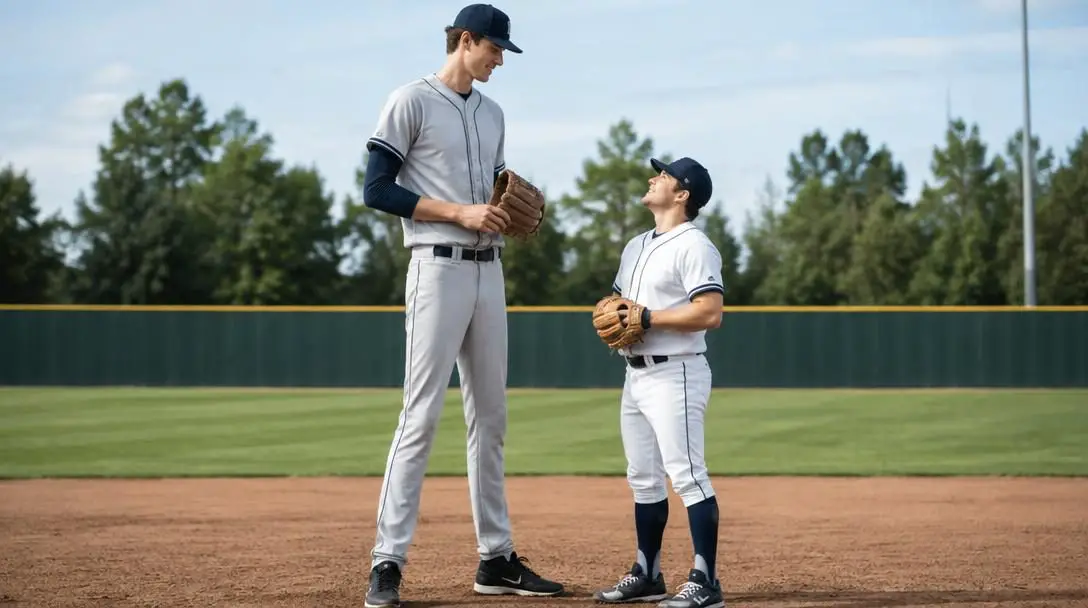
Unfortunately, Brackman spent the vast majority of his professional career navigating injuries and command struggles in the minor leagues. He finally broke through to the majors in September 2011, making three relief appearances for the Yankees. His big-league career ended after just 2.1 total innings pitched, illustrating how difficult it can be for towering athletes to master the repeatable mechanics necessary to survive at the game’s highest tier.
The biomechanics of extreme height on the mound
Understanding how pitchers like Randy Johnson or Jon Rauch succeeded requires looking at the physical laws governing baseball mechanics. Pitching is an intricate kinetic chain: force is generated from the back leg pushing against the rubber, transferred through the hips and core, and accelerated through the shoulder, elbow, and fingertips. When an athlete stands 6’10” or 6’11”, that kinetic sequence undergoes significant modifications.
Releasing the baseball closer to home plate effectively steals precious reaction time from the batter.
The primary advantage of extreme height lies in release point elevation and stride extension. Because tall pitchers possess longer legs, they naturally stride farther down the pitching mound toward home plate. While an average pitcher might release the ball 5.5 to 6 feet in front of the rubber, an athlete standing 6’10” can achieve an extension exceeding 7 feet. By shortening the physical distance between the release point and home plate, the pitch has less travel time, causing a 92-mph fastball to appear significantly faster to the batter. Furthermore, releasing the ball from a higher elevation produces a steep downward plane, forcing hitters to adjust their swing paths to hit a ball dropping at an unfamiliar angle.
Conversely, extreme height introduces serious physical vulnerabilities. Long arms and legs act as extended levers. In mechanical physics, the longer a lever is, the more difficult it is to control its exact path in space. If a pitcher’s stride foot lands just two inches out of alignment, the throwing hand can miss its intended target by a foot. Towering pitchers frequently struggle with early-career command issues because mastering the fine motor control of a 6’11” body requires immense core stability and body awareness.
Five steps for developing towering baseball pitchers
Modern coaching staffs use structured physical regimens to help exceptionally tall pitchers synchronize their long limbs and protect their joints. Successfully developing a pitcher who stands 6’10” or taller relies on five essential steps:
- Build a strong core and lower-body foundation: Because long levers place enormous rotational stress on the torso, training must prioritize hip stability, glute strength, and core control so the athlete does not collapse on their landing leg.
- Prioritize delivery repeatability over raw power: Pitchers of this stature do not need violent movements to generate velocity; coaches must emphasize repeating identical foot placement and arm slots on every pitch.
- Master balance and tempo from the windup and stretch: Taller pitchers often allow their upper body to rush ahead of their lower half, making tempo drills essential to keep the head aligned over the center of gravity during the leg lift.
- Develop pitches that accentuate the downward plane: Pitch repertoires should emphasize offerings that exploit the natural angle of release, such as sharp-sinking two-seamers, downward-breaking sliders, and splitters.
- Manage throwing volume and joint recovery: The torque placed on the elbow and shoulder by longer arm paths demands strict workload limits, specialized mobility exercises, and dedicated recovery periods between outings.
Common mistakes in evaluating tall pitching prospects
Over the decades, scouts, coaches, and front offices have frequently misunderstood how physical height translates to pitching performance. Avoiding these errors is critical when assessing oversized talent:
- Assuming height automatically guarantees elite velocity: Ball speed is produced through rapid hip-to-shoulder separation, arm acceleration, and efficient energy transfer, not stature alone; a 6’10” pitcher with sluggish rotation will throw slower than a compact pitcher with explosive mechanics.
- Rushing tall prospects through minor league systems: Athletes who experience rapid adolescent growth spurts often take several additional years to develop neuromuscular coordination, meaning tall pitchers often require extra development time to harness their control.
- Forcing every tall pitcher into an over-the-top arm slot: Coaches often make the mistake of demanding that every tall pitcher throw straight overhand to maximize height; forcing an unnatural arm angle can ruin pitch movement and lead to shoulder impingement.
- Overlooking bullpen utility: Front offices sometimes abandon tall prospects when they fail as starters, overlooking how effective their unique release points and downward planes can be in short, late-inning relief outings.
The future of height in professional baseball
As modern front offices invest heavily in high-speed cameras, biomechanical motion capture, and ball-tracking radar, the evaluation of height in baseball is becoming far more sophisticated. Teams no longer simply look at a player’s listed height in a media guide; they measure precise stride extension, vertical release height, and vertical approach angle (VAA).
These advanced tools make it easier for player development departments to identify mechanical hitches in tall pitchers earlier in their careers. Wearable sensors allow coaches to monitor how fatigue impacts a 6’11” pitcher’s kinetic chain across multiple innings. While the search for the game’s first verified seven-foot player continues across collegiate rosters and international pipelines, the modern game has established a clear blueprint: sheer height is only valuable when combined with impeccable timing, repeatable mechanics, and athletic balance.
Frequently asked questions
Has there ever been a seven-foot player in Major League Baseball?
No, there has never been a verified seven-foot player in Major League Baseball history. The tallest players to ever play in an official MLB game are Jon Rauch and Sean Hjelle, who both measure 6’11”.
Who is the tallest player ever inducted into the Baseball Hall of Fame?
Randy Johnson is the tallest player in the National Baseball Hall of Fame. Standing 6’10”, the legendary left-hander was elected to Cooperstown in 2015 following a 22-year career featuring 303 wins and 4,875 strikeouts.
Why have all players 6’10” and taller been pitchers?
Extreme height creates significant disadvantages for hitters, including a massive strike zone and longer swing paths that make it difficult to catch up to high velocity. For pitchers, however, extreme height provides natural advantages in release extension and downward angle.
What is stride extension, and why does it benefit tall pitchers?
Stride extension refers to how far down the mound toward home plate a pitcher releases the ball. Because taller pitchers have longer legs, they release the ball closer to the plate, giving the hitter less physical distance and reaction time to identify the pitch.
Did Chris Young win a World Series during his career?
Yes. Standing 6’10”, Chris Young was a key contributor as both a starting pitcher and relief pitcher for the Kansas City Royals during their 2015 World Series championship season.
The bottom line
While baseball may never become a sport dominated strictly by giants like basketball, the historical record proves that extreme height can achieve greatness on the diamond under the right conditions. From the Hall of Fame dominance of Randy Johnson to the groundbreaking 6’11” achievements of Jon Rauch and Sean Hjelle, towering pitchers have created some of the most memorable visual and competitive dynamics in the history of the sport. As biomechanical training continues to refine how long-limbed athletes coordinate their bodies, the league will continue to welcome towering pitchers capable of leveraging every inch of their stature from the pitching rubber to home plate.