Who Would Be on the Mount Rushmore of Oregon Sports?
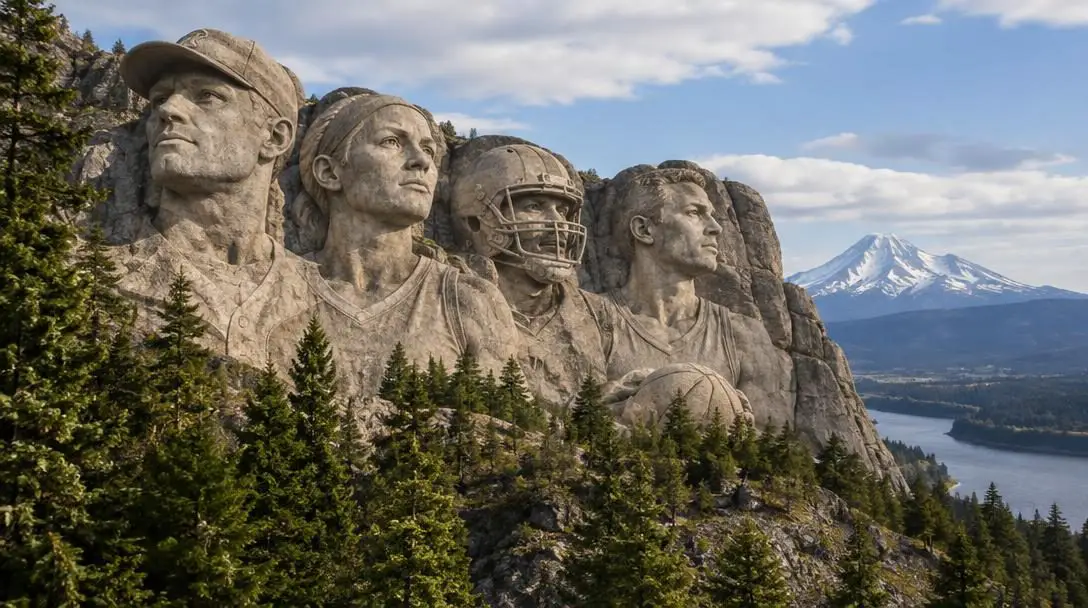
Athletics at the University of Oregon carry a distinct identity recognized throughout collegiate athletics. For generations, sports fans associated the university primarily with its dominant track and field program, which turned Eugene, Oregon into the revered destination known globally as Track Town, USA. Beginning in the 1990s, the school rapidly broadened its national footprint, turning Duck football into an offensive juggernaut renowned for explosive play and an ever-shifting rotation of cutting-edge uniforms. Over time, that momentum expanded into basketball and other varsity programs, elevating the entire athletic department into an elite national powerhouse.
Compressing more than a century of athletic competition into an imaginary four-person monument in Eugene requires evaluating individual records, cultural significance, and transformational leadership. By weighing individual accolades, historical milestone achievements, and departmental legacy across different eras, four individuals rise above all others to form the definitive Mount Rushmore of Oregon sports.
Key takeaways
- The selections span track, football, basketball, and visionary philanthropy to reflect the university's full athletic history.
- Phil Knight provided foundational support and over $1 billion in contributions that modernized Oregon sports facilities and branding.
- Marcus Mariota captured the school's first Heisman Trophy while establishing record-setting collegiate numbers on the gridiron.
- Steve Prefontaine sparked the American running boom and established Eugene's global running reputation by losing only three collegiate races.
- Sabrina Ionescu redefined college basketball by producing a historic statistical milestone and sweeping national honors before going number one overall.
The four faces of the Oregon Ducks Mount Rushmore
Selecting only four figures from across the school's storied history means identifying individuals whose contributions fundamentally changed the direction of their sports and elevated the university's national profile. These four icons represent visionary institutional investment, historic excellence on the football field, enduring running lore, and unprecedented dominance on the basketball court.
Phil Knight
- Collegiate background: Three-season varsity track runner at Oregon
- Key role: Co-founder of Nike and primary athletic benefactor
- Total investment: Well over $1 billion contributed to the university
- Enduring nickname: Uncle Phil
You simply cannot recount the history of Oregon athletics without spotlighting Phil Knight. Before building a worldwide empire, Knight was an active student-athlete on campus, competing as a varsity distance runner for the Ducks track team across three collegiate seasons. Yet his position on the mountain is rooted in what he created after his running days in Eugene concluded. As the co-founder of Nike, Knight developed unprecedented commercial influence and directed that success back toward his alma mater.
His philanthropy revolutionized the entire scope of Duck athletics. Knight backed major developments across campus, financing the construction of a premier basketball arena and pouring massive resources into elite facilities for track and football. His sustained backing, totaling well over $1 billion across the university, helped modernize Oregon's competitive capabilities and transformed Eugene into a destination that attracts top-tier talent from across the globe.
Marcus Mariota

- Primary position: Quarterback
- Major milestone: 2014 Heisman Trophy winner (first in program history)
- Career offensive production: 105 passing touchdowns and 29 rushing touchdowns
- Draft status: Second overall selection, highest-drafted Duck since 1955
Throughout the 1990s and 2000s, Oregon football steadily climbed toward elite contention behind notable quarterbacks like Joey Harrington and the rapid spread concepts popularized by Chip Kelly. The ultimate culmination of that multi-decade ascent arrived when the coaching staff landed Marcus Mariota out of Honolulu, Hawaii. Mariota quickly transformed the program from a perennial Pac-12 contender into a legitimate national title contender, pairing quiet composure with unmatched dual-threat execution.
In 2014, Mariota made school history by capturing the University of Oregon's first Heisman Trophy, alongside a sweep of top hardware including the Maxwell Award, Manning Award, Walter Camp Player of the Year, and Davey O'Brien Award. Over his brilliant college tenure, he amassed 10,796 passing yards and 105 touchdowns through the air, while tacking on 2,237 rushing yards and 29 scores on the ground. When his collegiate career wrapped up, he became the highest-drafted Duck since George Shaw went first overall in 1955, hearing his name called second overall in the professional draft.
Steve Prefontaine
- Track event focus: Middle and long-distance running
- Collegiate record: Suffered only three collegiate losses, all in the 1-mile event
- Personal best: 3:54.6 in the 1-mile run (established in Eugene, 1973)
- International achievement: Bronze medal at the 1972 Olympic Games
Known universally as "Pre," Steve Prefontaine captured the imagination of distance running enthusiasts and established Eugene as the spiritual home of American track and field. Despite his life ending tragically at the age of 24, Prefontaine left an indelible imprint on American athletics. He possessed an aggressive front-running strategy and an electric racing style that turned collegiate track meets at Hayward Field into must-see cultural events, sparking a widespread running movement across the nation during the 1970s.
During his varsity years representing Oregon, Prefontaine achieved an astonishing degree of supremacy. He was defeated only three times in an Oregon uniform, with every single loss occurring exclusively in the 1-mile event. On the global stage, he secured a bronze medal at the 1972 Olympic Games, proving his prowess against the best runners in the world. In 1973, racing on his home track in Eugene, he logged a personal best in the 1-mile distance with a blistering time of 3 minutes and 54.6 seconds, cementing his immortal status in Track Town lore.
Across track, football, basketball, and visionary leadership, the candidates span generations of excellence.
Sabrina Ionescu

- Recruiting status: Highest-rated recruit in Oregon women's basketball history
- NCAA milestone: Sole player in history with 2,000+ points, 1,000+ rebounds, and 1,000+ assists
- National honors: 2020 Naismith Player of the Year and AP Player of the Year
- Draft legacy: First player in Oregon history selected number one overall in WNBA draft
Arriving on campus with immense expectations as the highest-rated recruit in the women's basketball program's history, Sabrina Ionescu orchestrated one of the most decorated collegiate careers in basketball history. Her versatility, floor leadership, and scoring transformed the Ducks into a dominant force, drawing packed arenas and rewriting national record books throughout her four-year run in Eugene.
Ionescu achieved a statistical benchmark never before witnessed in college basketball, ending her career as the only player in NCAA history to collect at least 2,000 points, 1,000 rebounds, and 1,000 assists. Her individual accolades were equally unmatched: she earned Pac-12 Player of the Year honors for three consecutive seasons and claimed the Nancy Lieberman Award three consecutive times from 2018 through 2020. Her collegiate journey peaked in 2020 when she swept the Naismith Player of the Year and AP Player of the Year honors, concluding her legacy by becoming the first Oregon Duck selected first overall in the WNBA draft.
At a glance: comparing Oregon's Mount Rushmore icons
Evaluating these four figures side-by-side demonstrates how distinct each contribution is to the larger identity of University of Oregon athletics. The following breakdown illustrates their individual areas of dominance and long-term legacy.
| Icon | Primary Era | Primary Discipline | Signature Milestone or Distinction | Departmental Legacy |
|---|---|---|---|---|
| Phil Knight | 1950s (athlete) / 1990s–present (benefactor) | Track / Institutional Support | Invested well over $1 billion into university athletics | Built modern athletic infrastructure and national brand identity |
| Marcus Mariota | 2012–2014 | Football | First Heisman Trophy winner in Oregon history; 134 total touchdowns | Elevated Duck football to national championship contender status |
| Steve Prefontaine | 1969–1973 | Track and Field | Only three college losses; 1972 Olympic bronze medalist | Catalyzed the American running boom and established Track Town, USA |
| Sabrina Ionescu | 2016–2020 | Women's Basketball | Only NCAA player with 2K points, 1K rebounds, and 1K assists | Turned Duck basketball into a national championship powerhouse |
Notable Ducks who just missed the cut
Because an athletic Mount Rushmore permits only four honorees, exceptional figures who shaped their respective programs inevitably get left behind. Several prominent Duck luminaries were seriously considered for inclusion:
- Bill Bowerman: The legendary track coach who mentored generations of world-class runners, fundamentally built Eugene's distance culture, and served as the direct bridge to the creation of Nike alongside Phil Knight.
- Dan Fouts: The prolific quarterback who set early standards for passing brilliance at Oregon before launching an iconic career in professional football.
- Ahmad Rashad: The dynamic offensive talent whose versatile playmaking during the late 1960s and early 1970s brought critical national attention to the university's gridiron program.
- Joey Harrington: The charismatic quarterback whose late-1990s and early-2000s leadership ignited the modern era of Duck football and established the school on the national bowl scene.
- Payton Pritchard: The dependable, high-scoring guard whose toughness and steady leadership carried the men's basketball team to sustained conference and national success.
- Ashton Eaton: The dominant multi-event track and field standout who brought global glory to Track Town, USA by mastering the decathlon at the highest collegiate and international levels.
The evolution of Duck athletics: from Track Town to national brand
To fully appreciate the selection of these four legends, it is essential to understand the institutional trajectory of the University of Oregon. For much of the twentieth century, Eugene operated primarily as a distance-running capital. The spiritual center was Hayward Field, where elite track and field competitions drew national headlines decades before other campus teams gained consistent nationwide recognition.
The football team periodically showed elite talent, such as running back and quarterback George Shaw in the 1950s, followed by Dan Fouts and Ahmad Rashad in the early 1970s. However, national title contention remained elusive. That dynamic shifted during the 1990s and 2000s, when modern schemes, high-profile recruitment, and iconic uniform variations—famous for rarely repeating a combination across an entire season—catapulted the team into the upper tier of the sport.
Meanwhile, major investments altered the university's basketball infrastructure. The construction of a state-of-the-art arena provided a modern home for elite prospects, setting the stage for deep postseason runs and opening the door for superstars like Sabrina Ionescu to choose Eugene over legacy basketball programs.
How the Mount Rushmore framework works in sports evaluation
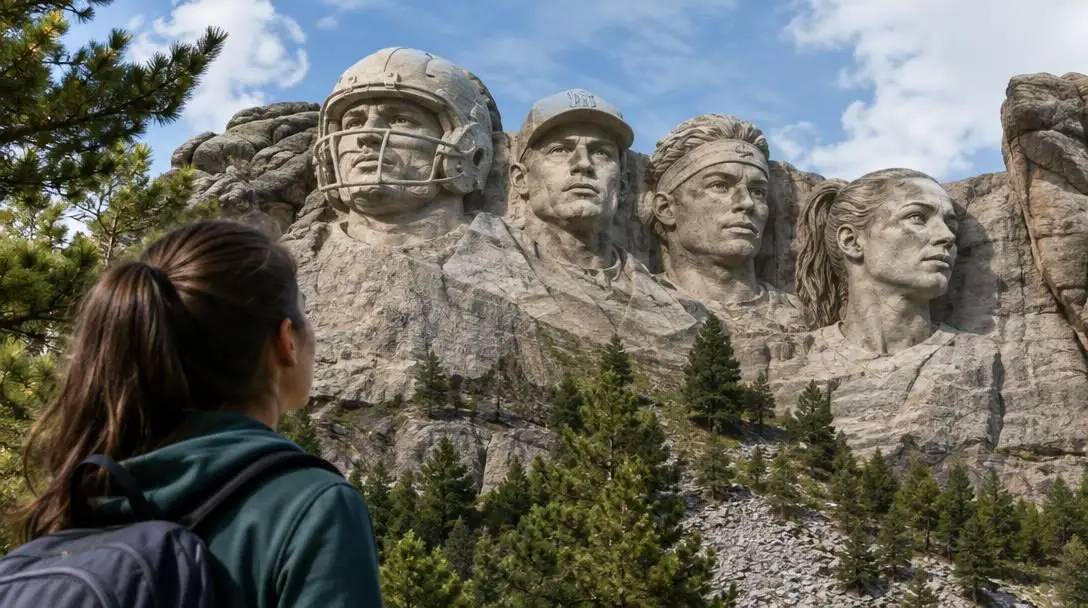
Modeled on the massive granite carving in the Black Hills of South Dakota that depicts four United States presidents, the sports Mount Rushmore format serves as an analytical exercise to establish the defining figures of a program. Because the ceiling is strictly limited to four individuals, analysts must weigh multiple dimensions rather than relying solely on single-game box scores or cumulative career volume:
- Peak individual excellence: Achieving the pinnacle of individual achievement within a sport, including Heisman Trophies, national player of the year honors, and historic records.
- Foundational cultural impact: Sparking sustained enthusiasm for a sport, altering spectator interest, and permanently defining the personality of an athletic program.
- Pioneering firsts: Achieving milestones never previously reached by any athlete in university or collegiate history, such as going number one overall in an elite draft.
- Institutional transformation: Supplying the leadership, funding, or infrastructure that empowers teams across multiple decades to compete at the highest level.
Practical steps for constructing an athletic Mount Rushmore
If you want to build an athletic Mount Rushmore for your favorite university, franchise, or hometown, following a structured methodology ensures your selections remain defensible during spirited debates:
- Establish clear selection parameters: Decide at the outset whether your list evaluates collegiate performance strictly, factors in professional achievements, or values off-field contributions and institutional support.
- Compile an expansive nominee roster: Gather premier contenders across multiple eras and sports rather than concentrating solely on the most visible program.
- Measure era-adjusted dominance: Compare each athlete against their contemporaneous peers, acknowledging that players who dominated their specific era warrant significant credit.
- Evaluate trophy cases and milestone records: Examine the collection of national hardware, All-American designations, and historical benchmarks that distinguish good players from legendary ones.
- Assess cultural and institutional footprint: Determine how integral each candidate remains to the visual, cultural, and competitive identity of the institution.
- Execute the final trims: Narrow your elite group down to exactly four, formulating clear justifications for why the last candidates cut fell just short of the mountain.
Common analytical mistakes to avoid in sports debates
When participating in collegiate sports arguments, fans frequently fall into predictable evaluation traps. Avoiding these common analytical missteps helps ensure a fair and historically grounded evaluation:
- Falling victim to recency bias: Overemphasizing athletes who competed over the past ten years while neglecting early pioneers who built the foundation of the department's reputation.
- Confusing professional glory with collegiate impact: Boosting a player's college ranking simply because they achieved long-term fame in professional leagues, rather than focusing on their collegiate production.
- Disregarding off-field architects: Excluding coaches, athletic directors, and key benefactors whose structural investments made modern athletic triumphs possible.
- Ignoring cross-discipline balance: Permitting one prominent sport, such as football, to occupy every slot while ignoring storied Olympic or hardwood programs.
- Relying entirely on raw counting numbers: Comparing absolute yardage or point totals across different decades without adjusting for changes in pace, season length, or tactical systems.
What to watch in the future of Duck athletics
An athletic Mount Rushmore is an ongoing evaluation rather than an unchangeable monument. As the university continues to invest in high-level recruiting and national title pursuits, future classes of athletes will challenge established standards. Several key factors will influence whether the current four honorees remain unchallenged over the coming decades:
- Championship-winning catalysts: An individual who leads the football team to an elusive national championship could generate enough support to demand inclusion on future ballots.
- Hayward Field's continued prominence: As Eugene remains the epicenter of major national and international track competitions, future distance and sprint stars will have opportunities to match Prefontaine's mythic standard.
- Multi-sport all-time records: Any prospective student-athlete who shatters NCAA division records while sweeping major national player of the year awards will immediately enter the discussion alongside Sabrina Ionescu.
Frequently asked questions
Why is Phil Knight included instead of a traditional coach or athlete?
Phil Knight was a three-year varsity track runner at Oregon, but his primary impact stems from co-founding Nike and donating well over $1 billion to the university. That transformative support funded state-of-the-art facilities, elevated Duck football and basketball, and turned Oregon into a global athletic brand.
Why did Marcus Mariota make the mountain over other Duck quarterbacks?
Marcus Mariota is the only player in University of Oregon history to win the Heisman Trophy, capturing it in 2014 alongside the Maxwell, Manning, Walter Camp, and Davey O'Brien awards. He totaled 134 collegiate touchdowns and became the program's highest draft pick since 1955 when he was chosen second overall.
What made Steve Prefontaine such a legendary figure at Oregon?
Steve Prefontaine lost only three collegiate races throughout his entire career at Oregon, with all three coming exclusively in the 1-mile event. His aggressive front-running style, 1972 Olympic bronze medal, and 1973 personal-best mile time of 3:54.6 in Eugene sparked the American running boom and established Eugene as Track Town, USA.
What NCAA record distinguishes Sabrina Ionescu from all other basketball players?
Sabrina Ionescu is the only player in NCAA basketball history to record at least 2,000 career points, 1,000 career rebounds, and 1,000 career assists. She was a three-time Pac-12 Player of the Year, swept the 2020 national player of the year awards, and became the first Duck drafted number one overall in the WNBA.
Which prominent Ducks narrowly missed being chosen for the Mount Rushmore?
Prominent figures who just missed the final four include iconic track coach Bill Bowerman, star passing quarterbacks Dan Fouts and Joey Harrington, versatile playmaker Ahmad Rashad, men's basketball star Payton Pritchard, and multi-event Olympic champion Ashton Eaton.
The bottom line
Constructing the Mount Rushmore of Oregon sports reveals an athletic department defined by innovation, individual brilliance, and world-class ambition. From Steve Prefontaine sparking a national distance-running phenomenon at Hayward Field to Marcus Mariota claiming the school's first Heisman Trophy, Oregon's sporting history is filled with moments of athletic supremacy. Sabrina Ionescu authored a basketball resume unmatched in collegiate annals, while Phil Knight provided the visionary infrastructure and financial backing that turned Eugene into an international sports destination. Together, these four foundational figures represent the gold standard of Duck athletic achievement.