5 Differences Between Words With Friends And Classic Scrabble
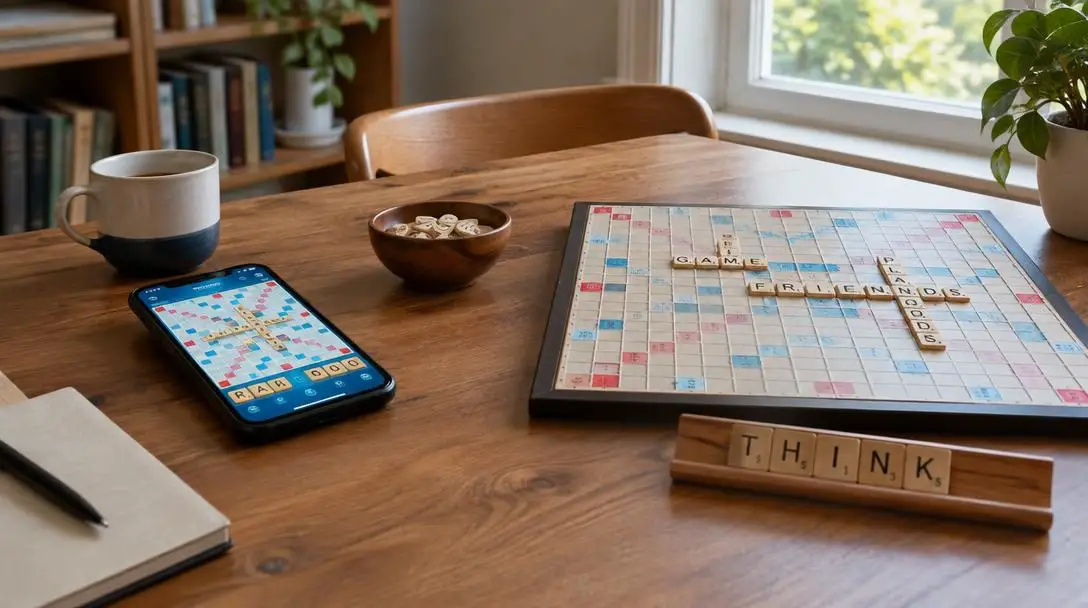
Word games have captivated players across generations, providing an enduring outlet for strategic thinking, vocabulary expansion, and social interaction. At the forefront of this genre are classic Scrabble and Words With Friends. While both titles share the foundational framework of placing interlocking letter tiles on a designated grid to form words and accumulate points, their historical paths, core mediums, and player cultures diverge in fundamental ways.
Classic Scrabble boasts a storied heritage tracing back to its introduction in 1938, eventually expanding into an international pastime with over 150 million sets sold globally alongside a dedicated tournament circuit. Decades later, as mobile technology flourished, Words With Friends revolutionized remote word play by bringing asynchronous matches to handheld devices, attracting more than 10 million monthly active users. Today, Words With Friends stands as an established digital staple, while classic Scrabble remains the definitive in-person tabletop experience.
Key takeaways
- Classic Scrabble originated in 1938 as a physical tabletop board game, whereas Words With Friends was built primarily as an asynchronous mobile application.
- Board layouts differ substantially, with Scrabble utilizing an X-shaped multiplier layout and edge bonus tiles, while Words With Friends relies on concentric diamond configurations and paired corner triple-word squares.
- Scrabble adheres to a strictly regulated official lexicon, whereas Words With Friends uses a modified benchmark dictionary that accepts informal modern slang.
- Point valuations on key letter tiles shift between games, offering higher scores for B, C, M, and J in Words With Friends, but higher payouts for H and Y in Scrabble.
- Scrabble assesses competitors through formal ELO ratings in sanctioned clubs, while Words With Friends focuses on casual social leaderboards and weekly score tallies.
How the two word-game giants compare at a glance
Although the underlying principle of both games involves building words horizontally and vertically across bonus squares, their mechanical execution diverges in several measurable ways. The table below outlines how these two titles differ across core components, from release history to scoring frameworks:
| Feature | Classic Scrabble | Words With Friends |
|---|---|---|
| Primary Platform | Physical tabletop board (with digital Hasbro platforms) | Mobile smartphone app (with minor physical adaptations) |
| Introduced | 1938 | Mobile app era (decades later) |
| Player Reach | Over 150 million versions sold worldwide | More than 10 million monthly active users |
| Official Dictionary | Official Scrabble lexicon (supported by Merriam online tool) | Modified Enhanced North American Benchmark Lexicon |
| Competitive Rating System | Formal ELO ratings through official clubs and tournaments | Casual social leaderboards and weekly high-score events |
| Board Multiplier Pattern | X-shaped center layout, edge half-diamonds with single triple-words | Concentric diamond patterns with paired corner triple-words |
| Higher-Value Letters | H and Y award more points than in Words With Friends | B, C, M (+1 point) and J (+2 points) award more points than in Scrabble |
The 5 core differences between Scrabble and Words With Friends
Understanding where these games part ways allows players to adjust their tactical strategies, tile tracking, and opening moves effectively. The five key operational shifts below explain the operational differences between each title.
Digital Features Versus Physical Traditions
The native formats dictate how each game is experienced by its player base. Words With Friends thrives primarily inside an application environment designed for remote exchanges, automated scoring calculations, and casual matchmaking across vast distances. Players can take their turns over hours or days without sitting across a table from their opponent. In contrast, classic Scrabble is predominantly cherished as a face-to-face physical board game. Although Scrabble offers online options through Hasbro digital platforms, and Words With Friends has made minor ventures into physical boxed editions, each title commands its own distinct domain: mobile touchscreens for Words With Friends and living room tables for classic Scrabble.
In the digital realm, automated validation prevents invalid plays instantly, taking away the traditional tension of bluffs, illegal words, and formal adjudication. In contrast, the tabletop environment of Scrabble leans heavily on physical equipment, manual scorekeeping, tactile wooden or plastic tile draws from an opaque bag, and the timeless ritual of challenging an opponent's questionable word choice over a printed or digital word authority.
Tile Placement and Board Architecture
Both games make strategic use of bonus squares—including double-letter, triple-letter, double-word, and triple-word scores—but place them in completely opposite configurations. On a classic Scrabble board, the specialty tiles are arranged in an X-shaped pattern stretching toward the corners, complemented by half-diamond formations along the outer borders that feature triple-word score squares at their centers. The double-letter scores closely surround the starting center star square diagonally, keeping early scoring moderate and forcing players to build outward to reach the highest rewards.
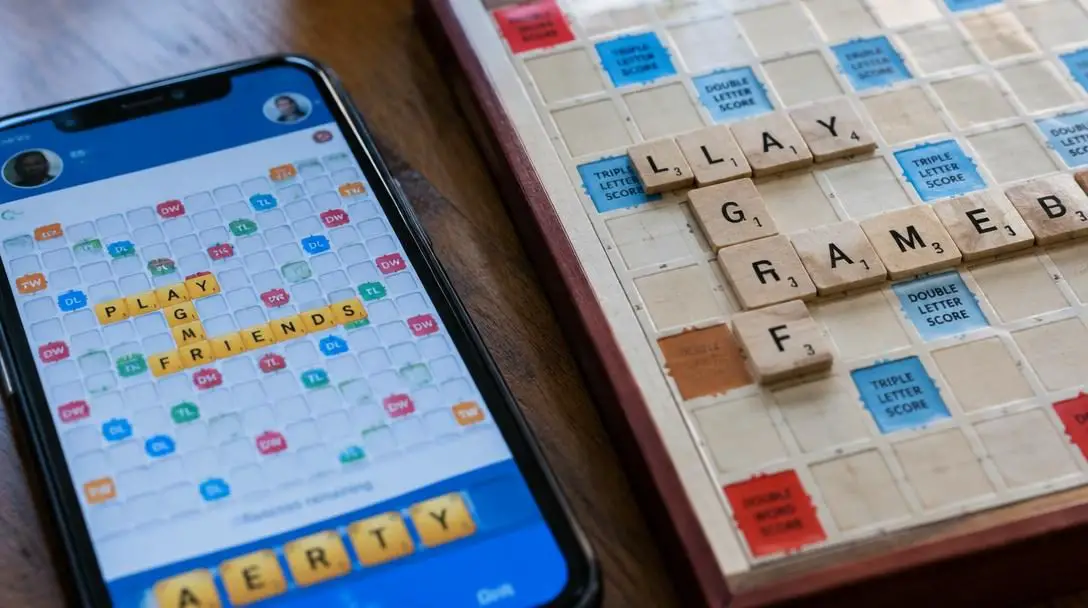
In contrast, the Words With Friends board displays a diamond configuration enclosing the center area, positioning double-word scores four spaces outward in each cardinal direction. This central setup is ringed by an outer diamond missing its finishing tile, alongside diagonal sets of four bonus tiles in each corner that conclude with two triple-word tiles at the ends of the lines. These spatial patterns radically alter board control, rack balance, and tactical defensive maneuvers.
Understanding the structural divergence between physical grid layouts and digital multiplier patterns is what separates casual tile placers from masters of board control.
The Dictionary and Vocabulary Standards
The references used to validate words differ significantly across both environments. Classic Scrabble relies on an official, strictly governed lexicon created and frequently updated specifically for competitive and casual play. Publisher Hasbro also partners with Merriam to provide an easily accessible online tool to resolve disputes right at the board. Every competitive tournament player studies curated word lists containing obscure two-letter roots, unusual vowel dumps, and precise inflections sanctioned by competitive governing bodies.
Words With Friends does not draw from Scrabble's official reference; instead, it utilizes a modified version based on the Enhanced North American Benchmark Lexicon. This foundation allows a significantly broader range of modern slang words tailored for mobile users, making it much more permissive than traditional Scrabble word lists. The inclusion of pop culture terms, text-friendly abbreviations, and relaxed colloquialisms creates a vastly different linguistic playing field where traditional Scrabble purists may find themselves surprised by what clears the automated digital referee.
Ranking System and Competition Level
Scrabble features an established competitive framework that incorporates official tournaments and clubs worldwide. Players earn formal ratings using the ELO system, where defeating a higher-rated opponent yields a substantial boost in a player's standing, while losing to a lower-rated player incurs a sharp penalty. This provides serious competitors with a clear, mathematically sound measurement of where their skill stands against competitors across the globe.
In Words With Friends, competitive elements are designed to be lighter and more accessible. While players can climb community leaderboards and participate in weekly high-score events, the rankings focus primarily on comparisons among social circles, casual matchmaking brackets, and personal scoring records rather than sanctioned, organized global tournament circuits. The digital game emphasizes social banter, streak tracking, and asynchronous engagement across friendly networks over cutthroat tournament ladders.
Letter Score Differences
Scoring values assigned to specific tiles vary between the games, leading to higher average scores in Words With Friends. Tiles such as J carry two additional points in Words With Friends compared to Scrabble, while letters like B, C, and M are each worth one extra point. These subtle additions inflate overall point totals and encourage explosive multiplier plays on common, flexible consonants.
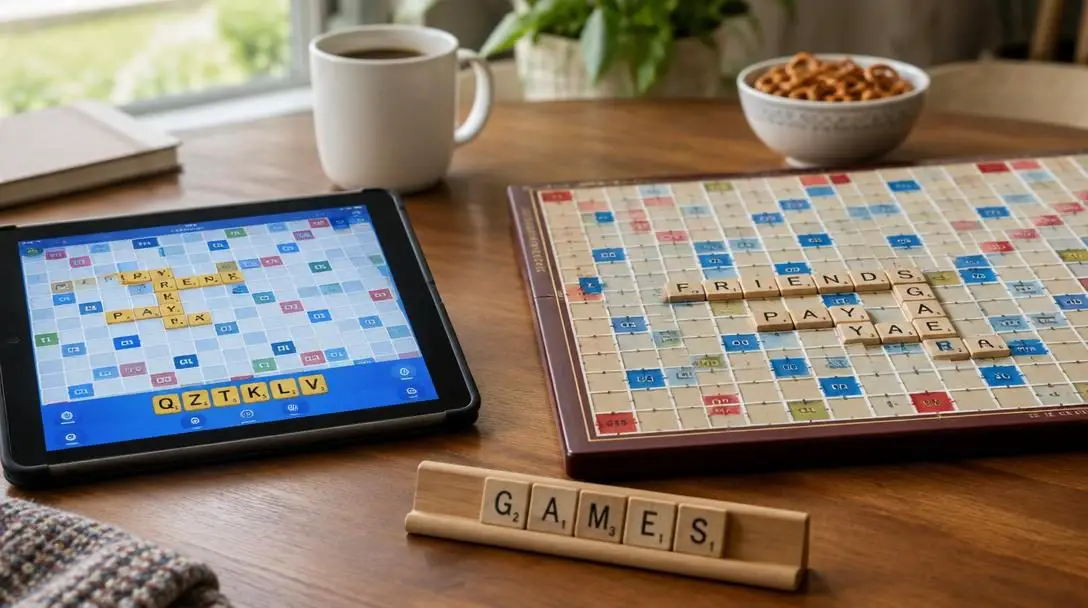
On the other hand, classic Scrabble values the letters Y and H higher, assigning each an additional point over their Words With Friends equivalents. These targeted numerical tweaks ensure that tile valuation, rack management, and premium placement strategies cannot be applied identically across both titles without careful mathematical adjustments.
Strategic steps to adapt between both games
Succeeding in either word game requires adapting your strategy to the specific board and rule variations. Follow these actionable steps to tailor your playstyle to whichever format you are playing:
- Verify the lexicon before starting: If you are sitting down for a match of Scrabble, agree on the exact edition of the official dictionary or use the online Merriam tool to resolve questionable plays. When opening a match in Words With Friends, remember that the Enhanced North American Benchmark Lexicon permits informal and modern slang that would be disqualified in standard Scrabble.
- Map out bonus squares based on the grid: In Scrabble, keep a watchful eye on the outer edges and the half-diamond formations that house triple-word score tiles, preventing opponents from easily reaching them. In Words With Friends, track the diamond layout that surrounds the center and the diagonal paths toward the corner triple-word tiles to guard against leaving open lanes.
- Calculate values using title-specific letter points: Prioritize playing the letters B, C, M, and especially J on multiplier tiles in Words With Friends to maximize their increased point values. If you are playing classic Scrabble, redirect that high-multiplier focus toward the letters H and Y, since they are worth more points on the classic board.
- Adopt format-appropriate pacing: When playing Scrabble in person, manage your time effectively during each turn to maintain an engaging rhythm with the other players at the table. In Words With Friends, use the asynchronous digital format to take your time assessing the board without the immediate social pressure of an in-person opponent waiting across from you.
Common mistakes to avoid when switching formats
Players frequently move back and forth between both titles without adjusting their mental frameworks. Being aware of these missteps will help you maintain a competitive edge regardless of the platform:
- Assuming tile values are identical: Many players treat tile bags as interchangeable. Forgetting that a letter like J yields a higher baseline in Words With Friends, or that H and Y are worth more in classic Scrabble, leads to sub-optimal tile placement on premium multipliers.
- Overlooking grid architecture changes: Applying a Scrabble opening or defensive layout to a Words With Friends board can lead to immediate trouble. Because Words With Friends places double-word scores four spaces away from the center in cardinal directions and lines its corners with two triple-word tiles, overlooking these patterns gives your opponent easy access to massive scores.
- Attempting casual slang on the physical board: Words accepted automatically in Words With Friends may not be valid under the official Scrabble dictionary. Relying on mobile habits can result in lost turns or failed challenges during an in-person match.
- Underestimating the opponent's rating context: In competitive Scrabble, an opponent's high ELO rating signals serious tournament experience and deep study of word lists. In Words With Friends, high placement on a weekly leaderboard often reflects play volume and frequency against friends rather than sanctioned competitive mastery.
- Neglecting defensive tile management: Because Words With Friends features higher point structures on common letters like B, C, and M, opening up multiplier paths is far riskier than in classic Scrabble. Failing to close off access to double and triple multipliers can quickly inflate your opponent's score.
Frequently asked questions
Why are scores generally higher in Words With Friends than in Scrabble?
Scores are higher in Words With Friends primarily because several versatile letters—specifically J, B, C, and M—carry higher base point values. Additionally, the board's corner architecture features paired triple-word score tiles, offering greater opportunities for massive multiplier combinations.
Can I use the official Scrabble dictionary when playing Words With Friends?
While words valid in Scrabble are almost always accepted in Words With Friends, Words With Friends relies on a modified version of the Enhanced North American Benchmark Lexicon. This means it accepts many modern slang words and informal colloquialisms that the official Scrabble dictionary rejects.
Does Scrabble have an official online version?
Yes. Although classic Scrabble is beloved as a physical tabletop experience, Hasbro has expanded the title into digital environments through website platforms that allow users to play against computer opponents, connect with friends, or challenge competitors worldwide.
Which game features a more rigorous competitive rating system?
Classic Scrabble features a more formal competitive structure. It uses the ELO rating system across sanctioned clubs and international tournaments, where beating higher-ranked players significantly boosts your standing. Words With Friends focuses on social leaderboards and weekly score tallies among personal connections.
Which letter tiles are worth more in classic Scrabble than in Words With Friends?
In classic Scrabble, both H and Y are worth one point more than their counterparts in Words With Friends, making them valuable assets to target on premium multiplier squares during a physical match.
The bottom line
Deciding whether to focus on Words With Friends, classic Scrabble, or both depends entirely on your lifestyle, competitive goals, and preferred social dynamics. If your objective is to compete in formal environments where your skill is measured via a structured ELO rating system, classic Scrabble offers a venerable, rigorous testing ground rooted in nearly a century of tournament tradition. Its disciplined dictionary standards and balanced board layout reward meticulous spatial planning and strict vocabulary memorization.
Conversely, if you value flexible pacing, contemporary vocabulary, and convenient gameplay that fits into short breaks throughout your day, Words With Friends remains the premier digital alternative. Its generous letter values, paired corner multipliers, and relaxed lexicon cater to lively, high-scoring contests among friends and mobile players across the globe. By mastering the distinct grids, dictionaries, and tile values of both platforms, you can seamlessly navigate between tabletop matches and mobile screens without missing a beat.