5 Most Addictive 8-Bit Games
Modern gaming is characterized by photo-realistic graphics, expansive open worlds, and cinematic cutscenes running at sixty frames per second or higher. Contemporary game engines produce digital environments that can rival real-world fidelity. Yet the core design concepts that anchor the interactive entertainment industry were established decades ago under severe computational limits. During the 1980s, developers relied on home consoles and arcade systems restricted to eight bits of processing power.
Operating within narrow memory bounds and constrained color palettes, software engineers could not rely on surface-level visual spectacles. Instead, they focused entirely on mechanical precision, instant responsiveness, and engaging gameplay loops. Consoles like the Nintendo Entertainment System—known as the Family Computer or Famicom in Japan—and classic coin-operated arcade cabinets became testing grounds for design philosophies that continue to define modern video games and fuel worldwide speedrunning communities.
Key takeaways
- Technical limitations forced 1980s developers to prioritize responsive controls and clear spatial design over elaborate visual aesthetics.
- Foundational 8-bit titles introduced enduring industry standards, from battery-backed save files to genre-defining movement physics.
- Short feedback loops and deterministic enemy patterns created an addictive state of flow that remains engaging today.
- Mastering retro games requires understanding hardware quirks, such as inaccurate sprite hitboxes and directional pad inputs.
The mechanics behind addictive 8-bit design
The compelling quality of classic eight-bit releases was not an accident; it was the product of disciplined systems engineering. With hardware limited to minute amounts of memory, developers had to ensure that every visual element, audio cue, and player input served an active structural purpose. This economic design gave rise to the rapid feedback loop, a mechanic in which player actions generate instantaneous reactions. In arcade and early console environments, clearing an obstacle or scoring points provided immediate sensory feedback, drawing players into an unbroken rhythm of action and reward.
Another fundamental pillar of this era was spatial clarity. Because hardware could not render dense visual clutter or cinematic post-processing, game screens remained legible at all times. Sprites clearly distinguished hazards, platforms, and rewards, reducing cognitive friction and allowing players to focus entirely on route optimization and physical dexterity. As players grew comfortable with baseline movement, systems introduced escalating risk, increasing speeds and obstacle density without altering core rules. When a character failed, the player understood the mistake as their own execution error rather than a system failure, prompting an immediate desire to try again.
At a glance: Five landmark 8-bit titles
| Game | Release Year | Original Developer | Key Historical Milestone |
|---|---|---|---|
| Pac-Man | 1980 | Namco | Certified by Guinness as the most successful coin-operated game |
| Tetris | 1984 | Alexey Pajitnov | Ranks as the third best-selling video game of all time |
| Super Mario Bros. | 1985 | Nintendo | Revitalized the home console market with scrolling platform design |
| The Legend of Zelda | 1986 | Nintendo | First NES title to implement an internal battery backup save system |
| Castlevania | 1986 | Konami | Pioneered deliberate, high-challenge action-platforming in dark fantasy |
Five 8-bit classics that defined the era
Among the vast library of software created during the eight-bit era, a handful of titles achieved historic cultural and commercial resonance. These games established genres, proved the viability of home consoles, and continue to serve as the structural framework for major modern gaming franchises.
Tetris

- Initial Release: 1984
- Creator: Alexey Pajitnov
- Sales Milestone: Third best-selling video game of all time
Created in 1984 by Soviet software engineer Alexey Pajitnov, Tetris stands as a singular achievement in electronic puzzle design. The game bypasses language and cultural differences through intuitive geometric logic. Players arrange falling blocks composed of square units, rotating and maneuvering them to assemble complete horizontal lines. Completed lines vanish, granting points and clearing space on an increasingly crowded board. As the player succeeds, the game raises the falling speed, demanding heightened concentration and faster spatial reasoning.
The publishing rights to the game were held by Nintendo for an extended period before returning to Pajitnov following a lengthy legal dispute. The franchise has since expanded across virtually every interactive medium, including an EA Mobile edition released in 2006 that achieved over 100 million sales, alongside unique variations such as a Nintendo 64 release featuring an eccentric story mode. Its ability to place players into an uninterrupted state of mental flow makes it an enduring staple of casual and competitive gaming alike.
The Legend of Zelda

- Initial Release: 1986
- Directors: Shigeru Miyamoto and Takashi Tezuka
- Hardware Innovation: First NES cartridge with internal battery backup
Developed by Shigeru Miyamoto and Takashi Tezuka in 1986, The Legend of Zelda completely expanded player expectations regarding the scope of home console software. First released in Japan for the Family Computer Disk System and later distributed worldwide on the Nintendo Entertainment System, the title set a new technical standard by incorporating an internal battery backup. This hardware feature freed players from having to beat an entire game in a single sitting or manage cumbersome password strings, establishing the save feature as a basic console standard.
The game presented players with a vast non-linear overworld connected to intricate underground labyrinths. Rather than directing players along a rigid linear path, the adventure encouraged organic discovery, environmental puzzle-solving, and dangerous combat. This foundational release created an action-adventure blueprint that propelled the series to the top tier of the medium, paving the way for critically acclaimed successors such as Ocarina of Time, Twilight Princess, and Breath of the Wild.
Simple, easily readable parameters combined with high-stakes execution generated a level of focus that spanned generations and international borders.
Super Mario Bros.
- Initial Release: 1985
- Developer: Nintendo
- Adaptation Milestone: Major theatrical animated movie released in April 2023
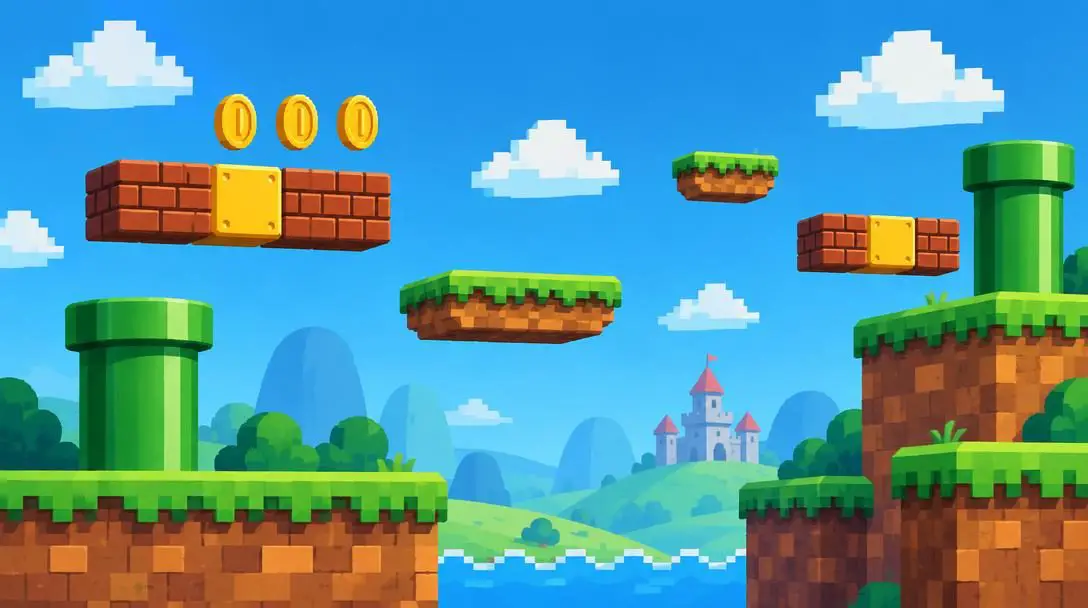
Serving as the direct successor to the arcade title Mario Bros., Nintendo's 1985 platformer Super Mario Bros. reinvigorated the international console industry following an economic downturn in North America. The game placed players in control of Mario as he traversed horizontally scrolling environments filled with obstacles, bottomless pits, and unique enemy encounters. Players stomp on goombas and koopas on the surface or dive underwater to navigate past menacing bloopers, steadily learning the rules of momentum, inertia, and vertical precision.
The genius of the game lies in its carefully graded difficulty curve. The early stages teach the core mechanics of movement, jumping, and power-up progression without heavy-handed instructions, while later worlds test reflexes and timing. This approachable design turned Mario into a global pop culture icon, culminating in decades of franchise releases and a blockbuster animated feature film that arrived in theaters in April 2023.
Castlevania

- Initial Release: 1986
- Developer: Konami
- Protagonist: Simon Belmont
Released by Konami in 1986, Castlevania introduced a darker, gothic tone and a methodical approach to 8-bit platforming. Players take on the role of Simon Belmont, an adventurer armed with a legendary whip and secondary weapons who enters the castle of Count Dracula. Unlike the floaty, forgiving jumps found in many contemporary platformers, the movement in Castlevania is deliberate and heavy. Once Simon commits to a jump or a whip strike, the player is locked into that animation frame, demanding absolute precision and foresight.
The title offered a substantially more challenging experience than casual platformers, demanding that players memorize enemy spawn triggers, projectile patterns, and hazard timings. While later iterations evolved into exploration-heavy experiences like Symphony of the Night, the 3D action franchise Lords of Shadow, and appearances across the Super Smash Bros. roster, this initial eight-bit release laid the atmospheric and mechanical foundations for one of Konami's premier properties.
Pac-Man
- Initial Release: 1980
- Developer: Namco
- Original Title: Puck Man
Engineered by Namco and released in 1980 under its original Japanese title Puck Man, Pac-Man is the defining icon of the golden age of arcade machines. Certified in 2008 by the Guinness Book of World Records as the most successful coin-operated game in history, the title challenged players to navigate a neon-blue maze, consuming dots while evading four distinct ghosts. The instant feedback of clearing pellets alongside the tension of power-pellet reversals turned the cabinet into an unprecedented worldwide cultural phenomenon.
Unlike other foundational franchises that shifted genres across console generations, the core identity of Pac-Man remained remarkably faithful to its arcade roots. Aside from minor experiments like a Super Nintendo release featuring a point-and-click story mode, the brand maintained its focus on maze traversal, high-score competition, and refined variants such as Ms. Pac-Man.
Step-by-step approach to mastering classic 8-bit games
Tackling eight-bit games today can be deeply satisfying for enthusiasts exploring design history or aiming for high scores. To engage with these demanding retro releases effectively, follow this structured routine:
- Select an authentic or accurate platform. While original cartridges and consoles provide authentic hardware performance, verified digital re-releases, retro compilations, and dedicated classic mini-consoles offer easy display connectivity on modern high-definition monitors.
- Use a dedicated four-way directional pad. Modern analog control sticks are designed for smooth 360-degree input, which can cause accidental diagonal commands in grid-based arcade mazes like Pac-Man or tight platformers like Castlevania. A quality digital D-pad ensures input accuracy.
- Examine basic movement and commitment windows. Spend time testing momentum in safe areas. Observe jump trajectories in Super Mario Bros., the static attack frames of Simon Belmont's whip, or how tetraminos rotate near the wall boundaries in Tetris.
- Identify deterministic enemy behavior. Because early games operated under memory constraints, hazard routines were rigidly scripted. Watch enemy spawn positions, walking cadences, and projectile paths to anticipate hazards instead of reacting on impulse.
- Segment broad objectives into milestones. Expansive titles like The Legend of Zelda can feel overwhelming without direction. Focus on completing one specific dungeon, collecting a designated weapon upgrade, or clearing a single map sector per session.
- Study routes established by experienced speedrunners. Review high-level archival runs to discover how seasoned players handle difficult chokepoints, manage inventory resources, and exploit safe positioning strategies.
Frequent pitfalls when returning to 8-bit design
Players acclimated to modern video game conventions often experience culture shock when loading up titles from the 1980s. Keeping these common mistakes in mind will save considerable frustration:
- Assuming safety nets exist: Modern conveniences like automatic mid-stage checkpoints, passive health regeneration, and dynamic difficulty scaling were non-existent. Aside from pioneering titles like The Legend of Zelda with its battery backup, most 8-bit games require completing the experience in a single run or starting over when your lives run out.
- Sprinting through uncharted rooms: Moving too quickly across scrolling screens frequently triggers multiple enemy spawn waves at once, creating unavoidable damage traps in unforgiving action games.
- Misreading collision hitboxes: Eight-bit consoles calculated physical collisions using rudimentary rectangular bounding boxes. The functional damage area does not always match the visible edges of a sprite, requiring an extra margin of safety when leaping past hazards.
- Relying purely on twitch reflexes: High-level play in retro games relies far more on pattern memorization and stage familiarity than raw reaction speed. Trying to react to traps in real time usually results in rapid defeat.
Frequently asked questions
Why did The Legend of Zelda require an internal battery backup?
Because of its unprecedented scale and non-linear structure, completing The Legend of Zelda in a single sitting was unrealistic for most players. The internal battery backup allowed the cartridge's memory to save player progress, inventory, and dungeon status between play sessions without relying on lengthy, error-prone password systems.
Who originally designed Tetris, and why were the rights disputed?
Tetris was created in 1984 by Soviet software engineer Alexey Pajitnov. Because it was developed while Pajitnov worked for the Soviet Academy of Sciences, the commercial rights were initially managed and distributed by the Soviet government, leading to licensing agreements with companies like Nintendo. Following a protracted legal battle, Pajitnov eventually reacquired the rights to his intellectual property.
How does Castlevania's jump mechanic differ from Super Mario Bros.?
In Super Mario Bros., players can influence Mario's velocity, height, and horizontal trajectory in mid-air using momentum-based controls. In contrast, Castlevania utilizes strict, fixed jump arcs. Once Simon Belmont leaves the ground, his trajectory cannot be altered, and swinging his whip stops his forward momentum, demanding precise timing and deliberate positioning.
What makes Pac-Man the most successful coin-operated game in history?
In 2008, the Guinness Book of World Records officially certified Pac-Man with this title due to its global reach, massive cabinet production numbers, and sustained revenue generation across arcade venues worldwide, outpacing competing arcade machines of the era.
Why is an authentic D-pad recommended over an analog stick for 8-bit games?
Classic eight-bit games were programmed for digital four-way or eight-way directional switches. Modern analog thumbsticks lack physical gates for cardinal directions, making it easy to register unintended diagonal inputs, which can result in missed turns in Pac-Man or accidental missteps in platformers.
The bottom line
The longevity of the eight-bit era proves that engaging gameplay does not depend on technological abundance. By working inside the strict processing and memory constraints of early hardware, developers in the 1980s distilled game design down to its purest elements: direct player agency, consistent rule sets, and responsive controls. Titles like Tetris, The Legend of Zelda, Super Mario Bros., Castlevania, and Pac-Man did more than entertain a single generation—they established the visual grammar, mechanical logic, and foundational standards that continue to shape the video game industry today.