5 Mistakes People Make When Learning A Foreign Language

Learning a foreign language opens doors to richer personal and professional opportunities, whether you are communicating with international colleagues, navigating travel abroad, or connecting with neighbors in your local community. Yet many adults find that despite a passionate start, their momentum stalls and conversational fluency remains out of reach.
The difficulty rarely stems from a lack of natural linguistic talent. Instead, adult learners often fall back on rigid schoolhouse habits—such as silent memorization, rote drills, and grammar examinations—that fail to build spontaneous conversational reflexes. By understanding how the human brain actually absorbs speech and avoiding predictable missteps, you can turn an uphill struggle into an enjoyable, rewarding pursuit.
Key takeaways
- Prioritizing auditory input over silent memorization trains your brain to recognize real-world pronunciation, rhythm, and speech boundaries.
- Studying complete sentences in familiar contexts is far more effective than memorizing isolated vocabulary lists and rigid grammatical formulas.
- Engaging with genuinely interesting media, such as cartoons, poetry, and literature, prevents burnout and boosts retention.
- Short daily study sessions of 20 to 30 minutes produce superior long-term results compared to occasional, exhausting marathon cramming.
- Embracing speech errors and tracking them in a dedicated journal removes conversational anxiety and accelerates practical fluency.
How natural language acquisition works
Traditional academic environments frequently treat foreign languages as intellectual puzzles governed by abstract rules and equations. In contrast, cognitive research reveals that the brain absorbs language most effectively when it encounters speech as a living medium for social exchange. Successful acquisition requires a dynamic balance between acoustic processing, contextual relevance, and psychological comfort.
The foundational layer of speech acquisition is auditory input. Before the vocal apparatus can produce clean, accurate sounds, the auditory cortex must become acclimated to the cadences, stress patterns, and pitch variations of the target language. When you listen to native speech, your mind works below the surface to distinguish word boundaries within continuous streams of sound. Silent reading and flashcard drills bypass this essential sensory phase entirely.
The second pillar is contextual immersion. Rather than learning isolated words, the human brain retains terms when they are woven into full sentences, stories, and conversations. Surrounding details provide clues to meaning, constructing multi-layered associative networks that make retrieval fast and effortless during live conversation.
Finally, language acquisition relies on psychological conditioning. A learner who feels threatened by imperfection enters an anxious state that inhibits spontaneous speech. True fluency develops when you view conversation not as an examination, but as an experimental space where iterative feedback drives progress.
The five critical mistakes learners make
Adult learners often work diligently while unknowingly reinforcing habits that stall their progress. Addressing these five widespread pitfalls directly transforms language study from an exercise in frustration into a sustainable, motivating habit.
| Mistake | Underlying Problem | Corrective Strategy |
|---|---|---|
| Forgetting to listen | Over-reliance on silent reading and text translations | Incorporate daily music, podcasts, news, and movies from native speakers |
| Learning rules without context | Accumulating abstract grammar without conversational utility | Study full sentences and personally relevant vocabulary |
| Using boring materials | Relying on generic apps and dry workbooks that drain focus | Engage with literature, cartoons, and community gatherings |
| Studying irregularly | Cramming for hours sporadically, leading to rapid burnout | Maintain daily 20-to-30-minute sessions over a year or more |
| Fearing mistakes | Silence and avoidance driven by fear of looking foolish | Welcome errors, request active corrections, and log progress |
Mistake 1: Forgetting to listen
Many students spend months reviewing flashcards, completing written grammar exercises, or tapping prompts in an app without dedicating time to auditory training. While memorization expands passive recognition, failing to listen stunts conversational comprehension. When you read a foreign word in silence, your internal voice often defaults to the phonetics of your native tongue, cementing fossilized pronunciation errors that are difficult to correct later.
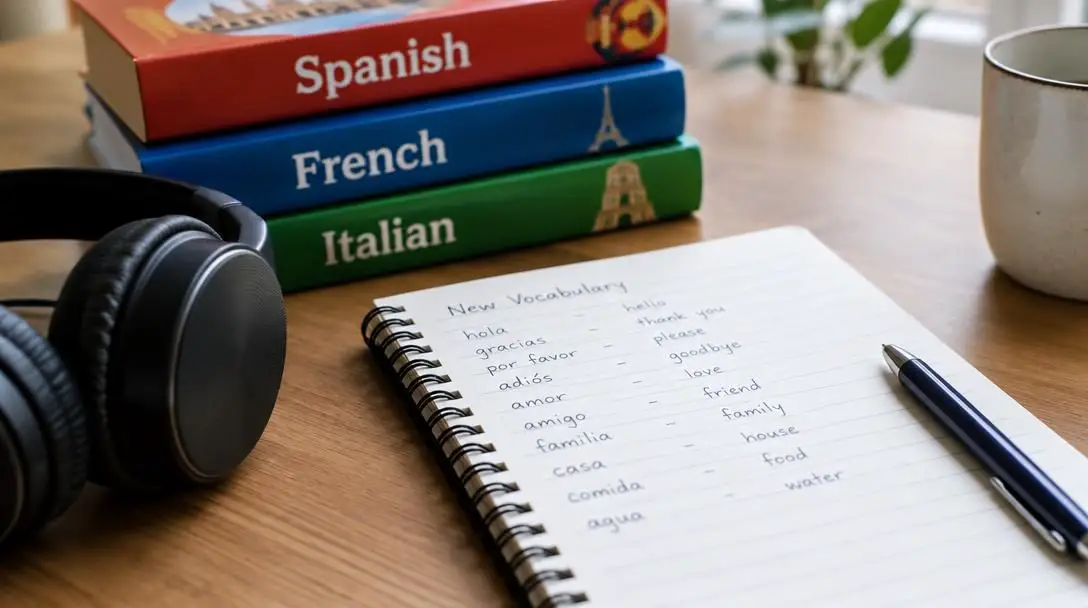
Listening trains your ear to recognize authentic intonation, natural contractions, and the rhythmic flow of normal speech. In your spare time, listen to music, podcasts, radio broadcasts, and foreign films featuring native speakers. By immersing your ears in real-world audio, you teach your brain to decode speech at native velocity.
Mistake 2: Learning rules but not context
Memorizing grammatical paradigms and isolated vocabulary words produces disjointed knowledge. When an unexpected question arises in conversation, students who rely strictly on mechanics pause to consult an internal grammar checklist, resulting in halting, unnatural speech.
To communicate effectively, shift your focus to contextual comprehension. Study complete sentences and functional dialogues so you intuitively absorb how ideas link together. Prioritize terminology directly related to your work, home life, and personal interests. Mastering words you actually use every day provides immediate utility and strengthens your motivation to continue.
Embrace errors as the natural milestones of linguistic growth rather than signs of personal inadequacy.
Mistake 3: Using boring learning material
Learners often default to popular apps or dry textbooks simply because they are familiar or convenient. However, monotonous exercises drain mental stamina. When you dread your study sessions, your focus wanders, and your brain refuses to encode the information into long-term memory.
Make your study materials intrinsically captivating. Watch animated cartoons with or without subtitles, read short stories, try writing simple poetry, or attend local cultural gatherings. When the material sparks genuine curiosity, language acquisition ceases to feel like an exhausting obligation and becomes an engaging exploration.
Mistake 4: Studying irregularly
An initial burst of enthusiasm often leads new learners to spend multiple hours studying each day. Unfortunately, intense marathon sessions inevitably collide with daily responsibilities, leading to fatigue, missed days, and eventual abandonment of the study plan.
Consistency outperforms intensity every time. Committing to a modest daily window protects you from burnout and maintains your momentum. Furthermore, accept that foreign language mastery requires sustained effort over a year or more. Adopting a long-term mindset gives your brain the necessary runway to build effortless recall.

Mistake 5: Being afraid of mistakes
Adult learners often feel uncomfortable sounding childish, clumsy, or imprecise. To protect their pride, many avoid speaking with language partners or native speakers, refusing to speak until they feel their grammar is flawless. This defensive avoidance guarantees stagnation.
Speech errors are essential diagnostic signals. Ask your language partners and tutors to correct your mistakes, and record their feedback in an error-tracking journal. By actively documenting and reviewing your slip-ups, you strip away the embarrassment and steadily convert weak points into lasting strengths.
A balanced daily study framework
To overcome these five hurdles, replace disorganized cramming with a structured, step-by-step daily routine. Allocating manageable blocks of time across complementary activities guarantees steady progress without overwhelming your schedule.
- Complete morning listening input: Spend 10 to 15 minutes listening to a native podcast, radio station, or music playlist, focusing on cadence and rhythm rather than parsing every single word.
- Conduct contextual vocabulary study: Dedicate 15 minutes to reviewing complete sentences that incorporate phrases relevant to your daily routine, occupation, or upcoming plans.
- Engage with enjoyable foreign media: Spend another 15 minutes reading foreign literature, watching foreign-language video content, or practicing creative writing.
- Participate in active speaking: Converse with a tutor, study partner, or community group, treating each exchange as an opportunity to experiment freely.
- Update your error and progress log: Write down corrections received during conversation, note areas needing review, and celebrate newly mastered expressions.
Common language learning myths to discard
Misconceptions about how languages are learned often steer students toward ineffective study habits. Discarding these common myths will help you maintain realistic expectations and preserve your motivation.
- The myth of passive fluency: Tapping choices on a screen or reading silently does not build conversational reflexes; oral production requires real-time auditory processing and physical vocal practice.
- The perfectionist trap: Waiting until you have mastered every grammatical rule before speaking ensures you will never start; functional communication should always precede grammatical refinement.
- The weekend marathon myth: Cramming for four hours on a Saturday cannot make up for five days of inactivity, as memory consolidation requires frequent repetition.
- The illusion of effortless mastery: Programs advertising effortless fluency in thirty days set unrealistic benchmarks; achieving lasting conversational comfort requires consistent effort across a year or more.
Evaluating your study resources and environment
Take an honest inventory of your current learning habits. Are your textbooks or digital tools genuinely stimulating, or are they dry obligations you force yourself to open? If your resources bore you, swap them for authentic cultural media, engaging literature, and direct human conversation.
Next, audit your daily calendar. Pinpoint a dedicated 20-to-30-minute block that you can guard against interruptions every day. Treat this window as a non-negotiable appointment with yourself. Sustaining this focused routine over twelve months will yield far more communicative confidence than irregular bursts of effort ever could.
Frequently asked questions
How much time should I spend studying a foreign language each day?
A consistent schedule of 20 to 30 minutes per day is far more effective than cramming for several hours once a week. Short daily sessions prevent mental fatigue and allow your brain to consolidate information during rest periods.
Why is listening so critical if my primary goal is speaking?
Listening trains your brain to decipher word boundaries, accent patterns, and authentic pacing. Without regular auditory input from native speakers, you are likely to mispronounce words based on native-language spelling habits.
When should I begin speaking with native speakers?
You should begin speaking as early as possible. Waiting until you have mastered grammar rules creates conversational anxiety; real-world interaction provides immediate feedback and teaches practical communication skills.
What should I do if traditional textbooks feel too boring?
Replace generic materials with engaging media such as animated cartoons, podcasts, foreign music, poetry, and literature. Using compelling content keeps your motivation high and improves long-term retention.
How can I overcome the fear of making mistakes in front of others?
Reframe errors as normal, indispensable milestones of linguistic growth. Ask your conversation partners for explicit corrections and maintain a dedicated error journal to track your progress and remove the stigma of imperfection.
The bottom line
Mastering a foreign language is not a test of intellectual brilliance or an innate gift reserved for a fortunate few. It is an organic process of acoustic adaptation, pattern recognition, and social experimentation. By listening attentively, studying words within natural contexts, using stimulating resources, showing up every day, and welcoming errors, you build a sustainable path toward authentic conversational fluency.