5 Surprising Facts About the Human Nose

The human nose is an extraordinary and intricate organ that quietly anchors our everyday respiratory function and sensory awareness. While frequently perceived through a purely cosmetic lens or noticed only during bouts of seasonal allergies and colds, the nose performs essential biological duties every second of the day. Its architecture is built to condition the air entering the body, shield delicate pulmonary tissue from external hazards, and orchestrate our perception of the surrounding environment.
Beyond basic air passage, modern scientific understanding reveals that the nose operates as an exceptionally sophisticated sensory interface. From deciphering microscopic chemical signatures in the air to signaling systemic health challenges, nasal anatomy bridges external surroundings and internal physiology. Taking a closer look at its anatomical realities reveals an organ with surprising biological complexity, evolutionary diversity, and direct influence over human well-being.
Key takeaways
- The human olfactory system possesses an expansive sensory capacity capable of distinguishing more than one trillion distinct scents.
- Nasal structure is largely dictated by hereditary factors, with bone and cartilage profiles shaped across diverse ancestral lineages.
- Up to 80 percent of what is perceived as flavor depends on olfactory receptors rather than the tongue alone.
- Internal nasal passages actively warm, filter, and humidify ambient air to shield the lower respiratory tract from damage.
- Observable changes in nasal appearance, such as discoloration or a collapsed bridge, can serve as indicators of systemic medical conditions.
The Anatomy and Internal Architecture of the Nose
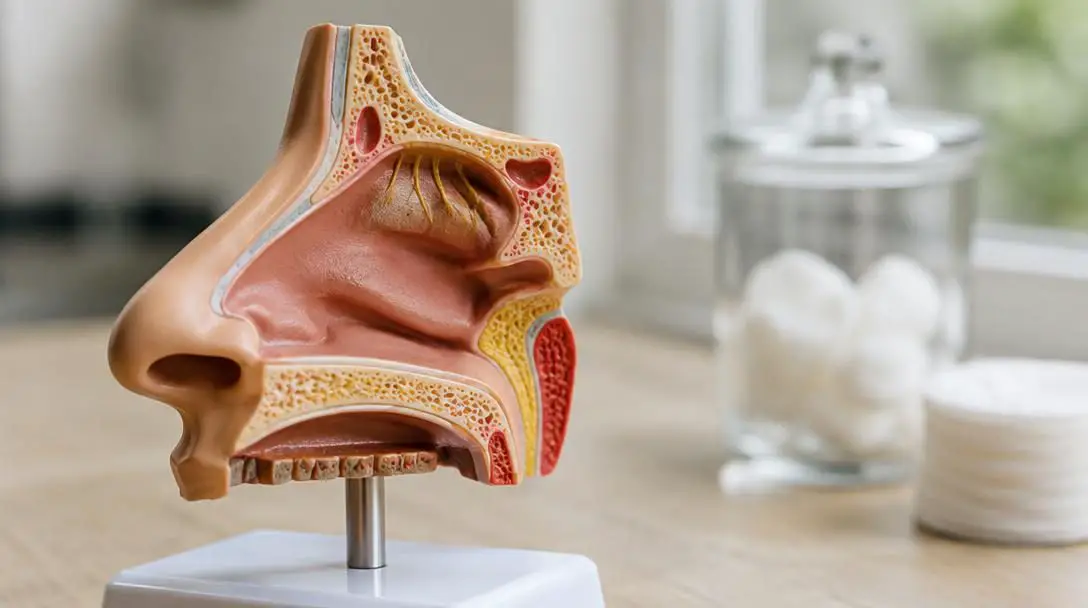
To appreciate how the nose functions, one must examine its intricate physical design. The external nose consists of a supportive framework built of both bone and flexible cartilage covered by protective skin. The upper portion, widely referred to as the bridge, is composed of sturdy nasal bones. In contrast, the lower, flexible portions—such as the nostrils and the nasal tip—derive their contour and flexibility from distinct cartilage plates.
Internally, the structure transitions into the nasal cavity, a spacious chamber divided cleanly down the center by the nasal septum. This cavity is lined throughout with a specialized mucous membrane furnished with microscopic, hair-like structures known as cilia. These structures move in coordinated waves to entrap airborne impurities before they can travel deeper into the respiratory system. Surrounding the main cavity are the paranasal sinuses, which are air-filled pockets within the skull bones that connect directly to the nasal passages, playing a vital role in vocal resonance, skull lightening, and air processing.
Five Surprising Discoveries About the Human Nose
Far from being a passive conduit for air, the nose exhibits an array of refined physiological traits. Below are five remarkable facts highlighting its sensory range, genetic origins, culinary influence, and medical significance.
| Fact | Primary Mechanism | Health and Sensory Impact |
|---|---|---|
| Trillion-Scent Detection | Olfactory receptor neuron binding | High-resolution differentiation of environmental odors |
| Genetic Architecture | Hereditary bone and cartilage patterning | Diverse ancestral contours and facial morphology |
| Flavor Construction | Retronasal olfaction during chewing | Supplies up to 80% of culinary flavor nuance |
| Respiratory Conditioning | Mucosal humidification and ciliary filtration | Prevents bronchial drying and chronic infections |
| Diagnostic Indicator | Vascular reactivity and tissue stability | Reveals circulatory, allergic, or autoimmune conditions |
Detecting Over One Trillion Different Scents
- Sensory capacity: Over one trillion scents
- Key anatomical driver: Olfactory receptor network
- Comparison: Far surpasses previous historical estimates
For decades, conventional wisdom held that the human sense of smell was blunt and underdeveloped compared to that of other mammals. Modern research has overturned this assumption, confirming that the human nose can differentiate among more than one trillion distinct scents. This vast sensory range is powered by the olfactory system, a dense network of specialized receptor cells situated high in the nasal vault.
Unlike the visual system, which relies on a small collection of primary photoreceptors to construct color, the olfactory apparatus uses diverse receptors capable of binding to an immense variety of volatile airborne molecules. Each unique molecule or chemical blend triggers a tailored pattern of nerve impulses, enabling humans to navigate safety hazards like smoke or spoiled food and enjoy the delicate aromatic notes of botanicals and cuisine.
Nose Shape Is Fundamentally Determined by Genetics
- Structural basis: Bone, cartilage, and soft tissue
- Inheritance pattern: Multi-gene hereditary factors
- Ancestral variations: Narrower bridge profiles versus broader bases
The distinctive shape of an individual's nose is heavily governed by complex genetic factors passed through generations. These inherited blueprints regulate how nasal bones knit together, the thickness of cartilage plates, and the distribution of overlying soft tissue. Because environmental adaptations influenced ancestral populations over thousands of years, nose shapes display characteristic patterns worldwide.
For example, populations with European ancestry frequently exhibit narrower, more prominent nasal contours, whereas individuals of African descent typically feature broader, flatter nasal architecture. Beyond biology, nose shape has historically carried notable cultural weight, functioning in various societies as a benchmark of aesthetic harmony, social standing, or regional identity.
The Sense of Taste Relies Heavily on Nasal Receptors
- Sensory contribution: Up to 80% of perceived flavor
- Pathway: Retronasal transit via the pharynx
- Clinical clue: Loss of flavor during congestion
While people naturally attribute culinary enjoyment to the tongue, the gustatory system on its own can only identify rudimentary taste sensations such as sweet, sour, salty, bitter, and umami. The rich, complex dimension of culinary enjoyment actually stems from the nose, with up to 80 percent of perceived flavor originating from olfactory input.
As food is masticated, microscopic volatile compounds evaporate and travel upward through the back of the mouth into the nasal cavity—a dynamic known as retronasal olfaction. When these molecules stimulate olfactory receptors, the brain combines their signals with basic tongue inputs. This interconnected system explains why head colds and blocked sinuses rob meals of their flavor, leaving food tasting flat and indistinct.
Without the continuous sensory input of the olfactory receptors, human flavor perception collapses down to basic, unnuanced tongue sensations.
Nasal Passages Act as an Advanced Environmental Filter
- Primary actions: Cleansing, warming, and humidifying
- Protective barrier: Mucus lining and hair-like cilia
- Risk of obstruction: Sinusitis, sleep apnea, chronic congestion
Every breath drawn through the nostrils undergoes immediate, intensive processing. The internal nasal lining functions as an efficient biological climate-control unit, filtering and humidifying ambient air before it enters the vulnerable tissue of the lungs. The internal mucous blanket captures dust, microbes, and pollutants, while mucosal blood flow warms incoming air to core body temperature.
When chronic congestion or anatomical blockages impede nasal breathing, the respiratory system suffers. Mouth-breathing bypasses this natural purification stage, exposing lower airways to dry, unconditioned air and allergens. Chronic impairment can foster recurrent bouts of sinusitis, exacerbate obstructive sleep apnea, and create persistent pulmonary irritation.
Nasal Appearance Serves as a Health Diagnostic Tool
- Erythema and swelling: Common signs of allergic response
- Cyanotic tint: Potential indicator of circulatory compromise
- Saddle nose deformity: Marker of severe trauma or granulomatosis with polyangiitis
Because the external nose is densely vascularized and covered by sensitive cutaneous layers, its external presentation often provides vital diagnostic clues regarding systemic health. Sudden or sustained changes in nasal color, skin texture, or structural integrity warrant careful clinical consideration.
A persistently red, swollen nose frequently indicates active allergic reactions or localized inflammation. A bluish or dusky hue (cyanosis) can signal sub-optimal blood oxygenation or vascular insufficiency. Furthermore, structural shifts—such as a collapsed bridge or "saddle nose" appearance—can develop following physical trauma or point toward underlying autoimmune disorders like granulomatosis with polyangiitis.
How the Nose Coordinates Its Core Mechanics
The daily operation of the nasal system can be grouped into three synchronized physiological workflows: olfactory transduction, air conditioning, and flavor synthesis. Each operates through distinct anatomical mechanisms that run concurrently during regular respiration and nourishment.

Olfactory transduction begins when airborne molecules enter the nasal vestibule during inhalation. These microscopic chemicals dissolve into the thin mucus layer covering the olfactory epithelium, where they bind directly to receptor neurons. This molecular binding generates electric nerve signals that travel instantly along the olfactory nerve straight into the brain's sensory cortex, creating our conscious awareness of distinct odors.
Simultaneously, the air conditioning mechanism prepares outside air for pulmonary reception. The turbinates—curved bony structures inside the nasal cavity—create turbulent airflow that maximizes contact between incoming air and the vascularized mucous membrane. This turbulence deposits particulate matter onto sticky mucosal walls while transferring latent heat and moisture to the air stream, keeping bronchial tissues healthy.
Finally, flavor processing leverages the anatomical highway between the pharynx and the posterior nasal aperture. During eating, the rhythmic movements of chewing and swallowing pump aroma-laden air upward behind the soft palate. This retronasal airflow delivers a concentrated stream of food volatiles to the olfactory cleft, allowing the central nervous system to merge olfactory data with tongue sensations into an integrated perception of taste.
Daily Nasal Care: How to Maintain Clear Airway Passages
Given the central role the nose plays in both systemic immunity and sensory performance, keeping nasal passages clean, clear, and hydrated requires consistent self-care. The following sequence provides a practical approach to optimal nasal maintenance:
- Perform gentle nasal clearance: Blow your nose softly into a clean tissue, clearing one nostril at a time to prevent high-pressure backflow toward the sinuses.
- Hydrate internal membranes: Administer a gentle saline nasal spray into each nostril once or twice daily, especially in dry, heated, or air-conditioned rooms.
- Minimize contact with airborne irritants: Reduce exposure to second-hand cigarette smoke, industrial fumes, chemical vapors, and heavy dust concentrations that paralyze protective cilia.
- Assess structural and skin changes: Periodically observe the nasal bridge and nostrils in a mirror to detect uncharacteristic redness, persistent swelling, cyanosis, or structural collapse.
- Seek timely care for blockages: Consult a qualified healthcare professional if chronic congestion, snoring, or sinus pressure impedes smooth nasal breathing for more than several consecutive weeks.
Common Nasal Care Mistakes to Avoid
Many individuals unknowingly compromise their nasal health by adopting habits that irritate or damage internal tissues. Recognizing and correcting these frequent errors preserves long-term respiratory performance:
- Overusing medicated decongestant sprays: Relying on medicated chemical decongestants for more than a few consecutive days can induce rebound congestion, worsening nasal tissue swelling once the medication wears off.
- Ignoring chronic nasal obstruction: Treating persistent congestion as merely an unavoidable inconvenience can allow underlying conditions like sinusitis or sleep apnea to progress unchecked.
- Exposing airways to tobacco smoke: Inhaling active or passive smoke strips the nasal mucosa of protective moisture and impairs the movement of the hair-like cilia.
- Dismissing structural bridge collapse: Overlooking changes in the bridge contour, such as a saddle nose, delays diagnosis of previous physical injuries or conditions like granulomatosis with polyangiitis.
- Neglecting ambient humidity: Living in excessively dry environments without supplemental humidification dries out mucosal barriers, leaving them prone to irritation, bleeding, and compromised filtration.
Frequently asked questions
How does the human nose distinguish over one trillion scents?
The olfactory system contains an extensive network of specialized receptor cells. Rather than relying on a small set of receptors, these cells recognize diverse molecular combinations in airborne compounds, sending distinct neural signals that the brain translates into more than one trillion unique scent profiles.
Why do different ethnic groups have distinct nose shapes?
Nose shape is predominantly governed by genetics and evolutionary heritage. Multiple genes dictate the development of nasal bone, cartilage, and soft tissue, resulting in characteristic ancestral variations such as narrower bridges in European lineages and broader bases in African lineages.
Why does food lose its taste when you have a cold?
Because up to 80 percent of flavor perception is derived from smell, nasal congestion blocks volatile food aromas from traveling retronasally to the olfactory receptors. Without this aromatic input, the brain receives only basic taste sensations from the tongue, making meals seem bland.
What is a saddle nose deformity, and what causes it?
A saddle nose refers to a visible collapse or depression of the nasal bridge. It typically stems from prior physical trauma to the facial bones or from underlying systemic autoimmune conditions, such as granulomatosis with polyangiitis, which weaken the nasal cartilage.
What is the best way to keep nasal passages healthy?
Maintain healthy nasal passages by practicing gentle clearance, using non-medicated saline sprays to preserve mucosal hydration, avoiding respiratory irritants like smoke and dust, and seeking medical guidance for prolonged congestion or sleep-disordered breathing.
The bottom line
The human nose is far more than a decorative facial landmark or a simple air intake valve. It is an evolutionary marvel that integrates high-capacity chemical sensing, sophisticated respiratory protection, and vital health diagnostics into a single compact structure. Capable of distinguishing over a trillion scents and providing the primary sensory architecture for human flavor perception, the nose shapes how we engage with nourishment, nature, and other people every day.
Safeguarding this sensory powerhouse requires attentive daily care, routine hydration, and respect for its delicate internal physiology. By avoiding harmful habits like smoke exposure and decongestant overuse, while remaining vigilant for visual changes like discoloration or bridge collapse, you can preserve your nasal health for decades. A clear, well-maintained nose ensures easy breathing, protects vulnerable lungs, and keeps the full spectrum of the world's aromas and flavors vibrantly alive.