CRISPR: The Weird Science Of Editing Your Own Genes

Science has advanced at a blistering pace over the last century, compressing more transformative breakthroughs into a few generations than occurred in all previous human history combined. As researchers accelerate their capacity to analyze and manipulate the fundamental building blocks of biology, the future of medicine looks simultaneously exhilarating and profoundly mysterious. While foreseeing the exact state of biotechnology decades from now remains impossible, foundational discoveries made over the past several years have established the groundwork for an era centered on direct genomic modification.
Chief among these revolutionary breakthroughs is CRISPR, a molecular mechanism that provides researchers with the unprecedented ability to alter genetic sequences inside living organisms. An acronym for Clustered Regularly Interspaced Short Palindromic Repeats, the technology sounds dauntingly complex, yet its essential mechanism is grounded in an elegant, ancient defense system discovered within single-celled life. From its early origins as a microbial shield against pathogens to modern clinical trials combating life-threatening human illnesses, CRISPR is fundamentally reshaping the landscape of modern medicine.
Key takeaways
- CRISPR originated as a natural bacterial immune system that records viral genetic code to recognize and destroy subsequent infections.
- The gene-editing mechanism relies on a programmable guide sequence to navigate the genome and a specialized Cas9 protein that acts as molecular scissors to cut DNA.
- Initially utilized to modify agricultural crops, the platform has expanded into rapid viral diagnostics and clinical trials targeting conditions such as cancer, HIV, diabetes, and blindness.
- Because the technology is relatively straightforward and accessible, the global scientific community places high priority on active self-regulation to prevent socioeconomic inequality and unethical genetic modifications.
From Microbial Warfare to Modern Gene Editing
To grasp how CRISPR operates inside complex human cells, it is essential to trace its natural heritage. Long before scientists conceptualized rewriting genetic code to cure inherited diseases, single-celled microbes were locked in perpetual survival battles against predatory viruses. To defend themselves against recurring viral attacks, microorganisms evolved an adaptive immune response. When a bacterium survives an infection, it captures and stores snippets of the invading virus's genetic sequence, embedding them between repeated segments of its own DNA. These repetitive architectures are precisely what scientists termed clustered regularly interspaced short palindromic repeats.
When biochemist Jennifer Doudna and her collaborators examined these defensive sequences, they unraveled the exact biological machinery bacteria use to deploy this genetic memory. For her pioneering work in developing the technology into a programmable genome-editing tool, Doudna was awarded a Nobel Prize in 2020. Describing the core biology behind the discovery, Doudna noted:
"CRISPR is, in fact, a bacterial immune system. It’s an ancient system that evolved in microbes to allow prevention of viral infection…our work with the laboratory revealed that one of the components of this CRISPR immune system is, in fact, a protein that’s called Cas9, that can be programmed to find and cut virus DNA."
By pairing the stored genetic archive with an enzyme capable of slicing double-stranded DNA, microbes possessed an internal surveillance force. Recognizing that this bacterial system could be re-engineered, scientists transformed an obscure microbiological defense into a universal molecular instrument. About a decade before making widespread headlines in human trials, CRISPR was deployed in agriculture, allowing researchers to alter crop genetics to improve food characteristics. Those agricultural successes confirmed that the molecular machinery could function outside bacteria, setting the stage for advanced trials in human health.
The Molecular Architecture of the CRISPR-Cas9 System
At the microscopic level, editing a genome with CRISPR is remarkably streamlined compared to historical genetic engineering methods. Rather than relying on cumbersome synthetic proteins that must be redesigned from scratch for every target, CRISPR operates using two primary modular parts: a programmable targeting sequence and an enzymatic cutting unit.
| Component | Biological Role | Functional Analogy | Primary Mechanism |
|---|---|---|---|
| Guide Sequence | Genome navigation and targeting | Molecular GPS | Scans DNA to bind precisely with a complementary genetic address |
| Cas9 Protein | Double-stranded cleavage | Molecular scissors | Cuts through both strands of the target DNA at the designated site |
| Cellular Repair Machinery | DNA reconstruction and sequence modification | Biological patch kit | Mends the break, allowing researchers to disrupt an unwanted gene or insert new code |
The Guide Sequence
The navigational engine of the system consists of a customized RNA sequence designed to match the exact stretch of DNA targeted for modification. Because genetic material naturally seeks its complementary sequence, this guide strand travels through the immense library of a cell's genome, ignoring billions of unrelated base pairs until it locks onto its matching counterpart with pinpoint accuracy.
The Cas9 Protein
Bound to the guide sequence is the Cas9 enzyme, a specialized protein that executes the physical cut. Once the guide locates and docks onto the target sequence, Cas9 activates, cleaving both strands of the double helix. Describing the immense flexibility of this mechanism, Robert Reed, a professor of biology at Cornell University, explained, "You can just point it at a place in the genome and you can do anything you want at that spot."
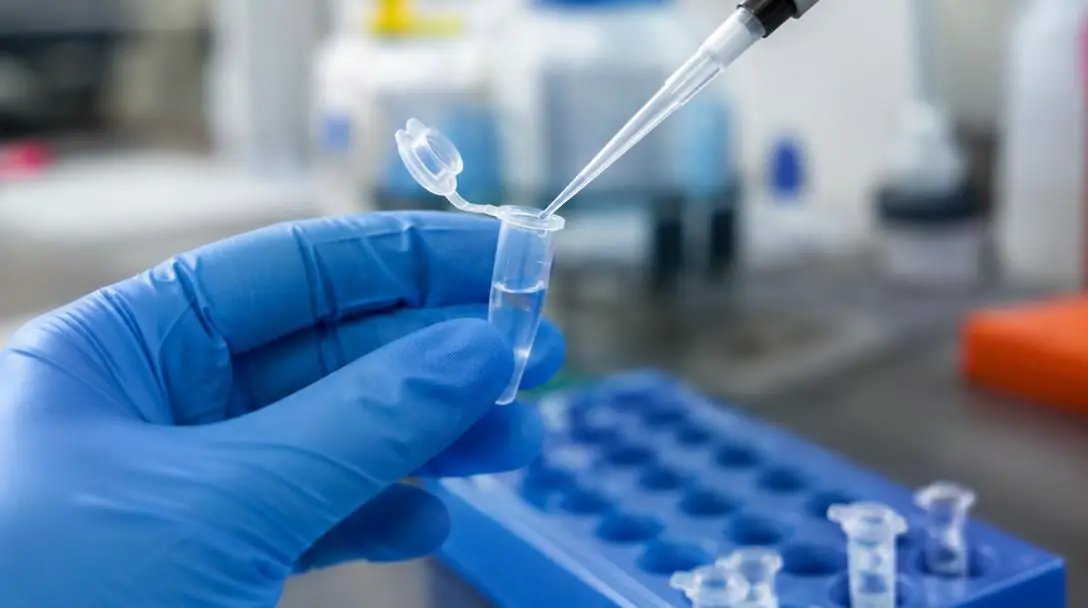
Technically, CRISPR causes a gene mutation by cutting like a knife or a pair of scissors.
Cellular Repair Machinery
Once Cas9 slices the chromosome, the cell's native survival mechanisms engage immediately to repair the fracture. Left to its own devices, the cellular repair crew frequently makes small errors when gluing the ends back together, effectively silencing or knocking out a malfunctioning gene. Alternatively, scientists can provide a synthetic template during the repair window, directing the cell to incorporate an entirely new sequence at the cut location.
How CRISPR Gene Editing Works in Practice
Moving a therapeutic or diagnostic CRISPR intervention from the drawing board to living biological tissue requires a rigorous, multi-stage protocol. While specific laboratory workflows change based on the organism and objective, the fundamental procedure follows six distinct phases:
- Identifying the Target Sequence: Scientists isolate the exact genetic code responsible for an ailment or trait, such as a mutated gene causing inherited blindness or viral sequences found in COVID-19.
- Designing the Guide: Researchers synthesize a complementary genetic guide strand that mirrors the specific DNA target, ensuring Cas9 acts solely at the designated chromosomal location without unintended cross-reactivity.
- Assembling the Molecular Complex: The engineered guide sequence is paired with the Cas9 enzyme in the laboratory, forming an active, armed CRISPR-Cas9 ribonucleoprotein complex.
- Delivery into Cells: The functional complex is introduced across the cell membrane into the cellular interior, successfully navigating into the nucleus where the target genomic DNA resides.
- Locating and Cutting DNA: The guide navigates the genome, latches onto the matching nucleotide sequence, and prompts Cas9 to slice through the double-stranded DNA helix.
- Monitoring Cellular Outcomes: Researchers monitor cellular responses to confirm the targeted site underwent mutation, deletion, or insertion as planned, while verifying that surrounding cellular vitality remains intact.
Diagnostic and Clinical Applications
While theoretical discussions about gene editing often focus on speculative scenarios, CRISPR is already actively deployed across multiple medical fronts. Its dual ability to both detect minute amounts of genetic material and cut existing sequences makes it uniquely versatile.
COVID-19 Diagnostics
Because the CRISPR machinery excels at homing in on discrete genetic codes, it proved extraordinarily useful during the emergence of the COVID-19 pandemic. By programming guide sequences to recognize unique signatures of viral RNA, researchers engineered rapid diagnostic platforms capable of verifying active infections with clinical accuracy.
Cancer
Oncological research explores using CRISPR to edit a patient's immune cells, reprogramming them to better recognize, track down, and eliminate malignant tumors that normally evade natural immune surveillance.
HIV
Human immunodeficiency virus embeds its viral blueprint directly into the host organism's cellular genome, making it notoriously difficult to eradicate with conventional antivirals. Researchers are deploying CRISPR to locate and cut out integrated HIV DNA from infected host reservoirs.
Diabetes
Investigational therapies are evaluating how targeted gene modifications could restore metabolic function or protect insulin-producing pancreatic cells from autoimmune destruction, addressing underlying root causes of the disease.
Blindness
Certain forms of inherited vision loss stem from identifiable single-gene defects within retinal tissue. Clinical investigations have utilized direct, localized delivery of CRISPR complexes to repair or deactivate damaging genetic mutations directly within ocular cells.

Bioethics, Social Equity, and Self-Regulation
Because CRISPR is substantially simpler, faster, and more economical to deploy than prior genetic engineering frameworks, its accessibility creates urgent ethical challenges. The capacity to edit living human DNA provides tremendous therapeutic promise, but it also carries serious risks regarding socioeconomic division and potential abuses.
A primary fear among ethicists and medical observers is that access to genomic alterations could mirror preexisting wealth disparities. If genetic enhancements or life-saving interventions remain restricted by financial privilege, society risks establishing genetic stratification, where genetic modifications are used to weed out certain people socioeconomically.
Recognizing the ease with which CRISPR can be manipulated, the international scientific community has focused extensively on professional self-governance. Robert Truog of Harvard Medical School underlined this collective responsibility, stating:
"The concern is that with technologies that are relatively easy to use, like CRISPR, how does the scientific community regulate itself? If there's a silver lining to this cloud, I think it is that the scientific community did pull together to be critical of this work, and took the responsibility to seriously use the tools available to them to regulate themselves."
Establishing binding professional norms, publishing ethical boundaries, and engaging in open discourse remain indispensable. Only by maintaining rigorous oversight can scientists protect clinical safety and public trust while advancing critical treatments for debilitating medical conditions.
Common Misconceptions About Gene Editing
Intense media interest surrounding CRISPR has fostered several widespread misunderstandings regarding how the technology functions, its historical roots, and its current clinical maturity. When evaluating updates in genomic medicine, it is helpful to keep these common traps in mind:
- Assuming CRISPR is a brand-new invention: While modern laboratory applications date back only a few decades, CRISPR is fundamentally an ancient natural immune defense that bacteria have used to thwart viral infections for eons.
- Believing it only treats inherited diseases: Although human therapeutics receive the bulk of media attention, CRISPR is also a powerful diagnostic instrument—demonstrated prominently during the COVID-19 pandemic—and a foundational research tool.
- Overlooking its agricultural foundation: Human clinical trials were not the immediate first step. Researchers initially tested and refined CRISPR-based genetic modifications in food crops and agricultural plants to observe how targeted mutations altered organism traits.
- Assuming the science is entirely settled: While precision has improved exponentially, the technology remains in an exploratory, developmental phase. Long-term cellular consequences, delivery efficiency, and unintended mutations continue to be studied across global research labs.
- Believing the technology can self-govern without effort: Because CRISPR components are relatively straightforward to synthesize, robust ethical oversight and self-regulation by researchers and governing bodies are vital to protect patients from unregulated experimentation.
Frequently asked questions
What does the acronym CRISPR actually stand for?
CRISPR stands for Clustered Regularly Interspaced Short Palindromic Repeats, referring to the distinct, repetitive genetic patterns that bacteria use to store fragments of viral DNA from previous infections.
Who was recognized for pioneering CRISPR as a gene-editing tool?
Jennifer Doudna received a Nobel Prize in 2020 for her groundbreaking biochemical research demonstrating that the bacterial Cas9 enzyme could be programmed with custom guide RNA to find and cut specific sequences of DNA.
How does CRISPR differ from older genetic engineering methods?
Traditional genetic engineering required designing and assembling complex, custom proteins for every targeted DNA sequence. CRISPR simply uses a standard Cas9 cutting protein paired with an easily synthesized RNA guide, making the process much faster, cheaper, and more adaptable.
What severe health conditions are currently being targeted with CRISPR?
Researchers are actively studying and conducting trials using CRISPR to target serious conditions including cancer, HIV, diabetes, and inherited forms of blindness, alongside its established role in viral diagnostics.
Why is scientific self-regulation so important for this technology?
Because CRISPR is relatively accessible and simple to program, scientists must regulate themselves to prevent unethical applications, such as widening socioeconomic divisions through selective genetic modifications or conducting untested procedures on humans.
The Bottom Line
CRISPR has initiated one of the most transformative eras in the history of biological science. What began as an obscure microbial immune defense mechanism has rapidly matured into a programmable molecular scalpel capable of revising the code of life itself. While significant questions remain regarding long-term clinical safety, equitable healthcare distribution, and ethical governance, the momentum behind gene editing is unmistakable.
As ongoing research refines the accuracy of Cas9 and expands clinical trials for intractable conditions like cancer, HIV, diabetes, and blindness, discussions about gene editing will transition from academic laboratories to everyday medical consultations. Understanding the biological mechanisms, realistic capabilities, and societal stakes of CRISPR ensures that patients, clinicians, and the broader public can navigate this emerging genetic landscape with clarity and responsible foresight.