Does 4 Pics 1 Word Help Train Your Brain?

Since the advent of smartphones, mobile word association games have transformed how millions of people spend their spare moments. Among the most enduring titles in app stores is 4 Pics 1 Word, a streamlined puzzle game downloaded millions of times worldwide. The game presents players with a simple challenge: examine a quartet of distinct photographs, uncover the hidden conceptual thread tying them together, and spell out the matching word using a pool of scrambled letters.
Because the game deals with linguistic association, visual interpretation, and problem solving, players routinely wonder whether their daily puzzle sessions deliver legitimate cognitive benefits. While casual mobile gaming is often dismissed as mere distraction, understanding how visual pattern recognition and vocabulary retrieval stimulate the brain offers a clearer perspective on whether games like 4 Pics 1 Word can support mental sharpness.
Key takeaways
- 4 Pics 1 Word exercises visual pattern recognition, semantic association, and vocabulary recall during short puzzle sessions.
- Research published in Frontiers in Aging Neuroscience suggests that brain games targeting working memory and problem solving can support cognitive function in older adults.
- The game relies on lateral thinking and cognitive flexibility by challenging players to look beyond literal imagery to metaphors, actions, and shared properties.
- Digital word games provide mental stimulation, but they work best as complements to core brain-health habits like exercise, nutrition, sleep, and social interaction.
From Printed Riddles to Touchscreens: The Evolution of Word Puzzles
Word association challenges are far from a modern invention. For centuries, printed puzzle books, newspaper crosswords, anagrams, and illustrated riddles served as standard intellectual diversions. These traditional pastimes challenged readers to synthesize general knowledge, test their spelling, and use deductive reasoning to solve structured linguistic problems. However, physical puzzle formats naturally came with limitations, including the need for writing utensils, physical print copies, and fixed, non-interactive layouts.
The rise of modern mobile technology fundamentally reshaped this genre. Developers adapted the foundational principles of word association into dynamic, portable software engineered for touch interfaces. By removing setup requirements, recurring publication costs, and bulky accessories, digital adaptations democratized puzzle solving. Players can launch an application during a morning transit ride or an evening break, receiving instant feedback on their deductions. Within this digital shift, 4 Pics 1 Word stripped away unnecessary narrative complications, focusing entirely on pure visual-to-linguistic deduction.
Mechanics of 4 Pics 1 Word: How the Visual Puzzle Operates
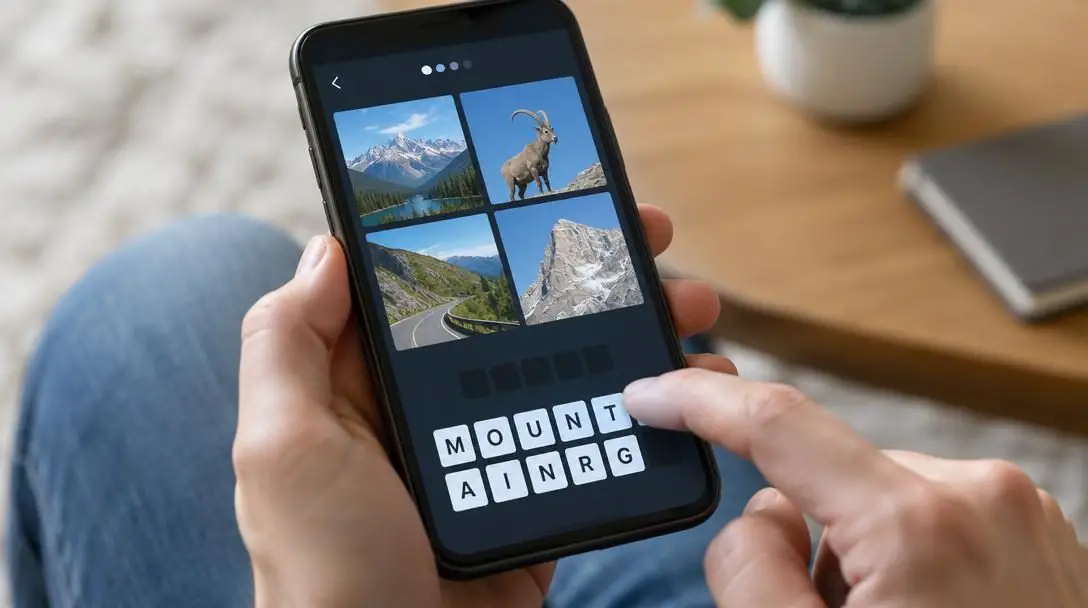
The operational framework of 4 Pics 1 Word is intentionally minimal, allowing players of varying skill levels to engage immediately without parsing complicated rulebooks. When a new stage begins, the screen displays a two-by-two grid containing four separate photographs. Directly beneath the visual grid sits a series of empty letter slots that indicate the exact character count of the mystery word. Below those empty slots rests a keyboard-style bank of scrambled letters containing the necessary solution characters mixed with misleading distractor tiles.
To solve a puzzle, the player must identify the unifying concept that links every photograph in the grid. For instance, if the four pictures show a personal automobile, an illuminated traffic light, a hands-on steering wheel, and a reflective road sign, the common semantic thread connecting all four scenes is the word drive. Players tap the letters from the lower bank to fill the blank slots in sequential order.
The game provides immediate visual confirmation when a player inputs the correct sequence, automatically advancing them to the next level while granting in-game currency or points. If an error is made, players can tap placed letters to return them to the letter bank and test an alternative hypothesis. When a puzzle proves exceptionally difficult, players can spend their accrued points to unlock hints, such as revealing a correct letter in its proper slot or removing superfluous distractor letters from the available pool.
Core Cognitive and Psychological Benefits of Playing
While 4 Pics 1 Word is fundamentally an entertainment application, the cognitive operations required to solve its challenges demand active mental processing. The game recruits several interacting cognitive domains, turning casual play into a workout for specific mental faculties.
Improving Problem-Solving Skills
Deductive reasoning is at the heart of every level in 4 Pics 1 Word. When presented with four visually divergent photographs, the brain cannot simply rely on surface-level observation. A player might see an icy landscape, an emotionless facial expression, a glass of water with ice cubes, and a frosty windowpane. To solve the puzzle, the player must actively filter out extraneous details—such as the person's clothing or the shape of the glassware—and isolate the fundamental property linking every image: cold. This process of identifying latent patterns and synthesizing visual clues into a single conclusion strengthens inductive and deductive problem-solving pathways.
Enhancing Cognitive Flexibility
Cognitive flexibility refers to the brain's ability to switch between different concepts, adjust to new information, and approach challenges from unexpected angles. In 4 Pics 1 Word, literal interpretations frequently lead to dead ends. An image of a bank building, a river shoreline, an aircraft tilting sideways, and a pool table cushion might confuse a player searching purely for architectural terms. The player must abandon rigid literal definitions to recognize that the unifying word is bank. Shifting smoothly between concrete representations, metaphorical relationships, and secondary definitions exercises lateral thinking and mental adaptability.
Boosting Vocabulary and Spelling
Language retention requires ongoing reinforcement. By requiring players to translate visual representations into precise written terms, the game activates the brain's internal lexicon. Players frequently encounter words that sit outside their everyday conversational vocabulary, prompting them to retrieve lesser-used terms from long-term memory storage. Furthermore, because solutions must be spelled out letter by letter using a mixed tile bank, the game reinforces orthographic memory, spelling accuracy, and correct character sequencing.
Strengthening Working and Short-Term Memory
Solving a multi-image riddle relies heavily on working memory—the mental workbench where information is temporarily held and manipulated. A player must hold the visual details of the first two pictures in mind while analyzing the third and fourth, cross-referencing candidate words against the available letter slots and the visible letter bank. Additionally, players naturally retain mental notes of words and thematic associations encountered in preceding stages, calling upon short-term memory recall to avoid repeating incorrect guesses and to identify recurring visual metaphors.
Reducing Stress Through Low-Stakes Engagement
Mental wellness plays an indispensable role in overall cognitive performance. Chronic stress and cognitive overload impair attention, decision-making, and memory consolidation. Engaging with a calm, self-paced puzzle game provides a structured mental diversion from daily stressors. Because the game features no punitive failure timers or high-stakes losses, it produces a state of focused relaxation. Successfully cracking a challenging visual riddle also triggers a mild sense of accomplishment and dopamine release, offering a refreshing mental reset during a hectic day.
What Scientific Research Says About Digital Brain Games
The broader marketplace for brain-training applications has grown dramatically over the past two decades, with numerous commercial platforms claiming their digital drills can measurably boost general intelligence or ward off age-related cognitive decline. When evaluating these assertions, the wider scientific consensus remains cautious and nuanced.
Research indicates that while brain games do stimulate the mind, their benefits are often specific to the tasks being practiced. However, targeted research demonstrates that certain cognitive benefits do occur. For example, a 2016 study published in the journal Frontiers in Aging Neuroscience investigated the effects of brain-training games requiring working memory and problem-solving skills in older adults. The researchers found that participating in these structured mental challenges resulted in measurable improvements in cognitive function within the tested domains.
While digital word puzzles engage working memory, they cannot replace foundational habits like regular physical exercise, balanced nutrition, and active social connection.
At the same time, cognitive researchers consistently emphasize that digital puzzle games are not a magic bullet for mental longevity. Software cannot replace the broad, holistic benefits derived from regular cardiovascular exercise, nutrient-dense dietary habits, restorative sleep, and sustained interpersonal socialization. Mobile word puzzles are best understood as an enjoyable form of targeted mental stimulation that can complement—rather than replace—a healthy, brain-conscious lifestyle.
Comparing 4 Pics 1 Word to Dedicated Brain-Training Suites
Many structured brain-training platforms require recurring subscriptions, extensive baseline testing, and rigid daily regimens. Comparing 4 Pics 1 Word against these specialized platforms highlights why casual word-association games remain exceptionally popular for everyday mental exercise.

| Feature | 4 Pics 1 Word | Dedicated Brain-Training Suites |
|---|---|---|
| Access Model | Free mobile download with optional hints | Often requires paid monthly or annual subscriptions |
| Core Mechanics | Visual pattern matching and word spelling | Multi-domain cognitive tasks (math, speed, memory) |
| Social Integration | Informal collaboration and screenshot sharing | Individual performance tracking and global percentiles |
| User Experience | Instant play with zero onboarding tutorials | Structured assessments, diagnostic baselines, and timed drills |
Accessibility Across Devices
Unlike complex software suites that require specialized hardware configurations or extensive onboarding tutorials, 4 Pics 1 Word is universally accessible on standard iOS and Android smartphones and tablets. It requires minimal digital storage and can be launched instantly. This frictionless accessibility makes it easy for individuals across all age brackets to weave short, mentally stimulating breaks into their normal daily routines without financial commitments.
Simplicity of Mechanics
Dedicated cognitive software platforms often require users to navigate complex statistical dashboards, tracking percentile shifts and calibrated difficulty algorithms. In contrast, 4 Pics 1 Word features an intuitive interface that requires no explanation. The rules are immediately obvious to children, working adults, and seniors alike. By eliminating technical barriers and confusing menus, players can direct 100 percent of their mental energy toward solving the actual puzzle on screen.
Opportunities for Socialization
While many brain-training programs are strictly solitary experiences designed around individual performance tracking, 4 Pics 1 Word naturally fosters social collaboration. Players routinely pass their phones to friends, ask family members for input on a stubborn level, or send puzzle screenshots to group chats. This collaborative problem solving encourages verbal communication, joint deduction, and lively debate over competing interpretations of the imagery.
Visual and Linguistic Variety
Repetition can cause mental drills to feel like tedious chores. 4 Pics 1 Word counters fatigue by introducing an expansive variety of photographic styles, cultural references, and linguistic categories. One level might test knowledge of culinary ingredients, while the next explores mechanical engineering, abstract emotional concepts, or natural geography. This dynamic visual rotation prevents automated responses, forcing the player to reset their perspective with every new stage.
Practical Steps to Maximize Mental Engagement
Mindless tapping diminishes the cognitive return of any puzzle game. To gain the greatest mental stimulation from 4 Pics 1 Word, players can approach each stage with intentional analytical strategies rather than relying on casual guesswork.
- Analyze each photograph individually before looking down: Take several seconds to examine every quadrant of the grid in isolation. Note specific objects, visible background elements, prominent colors, materials, and implied actions before glancing at the letter count or letter bank.
- Formulate the thematic connection deliberately: Ask yourself what abstract category, shared physical attribute, or functional purpose unites the scenes. Determine whether the underlying connection is best expressed as a noun, a descriptive adjective, or an action verb.
- Resist immediate letter scrambling: Avoid the temptation to tap available letters at random in the hopes that an answer reveals itself. Attempt to produce the complete word in your mind first, treating the letter bank merely as a tool to verify and spell your hypothesis.
- Set personal time challenges: If early levels feel overly simple, train your visual processing speed by challenging yourself to identify the unifying concept within ten to fifteen seconds without using hints.
- Turn stubborn roadblocks into collaborative discussions: When a puzzle proves difficult, share the screen with a friend, coworker, or family member. Discussing what each observer notices stimulates verbal communication and exposes you to alternative ways of categorizing visual information.
Common Pitfalls That Hinder Cognitive Value
While the game is engineered to be approachable, certain user habits can undermine both the mental challenge and the long-term satisfaction of solving puzzles.
- Over-relying on hints and letter reveals: Spending in-game currency to reveal correct letters or discard unused distractors at the first sign of difficulty robs the brain of the opportunity to work through productive struggle.
- Brute-force trial and error: Repeatedly tapping random letter combinations into the answer slots bypasses deductive reasoning, pattern recognition, and semantic processing entirely.
- Fixating on a single image: Players frequently lock their attention onto the most visually striking picture in the quartet, attempting to force an answer that fits that specific image while ignoring contradictions in the remaining three.
- Assuming literal interpretations are always correct: Overlooking metaphorical, auditory, or secondary meanings of words often results in prolonged frustration, particularly when concrete visual clues represent abstract concepts.
- Playing past the point of mental fatigue: Grinding through dozens of levels in a single sitting leads to diminished attention spans, eye strain, and automatic tapping, transforming an active mental exercise into passive screen consumption.
Frequently asked questions
Does playing 4 Pics 1 Word raise your IQ?
There is no scientific evidence demonstrating that playing 4 Pics 1 Word or similar mobile puzzle games increases general intelligence or IQ scores. While the game exercises specific cognitive skills such as semantic retrieval, pattern detection, and deductive reasoning, these improvements primarily make you better at word-association tasks rather than elevating overall baseline intelligence.
How many levels should you play per day for mental stimulation?
Playing in short, focused intervals of 10 to 20 minutes—typically five to fifteen levels depending on difficulty—is ideal. Brief sessions maintain high attention levels and prevent the mental fatigue that leads to mindless guessing and trial-and-error tapping.
Can word puzzle games help prevent age-related cognitive decline?
While studies such as the 2016 research published in Frontiers in Aging Neuroscience indicate that working memory and problem-solving games can improve cognitive function in older adults, games alone cannot prevent dementia or neurodegenerative decline. Long-term brain health depends on a combination of cardiovascular exercise, balanced nutrition, sufficient sleep, and regular social interaction.
Is 4 Pics 1 Word suitable for building children's vocabulary?
Yes. The game's combination of clear photographic clues and spelling mechanics makes it an engaging tool for young learners. It reinforces orthographic memory, introduces new words in context, and helps children practice abstract association by linking diverse real-world images to single vocabulary terms.
The bottom line
4 Pics 1 Word is an enjoyable, well-designed mobile puzzle that delivers authentic mental engagement in bite-sized sessions. By requiring players to cross-reference multiple visual inputs, deduce common threads, and spell out solutions from jumbled letters, the game actively exercises working memory, deductive problem solving, cognitive flexibility, and vocabulary recall.
However, digital puzzles should not be viewed as a standalone solution for cognitive health. The human brain thrives on a diverse array of physical, social, and intellectual stimuli. Pairing regular physical workouts, balanced nutrition, restorative sleep, deep reading, and rich interpersonal conversations with occasional, mindful rounds of 4 Pics 1 Word ensures that your gaming habit serves as a fun, refreshing component of a balanced, mentally active lifestyle.