How to Balance a Chemical Equation
Balancing chemical equations is considered a foundational skill in the study of chemistry. Chemical reactions occur whenever atoms and molecules break apart and recombine to create entirely new substances, whether through industrial synthesis, natural decomposition, or everyday combustion. A chemical equation serves as the written representation of this recombination, utilizing standard periodic element symbols along with numbers to communicate the precise amounts of each element involved.
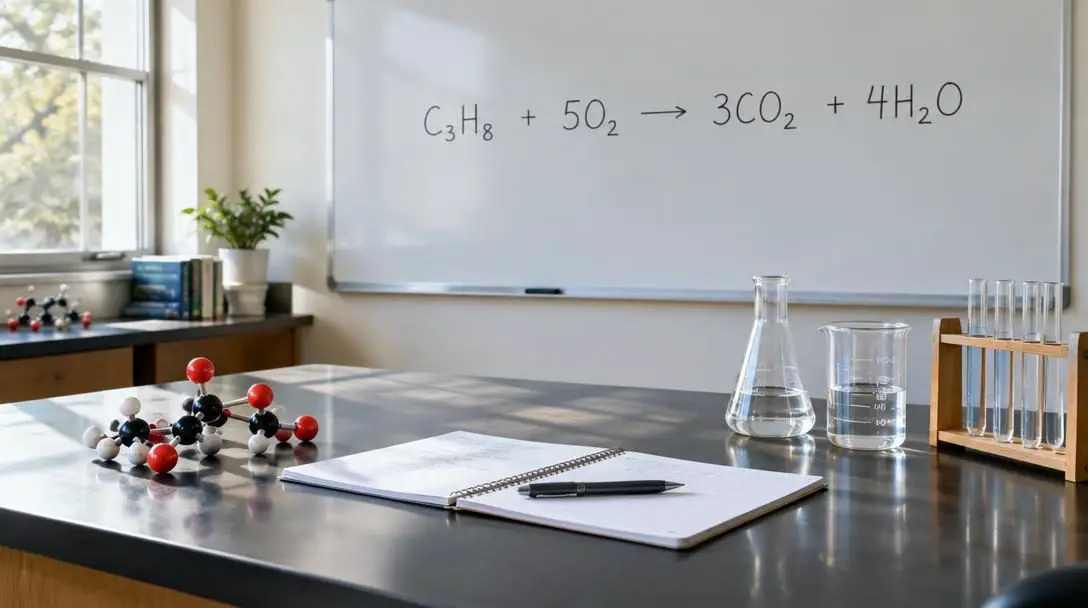
In standard chemical reactions, matter cannot be created or destroyed. Because of this universal principle, any accurate chemical equation must show the exact same quantity of each type of atom on both sides. A classic example of such a transformation is the burning of propane to yield water and carbon dioxide, written in unbalanced form as C3H8 + O2 produces H2O + CO2. The arrow in these formulas marks a transformative chemical change, operating functionally like an equal sign in mathematics. If the atom counts on the pre-change side fail to match those on the post-change side, the equation fails to represent the physical reality of the reaction accurately.
Key takeaways
- Chemical equations must maintain equal atom counts on both sides to satisfy the principle that matter cannot be created or destroyed.
- Subscripts dictate a substance's unique chemical identity and cannot be altered, whereas coefficients multiply entire molecules to balance equations.
- Effective balancing begins with elements that appear in simpler, single compounds while leaving common elements like hydrogen and oxygen for last.
- Coefficients must apply to every atom within a compound and should always be reduced to their lowest whole-number ratio upon completion.
The Anatomy of a Chemical Equation: Subscripts, Coefficients, and Sides
To interpret and balance chemical equations correctly, one must understand how numbers and positions are used in chemical formulas. A chemical reaction is divided into two distinct sections separated by a central arrow. The left side, often called the pre-change side, lists the original chemical substances present before the reaction occurs. The right side, known as the post-change side, lists the new chemical substances that have formed as a result of the transformation.
Numbers appear within these formulas in two fundamentally different roles: as subscripts and as coefficients. Recognizing the difference between these two placements is vital for performing any chemical calculation.
Subscripts are the smaller numbers written directly after an element's symbol, placed slightly lower on the line. The subscript indicates the specific number of atoms for that element bound within that individual molecule. If an element appears without a subscript, it exists as a single atom within that chemical unit. Most importantly, subscripts define the chemical identity of the substance itself and cannot be altered or moved during the balancing process.
Coefficients, on the other hand, are the whole numbers placed directly in front of an entire molecule or formula unit. A coefficient multiplies every single atom within that entire chemical formula. For example, adding a coefficient of 3 in front of carbon dioxide, written as 3 CO2, triples the entire molecule, resulting in three times as many carbon and oxygen atoms as exist in a single CO2 unit.
| Feature | Subscript | Coefficient |
|---|---|---|
| Placement | Lower right after an element symbol | Directly in front of an entire chemical formula |
| Function | Specifies the number of atoms bound in a single molecule | Specifies the number of whole molecules or units present |
| Modifiable? | No; fixed by chemical identity | Yes; adjusted to balance atom counts |
| Scope of Effect | Applies only to the immediately preceding element or bracketed group | Multiplies every element across the entire compound |
Mastering the Step-by-Step Method: Balancing Propane Combustion
While various techniques can be used to balance a simple chemical equation, following a traditional step-by-step process ensures accuracy and prevents confusion. You can work through the reaction involving the burning of propane—C3H8 + O2 produces H2O + CO2—using a methodical, orderly routine.
In standard chemical reactions, matter cannot be created or destroyed, requiring every single atom entering a reaction to be accounted for when products form.
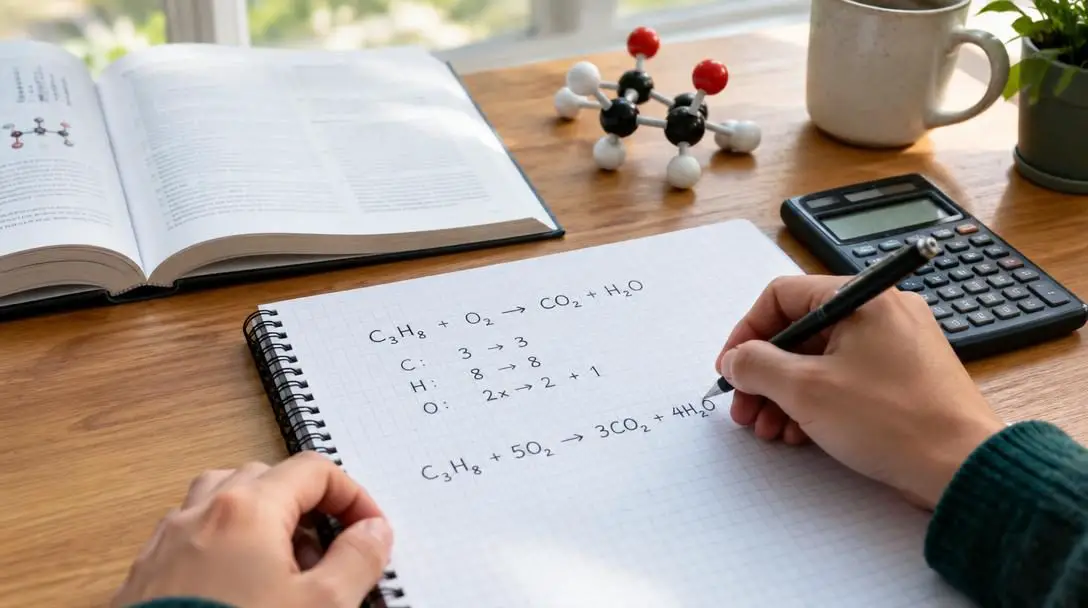
- Record the initial atom inventory for each element. Begin by using the unbalanced equation as your guide to count and list the atoms present on each side. First, record the total number of atoms for each individual element on the left (pre-change) side of the equation. Next, repeat this counting process for the right (post-change) side. Remember that elements without a subscript exist as a single atom. It is best practice to organize this information in two vertical columns positioned side by side, allowing each element to sit directly beside its counterpart across the equation. For the initial propane equation, your inventory shows C=3, H=8, and O=2 on the pre-change side, while the post-change side shows an unbalanced count of C=1, H=2, and O=3 (distributed between one oxygen in H2O and two oxygens in CO2).
- Save the most common elements for last. Once your coordinated columns are drawn, plan the sequence in which you will adjust the elements. You should approach the placement of coefficients strategically rather than adjusting elements at random. It is recommended to leave extremely common elements, such as hydrogen and oxygen, until the final stages of the balancing routine. Because hydrogen and oxygen appear in a broad variety of chemical molecules, they often appear across multiple compounds on both sides of a reaction, making them more complicated to balance early on.
- Start with single elements in simpler forms. Examine the chemical formulas to find elements that exist without subscripts or appear in simpler forms. Look for single elements that appear on both sides of the equation first, followed by those appearing on one side or the other. In the reaction C3H8 + O2 produces H2O + CO2, carbon appears as a single atom within CO2 on the right side, making it the ideal starting point for your calculations.
- Balance the carbon atoms. Because there are three carbon atoms on the left side in the C3H8 molecule and only a single carbon atom on the right side in CO2, you must place a coefficient of 3 in front of CO2 on the right side. Tripling the carbon dioxide molecule creates a total of 3 carbon atoms on the right side, balancing carbon across the equation. However, this addition also increases the oxygen count on the right, providing 6 oxygen atoms from the 3 CO2 molecules in addition to the 1 oxygen atom present in the water molecule, bringing the total right-side oxygen count to 7.
- Balance the hydrogen atoms. With carbon balanced at 3 atoms on both sides, proceed to hydrogen. The left side contains 8 hydrogen atoms in the C3H8 molecule, whereas the right side only has 2 hydrogen atoms in H2O. To equalize the hydrogen without changing molecular subscripts, add a coefficient of 4 in front of H2O. This multiplies the 2 hydrogen atoms by 4, yielding 8 hydrogen atoms on the right side and balancing hydrogen across both sides of the equation.
- Update intermediate oxygen totals and balance oxygen. Adding a coefficient of 4 to H2O also changes your oxygen tally. The 4 H2O molecules contribute 4 oxygen atoms. Adding these to the 6 oxygen atoms supplied by the 3 CO2 molecules gives a new total of 10 oxygen atoms on the right side of your equation. Finally, balance the oxygen atoms on the left side to match the right side. The left side currently contains an O2 molecule with 2 oxygen atoms. Adding a coefficient of 5 in front of the O2 molecule multiplies those 2 atoms by 5, resulting in exactly 10 oxygen atoms on the left side.
- Conduct a final verification audit. Step through each element one last time to confirm that the product of each coefficient and subscript on the left side matches the total count on the right side exactly. The balanced reaction reads C3H8 + 5 O2 produces 4 H2O + 3 CO2, featuring 3 carbons, 8 hydrogens, and 10 oxygens on each side.
| Element | Unbalanced Left | Unbalanced Right | Balanced Left (C3H8 + 5 O2) | Balanced Right (4 H2O + 3 CO2) |
|---|---|---|---|---|
| Carbon (C) | 3 | 1 | 3 | 3 |
| Hydrogen (H) | 8 | 2 | 8 | 8 |
| Oxygen (O) | 2 | 3 | 10 | 10 |
Five Common Balancing Mistakes to Avoid
Even when following standard procedures, it is easy to make basic counting errors. Keeping the following common pitfalls in mind will help you maintain precision throughout the process.
Altering Subscripts
A frequent mistake is attempting to balance atoms by changing the small subscript numbers inside chemical formulas. Subscripts indicate the chemical identity of a substance. Altering a subscript creates an entirely different, often non-existent chemical compound. For example, changing H2O to H2O2 to gain another oxygen atom transforms harmless water into hydrogen peroxide. Only coefficients placed directly in front of molecules may be changed.
Neglecting Compound Multiplication
When a coefficient is placed in front of a formula containing multiple elements, that coefficient applies to every atom in the compound. Forgetting to multiply all elements in the molecule leads to inaccurate atom counts. If you place a coefficient of 3 in front of CO2 to balance carbon, you must remember that the 3 also multiplies the 2 oxygen atoms, creating 6 oxygen atoms from that molecule alone.
Failing to Combine Oxygen Across Multiple Products
When an element appears in more than one compound on the same side of the equation—such as oxygen appearing in both H2O and CO2—it is critical to sum the atoms from both sources together when checking your column totals. Overlooking one of the sources will cause you to miscalculate the required coefficients on the opposite side.
Balancing Oxygen and Hydrogen First
Starting with hydrogen or oxygen before balancing less widespread elements often causes repetitive cycles of erasing and recalculating. Because these elements appear in multiple compounds across both sides of a reaction, changes made later to balance other elements will repeatedly alter the hydrogen and oxygen totals. Addressing single, unique elements first saves substantial time.
Forgetting Single Atoms Without Subscripts
When no subscript is written beside a chemical symbol, it represents a single atom rather than zero atoms. Overlooking these single atoms leads to skewed calculations at the very beginning of the process. For instance, in carbon dioxide (CO2), the absence of a number after C means exactly 1 carbon atom is present.
Advanced Considerations and Real-World Application
After mastering the basic method of balancing chemical equations, you can consider how these principles apply to broader chemical contexts. A balanced equation is not merely a theoretical puzzle; it represents the stoichiometric reality of physical reactions taking place in laboratories and industrial facilities.
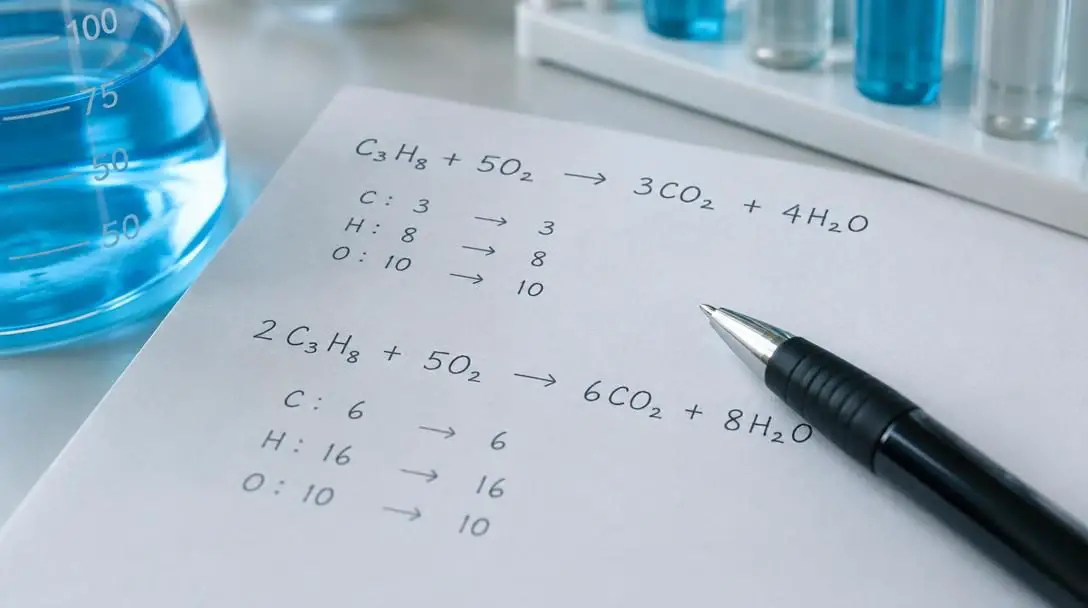
Once an equation is balanced, always verify that the set of coefficients represents the lowest possible whole-number ratio. If an equation balances with coefficients such as 2 C3H8 + 10 O2 produces 8 H2O + 6 CO2, every number shares a common divisor of 2. Dividing each coefficient by that common divisor yields C3H8 + 5 O2 produces 4 H2O + 3 CO2, which is the simplest and standard scientific representation.
As you progress to more complex chemical reactions, you will encounter polyatomic ions—groups of bonded atoms that travel together through a reaction unchanged, such as sulfates, nitrates, or hydroxides. In many cases, balancing these recurring units as single blocks rather than tallying their individual atoms separately can streamline the balancing process significantly.
Frequently asked questions
Why must chemical equations be balanced?
Chemical equations must be balanced because matter cannot be created or destroyed in standard chemical reactions. A balanced equation guarantees that the exact same quantity of each element's atoms exists before and after the reaction occurs, reflecting physical reality.
What is the difference between a coefficient and a subscript?
A subscript indicates the number of atoms bound within a specific molecule and cannot be altered because it defines the compound's chemical identity. A coefficient is a whole number placed in front of an entire molecule that multiplies every atom inside it and can be adjusted during balancing.
Why should hydrogen and oxygen be balanced last?
Hydrogen and oxygen are extremely common elements that frequently appear in multiple compounds on both sides of a reaction. Leaving them for the final steps prevents you from having to repeatedly erase and recalculate their totals as other elements are adjusted.
What should I do if an element has no subscript?
If an element symbol does not have a subscript written after it, it indicates that exactly one atom of that element is present in the molecule. It should never be counted as zero.
How do I know when a chemical equation is completely balanced?
An equation is completely balanced when an independent audit shows that the total number of atoms for every individual element is identical on both the left (pre-change) and right (post-change) sides, and the coefficients reflect the lowest whole-number ratio.
The bottom line
Balancing chemical equations is an essential scientific discipline rooted in the conservation of matter. By maintaining clear atom inventories, respecting the distinction between fixed subscripts and adjustable coefficients, and balancing elements in a strategic order from unique atoms to ubiquitous ones, anyone can solve chemical reactions with confidence and precision.