The Life Electrical: 5 Essential Electronic Circuits Facts For Beginners
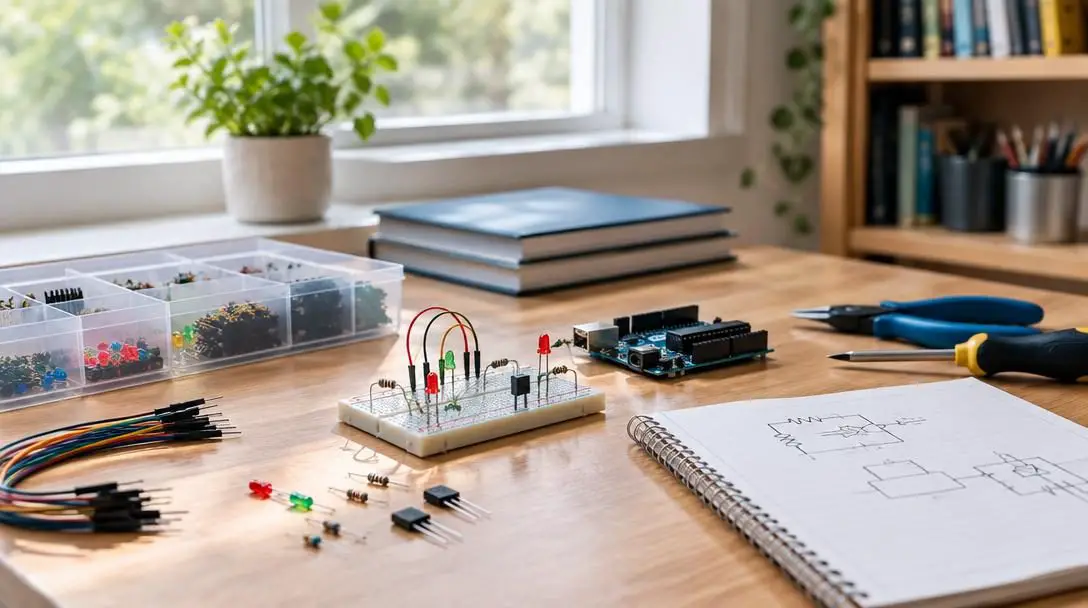
Building electronic circuits is an exceptionally rewarding and engaging craft. Beyond the immediate satisfaction of assembling functional hardware by hand, working with electronics instills disciplined critical thinking, spatial logic, and practical problem-solving skills. By constructing hardware yourself, you gain a tangible appreciation of the physical principles and electrical systems that underpin modern society, transforming everyday consumer devices from impenetrable black boxes into understandable mechanisms.
Every complex gadget—from handheld audio gear to home security sensors—is governed by the same baseline electrical behaviors found on an introductory experimenter board. Developing a firm grasp of essential circuit concepts, component functions, and measurement standards ensures your electronics workbench remains safe, methodical, and productive.
Key takeaways
- An electronic circuit controls the movement of electrical charge across interconnected nodes between a power source and a working load.
- The five foundational circuit components are capacitors, resistors, diodes, transistors, and inductors, each modifying charge via distinct physical properties.
- Voltage measures potential energy differences across points, current represents flow rate, and resistance dictates the ratio between the two.
- Energy dissipation caused by circuit resistance is measured in Joules per second, universally expressed as Watts.
- Grounding provides an essential zero-reference node that establishes stable measurement baselines and guides the forward path of electrical current.
The Building Blocks: Five Core Circuit Components
At its core, an electronic circuit is an electrical pathway intentionally structured to govern, direct, and utilize the flow of electricity. A functional design brings together primary components, connection points known as circuit nodes, an active energy source such as a battery or bench supply, and an energy-needing object situated on the receiving end. Circuit nodes act as bridges between components, commonly formed with insulated wire. To shape the behavior of electricity along these paths, circuits rely on five distinct components arranged in diverse configurations.
Capacitors
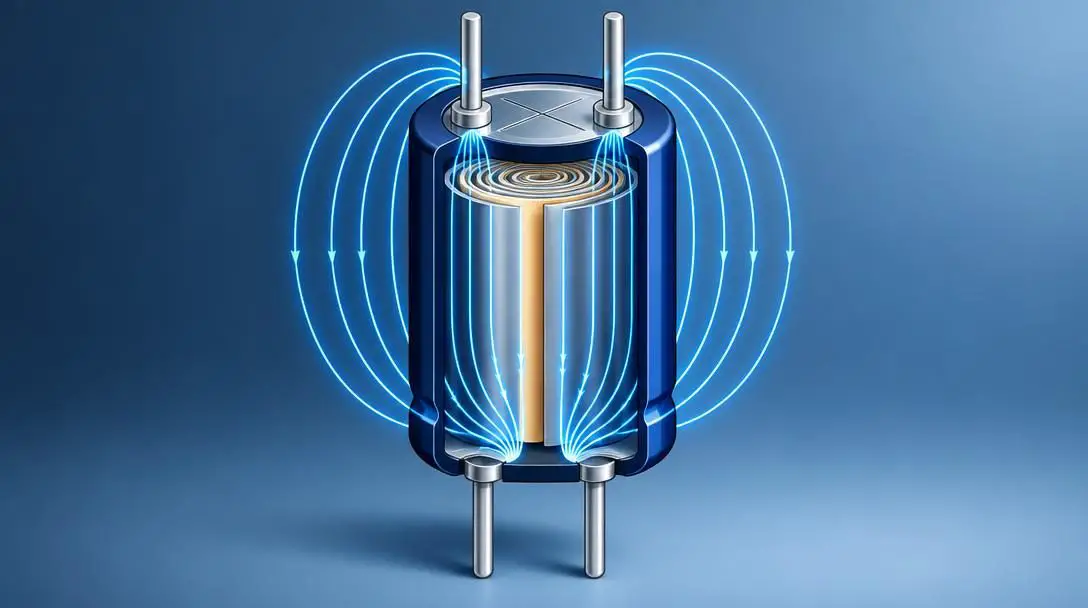
- Energy Storage Format: Electric potential (voltage)
- Discharge Speed: Approximately 90% of the speed of light
- Primary Function: Rapid burst energy delivery
A capacitor functions as an onboard energy reservoir designed to hold electricity along the circuit pathway in the form of voltage. Rather than dispensing power continuously over hours, a capacitor is built for swift release. When triggered or activated, it unloads its accumulated charge at approximately 90% of the speed of light. This rapid discharge makes capacitors indispensable for applications requiring sudden, concentrated bursts of electrical charge to stabilize supplies or activate high-speed components.
Resistors
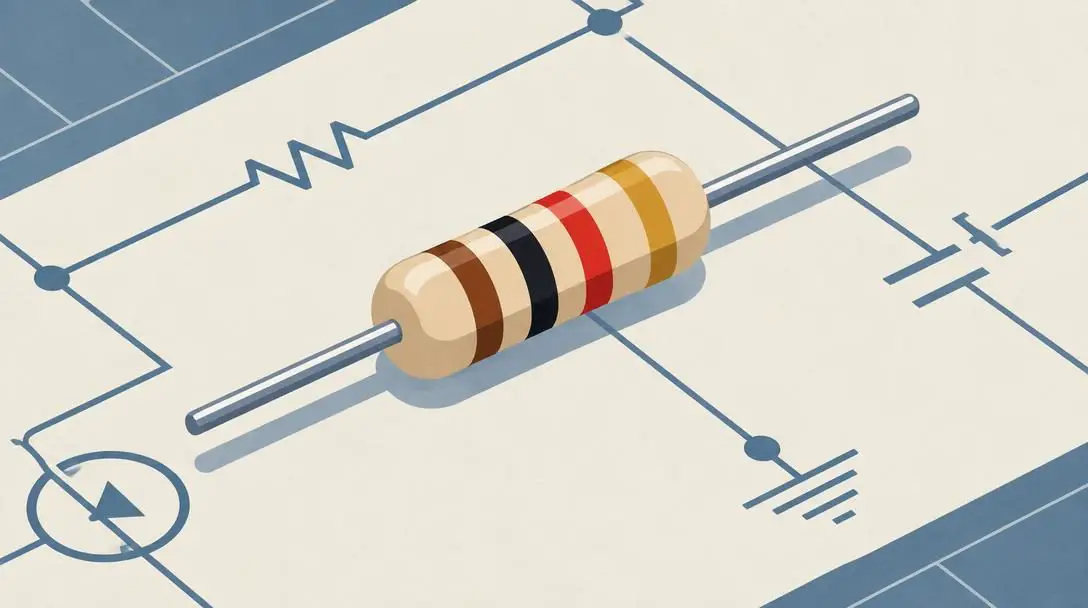
- Primary Function: Slows current flow and reduces voltage
- Energy Dissipation: Measured in Joules per second (Watts)
- Physical Size Trait: Smaller physical packages yield greater resistance
A resistor is engineered to impede the progression of electric current, directly lowering the voltage downstream. Within a resistor, energy flows in one direction. As current encounters resistance inside the component's internal material, a portion of that electrical energy is converted and dissipated away from the pathway. Counterintuitively for beginners, the smaller the physical resistor, the greater the resistance it exerts against the flowing charge.
Diodes
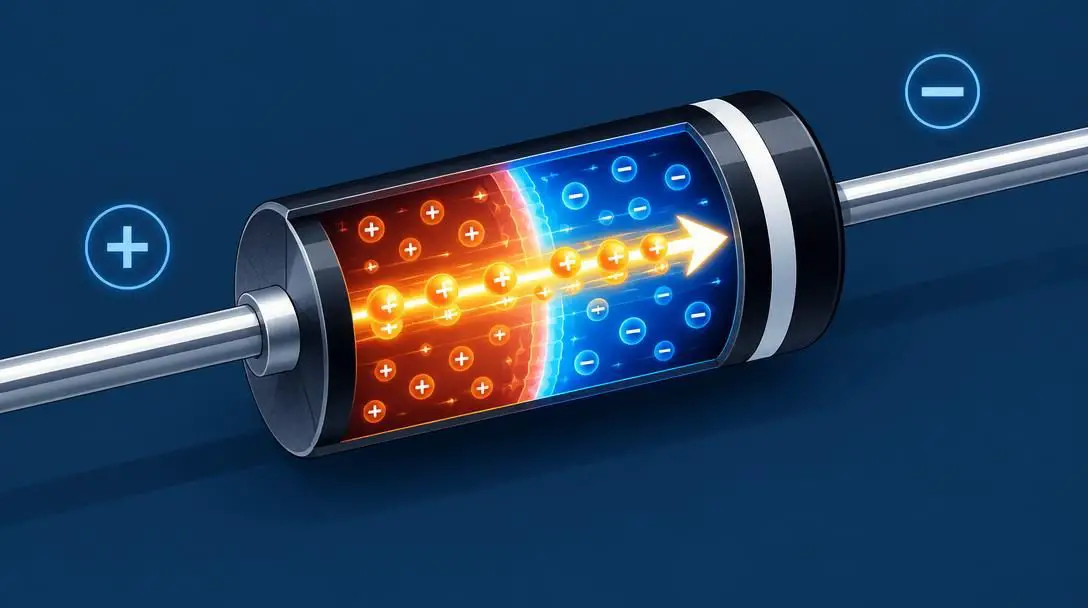
- Conduction Mode: One-way forward path
- Reverse Flow: Completely prohibited
- Current Response: Non-linear behavior
A diode serves as an uncompromising one-way gate for electrical current. It permits electricity to freely travel forward across its junction, but prevents that energy from reversing its course. Once electrical current moves past a diode, it cannot flow backward through that section of the circuit. This makes diodes critical for safeguarding delicate components from accidental reverse polarity and preventing destructive backflow.
Transistors
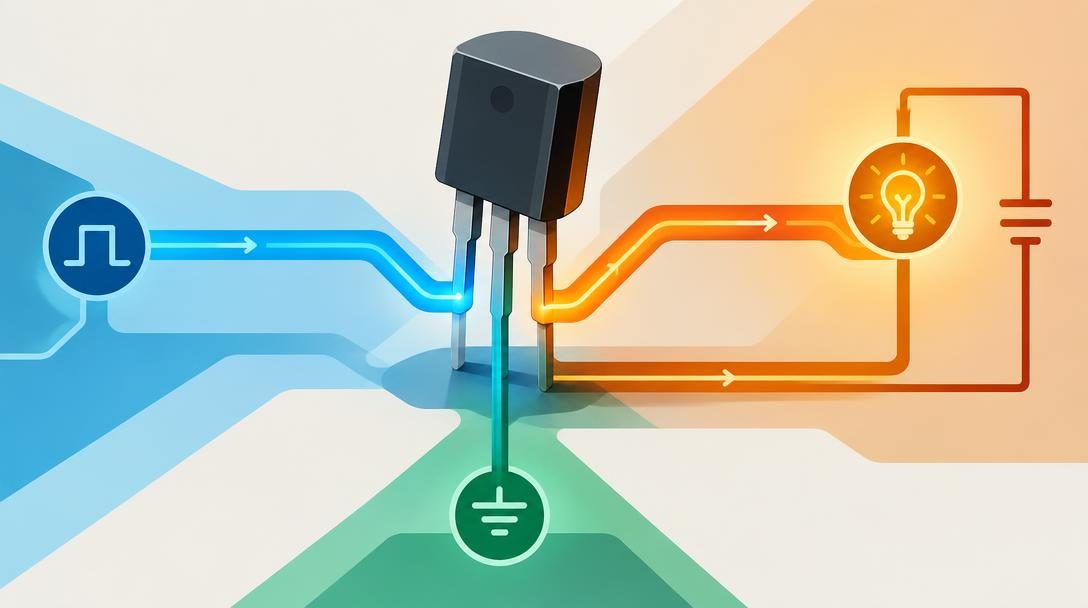
- Operating Principle: Controllable gateway
- Conduction State: Conductive yet fully interruptible
- Primary Use: Signal switching and pathway regulation
A transistor is inherently conductive, yet it possesses the unique capacity to halt current completely upon command. Operating much like a controllable valve or gateway, a transistor can open or shut an electrical pathway depending on the control signal it receives. This controllable switching mechanism allows low-power sections of a circuit to regulate larger power flows, enabling complex automated logic and variable signal amplification.
Inductors
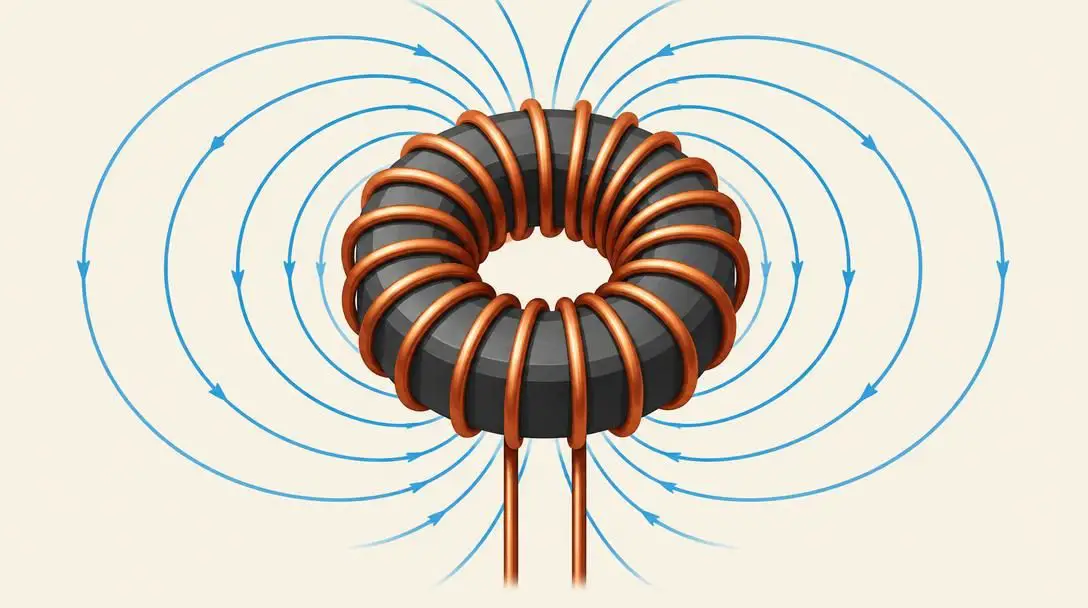
- Energy Storage Format: Magnetic field
- Component Class: Passive energy storage
- Operational Counterpart: Voltage-based capacitor
Similar to capacitors, inductors are specialized energy-storage devices. The fundamental difference lies in their storage mechanism: while a capacitor stores charge as an electric field of voltage, an inductor stores electrical energy in the form of a magnetic field. When current passes through the coils of an inductor, it generates a magnetic field that temporarily stores energy, releasing it back into the pathway as circuit conditions change.
| Component | Primary Role | Energy Handling | Circuit Behavior |
|---|---|---|---|
| Capacitor | Stores and rapidly discharges energy | Electric field (voltage) | Releases charge at ~90% the speed of light |
| Resistor | Reduces voltage and restricts current | Dissipates energy as heat (Watts) | Smaller size produces higher resistance |
| Diode | Enforces unidirectional flow | Passes forward current, blocks reverse | Non-linear electrical response |
| Transistor | Controls and switches current pathways | Regulates through conductive gating | Non-linear controllable gateway |
| Inductor | Stores energy during steady flow | Magnetic field | Complements capacitive storage devices |
The Core Electrical Dynamics: Voltage, Current, and Resistance
Controlling electricity requires understanding how force, flow, and opposition interact. These three behaviors—voltage, current, and resistance—are tied together in an exact mathematical relationship that determines how much work your circuit can perform and how safely it operates.
Voltage represents the potential energy difference measured between two distinct points along an electrical pathway. Specifically, voltage quantifies the total energy gained or lost between two components—such as between a capacitor and a resistor—whenever a unit of positive charge travels from one to the other. Because voltage reflects a difference in state, it is never an isolated, single-point value; it is always relative. When multiple components are linked sequentially across an active circuit, the total system voltage is the cumulative sum of the individual voltage drops across all connected parts.
Current describes the rate at which electrical charge flows through a continuous pathway. Current does not move randomly; its speed and volume depend entirely on the physical spacing of your layout, the applied voltage, and your component choices. When designing pathways, you must verify that every component placed along a shared run is adequately rated to carry that specific current without breaking down or burning out.
Resistance represents the fundamental ratio between your circuit's voltage and current, dictating how electrical energy is guided or dissipated.
Resistance dictates how easily charge moves through materials. When voltage travels along an ordinary conductor like an insulated copper wire, the energy behaves in a predictable, linear manner. However, introducing specialized semiconductor components like diodes or transistors causes current to respond in a non-linear fashion. As charge overcomes resistance inside these components, a fraction of the energy is dissipated out of the system. This rate of energy dissipation is measured scientifically in Joules per second (J/s), widely recognized by hobbyists and engineers as the Watt.
Grounding and the Complete Energy Loop
To establish a stable, functioning system, electrical charge requires both a continuous route and an agreed-upon baseline. Grounding provides this operational reference point. A ground is defined as a specific circuit node that serves as the stable zero-voltage reference against which all other voltage levels are measured and compared.
Power sources, including bench supplies and chemical batteries, provide a positive terminal and a negative terminal. In standard positive circuit configurations, the negative terminal is joined directly to the grounding circuit. This physical connection creates a definitive forward pathway: electrical charge departs the positive terminal, travels through the interconnected nodes and governing components, passes through the energy-needing load, and ultimately arrives at the negative ground terminal.
Some circuits also feature a virtual ground. A virtual ground is an engineered circuit node that replicates the reference properties and behavioral stability of a physical ground without holding an unbroken physical connection back to the main power supply. Consequently, electrical charge moves toward this virtual reference node without immediately traveling back to the primary supply terminal.
How Electronic Circuits Work Together
When completely assembled, an electronic circuit operates as an uninterrupted chain of cause and effect. The journey begins at the positive terminal of the power supply, where voltage creates the potential difference necessary to drive mobile charge into the pathway. Driven by this electrical force, charge travels through insulated wires to the first set of circuit nodes.
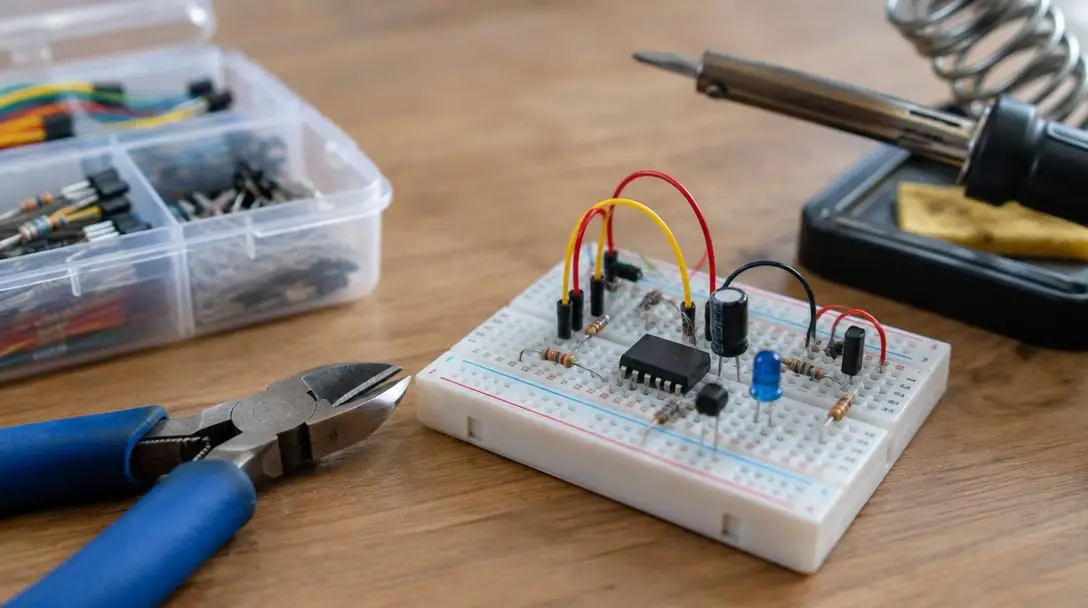
As the charge advances through the circuit, control components shape its characteristics:
- Resistors step down the voltage, dissipating unnecessary energy in Joules per second (Watts).
- Diodes ensure current proceeds strictly forward, preventing reverse surges that could damage polarity-sensitive sections.
- Transistors function as variable switches or gates, halting or letting current pass downstream based on external signals.
- Capacitors and inductors act as complementary storage banks, holding charge within voltage fields and magnetic fields to smooth out supply shifts or release rapid bursts on demand.
Eventually, the conditioned current reaches the energy-needing object—such as an LED, an audio speaker, an indicator buzzer, or a radio transmitter. Within this object, electrical energy is converted into functional work (light, sound, or wireless signals) before the remaining current completes its transit into the grounding circuit.
Step-by-Step Guide to Building Your First Circuit
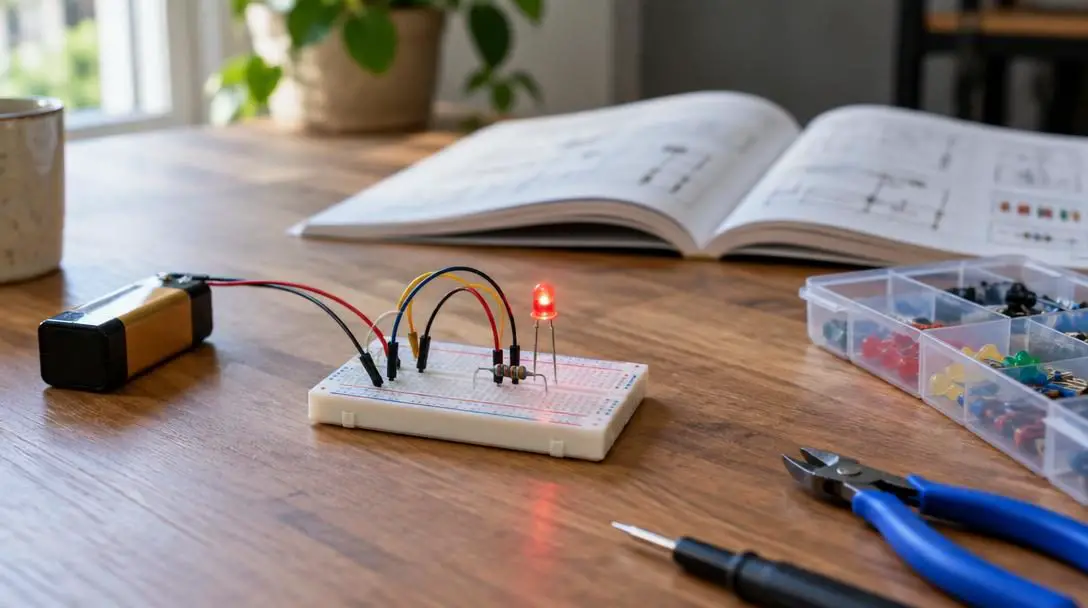
Methodical assembly is essential for successful electronics experimentation. By approaching your build systematically, you minimize errors, protect components, and make troubleshooting straightforward.
- Define the Objective and Power Source: Choose the energy-needing device you intend to drive, such as an indicator light or buzzer, and pair it with a suitable power source featuring clearly identified positive and negative terminals.
- Map the Pathway and Select Components: Plan the pathway needed to regulate the power safely. Calculate where resistors must be positioned to lower voltage and identify locations where diodes are required to prevent backward current flow.
- Establish the Primary Ground Node: Assign the negative terminal connection of your power source as the common grounding node to provide an unambiguous measurement baseline and an endpoint for current flow.
- Insert Controlled Gateways: Wire in transistors or manual switches along critical nodes so that you can deliberately start, stop, or direct current throughout the assembly.
- Connect Components via Secure Nodes: Using insulated hookup wires, link your components together end-to-end. Ensure all connections between the power supply, intermediate control devices, and the final load are mechanically secure.
- Measure Before Full Activation: Before turning on continuous power, take comparative voltage readings across components using your ground reference. Verify that component values match your design and ensure each part is rated to handle the anticipated current.
Common Circuit Mistakes to Avoid
Troubleshooting is a natural part of working with electronic circuits. Being aware of frequent assembly errors can save hours of bench time and keep components from burning out unexpectedly.
- Reversing Diode Polarity: Installing a diode backward completely blocks the circuit branch. Because a diode is strictly a one-way gate, reversed polarity brings the forward current to an absolute halt.
- Mismatching Current Ratings: Every component along a shared line must be rated to carry the full current passing through it. Forgetting to verify these current limits can cause excessive power dissipation, resulting in component overheating and failure.
- Misjudging Resistor Physical Size: Remember that physically smaller resistors generate greater resistance. Selecting an incorrectly sized component can dissipate too much energy or fail to drop voltage sufficiently for downstream parts.
- Omitting the Ground Reference: Forgetting to connect the negative supply terminal to the grounding circuit leaves your measurements without a baseline, leading to erratic readings or an incomplete open circuit where energy cannot return to ground.
- Assuming Pure Linear Conduction: While plain wires conduct electricity linearly, semiconductor devices like diodes and transistors exhibit non-linear behavior. Calculating circuit performance without accounting for these non-linear properties will skew your voltage and current expectations.
Expanding Your Electronics Toolkit
Mastering these foundational rules equips you to move past bare testing boards and begin assembling functional devices. Introductory hobbyists can channel these concepts into constructing classic hardware projects such as hand-held torches, basic audio walkie-talkies, portable transistor radios, and custom home security devices like burglar alarms.
Every single one of these gadgets relies entirely on the dynamic interaction of the same five components: capacitors storing voltage fields, inductors managing magnetic energy, resistors dropping voltage and radiating heat, diodes guarding one-way corridors, and transistors switching current across nodes. By observing ground references, balancing current loads, and taking methodical voltage measurements, you can transition confidently from basic experimentation to complex hardware creation.
Frequently asked questions
How does a capacitor differ from an inductor?
While both are energy-storage components, they store charge through different physical mechanisms. A capacitor stores electrical energy as an electric potential field (voltage) and discharges it rapidly—at around 90% of the speed of light. An inductor stores its electrical energy in the form of a magnetic field created by current traveling through its coils.
Why is voltage always measured between two points?
Voltage is not an absolute, single-point value; it represents the difference in electrical potential energy between two distinct locations. It quantifies the energy gained or lost when a unit of positive charge moves from one component to another across a circuit node.
What is a virtual ground in an electronic circuit?
A virtual ground is a circuit node that mimics the steady electrical characteristics and reference potential of a real ground, but lacks a direct, physical wiring connection back to the primary power supply. Charge can flow toward this node without immediately returning to the main power source.
How do physical resistor dimensions relate to resistance?
In electronic circuits, smaller physical resistors create greater resistance against current flow. As current passes through a resistor, energy is restricted and dissipated away from the path, measured as Joules per second or Watts.
What beginner devices can be built using these five core components?
With an understanding of capacitors, resistors, diodes, transistors, and inductors, beginners can construct practical gadgets such as battery-powered hand-held torches, transistor radios, audio walkie-talkies, and custom perimeter burglar alarms.
The bottom line
Understanding electronic circuits comes down to mastering the relationship between voltage, current, and resistance across an interconnected series of nodes. By learning how capacitors, resistors, diodes, transistors, and inductors regulate charge, beginners can safely design, build, and troubleshoot functional hardware. Maintaining stable ground references and respecting component ratings ensures that your initial projects—from simple indicator lights to working radios and alarms—operate reliably as you develop your skills on the workbench.