The Science of Language Learning

The human brain possesses an extraordinary capacity for linguistic growth. While approximately half the global population is bilingual, many more embark on the journey of acquiring an additional tongue later in life. The pursuit offers distinct advantages, granting access to new communities, unlocking novel employment opportunities, and fostering richer social bonds. Yet beyond these social and economic rewards, the physical act of learning a second language alters the neurological landscape in profound ways.
For generations, the scientific community operated under the assumption that the brain's structural framework locked into place after early childhood. Modern neuroscience has overturned that rigid doctrine, revealing an organ that continually rewires, expands, and reorganizes its pathways in response to fresh linguistic stimuli. By examining how language learning sculpts cortical tissue and sharpens cognitive processing, researchers have unlocked compelling evidence that linguistic mastery remains achievable across every stage of life.
Key takeaways
- The human brain retains lifelong neuroplasticity, enabling individuals to acquire new languages regardless of biological age.
- Acquiring an unfamiliar tongue physically increases the size of the hippocampus and cerebral cortex while reinforcing white matter integrity.
- Bilingualism enhances working memory and sharpens executive control by requiring the brain to actively manage two competing language systems.
- Consistent duration of study and real-time interaction with native speakers serve as primary drivers for lasting language retention.
- Challenging aging brain structures through language study can yield cognitive gains and reduce the risks associated with neurodegenerative conditions.
Neuroplasticity: Overturning the Myth of the Rigid Adult Brain
To comprehend how speech acquisition reshapes human thought, one must first look at the biological mechanisms of neuroplasticity. For decades, conventional neurological dogma maintained that after a critical developmental window in childhood, the architecture of the human mind hardened into permanent circuitry. Researchers once assumed that once an individual reached full physical maturity, the brain lost its capacity to spawn meaningful new neural pathways or adapt to complex unfamiliar systems.
Modern neuroscience has discarded this static perspective. The brain is an intrinsically dynamic organ designed to reshape its networks to accommodate novel information. Neurons and synaptic junctions do not fossilize with age. Instead, the brain builds fresh connections, stores new impressions, and physically remodels its internal wiring throughout an individual's life. This persistent plasticity ensures that acquiring complex skills, such as conversational fluency in an unfamiliar language, remains entirely viable for adult learners.
Scientific inquiry indicates that age is far from the deciding factor in language mastery. While children may absorb speech patterns through immersive environments, adult minds draw upon sophisticated conceptual frameworks that facilitate deep comprehension. Rather than chronological age, the primary determinants of long-term retention and fluency center on the duration of instruction and regular opportunities to interact directly with native speakers. Thanks to continuous technological breakthroughs in neuroimaging, scientists can now map this ongoing neural restructuring in extraordinary detail.
Five Ways Language Acquisition Reshapes the Brain
When an individual memorizes vocabulary lists, untangles unfamiliar grammatical structures, or attunes their ears to novel phonetic cadences, the central nervous system reacts immediately. Neuroscientists have documented measurable structural and functional changes across multiple regions of the brain as linguistic competence develops.
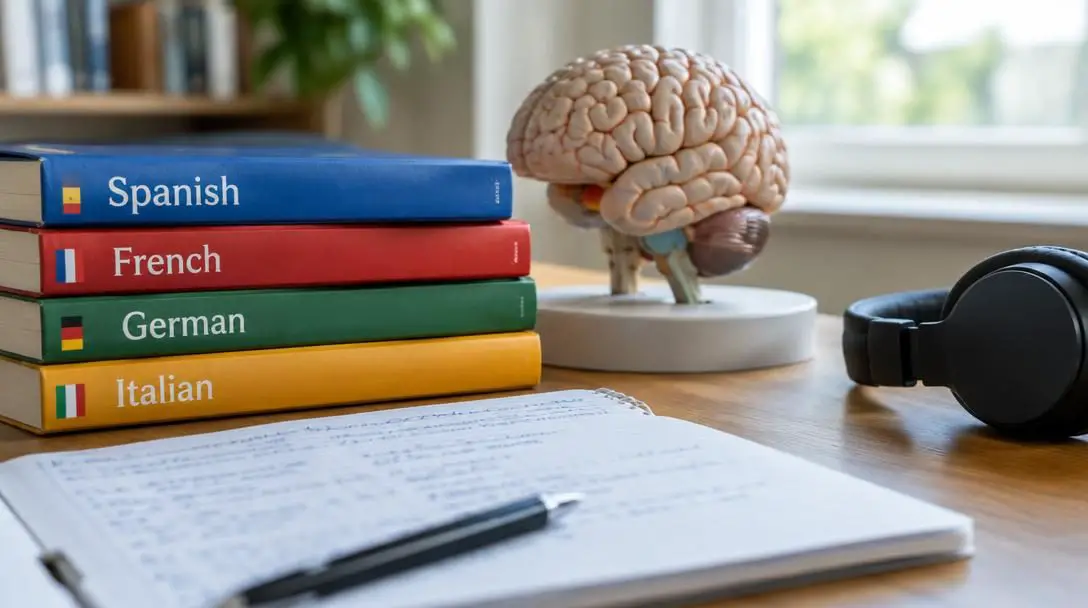
Increased Cerebral Cortex and Hippocampus Volume
Deliberate language study leads to a physical increase in the size of both the cerebral cortex and the hippocampus. The hippocampus plays an essential role in consolidating information from short-term to long-term storage, while the cerebral cortex governs higher-order cognitive processing, sensory perception, and conscious thought. In a landmark investigation conducted by neuroscientists at the Swedish Armed Forces Academy, researchers monitored military recruits tasked with learning an entirely unfamiliar foreign language at an accelerated pace. Using magnetic resonance imaging and electrophysiology to observe the recruits' changing brains, the scientists discovered that key cortical areas responsible for memory processing and active learning grew substantially compared to individuals who did not undergo rigorous language study.
Alterations in Gray and White Matter Density
The structural composition of the brain is broadly categorized into gray matter and white matter, both of which exhibit pronounced adaptations through language learning. Gray matter consists of neuronal cell bodies, dendrites, and synapses that actively process information. Brain scans demonstrate that multilingual individuals exhibit denser gray matter in the left hemisphere, the primary neurological hub where language information is analyzed and decoded. A higher concentration of gray matter indicates an organ rich in neural processing units. Concurrently, language learning fortifies the brain's white matter, which consists of myelin-insulated nerve fibers that link separate neural clusters. Scans reveal that older adults who speak more than one tongue maintain greater white matter integrity, facilitating rapid, uninterrupted communication across disparate cerebral regions.
Language acquisition challenges the precise areas of the brain that decline with age, turning linguistic practice into a powerful shield for cognitive health.
Strengthened Short-Term and Working Memory
Mastering an additional linguistic code provides immediate benefits to an individual's short-term and working memory systems. Working memory operates as an active mental workbench, holding pieces of temporary information in suspension while the brain analyzes, computes, and applies them to ongoing tasks. Research confirms that bilingual children consistently exhibit superior short-term recall compared to their monolingual peers. Furthermore, as an individual's proficiency across two languages deepens, their overall working memory capacity expands. Navigating two linguistic systems trains the brain to rapidly retrieve arbitrary word pairings, match grammatical paradigms, and retain conversational context under real-time conditions.
Enhanced Focus and Executive Control
Language study directly bolsters the brain's executive functions, the command network responsible for directing attention, planning, and filtering distractions. Because an individual who knows two languages holds both vocabularies active simultaneously, the brain must continually select words from the target language while actively suppressing interference from the competing tongue. This constant mental balancing act provides rigorous exercise for the prefrontal cortex and executive control systems. Bilingual individuals frequently demonstrate superior focus, greater mental flexibility when alternating between unrelated assignments, and an enhanced capacity to ignore irrelevant environmental stimuli.
Reduced Vulnerability to Neurological Decline
Because language learning demands intense synchronization across sensory, mnemonic, and executive circuits, it engages the precise neural systems that are most vulnerable to age-related degradation. Challenging these pathways fosters cognitive resilience, leading researchers to conclude that speaking multiple languages can mitigate some risks associated with degenerative neurological illnesses, such as Alzheimer's disease. In one study evaluating adults over 65 who were introduced to a new language, participants exhibited noteworthy improvements in baseline cognitive performance. This finding suggests that challenging the aging brain with unfamiliar linguistic frameworks actively counters cognitive decline by strengthening existing neural networks.
| Brain Structure or Function | Primary Neurological Role | Observed Change from Language Learning |
|---|---|---|
| Hippocampus and Cortex | Memory consolidation, conceptual learning, and sensory integration | Measurable expansion in overall volume and structural thickness |
| Left Hemisphere Gray Matter | Information processing, computation, and neuronal communication | Significantly denser concentration of active neural cell bodies |
| White Matter Tracts | High-speed signal transmission between distant brain regions | Heightened structural integrity, particularly among older adults |
| Executive Control System | Focus allocation, task management, and interference suppression | Superior ability to filter distractions and alternate tasks |
| Working Memory Capacity | Temporary data retention and active problem manipulation | Expanded processing bandwidth and accelerated recall speeds |
The Cognitive Mechanics of Multilingual Speech
The observable physical transformations within cortical tissue clarify why bilingualism sharpens mental acuity across diverse areas of daily life. When a person acquires a second language, the mind does not create an isolated mental compartment for the new lexicon. Instead, both language systems remain active at the same time. Even when conversing in an established mother tongue, corresponding phrases from the second language simmer just beneath the surface of consciousness.

Managing this dual activation requires internal oversight from the brain's executive control system. When speaking, the mind must identify appropriate vocabulary, enforce the correct grammatical rules, and actively suppress the unused language to prevent conversational mix-ups. This continuous suppression and selection process functions as an ongoing workout for the brain's attentional centers. As these inhibitory pathways strengthen through daily linguistic management, an individual's general capacity to ignore distractions, manage complex tasks, and pivot between competing priorities improves across non-linguistic domains as well.
A Step-by-Step Approach to Acquiring a Second Language
Because structural brain adaptations depend directly on instructional duration and genuine communicative application, aspiring learners should establish routines that prioritize dynamic usage over passive memorization. Implementing structured, actionable practices ensures optimal neural stimulation.
- Establish consistent instructional intervals: Organize your schedule around regular, dedicated study sessions throughout the week rather than sporadic cramming, giving your brain the repeated exposure needed to form durable synaptic connections.
- Engage directly with native speakers: Seek out conversation exchanges or community groups where you can speak with fluent speakers, exposing your auditory pathways to natural cadence, authentic accents, and real-time comprehension challenges.
- Exercise working memory through immediate recall: When listening to audio lessons or conversational partners, immediately summarize sentences or echo phrases out loud to stretch your short-term mental workbench.
- Embed the target language into functional routines: Ground abstract grammar and vocabulary into everyday activities by composing grocery lists, setting electronic interfaces, or maintaining a brief daily log in your new tongue.
- Progressively elevate linguistic complexity: As baseline comprehension solidifies, systematically introduce more demanding podcasts, literary texts, or cultural discussions to keep cortical and hippocampal structures actively expanding.
Common Traps and Misconceptions in Language Study
Many individuals abandon their foreign language goals due to mistaken assumptions about how the brain acquires and retains new systems of speech. Recognizing these frequent pitfalls allows learners to course-correct before cognitive fatigue or frustration sets in.
- Assuming adult minds cannot adapt: Surrendering to the false belief that adulthood closes the door on language acquisition disregards the reality of lifelong neuroplasticity and the documented cognitive gains seen in older students.
- Relying entirely on passive exposure: Confining study solely to silent flashcard reviews or automated software drills without active conversational output fails to trigger the executive control systems necessary for true fluency.
- Permitting irregular study gaps: Allowing weeks or months to lapse between study sessions disrupts the consistent duration of instruction required for the brain to consolidate new pathways.
- Treating speech as an analytical puzzle rather than communication: Over-emphasizing theoretical grammar rules at the expense of genuine social interaction diminishes personal motivation and neglects the brain's social communication centers.
- Harboring an acute fear of making mistakes: Hesitating to speak due to worries over imperfect syntax severely restricts the natural trial-and-error cycle that neurons rely upon to recalibrate and strengthen connections.
Frequently asked questions
Does age prevent adults from mastering a foreign language?
No. Modern research proves that the human brain retains neuroplasticity throughout life. While childhood affords natural immersion, adult learners possess advanced analytical skills that enable successful acquisition. Factors like duration of instruction and real-world conversational practice are far better indicators of language success than chronological age.
What specific brain regions experience physical growth during language learning?
Neuroimaging demonstrates that language acquisition leads to physical enlargement of both the hippocampus, which governs memory formation, and the cerebral cortex, which handles complex thought. Additionally, gray matter density increases within the left hemisphere, and white matter tracts throughout the brain gain greater structural integrity.
How does managing two languages improve general focus and concentration?
Because both languages remain simultaneously active in a bilingual brain, the executive control system must work continuously to select words from the chosen language while suppressing the alternative tongue. This constant inhibitory exercise sharpens overall attention control, making it easier to filter environmental distractions and switch between unrelated tasks.
Can learning a new language help protect against cognitive decline in older adults?
Yes. Language study stimulates brain regions that typically experience age-related decline. Studies examining adults over 65 learning a new language show notable cognitive improvements, and broader neurological research suggests that speaking multiple languages helps build cognitive resilience, potentially delaying symptoms of disorders like Alzheimer's disease.
Why is interacting with native speakers more beneficial than independent study alone?
Conversing with native speakers forces the brain to process unpredictable auditory stimuli, adapt to authentic speech cadences, and formulate real-time linguistic responses. This dynamic exchange engages working memory and executive control systems far more comprehensively than passive textbook study or isolated vocabulary drills.
The bottom line
Choosing to study an unfamiliar tongue represents far more than an intellectual pastime; it is an active investment in the physical vitality and longevity of your brain. Every newly assimilated idiom, nuanced pronunciation, and grammatical adjustment sends electrical signals across synapses, prompting the physical enlargement of vital memory centers and reinforcing the structural conduits that bridge disparate regions of the mind.
Whether your goal is to build international friendships, unlock fresh professional pathways, or actively shield your nervous system from the effects of cognitive aging, the biological mechanisms of neuroplasticity stand ready to support your ambition. By dedicating yourself to structured instructional time, pursuing regular dialogue with native speakers, and embracing the communicative process with curiosity, you can reshape your neural architecture and unlock a richer engagement with the wider world.