The Neuroscience Of Political Persuasion: How To Understand Your Political Instincts And Balance Them

Political debates often seem intractable. Whether discussing fiscal policy, civil liberties, or healthcare reform across a dinner table or an online forum, participants routinely find themselves baffled by how another rational person can arrive at conclusions diametrically opposed to their own. These disagreements feel uniquely intense because political stances rarely originate from detached, sterile calculations. Instead, they are tied to our personal identities, our moral intuitions, and the biological wiring that governs how human beings process social reality.
To understand why changing someone's mind—or altering our own—proves remarkably difficult, we have to look past the surface rhetoric of day-to-day controversies. Our political perspectives represent the cumulative output of early developmental influences, broader cultural values, unique lived experiences, and the hardwired architecture of the human brain. By examining the neurobiological and social mechanisms that govern political persuasion, we can identify our subconscious reflexes, insulate ourselves against cognitive distortions, and approach contentious civic discussions with greater objectivity.
Key takeaways
- Political viewpoints are shaped by a complex interplay of childhood upbringing, cultural environments, lived personal experiences, and neurobiology.
- The brain interprets political discourse through social cognition, prioritizing emotional safety and group cohesion over dispassionate analysis.
- Confirming existing beliefs stimulates the brain's internal reward system with dopamine, turning confirmation bias into a physically gratifying feedback loop.
- Balancing automatic political reflexes requires physiological self-awareness, active intellectual humility, and the intentional search for the strongest opposing viewpoints.
The Roots of Political Conviction: Upbringing, Culture, and Experience
Human beings do not arrive at voting age as blank slates waiting to be filled by white papers and statistical analyses. Rather, our political perspectives reflect an intricate mosaic assembled across years of lived experience. Long before an adolescent learns how a bill becomes law, the family unit establishes initial frameworks of fairness, authority, and collective obligation. Children absorb how their parents speak about community leaders, how financial strain is managed, and whether rules are treated as absolute structures or negotiable guidelines. These early exposures form an invisible benchmark for what feels normal, just, and orderly.
Surrounding the family is our cultural matrix, which dictates what virtues a society prizes most. Certain cultures place supreme value on individual liberty, self-reliance, and individual enterprise; others emphasize communal harmony, respect for institutional hierarchy, or duty to ancestral tradition. These cultural narratives provide an implicit set of priorities that frame every political debate. When an individual evaluates a policy proposal, they inevitably weigh it against the primary values emphasized by their community background, often without realizing that other cultures operate under equally consistent yet fundamentally different value hierarchies.
Layered over upbringing and cultural context are our individual life trajectories. Experiencing an unexpected medical emergency, facing protracted unemployment, benefiting from an educational scholarship, or running an independent small business all imprint durable emotional lessons. A person whose life was saved by an experimental public health initiative will perceive government spending differently than an entrepreneur who spent years struggling against municipal licensing bureaucracies. These experiences translate into intuitive heuristics—quick, instinctual rules of thumb that tell us which societal mechanisms are trustworthy and which are inherently flawed.
Inside the Brain: Social Cognition and the Dopamine Feedback Loop
Underneath our philosophical justifications lies the neurological engine of social cognition. Because human survival has historically hinged on group belonging and shared cooperation, our brains evolved to constantly monitor, interpret, and adapt to social signals. We track facial expressions, assess motives, and evaluate whether an opinion helps us fit into or alienates us from our social network. In political life, social cognition prioritizes group belonging over objective accuracy.
In this neurological context, emotion serves as the primary cognitive filter. Instead of treating political proposals as mathematical proofs, the brain gauges whether an idea generates feelings of security, belonging, threat, or moral disgust. When rhetoric makes us feel protected, morally upright, or vindicated, our cognitive processing immediately classifies that message as beneficial and accurate. Conversely, ideas that generate apprehension or challenge our status within our chosen tribe are flagged as dangerous long before our analytical faculties can impartially scrutinize the underlying data.
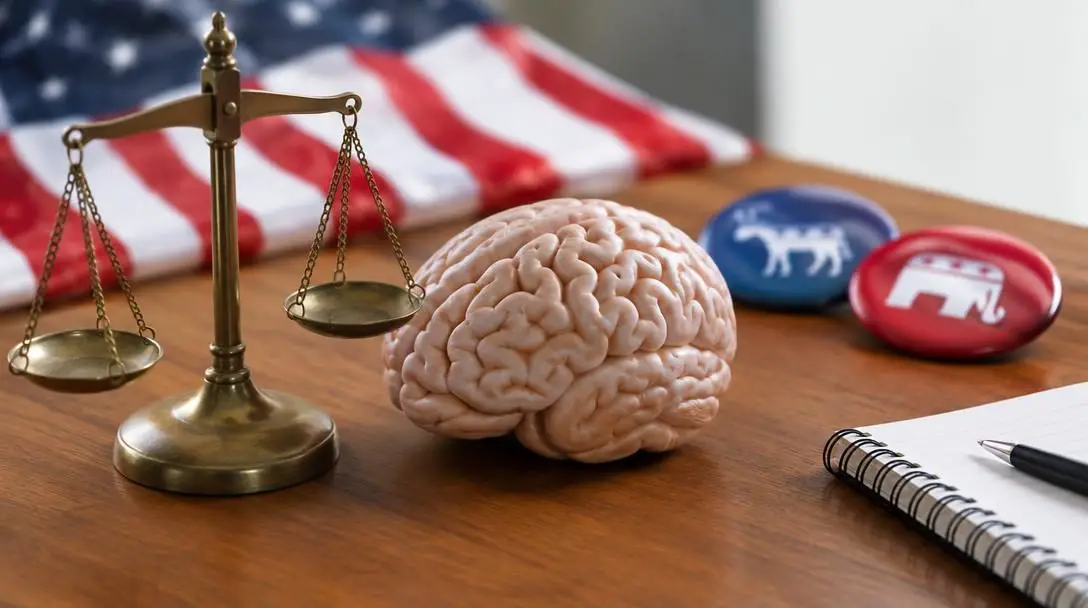
This dynamic is intensified by the brain's internal reward system. When we encounter an article, commentary, or poll that confirms our pre-existing beliefs, the brain releases dopamine—the neurotransmitter responsible for feelings of satisfaction, pleasure, and motivational drive. Being validated feels physically gratifying. This neurochemical release produces a powerful positive feedback loop: the brain seeks more confirming evidence to recreate that pleasurable sensation, reinforcing and hardening our existing worldview with every hit of validation.
Finding out that we are right delivers a genuine chemical reward, transforming confirmation bias from an intellectual error into an addictive neurobiological cycle.
Conversely, encountering conflicting information abruptly shuts off this dopamine pathway, replacing reward with discomfort and cognitive dissonance. Because the brain naturally prefers pleasure and predictability over distress and uncertainty, it instinctively searches for reasons to discredit, dismiss, or ignore contradictory information. Consequently, changing one's political views requires overcoming an innate neurochemical resistance that fights to protect our established mental models.
Dissecting Your Internal Reflexes: A Self-Audit Framework
Gaining mastery over your political instincts requires recognizing that your reactions are frequently automatic reflexes rather than deliberative thoughts. By deliberately investigating where these instincts originated, you can inspect your thinking with clinical detachment.
Upbringing and Early Authority Models
Your formative childhood environment plays a decisive role in establishing your baseline expectations regarding societal power structures. Reflecting on early experiences reveals whether your instinctual worldview leans toward compliance or skepticism.
- Core consideration: How authority figures, rules, and community obligations were treated during youth.
- Primary impact: Establishes baseline comfort with institutional control versus individual resistance.
- Hidden bias: Confusing the rules of one's household with universal moral truths.
Cultural Heritage and Community Norms
Every cultural tradition emphasizes specific values, ranging from individual enterprise to collective egalitarianism. Recognizing the unspoken axioms of your community enables you to understand that alternate perspectives often stem from distinct, coherent cultural frameworks rather than malice or ignorance.
- Core consideration: The balance between individual rights and collective social responsibility.
- Primary impact: Shapes which moral outcomes are seen as self-evidently good or harmful.
- Hidden bias: Assuming that your cultural priorities represent the only rational way to organize society.
Formative Personal Hardships and Milestones
Key life events—such as financial triumphs, severe health challenges, educational breakthroughs, or professional setbacks—leave persistent emotional memories. These experiences quietly influence how an individual assesses taxation, welfare, legal rights, and environmental regulations.

- Core consideration: Highly emotional successes and crises that shaped your financial and social security.
- Primary impact: Generates visceral reactions to policy proposals tied to those past struggles.
- Hidden bias: Generalizing an isolated personal event into a universal rule for all public policy.
A Step-by-Step Guide to Balancing Political Instincts
Moving from unconscious neurological reactivity to balanced, analytical engagement demands consistent mental conditioning. By replacing automatic emotional defenses with deliberate intellectual protocols, you can recalibrate your approach to public debates.
- Conduct rigorous, multi-perspective factual research. Step away from emotional headlines, social media commentary, and polarized hot takes. When an issue arises, trace the debate back to primary documents, verified data points, and the concrete evidence supporting distinct perspectives. Actively distinguish empirical facts from rhetorical embellishments and speculative predictions.
- Monitor your physiological reactions in real time. Pay close attention to your body during political discussions. If your pulse accelerates, your muscles tighten, or you feel defensive indignation rising, pause immediately. Recognize that this physiological response is the brain's threat-detection circuitry responding to an ideological challenge. Acknowledge the sensation, take a breath, and refuse to let physical agitation drive your analytical conclusions.
- Seek out the strongest possible opposing arguments. Avoid engaging with cartoonish, hyper-simplistic, or extreme caricatures of opposing views. Intentionally read the most rigorous, thoughtful, and evidence-backed articulations of the position you oppose. This habit, often referred to as steelmanning, strips away the cheap dopamine hit of attacking weak arguments and forces your brain to grapple with real substance.
- Structure conversations around mutual inquiry rather than victory. When discussing policy with peers or family members, abandon the ambition of winning the debate. Ask open-ended, clarifying questions: What led you to that conclusion? Which variables matter most to you in this issue? Curiosity disarms threat responses, allowing both parties to evaluate nuance without feeling cornered.
- Cultivate an active willingness to change your mind. Remind yourself regularly that altering your stance in light of compelling, verifiable facts is an indicator of maturity and intellectual discipline, not personal defeat. Celebrate instances where new evidence forces you to adjust an old assumption, as this actively conditions your brain to reward factual alignment over ideological stagnation.
Cognitive Traps That Sabotage Political Objectivity
Even individuals striving for balance frequently stumble into well-worn psychological pitfalls. When navigating the neuroscience of persuasion, being vigilant regarding these cognitive errors protects against subconscious backsliding.
| Cognitive Trap | The Neurobiological Trigger | Corrective Mental Habit |
|---|---|---|
| Equating Dopamine with Truth | Reward system fires when pre-existing biases are echoed by commentary. | Treat feelings of intellectual satisfaction as a prompt to verify sources rather than proof of correctness. |
| Maintaining Echo Chambers | Avoidance of cognitive dissonance drives individuals toward exclusively agreeable media. | Deliberately curate an information diet that includes divergent, high-quality viewpoints. |
| Letting Emotion Dictate Reality | Social cognition rejects unsettling data to safeguard emotional comfort. | Decouple factual reality from personal emotional preference; facts remain true regardless of comfort. |
| Ideological Identity Fusion | Political beliefs become fused with personal self-worth and communal belonging. | Separate your core identity from specific policy positions; view yourself as an investigator, not a soldier. |
| Conversational Combat | Adrenaline and threat circuits treat intellectual challenges as physical attacks. | Approach discourse as a cooperative expedition to discover truth rather than a contest to defeat an adversary. |
Frequently asked questions
Why does it feel so satisfying when a political commentator agrees with my viewpoint?
This sensation is driven by the brain's internal reward system. When you encounter information that affirms your pre-existing beliefs, your brain releases dopamine, a chemical associated with pleasure and validation. This creates an immediate neurochemical reward, making agreement feel inherently right and satisfying regardless of whether the argument is factually sound.
What is social cognition, and how does it affect political opinions?
Social cognition is the neurological process through which our brains interpret, store, and respond to social information, including group consensus, moral norms, and the intentions of others. In politics, social cognition often prioritizes maintaining social belonging and group safety over detached factual analysis, leading us to adopt positions favored by our trusted community.
Can our upbringing permanently dictate our political views?
While early childhood experiences and parental modeling establish foundational instincts about authority, justice, and social safety, they do not permanently determine adult beliefs. Through deliberate self-reflection, exposure to diverse cultural frameworks, and critical evaluation of evidence, individuals can consciously recalibrate their early instincts.
How can I stop myself from getting angry during a political argument?
Begin by monitoring your body for early physiological markers of anger, such as an increased heart rate or muscular tension. Recognize that these sensations are automatic threat responses triggered by an intellectual challenge to your cognitive models. Taking a deliberate pause, breathing deeply, and shifting from debating to asking curious, open-ended questions will help calm your nervous system.
What does it mean to steelman an opposing political argument?
Steelmanning is the practice of engaging with the strongest, most reasonable, and best-evidenced formulation of an opponent's perspective. It stands in direct contrast to strawmanning, which involves attacking an exaggerated, weak, or foolish version of an argument to gain an easy sense of victory.
The Bottom Line: Cultivating Long-Term Intellectual Flexibility
Balancing your political instincts is not a milestone you achieve once and permanently keep; it is an ongoing mental practice that requires continuous vigilance. Human biology naturally favors cognitive ease, routine, and ideological security. Whenever unprecedented political developments arise, our brains will instinctively attempt to interpret them through familiar emotional patterns and tribal allegiances unless we actively intervene.
To retain intellectual independence, pay close attention to your information intake and your immediate reflexes. When breaking news crosses your screen, observe how quickly you rush to embrace narratives that flatter your preferences, and observe whether you feel resistant when an inconvenient fact surfaces. By intercepting these automatic responses at the neurological threshold, you retain control over your own intellect rather than letting evolutionary heuristics dictate your conclusions.
Ultimately, developing this self-awareness yields benefits far beyond individual peace of mind. When citizens step into public spaces equipped with emotional self-regulation, curiosity, and respect for rigorous evidence, the entire tenor of societal debate changes. By neutralizing knee-jerk reactivity in favor of balanced inquiry, we transform political discourse from a battle of tribal reflexes into a collaborative pursuit of workable, enduring solutions.