5 Basic Outdoors Skills To Master

Even lifelong city dwellers can find themselves facing sudden, high-stakes wilderness emergencies. A simple mechanical vehicle breakdown along a remote mountain pass or a sudden, blinding snowstorm can instantly leave a driver and their passengers completely stranded for hours or multiple days without immediate rescue. In isolated regions where cell phone towers are sparse or nonexistent, dead zones prevent calls to emergency services, leaving travelers solely dependent on their own knowledge and readiness.
When professional emergency assistance cannot reach you, understanding basic self-reliance practices turns a potentially lethal catastrophe into a structured, survivable event. To stay alive without outside intervention, stranded individuals must manage four vital biological imperatives: maintaining normal body temperature, securing adequate hydration, resting safely, and finding sustenance. Mastering five core wilderness skills establishes the groundwork required to navigate these challenges calmly and effectively.
Key takeaways
- Building a fire using friction or mineral striking provides vital warmth, water purification, cooking capabilities, and predator deterrents when matches are soaked or unavailable.
- Constructing a debris hut, tarp lean-to, or snow cave protects your core body temperature far better than remaining in an unheated, stalled vehicle.
- Boiling surface water and harvesting condensation with an improvised solar still eliminate invisible contaminants that cause severe illness and dehydration.
- Learning essential knots transforms simple cordage into durable structural shelters, hunting triggers, and improvised survival tools.
- Procuring calories through simple fishing rigs and easily identifiable wild plants like dandelions, wild onions, and blackberries preserves energy during prolonged stranding.
At a Glance: The Five Fundamental Survival Skills
Every survival skill serves a distinct purpose in defending against environmental hazards. The following overview outlines each discipline, the basic tools or materials required, and its primary role in keeping you alive in the field.
| Skill | Primary Survival Purpose | Key Tools and Natural Materials | Critical Factor for Success |
|---|---|---|---|
| Fire Craft | Warmth, water purification, signaling, predator deterrent | Dry tinder, dead kindling, spindle and baseboard, or quartz and pyrite | Keeping materials completely dry and starting with fine, fluffy tinder |
| Shelter Building | Thermal regulation, wind blocking, weatherproofing | Ridgepole, branch frame, dense pine boughs, leaves, or waterproof tarp | Creating deep ground bedding to block conductive body heat loss |
| Water Purification | Hydration, preventing microbial sickness | Fireproof metal container, heat source, clear plastic sheeting, clean cup | Achieving a rolling boil or sealing a solar still airtight against moisture loss |
| Knot Tying | Structural rigidity, gear fabrication | Cordage, paracord, flexible saplings, straight sticks, shaped stones | Selecting the correct knot configuration to withstand dynamic tension |
| Food Procurement | Caloric maintenance, mental stamina | Flexible wire, string, stream banks, known edible flora (roots, greens, berries) | Absolute certainty in plant identification and patience when working water |
The Five Essential Outdoor Survival Skills
Surviving in an isolated natural setting requires proactive effort rather than passive waiting. Each of the following five core capabilities addresses a direct threat to human physiology, giving stranded travelers a reliable roadmap for sustained endurance.
Skill 1: Building a Fire
Fire remains the cornerstone of survival in every climate and season. Even during the peak of midsummer, overnight temperatures in high elevations, deserts, and dense woodlands can plummet sharply, exposing stranded individuals to hypothermia. Beyond critical warmth, a sustainable fire enables you to boil unpurified surface water, cook food, signal search teams, and keep curious predators away from your sleeping area.
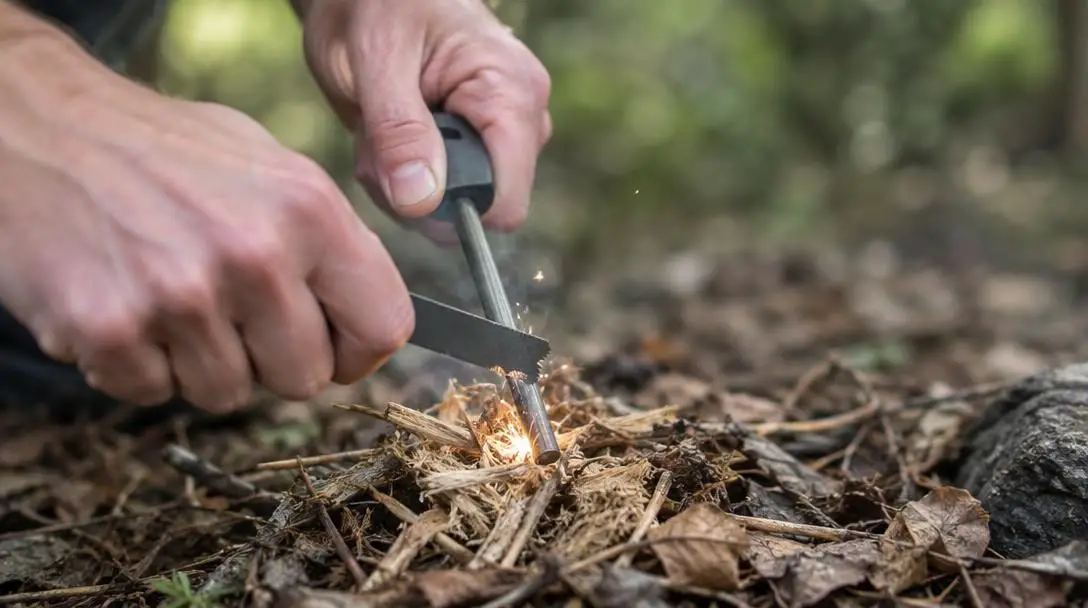
Relying solely on manufactured fire starters is a dangerous gamble. Standard matches can easily become waterlogged from rain, heavy snow, or accidental immersion during a stream crossing. If you find yourself without matches or a working lighter, you must turn to primitive friction or percussion methods to ignite your fuel.
The friction fire-making technique is an ancient, dependable survival method. It involves spinning a straight, bone-dry stick (a spindle) vigorously back and forth against a dry wooden baseboard. The constant rotational pressure wears away fine wood dust while generating intense friction heat. As that heat builds, it converts the accumulated wood dust into a smoldering coal, which can then be transferred into a prepared nest of dry grass or crushed dried bark and blown into open flame.
- Collect a generous double handful of ultra-dry tinder, such as dead dried grasses, shredded inner tree bark, dried pine needles, or fine wood shavings.
- Gather an ample supply of dry kindling twigs ranging in thickness from pencil lead to standard writing pens, storing them off damp soil.
- Stack a large reserve of thick, dry fuel logs; use only dead timber, as green wood contains sap and moisture that will choke developing flames.
- Produce a hot spark with mineral rocks (such as quartz or flint) or generate a glowing ember using a twirling stick and wooden hearth board directly over your tinder bundle.
- Once the ember forms inside the tinder nest, cup the bundle gently and blow with slow, steady breaths until the material combusts into flame.
- Carefully feed pencil-thin kindling into the flame, allowing the fire structure to breathe and expand before gradually adding thicker branches and heavier fuel logs.
Skill 2: Building an Effective Shelter
When you realize an emergency rescue will not arrive for hours or days, constructing a protective shelter must become your top priority. While an immobilized automobile might seem like an obvious refuge, remaining inside a dead vehicle is often a mistake. Once the engine runs out of fuel, the unheated metal cabin rapidly loses thermal energy, turning into a freezing refrigerator that drains away your body heat.
Constructing a dedicated shelter creates an insulated microclimate that blocks wind, sheds driving rain, and traps your radiating body heat.
If you have a durable waterproof tarp in your vehicle or backpack, constructing a temporary barrier against the elements is fast. You can suspend the tarp tautly across low-hanging tree branches, angle it sharply to deflect prevailing winds, or pin its borders down with heavy rocks and carved wooden pegs to create a protected lean-to.
When synthetic tarps are unavailable, natural evergreen forests provide ample raw materials for a classic debris shelter:
- Ridgepole placement: Select a thick, sturdy fallen limb and prop one end securely against a low tree fork or two interlocking support posts, leaving the opposite end on the ground.
- Rib framing: Lean dozens of straight, stout branches along both sides of the central ridgepole at roughly 45-degree angles to create a narrow, sloped A-frame skeleton.
- Debris shingling: Collect massive piles of dense evergreen boughs and weave them into the branch skeleton, working from the ground upward like roofing shingles to shed precipitation.
- Floor insulation: Pile dry pine needles, leaves, and soft moss inside the shelter at least several inches thick to insulate your torso and limbs against cold ground conduction.
In addition to debris huts, you can construct a traditional teepee frame by lashing several long poles together near the apex, spreading their lower bases in a wide circle, and layering boughs or tarps around the exterior. In deep winter conditions with heavy snowpack, you can dig a snow cave directly into a deep drift, carving a hollowed interior pocket that shields you from freezing winds.
Skill 3: Locating and Purifying Water
Dehydration impairs cognitive function, saps muscular strength, and rapidly accelerates shock. Yet drinking directly from natural streams, rivers, or mountain runoff is perilous. Pristine-looking wilderness water frequently harbors unseen microscopic pathogens and parasites that cause severe gastrointestinal distress, leading to rapid, life-threatening fluid loss.
The safest, most consistent way to purify open water in the field is through boiling. If you carry a fireproof metal cup, pot, or clean steel can, building a fire allows you to bring wild water to a rolling boil. Sustained boiling kills all dangerous microorganisms, making the water entirely safe to consume indefinitely.
When surface water is absent and no precipitation falls, you can extract clean moisture from arid ground by constructing an improvised solar still:
- Excavate a hole in the earth measuring roughly 2 feet wide by 2 feet long, and approximately 1 foot deep, choosing an area exposed to direct sunlight.
- Place an open, clean cup or collection bowl upright in the level center of the pit.
- Drape a clear or flexible plastic sheet smoothly across the mouth of the excavated pit, ensuring the center hangs above the cup without touching its rim.
- Weight the outer edges of the sheet with rocks, soil, or carved wooden stakes, creating a firm anchor on all four sides.
- Pack loose dirt continuously along the sheet's outer rim to seal all air gaps, trapping moisture and heat completely inside the pit.
- Place a small, smooth pebble directly in the center of the plastic sheet above your cup, creating an inverted cone that slants downward.
As solar energy heats the trapped earth, moisture in the surrounding soil evaporates into vapor. The vapor rises, contacts the cooler plastic membrane, condenses into water droplets, and runs down the inverted cone directly into the cup below.
Skill 4: Tying Practical Knots
Cordage is among the most versatile assets in any outdoor setting, but its utility depends entirely on knot integrity. A poorly tied hitch will slip under tension, causing shelters to collapse during windstorms or tools to separate under mechanical stress. Mastering a handful of strong, dependable knots allows you to bond separate natural components into rigid, dependable survival gear.
Proper knot craftsmanship supports three critical survival operations:
- Rigging structural shelters: Knots let you lash together timber for a teepee framework, string a taught ridgeline between two trees for a tarp, or anchor tension lines to ground stakes.
- Assembling field tools: Knowing how to secure items tightly allows you to bind a chiseled stone onto a straight wooden shaft to build an improvised spear, fashion crutches, or build transport litters.
- Operating food-procurement gear: Precise knots secure fine fishing line to improvised hooks, tether trigger mechanisms to bent saplings when setting traps, and anchor trotlines to roots.
Using the wrong knot on a fishing rig can cause line slippage when a fish strikes, costing you a meal. Conversely, reliable friction knots and square lashes hold firm under heavy rain, wind gusts, and mechanical loads.
Skill 5: Finding and Procuring Food
While packing non-perishable rations in your vehicle or daypack is an essential safety precaution, those supplies dwindle quickly during an extended emergency. Foraging for wild calories keeps your metabolism functioning, fuels body heat, and maintains mental determination until rescuers arrive.
Creeks, ponds, and river bends are productive areas for harvesting protein. If you carry a simple length of cordage or thread along with a short piece of bendable wire, you can shape the wire into a small fishing hook, lash it securely to your line, and catch fish in calm pools. In warm summer conditions, you can practice fish tickling: slowly sliding your bare hands under the undercut banks of calm streams, locating resting fish, and gently pinning or lifting them out by hand.
When harvesting wild flora, focus on three easily recognizable, nutrient-dense plants:
- Wild blackberries: Readily identifiable summer fruits that offer simple sugars for rapid energy and modest hydration.
- Wild onions: Ubiquitous wild bulbs with a pungent, unmistakable onion scent that can be dug up and eaten raw or boiled over a fire.
- Dandelions: Abundant, resilient weeds whose green leaves, golden flowers, and earthy roots are entirely edible, offering vital micronutrients and minerals.
Common Wilderness Survival Mistakes to Avoid
Under stressful survival conditions, panic can cloud judgment. Avoiding predictable, recurring tactical errors preserves your limited energy and maximizes your chances of survival.
- Procrastinating until twilight: Postponing firewood collection or shelter construction until darkness settles drastically increases your risk of injury and makes every task harder.
- Drinking raw surface water: Drinking unboiled water straight from creeks or rivers introduces bacteria, causing severe digestive illness and dangerous dehydration.
- Idling your vehicle's engine continuously: Burning through fuel to keep a car heater running depletes the tank, leaving you stranded in an unheated metal vehicle once the engine dies.
- Neglecting ground insulation: Laying directly on bare earth robs your body of thermal energy far faster than ambient air; always build a deep mattress of pine needles, leaves, or boughs.
- Experimenting with unverified vegetation: Foraging unknown roots or unfamiliar berries risks debilitating poisoning. Rely strictly on verified plants like dandelions, wild onions, and blackberries.
Practical Steps to Build Muscle Memory
Reading survival advice provides the conceptual foundation, but physical competence demands real-world repetition. Under freezing rain or heavy mental stress, theoretical knowledge easily falters without hands-on practice.
Begin by assembling a compact, permanent emergency kit for your vehicle's trunk. Include a durable waterproof tarp, 50 to 100 feet of high-strength cordage, a fireproof stainless steel container, malleable wire, waterproof matches, and a sturdy fixed-blade cutting tool. Keep these tools accessible rather than buried beneath heavy luggage.
Next, dedicate time to field practice in a controlled environment like a backyard or state park campsite. Practice starting a fire using rock strikes with quartz or flint, and try your hand at friction fire-making. Dig a test solar still on a sunny afternoon to observe its condensation yield firsthand, and practice tying your knots until your hands execute them effortlessly.
Frequently asked questions
Why shouldn't I just stay inside my vehicle if I get stranded in a snowstorm?
While an automobile provides immediate shelter from wind, it has poor thermal insulation. Once your fuel is spent and the engine stops, the thin metal cabin rapidly loses heat and becomes a freezing enclosure. It is better to construct an insulated debris hut or snow cave that traps your radiating body heat.
How can I tell if water from a mountain stream is safe to drink without boiling?
You cannot determine water safety by sight alone. Even crystal-clear mountain streams frequently carry invisible bacteria and microscopic parasites that cause severe illness. Unless you collect pure rainwater on a clean tarp, all wilderness surface water should be brought to a rolling boil before drinking.
What natural stones can I use to strike sparks if I lose my lighter?
Minerals such as flint, quartz, and iron pyrite will reliably produce hot sparks when struck against another hard rock that produces sparks. Catching these sparks in a fine, dry tinder nest of grasses or shavings allows you to nurture an ember into an open flame.
How deep and wide should I dig an emergency solar still?
A functional solar still requires an excavated hole roughly 2 feet long, 2 feet wide, and about 1 foot deep. Place a collection container in the center, stretch a plastic sheet over the opening, weight the borders, seal the perimeter with dirt, and place a small rock in the center to direct condensation into the cup.
Which wild plants are safest to forage for emergency nutrition?
Rely only on plants that can be identified with absolute certainty. Dandelions are completely edible from root to flower, wild blackberries provide simple sugars, and wild onions can be dug up and safely eaten raw or cooked once verified by their distinctive onion smell.
The Bottom Line
Wilderness survival is not an abstract concept reserved for hardcore explorers; it is a vital life skill for anyone traveling through isolated country. A sudden mechanical failure or an unexpected change in weather can isolate you without cell service in minutes. By understanding how to build a fire from scratch, construct an insulated shelter, purify wild water, tie reliable knots, and forage safe calories, you take command of your own safety. Practice these fundamentals before you need them, and you will carry the confidence to endure whatever unexpected challenges the wilderness brings your way.