5 Most Prestigious Universities in Australia
Australia has emerged as an international powerhouse in higher education, drawing scholars and students from across the globe through rigorous academic standards, high-impact research, and robust institutional systems. With over 40 universities nationwide, prospective students enjoy a wide spectrum of academic pathways across diverse environments, from compact capital campuses to bustling metropolitan centers.
A defining hallmark of the Australian tertiary sector is the public nature of its flagship institutions. Unlike the United States, where the most prominent colleges are frequently private, the premier universities across Australia are publicly funded and publicly governed. Several of these public universities routinely place within the top 50 worldwide across respected global ranking publications, balancing mass educational accessibility with elite research performance.
Key takeaways
- Most of Australia's highest-ranking universities are public institutions that consistently place within the global top 50.
- The leading five institutions balance distinct identities, ranging from the research-focused capital setting of the Australian National University to mega-campuses like Monash University and the University of Sydney.
- Graduate career outcomes are remarkably strong, with institutions like the University of Sydney and the University of Melbourne ranking among the world's best for graduate employability.
- Admissions operate through centralized selection ranks such as the ATAR for domestic school leavers, while international applicants typically apply directly or through accredited representatives.
The Australian Tertiary Landscape
While Australia is home to more than 40 recognized universities, a premier group consistently claims the spotlight when assessed by international reputation, citation impact, and specialized subject dominance. The nation's top five universities represent a dynamic blend of historic heritage, comprehensive scientific capabilities, and distinct geographic footprints. These five leaders are the Australian National University, the University of Queensland, the University of Sydney, Monash University, and the University of Melbourne.
Beyond this elite circle, other distinguished institutions also command substantial global prestige. Notable institutions that narrowly missed the top-five grouping include the University of Adelaide, the University of Western Australia, and the University of New South Wales Sydney (UNSW Sydney). Together, these institutions drive the nation's scientific discovery, attract international talent, and maintain extensive networks across global industries.
Unlike the United States, where the most prominent universities are frequently private, Australia's academic powerhouses are public institutions that compete at the highest tier of international scholarship.
At a Glance: Australia's Top Five Universities
The following table summarizes key institutional metrics and global placements for Australia's five premier universities based on available comparative reporting.
| University | Location | Founded | Approximate Enrollment | Key Subject Strengths |
|---|---|---|---|---|
| Australian National University | Canberra, ACT | 1946 | Around 20,000 | Optics, Arts & Humanities, Space Science, Geosciences |
| The University of Queensland | Brisbane, QLD | 1909 | Extensive / Large | Environment & Ecology, Pharmacology, Agriculture, Water Resources |
| University of Sydney | Sydney, NSW | 1850 | Around 75,000 | Endocrinology & Metabolism, AI, Oncology, Engineering |
| Monash University | Melbourne, VIC | 1958 | Over 86,000 | Pharmacology & Toxicology, Education Research |
| University of Melbourne | Melbourne, VIC | 1853 | Over 54,000 | Immunology, Infectious Diseases, Public Health, Psychiatry |
Profiles of the Five Leading Universities
Each of the top five universities possesses an individualized institutional history, unique strengths within specialized disciplines, and differing campus cultures.
Australian National University

- Founded: 1946
- Campus location: Canberra, Australian Capital Territory
- Student enrollment: Around 20,000 students
- Global standing: Close to the top 50 worldwide (US News)
Situated in the federal capital city of Canberra, the Australian National University (commonly referred to as ANU) holds an exceptional position within the country's tertiary system. It is the smallest university featured among the leading five in terms of its total student body. Despite its comparatively compact enrollment of roughly 20,000 students, ANU is widely celebrated for its concentrated research focus. It has been ranked by some organizations as the premier school in the country, with select media commentary describing it as the top university in the entire southern hemisphere.
The origins of ANU are intertwined with the physical and administrative construction of Canberra itself. After early planning was interrupted by World War II, the institution was formally founded in 1946 with a statutory mission to drive national research. Over the subsequent decades, ANU established an enviable academic heritage, graduating dozens of Rhodes scholars and educating two future Australian Prime Ministers. In subject-specific assessments, the university demonstrates notable versatility: its highest subject marks globally are in optics and arts and humanities, accompanied by world-class performances in plant and animal science, space science, and geosciences.

The University of Queensland

- Founded: 1909
- Campus location: Brisbane, Queensland
- Global standing: Top 40 worldwide (US News)
- Distinction: Top 10 globally for Environment and Ecology
Traced back to its founding in 1909, The University of Queensland (widely known as UQ) was initially considered a contentious endeavor. Early educational planners and local community leaders were polarized by two competing visions: one contingent advocated for the practical, land-grant college model prevalent in the American Midwest—prioritizing vocational trades, mechanical arts, and agriculture—while an opposing faction demanded an elite, classical curriculum modeled on historic British institutions like Oxford.
For several generations, UQ maintained that classical collegiate identity. A transformative turning point arrived in the 1990s, when the University of Queensland completed a structural merger with the Queensland Agricultural College. This unification effectively fused applied agricultural research with classical intellectual disciplines. Today, UQ operates as an expansive institution providing a vast range of study areas. According to US News, UQ stands comfortably within the top 40 universities globally, highlighted by a top-10 world ranking in environment and ecology, alongside high global marks in agricultural sciences, water resources, microbiology, and pharmacology.
University of Sydney
- Founded: 1850
- Campus location: Sydney, New South Wales
- Student enrollment: Around 75,000 students
- Financial endowment: Well over $3 billion AUD
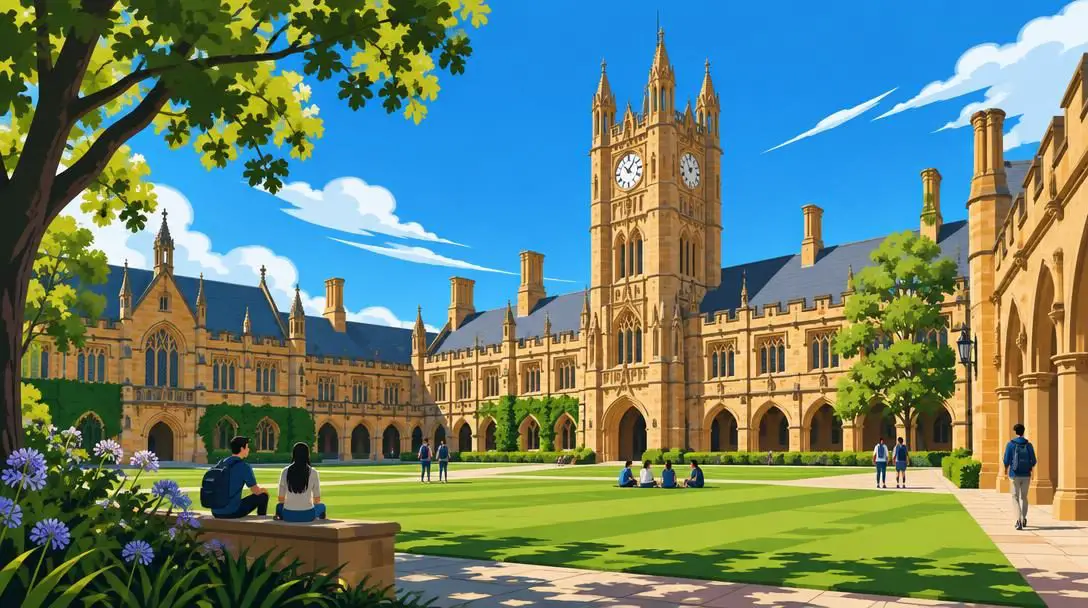
As the oldest university in Australia, founded in 1850, the University of Sydney is a cornerstone of the nation's intellectual and political life. Educating around 75,000 students, it is the second-largest institution among the top five. Backed by substantial institutional resources—including an endowment valued at well over $3 billion AUD—the university possesses the capital to maintain historic sandstone infrastructure alongside cutting-edge research facilities.
The University of Sydney is especially prominent in public leadership, having educated eight Australian Prime Ministers. Beyond governance, the institution delivers exceptional career outcomes for its broader student community: it ranks fourth in the world for graduate employability and entry into high-paying roles. Globally, US News positions Sydney just inside the top 30 universities worldwide. Academically, the institution places within the world's top 10 for endocrinology and metabolism, while maintaining near-top-10 standings in artificial intelligence, engineering, oncology, arts and humanities, and social sciences.
Monash University

- Founded: 1958
- Campus location: Melbourne, Victoria
- Student enrollment: Over 86,000 students
- Global standing: Top 40 worldwide (US News)
Named after General Sir John Monash and founded in 1958, Monash University is both the youngest and the single largest institution in this premier tier. Based in Melbourne, Monash accommodates an enrollment exceeding 86,000 students. Its vast footprint offers an extraordinary variety of co-curricular organizations, laboratories, and specialized study options. Because of its 20th-century establishment, Monash is characterized by contemporary architecture and ongoing structural modernization designed to meet the demands of fast-evolving industries.
Ranked within the world's top 40 by US News, Monash has achieved rare international dominance in specific academic subjects. The university boasts two distinct fields ranked among the top 10 on Earth. Its education and education research program places firmly in the global top 10, while its pharmacology and toxicology department is recognized as one of the top three programs worldwide, cementing Monash's status as a preeminent center for pharmaceutical discovery and medical learning.
University of Melbourne

- Founded: 1853
- Campus location: Melbourne, Victoria
- Student enrollment: Over 54,000 students
- Global standing: Near the top 25 worldwide (US News)
Established in 1853—just three years after the University of Sydney—the University of Melbourne is the second-oldest university in Australia. Hosting more than 54,000 students, it functions as a major anchor of Victoria's intellectual and cultural economy. The institution holds the distinct honor of achieving the highest overall placement of any Australian university in US News rankings, hovering near the top 25 worldwide.

Like the University of Sydney, the University of Melbourne is celebrated for its stellar graduate employability, reliably linking alumni to premier domestic and international employers. Its alumni network includes four Australian Prime Ministers alongside numerous leaders in the sciences and judiciary. Academically, the university is recognized for its medical and life science institutes, earning premier global standing in clinical fields such as infectious diseases, immunology, public health, and psychiatry.
How University Admissions and Operations Work in Australia
To evaluate these institutions effectively, prospective students must understand the underlying operational and academic structures of higher education in Australia. Because Australia's leading universities are comprehensive public institutions, they operate under strict national quality and regulatory frameworks while preserving institutional self-governance. They carry a dual obligation: educating large cohorts of domestic and international undergraduates and postgraduates, while driving substantial research agendas.
Several institutional mechanisms define the student experience in Australia:
- The Academic Calendar: In contrast to North American and European universities that start in August or September, the standard Australian university academic year runs from late February or early March through November. Most providers follow a two-semester format, though several offer trimesters or intensive winter and summer terms.
- Undergraduate Program Length: Standard bachelor's degrees in general disciplines—such as arts, commerce, and fundamental sciences—are typically structured as three-year programs. Professional or specialized tracks, including engineering, law, and medicine, or combined double degrees, require four to six years of structured study.
- Domestic Student Selection: High school graduates from Australian states are admitted primarily through standardized selection metrics, prominently the Australian Tertiary Admission Rank (ATAR). State-based admissions clearinghouses process applicant course preferences and compare them against university cutoffs.
- International Student Admissions: International candidates apply directly to their chosen university's portal or coordinate through certified education agencies. Admissions decisions depend on secondary school transcripts, previous higher education qualifications, and verified English language proficiency scores.
- Financial Underpinnings: Public universities rely on mixed revenue streams. These include commonwealth research funding, subsidized domestic tuition contributions, international student tuition revenue, and philanthropic endowments, exemplified by Sydney's multi-billion-dollar fund.
Step-by-Step Guide to Choosing and Applying
Applying to a top Australian university demands a clear, methodological strategy that accounts for subject specialties, campus culture, and structural prerequisites.
- Target Specialized Subject Strengths: Evaluate universities based on departmental excellence rather than broad institutional names alone. For example, applicants focusing on pharmacology may lean toward Monash University or the University of Queensland, whereas candidates pursuing space science or optics may find an optimal match at the Australian National University.
- Evaluate Campus Density and Geography: Determine whether you thrive in a smaller campus community or a bustling mega-university. ANU provides a focused environment of roughly 20,000 students in the nation's capital, whereas Monash, Sydney, and Melbourne host between 54,000 and 86,000 students within major commercial metropolises.
- Audit Program Prerequisites and Entry Cutoffs: Review specific course requirements carefully. Select professional degrees demand secondary-level mathematics, science, or language prerequisites. Domestic applicants must track historical ATAR cutoffs, while international candidates must ensure foreign certificates satisfy equivalent conversion baselines.
- Review Graduate Career Outcomes: If rapid post-degree corporate integration or high starting salaries are central priorities, examine institutional employment rankings. Both the University of Sydney and the University of Melbourne occupy elite international positions in employability indexes.
- Assemble Academic and Personal Documentation: Gather certified academic transcripts, proof of completed course prerequisites, official identification, and, where mandated, verified English language proficiency test reports well ahead of deadlines.
- Submit via the Designated Application Channel: Domestic secondary school graduates should submit their preference list through their state's tertiary admissions center. International and postgraduate applicants should submit directly through the university's online portal or through authorized representatives.
Common Application Mistakes to Avoid
Prospective students frequently encounter preventable setbacks when navigating Australian higher education. Avoiding these common traps ensures a smoother application cycle.
- Over-relying on Overall Institutional Rankings: A major misstep is assuming that a university's broad global standing reflects equal strength across all majors. While an institution may sit comfortably in the top 40 globally, specific niche departments at another university may boast superior facilities, faculty, or industrial connections.
- Underestimating Massive Student Populations: Transitioning from secondary education into an urban mega-university with 75,000 to over 86,000 students can lead to culture shock. Students must proactively seek out faculty consultations, student clubs, and advising resources to avoid feeling lost in huge lecture cohorts.
- Overlooking the Southern Hemisphere Calendar: International applicants accustomed to autumn semester starts in September frequently miscalculate deadlines for the primary February/March intake, leading to delayed enrollment or visa scheduling complications.
- Failing to Check Direct Subject Prerequisites: Meeting the baseline academic or ATAR cutoff does not guarantee admission if an applicant lacks mandatory secondary-level coursework in subjects like advanced mathematics or chemistry.
Frequently asked questions
Are Australia's top universities public or private?
Unlike the United States, where many prominent universities are private, the leading universities in Australia—including all five discussed in this article—are comprehensive public institutions funded through government research allocations, student fees, and institutional endowments.
Which Australian university is the oldest?
The University of Sydney is the oldest university in Australia, established in 1850. The University of Melbourne was established three years later in 1853, making it the second-oldest institution on the list.
Which top Australian university has the smallest student population?
The Australian National University (ANU), located in Canberra, is the smallest among the top five, with an enrollment of around 20,000 students. In contrast, institutions like Monash University enroll over 86,000 students.
How many Australian Prime Ministers have graduated from these institutions?
Among these top institutions, the University of Sydney has educated eight Australian Prime Ministers, the University of Melbourne has educated four, and the Australian National University has educated two.
Which universities narrowly missed Australia's top five list?
Other distinguished Australian universities that just missed this premier five list include the University of Adelaide, the University of Western Australia, and the University of New South Wales Sydney (UNSW Sydney).
The bottom line
Australia's elite universities offer a compelling combination of world-class research, substantial international respect, and practical career preparation. Whether drawn to the specialized research focus of the Australian National University in Canberra, the pharmaceutical and educational power of Monash University, the agricultural and ecological legacy of the University of Queensland, or the historic prestige and exceptional graduate employability of the University of Sydney and the University of Melbourne, students can find an institution tailored to their professional ambitions. By focusing on subject-level strengths, understanding the southern hemisphere academic timeline, and respecting the admissions prerequisites of each campus, prospective applicants can position themselves for long-term academic success.