Gardening with Limited Space: Creating a Lush Oasis in Small Areas
For generations, cultivating a garden was considered an endeavor reserved for those with substantial acreage. Traditional horticulture brought to mind sprawling suburban backyards, deep rural farm rows, and vast glass greenhouses stretching across manicured estates. In these traditional settings, plants could stretch their roots deep into native earth, drawing upon expansive underground reserves of moisture and nutrients while gardeners contended with long rows of weeds and heavy machinery.
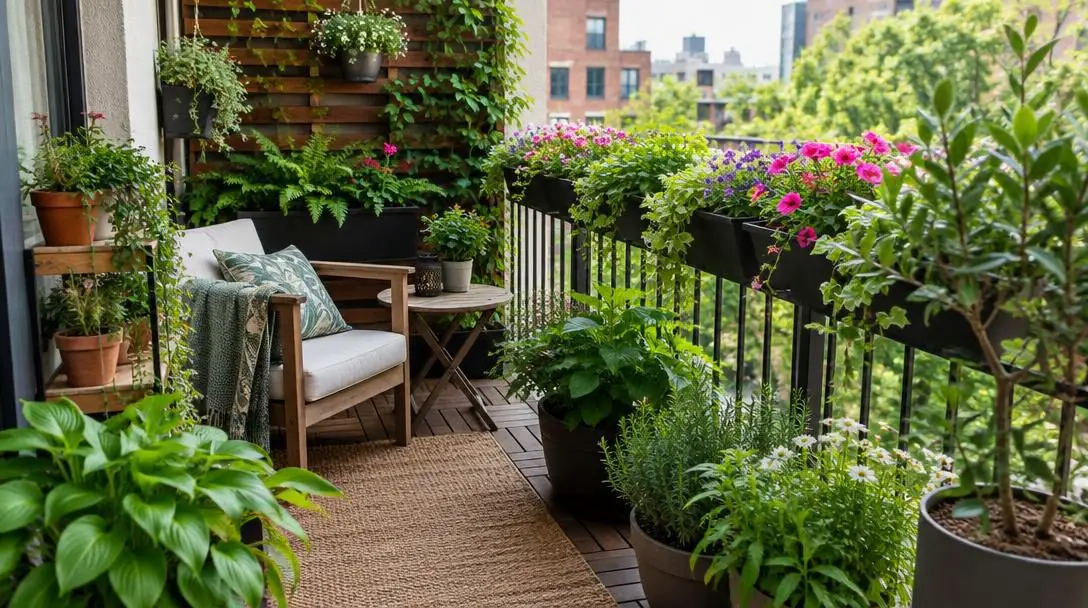
Modern residential living has radically reshaped this dynamic. Today, a growing percentage of the population makes its home in downtown apartments, compact townhouses, condominiums, and rental homes characterized by modest architectural footprints. Sprawling lawns are frequently replaced by concrete balconies, paved courtyards, narrow timber decks, or sunny window ledges. Yet moving into a compact home does not require abandoning the biological and psychological rewards of tending living greenery. By adapting fundamental botanical principles to tight spaces, home growers can transform modest urban nooks into productive, verdant retreats that yield fresh food and vibrant flowers with a fraction of the physical strain demanded by traditional plots.
Key takeaways
- Confined spaces require precise microclimate mapping to account for building shadows, reflected heat, and amplified wind patterns.
- Container growing, vertical frameworks, and elevated raised beds serve as the three foundational strategies for gardening without open ground.
- Arranging vegetation in stepped tiers ensures shorter, sun-loving varieties receive adequate light without being shaded by taller specimens.
- Companion planting substitutes for traditional crop rotation by combining pest-repelling and mutually beneficial species within compact soil volumes.
- Consistent watering and routine fertilization are mandatory because contained potting soils lose moisture and soluble nutrients rapidly.
The Mechanics of Small-Space Cultivation
Cultivating crops and ornamental displays within restricted boundaries requires more than simply scaling down open-field practices. Successful small-area horticulture relies on a calculated synthesis of spatial geometry, environmental observation, and artificial root management. In an open landscape, daylight and airflow disperse relatively evenly across wide terrain; in a compact urban setting, architectural boundaries fundamentally manipulate the growing environment.
Every patio, balcony, or window ledge contains distinct microclimates dictated by structural surroundings. Solid balcony railings, overhanging roof eaves, and neighboring multi-story buildings directly govern the path of sunlight and the movement of ambient air. A single stone terrace may endure three hours of intense, reflective heat from an adjacent brick wall before abruptly plunging into deep architectural shadow for the remainder of the afternoon. Similarly, narrow gaps between residential buildings create wind tunnels that accelerate moisture evaporation from tender leaves. Gardeners must systematically observe these shifting environmental factors to match specific plants with the exact physical conditions of each corner.
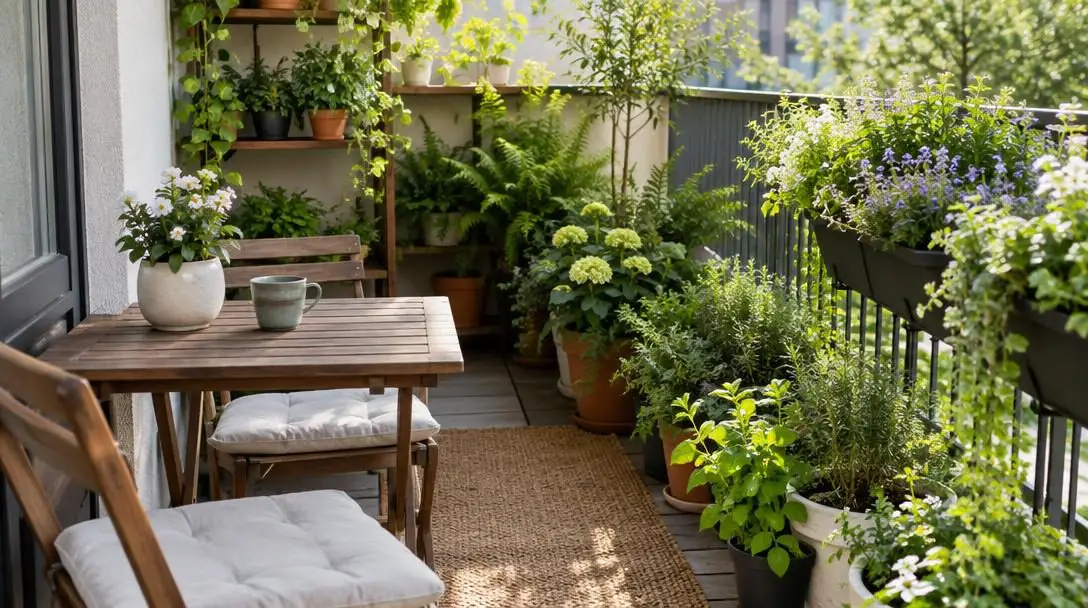
Because horizontal square footage is limited, growers rely on a stepped structural hierarchy to maximize solar capture. Taller specimens and climbing trellises are placed along the rear perimeter or against exterior walls, while medium-sized crops sit in the center and low, cascading herbs trail along the outer edges. This deliberate layering prevents taller foliage from blocking daylight to smaller understory companions, creating a dense, harmonious layout where every leaf captures incoming sunlight.
Small-space growing also shifts complete responsibility for the subterranean environment onto the gardener. In natural terrain, roots travel through native subsoil to find underground water pockets and ambient minerals. In a contained setting, plants depend entirely on an artificial soil blend held within an engineered vessel. This gives the gardener full authority over soil aeration, organic content, and drainage dynamics, eliminating poor native soils and subterranean weed invasion. However, this isolation also means the root zone cannot regulate its own moisture or fertility, requiring steady, attentive hydration and nutritional replenishment.
Core Methodologies for Limited Footprints
Gardeners working within restricted square footage typically anchor their setups around three proven cultivation strategies. These approaches can operate independently or combine into a multi-layered, interconnected system.
| Gardening Method | Ideal Location | Primary Advantage | Structural Materials | Root & Airflow Dynamic |
|---|---|---|---|---|
| Container Gardening | Balconies, small patios, window ledges | Complete mobility to follow sunlight | Unglazed clay, composite pots, hanging troughs | Confined root volume; requires excellent drainage ports |
| Vertical Gardening | Exterior walls, perimeter fences, deck railings | Maximizes skyward room without using floor space | Freestanding trellises, wall pockets, hanging baskets | Superior foliage air circulation; lowers fungal infection risks |
| Raised Bed Gardening | Paved courtyards, terraces, shared green plots | Ergonomic access and isolated soil perfection | Timber framework, durable concrete blocks | Deeper root run; excellent drainage and thermal stability |
Container Gardening
Container gardening remains the most adaptable and widespread approach for apartment balconies, stone patios, and narrow window sills. Growing in standalone vessels—such as traditional pots, window boxes, elongated troughs, heavy tubs, and suspended baskets—provides complete physical mobility. As the sun changes its seasonal angle from spring to high summer, mobile containers can be repositioned across the deck to track ideal light conditions.
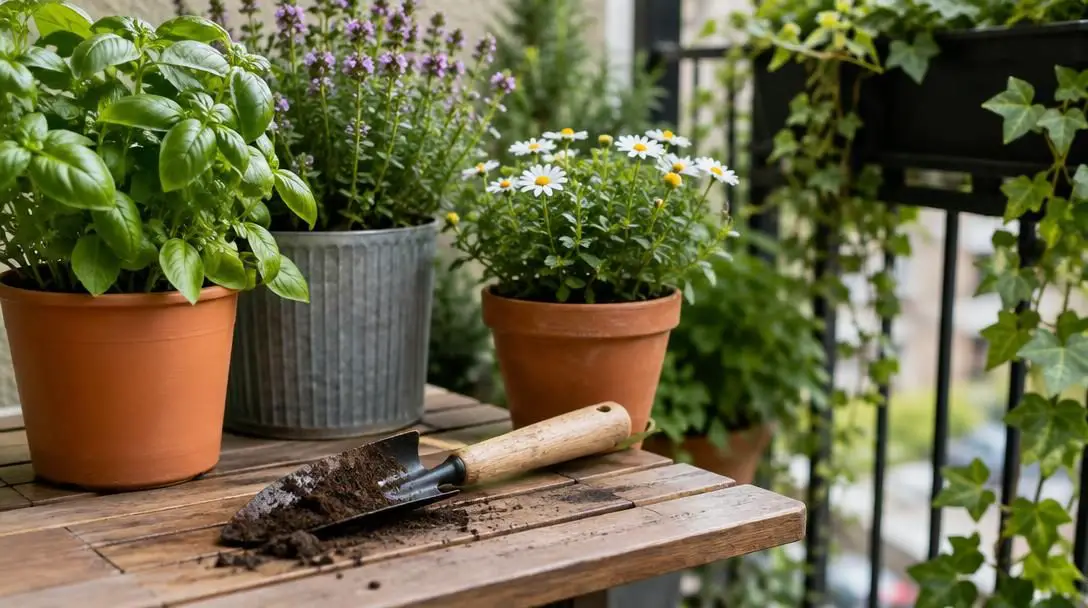
The choice of vessel material plays a major role in plant vitality. Porous containers, including classic unglazed terracotta pots and modern breathable composite planters, allow gas exchange directly through their walls. This breathability lets oxygen reach the root zone, protects sensitive roots against sudden ambient temperature spikes, and prevents excess moisture from pooling into stagnant, anaerobic reservoirs that foster fungal diseases.
Vertical Gardening
When floor space is limited, vertical gardening directs plant development upward. Instead of allowing vines, fruits, and flowering stems to sprawl across walkways, this method employs vertical surfaces such as perimeter fences, brick walls, and freestanding trellises to support skyward growth. Vining vegetables and climbing ornamentals readily fasten their tendrils to vertical frameworks, mesh systems, and wall-mounted pocket organizers.
Lifting plant canopies off the ground offers notable physiological benefits beyond saving space. Elevating stems into open air currents promotes rapid drying after rainstorms or hand-watering, significantly reducing the moisture films required for airborne fungal spores to germinate. Furthermore, training vines across an upright lattice exposes a broad surface area of foliage to incoming sunlight, boosting overall photosynthetic efficiency.
Lifting foliage off the pavement and directing it toward the sky opens up ground space while surrounding leaves with drying air currents that discourage disease.
Raised Bed Gardening
Raised bed installations serve as a productive middle ground between deep open fields and compact containers. Suited for ground-level terraces, paved urban courtyards, or shared residential green spaces, raised beds consist of elevated structural frames constructed from rot-resistant wooden planks or sturdy concrete blocks. The central cavity is then filled with a custom, nutrient-rich potting blend formulated for optimal moisture retention and aeration.
Raised beds remain isolated from compacted native dirt, foot traffic, and subterranean weed runners. Their elevated architecture ensures surplus irrigation drains freely away from the root zone while retaining adequate moisture within the amended blend. From an operational perspective, elevated beds reduce physical strain by minimizing deep bending and kneeling, making daily inspection, weeding, and harvesting far more comfortable.
The Strategic Value of Companion Planting
In large-scale farming, growers routinely cycle crops across distinct plots year after year to disrupt pest life cycles and prevent localized soil exhaustion. In small-space gardening, where the same containers, hanging troughs, and raised boxes must be used season after season without fallow periods, traditional crop rotation is impossible. Gardeners resolve this issue through companion planting.
Companion planting is the deliberate arrangement of complementary plant species in close physical contact within the same container, box, or planter bed. These biological pairings offer several practical advantages:
- Insect management: Strong aromatic foliage can mask vulnerable neighboring plants, confusing foraging insects and deterring common garden pests without chemical sprays.
- Subterranean space efficiency: Pairing shallow-rooted herbs or leafy greens with deeper taproot vegetables allows both species to draw water and nutrition from separate soil depths within the same pot.
- Microclimate shelter: Sturdier, broader plants can provide partial shade and wind protection to more tender, heat-sensitive understory greens.
A classic demonstration of companion planting is pairing fragrant sweet basil with tomato vines in a shared planter. The volatile essential oils produced by the basil leaves help repel common insects that prey on tomato foliage. At the same time, generations of gardeners have observed that growing these two species together enhances the aromatic qualities and culinary flavor of the ripening tomatoes.
Step-by-Step Implementation Guide
Building a flourishing, productive garden in a tight footprint requires following a clear sequence of steps to ensure the site, containers, and plant varieties function together effectively.
- Evaluate sunlight patterns: Monitor your balcony, patio, or window ledge every two hours across a full day, recording direct sun exposure to classify each zone as full-sun, partial-shade, or deep-shade.
- Define your gardening objective: Decide whether your primary purpose is harvesting kitchen herbs, producing fresh vegetables, arranging ornamental flowers, or balancing a blend of all three.
- Select size-appropriate cultivars: Choose dwarf, compact, or determinate bush varieties designed for container culture rather than sprawling, indeterminate varieties that require extensive root space.
- Acquire appropriate containers and materials: Source breathable vessels made from clay or composite materials, ensuring every pot has open drainage ports. If building a raised bed, assemble a sturdy wood or concrete frame in your sunniest location.
- Prepare vertical support systems: Fasten sturdy trellises, hang durable wall-mounted pocket organizers, or anchor heavy-duty ceiling hooks before filling containers with damp, heavy soil.
- Add high-grade growing media: Fill your pots and raised beds with an amended potting mix formulated for container drainage, avoiding dense garden soil that compacts in containers.
- Plant with structural hierarchy: Position tall varieties against back walls, arrange mid-sized crops in the middle, and set trailing herbs along front container rims, integrating companion pairings like basil and tomatoes together.
- Hydrate thoroughly and position: Water newly planted vessels until moisture drains freely from the base ports, then shift mobile containers into their designated sunny microclimates.
Critical Pitfalls to Avoid in Compact Plots
Because plants in small spaces live within isolated, limited volumes of soil, minor management mistakes can quickly harm their health. Avoiding these common missteps keeps small-space ecosystems balanced and resilient.
- Using vessels without drainage: Potting plants in decorative containers lacking drainage holes causes water to pool at the base. This standing moisture suffocates root tips and leads to fatal root rot.
- Overcrowding large plant varieties: Squeezing standard-sized field varieties into small pots restricts root growth, exhausts water reserves within hours, and starves neighboring plants of light and nutrients.
- Inconsistent watering routines: Exposed balcony containers and suspended baskets dry out quickly under wind exposure and ambient heat. Letting soil swing between bone-dry conditions and oversaturation causes root shock and leaf drop.
- Disregarding light needs: Forcing sun-loving crops into shaded alcoves produces leggy, weak stems and minimal yields, while placing delicate shade plants against reflective, baking walls causes foliage scorch.
- Neglecting supplemental nutrition: Regular watering flushes soluble minerals out through the drainage holes over time. Failing to replenish nutrients leaves plants pale, weak, and unproductive.
- Overlooking early pest indicators: In dense arrangements where leaves touch, small pest populations can spread across an entire collection in a matter of days. Regularly check the undersides of leaves to catch infestations early.
Daily Maintenance and Long-Term Vitality
Maintaining a small-scale garden requires regular, observant care. In compact plots, changes in wind speed, temperature, and moisture levels make an immediate impact on plant health. Spending a few quiet minutes each day checking on your plants helps you catch minor stressors before they escalate into larger problems.
Begin your daily routine with a physical moisture check. Rather than watering on a rigid timer, insert a finger roughly an inch into the potting mix. If the soil feels dry beneath the surface, water slowly and thoroughly until moisture runs out of the container base. During midsummer heat waves, elevated hanging baskets and wind-swept balcony pots may need hydration once or even twice daily, whereas protected courtyard beds hold moisture longer.
Routine pruning is equally important in compact spaces. Pruning away yellowing foliage, removing spent blossoms, and pinching back aggressive vegetative tips prevents unwanted shade and channels the plant's energy into fresh blooms and fruit. Pruning also preserves open pathways through the canopy, maintaining the airflow needed to keep fungal issues at bay.
Finally, support your soil throughout the growing season. Because regular watering gradually washes soluble nutrients through container drainage holes, plants rely on ongoing nourishment to stay healthy. Providing light, balanced applications of supplemental plant food throughout the active growing period keeps foliage deep green, supports robust root growth, and sustains a steady harvest from early spring until autumn frost.
Frequently asked questions
Can I use ordinary garden soil to fill my containers and raised beds?
No, standard backyard soil should not be used in containers or small elevated beds. Native topsoil contains dense clay and silt particles that compact tightly inside container walls, preventing water from draining and cutting off the oxygen supply to root systems. Instead, select an amended potting medium specifically formulated for container drainage and balanced aeration.
How can I tell if my balcony provides enough sunlight for vegetables?
Perform a sunlight survey by checking your balcony every two hours throughout a clear day. Fruiting vegetables, such as tomatoes, generally need at least six hours of direct, unfiltered sunlight daily. If your space receives only two to four hours of direct light, focus on leafy greens and culinary herbs, which thrive in partial shade.
Why do hanging baskets dry out much faster than ground-level containers?
Hanging baskets are fully elevated into moving air currents, exposing both their top surface and their entire outer circumference to ambient winds. This increased air circulation accelerates evaporation from the porous container walls and upper soil layer, causing them to dry out far more rapidly than shaded, ground-level pots.
How do I prevent tall plants from shading out smaller herbs in a small footprint?
Organize your plants in stepped tiers based on height and sunlight orientation. Place your tallest specimens, trellised vines, and vertical planters along the rear perimeter or directly against structural walls, and arrange mid-sized and low-growing varieties progressively forward toward the front rim where incoming light is strongest.
What makes porous terracotta pots better than non-porous plastic containers?
Porous unglazed terracotta and breathable composite materials allow air and moisture vapor to pass through their walls. This natural gas exchange helps oxygen reach plant roots, prevents water from collecting in the base of the pot, and insulates root systems from sudden temperature fluctuations.
The bottom line
Gardening successfully does not depend on having an expansive lawn or an open field. By adopting smart spatial layouts, choosing breathable containers, training crops upward on vertical supports, and applying companion planting principles, growers can transform modest urban environments into rich, productive ecosystems. Careful attention to light patterns, soil quality, and steady watering allows even the smallest balcony, deck, or window ledge to become a rewarding, verdant sanctuary.