The Art of Espalier: Tips for Training Fruit Trees into Ornamental Shapes
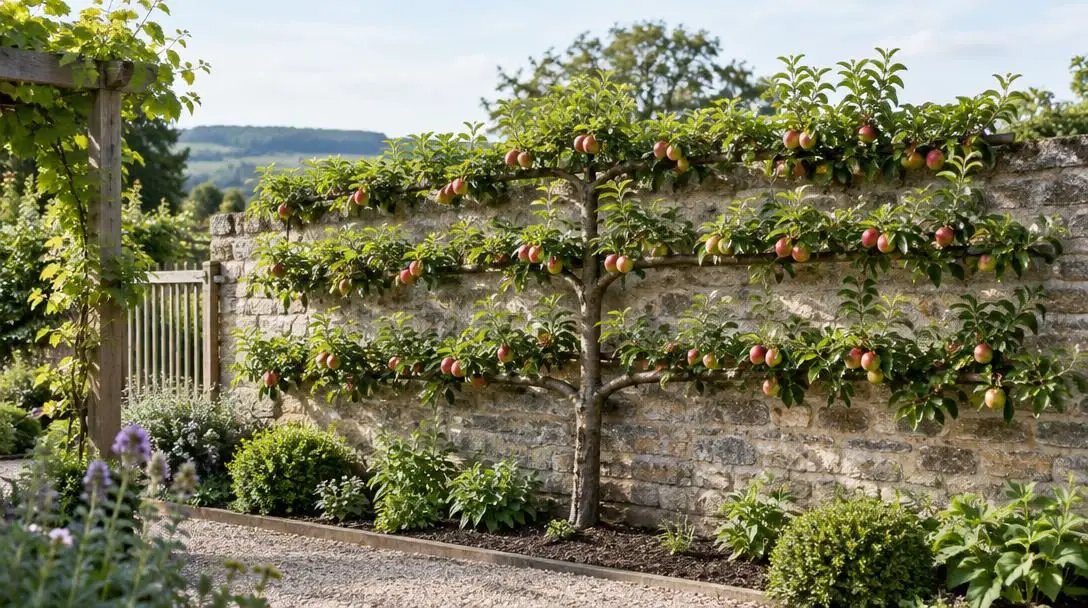
Espalier is an ancient horticultural tradition that merges architectural design with fruit cultivation, training woody plants to grow flat against two-dimensional surfaces such as walls, fences, and trellises. Originating in ancient Rome, where early growers utilized stone walls and tight courtyard spaces to nurture grapes and figs, the practice arose out of pure necessity. Urban growers needed a reliable way to harvest fresh fruit without allowing sprawling crowns and sprawling canopies to overtake limited ground space.
Over the centuries, gardeners transformed this utilitarian survival technique into a refined horticultural discipline. By securing flexible stems to rigid wire systems, growers discovered that flattened trees combine the beauty of climbing vines with the productivity of a traditional orchard. Today, espalier enables gardeners to bring productive, ornamental beauty into compact modern environments, turning bare fences, exterior home walls, and narrow patio boundaries into living works of art.
Key takeaways
- Espalier redirects vegetative growth hormones into productive fruit spurs by training flexible young branches along horizontal or angled support lines.
- Two-dimensional growing maximizes sunlight exposure and airflow, significantly improving fruit quality while reducing moisture-related foliage diseases.
- Selecting dwarf or semi-dwarf rootstocks is essential for maintaining manageable growth and preserving clean geometric patterns over time.
- Successful maintenance requires a dual-pruning approach: structural shaping during the winter dormancy and vigor control during active summer growth.
- Support systems and wires must be fully anchored and planned before the tree is placed into the ground.
The Horticultural Science Behind Espalier
To understand why espalier works so effectively, gardeners must look at how a tree responds when forced out of its standard three-dimensional growth habit. Naturally, fruit trees prioritize vertical growth, sending shoots upward to compete with neighboring foliage for open light. In an espalier framework, the tree's natural habit is redirected using a support structure, strategic ties, and deliberate pruning.
A primary factor in how espalier works is the deliberate alteration of branch orientation. When branches are bent into horizontal or angled trajectories, the natural movement of internal hormones shifts. This redirected energy slows vigorous vertical vegetative growth and encourages the development of short fruiting spurs. Instead of expending energy building massive woody trunks and non-bearing water sprouts, the tree reallocates its resources toward flowering blossoms and dense fruit clusters.
Redirecting a branch horizontally shifts internal nutrient flows, curbing aggressive upward growth and channeling the tree's energy into fruitful spur production.
Beyond hormonal balance, espalier dramatically alters the tree microclimate. In a standard orchard tree, the interior canopy becomes a dense, shadowed tangle of leaves. Sunlight struggles to penetrate the center, leaving interior branches unproductive and prone to dampness. By flattening the entire canopy against a single plane, sunlight reaches every branch, leaf, and blossom directly. This uniform solar exposure encourages even fruit ripening and increases sugar concentration. Concurrently, air circulation is greatly amplified. Wind moves unimpeded across the exposed framework, drying wet foliage after rainstorms and suppressing humidity-loving fungal diseases.
Key Benefits of Growing Fruit in Two Dimensions
Planting an espalier system offers distinct functional, physiological, and visual advantages that traditional freestanding trees cannot match:
- Extreme space efficiency: Homeowners can produce substantial fruit harvests along narrow side yards, driveway borders, patio margins, and walkway perimeters where standard trees would overwhelm the area.
- Effortless harvesting: Because the canopy is trained flat and kept low, all fruit remains visible and within reach, eliminating the need to climb tall ladders or navigate cumbersome picking poles.
- Streamlined maintenance: Checking foliage for pests, applying organic sprays, thinning heavy fruit sets, and seasonal pruning become straightforward when every stem is laid out in a single plane.
- Optimized health and ripening: Maximum light interception ensures even color and higher quality fruit, while constant airflow lowers the risk of persistent mildew and fungal infections.
- Year-round architectural appeal: Even in midwinter after leaves have dropped, the stark geometric symmetry of the branches creates a striking sculptural focal point on bare masonry or wooden fences.
Selecting Suitable Trees and Necessary Materials
Not every woody specimen adapts easily to two-dimensional training. The most successful espalier projects rely on fruit varieties that readily produce fruit on long-lived spurs along the primary horizontal arms. Suitable fruit varieties that respond exceptionally well to espalier include:
- Apple: The premier choice for beginners, highly tolerant of rigorous bending and prone to forming dense fruiting spurs.
- Pear: Flexible, vigorous, and ideally suited for formal, rigid geometric frameworks.
- Cherry: Best adapted to looser, open-branch patterns like fans.
- Peach: Fast-growing stone fruit that produces fruit on newer wood, making fan systems ideal.
- Apricot: Well suited to sunny wall positions that capture and reflect residual heat.
- Plum: Responds vigorously to training along wide horizontal or radiating wires.
When shopping at a plant nursery, pay close attention to rootstock vigor. Always choose specimens grafted onto dwarf or semi-dwarf rootstocks. Full-sized standard trees produce wood far too aggressively, demanding ceaseless pruning to keep them contained within a modest framework. Dwarf and semi-dwarf trees mature at a naturally restrained size and yield smaller, easily supported crops that will not tear limbs away from their trellises. Inspect individual candidates for a strong, plumb central trunk, balanced lateral branch spacing, and proven resistance to common regional diseases.
Before planting, gather the structural materials required to construct a permanent support matrix:
- A sturdy mounting surface, such as a masonry wall, reinforced wooden fence, or heavy freestanding posts.
- Heavy-gauge galvanized wire, eye bolts, turnbuckles, and wall anchors capable of holding tension under the weight of mature, fruit-laden limbs.
- Smooth bamboo stakes to hold young green stems straight between wire intervals.
- Flexible plant ties or soft garden twine that can hold branches firmly without cutting into expanding bark.
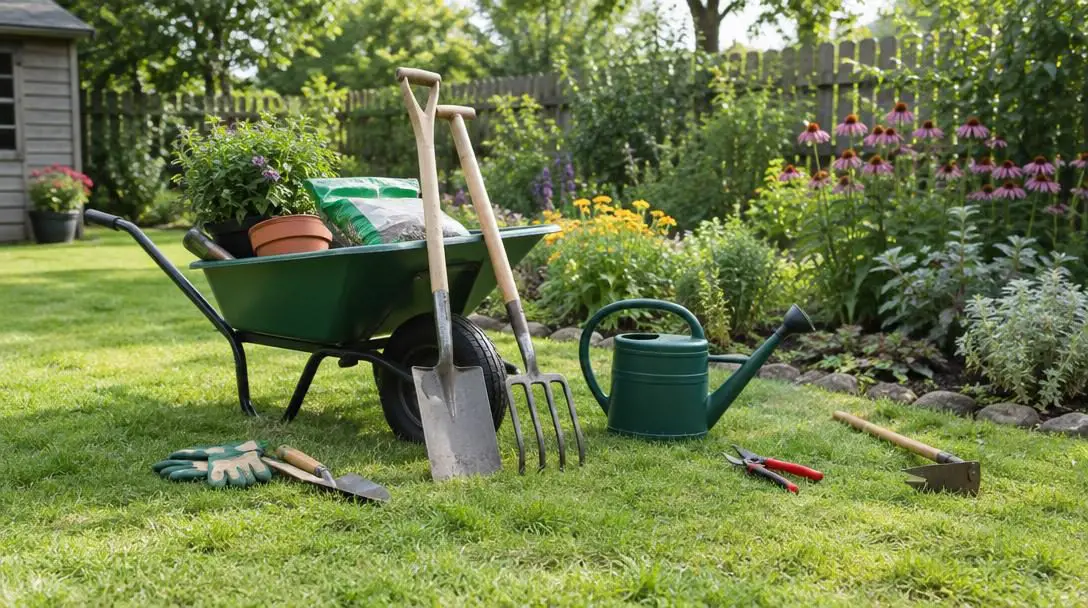
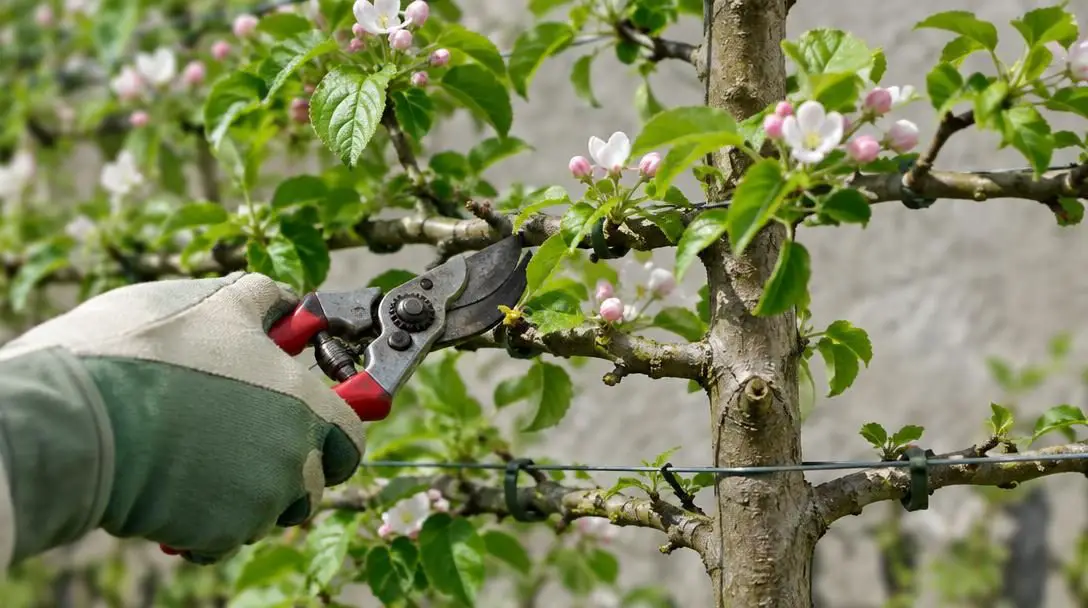
- High-grade bypass hand pruners, long-handled pruning shears, and a small, narrow pruning saw for precise cutting.
Popular Espalier Patterns and Designs
Before driving an anchor into a wall, select a specific geometric pattern. Each design carries different pruning rules, spatial requirements, and suitability for specific tree species.
| Pattern | Branch Orientation | Best Fruit Pairings | Primary Visual Character |
|---|---|---|---|
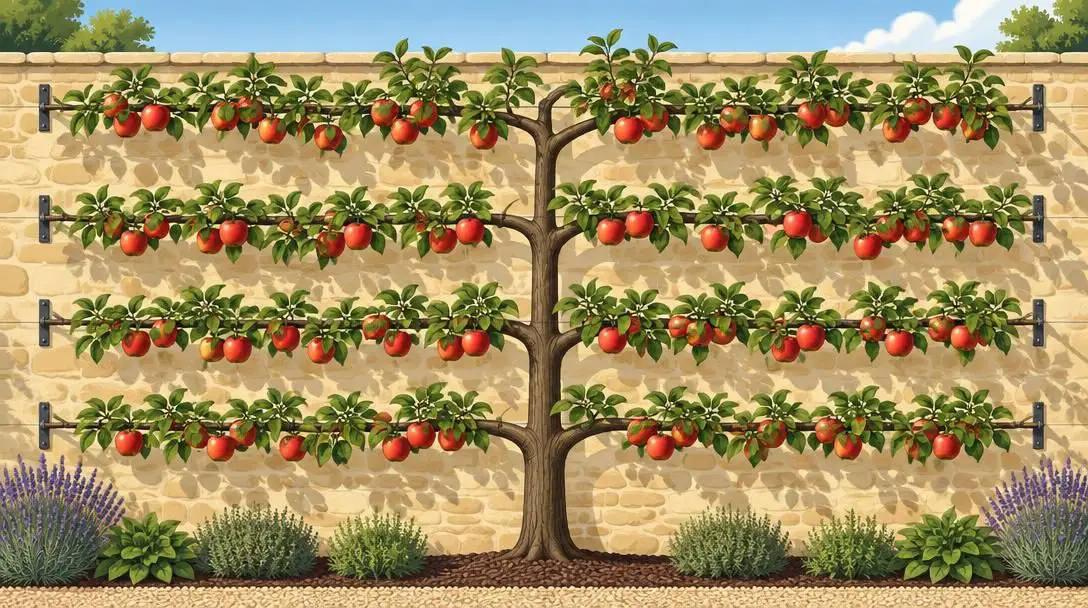
| Horizontal T / Cordon | Right angles, tiered horizontal arms | Apple, Pear | Classic, formal, orderly tiers |
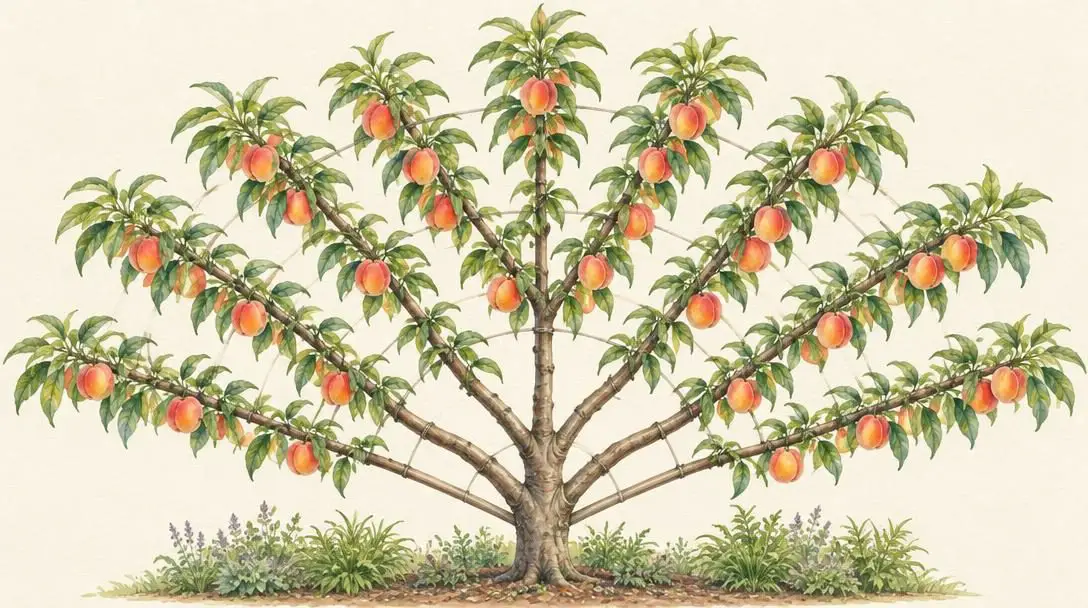
| Fan | Radiating outward from low central hub | Peach, Cherry, Apricot, Plum | Soft, natural, spread out like a folding fan |
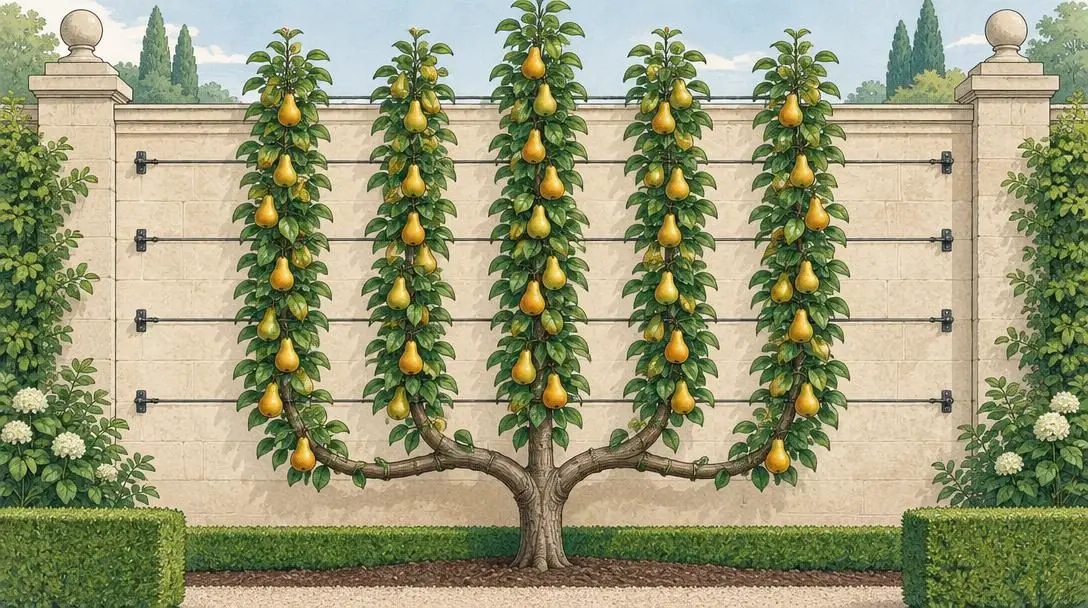
| Candelabra | Horizontal baselines curving 90 degrees upward | Apple, Pear | Architectural, vertical columns, formal |
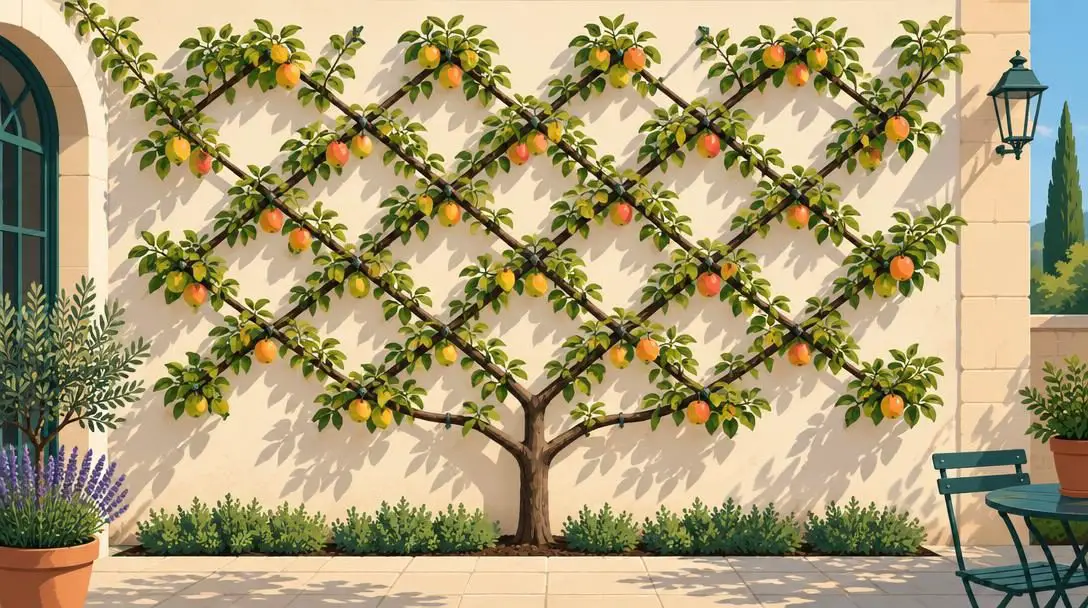
| Diamond | Symmetrical diagonal crisscrossing | Apple, Pear | Lattice-work, high-density geometric appeal |
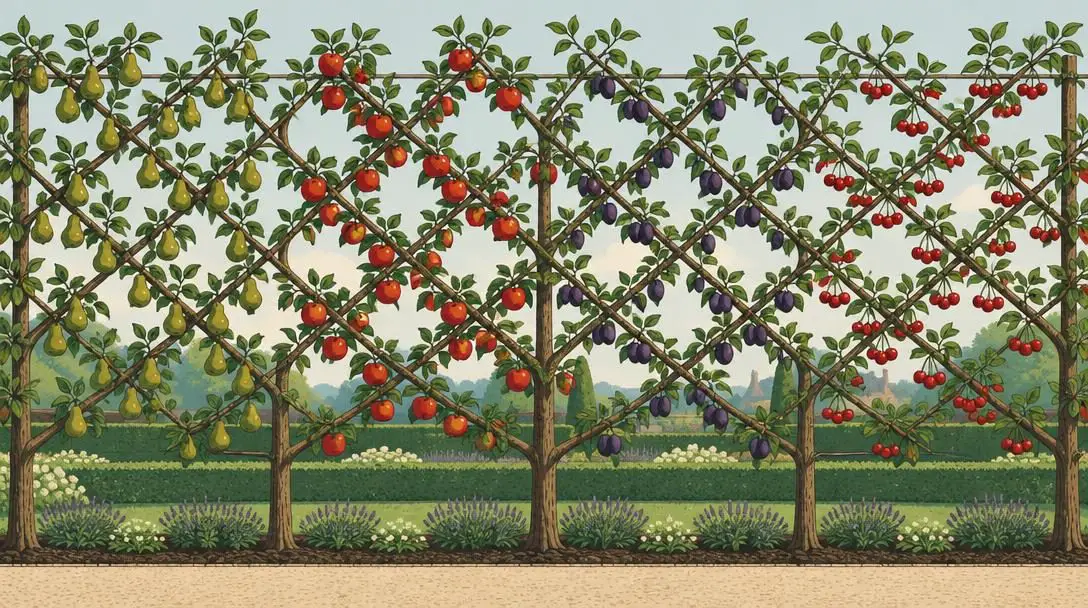
| Belgian Fence | Interlocking diagonal arms across multiple trees | Apple, Pear | Continuous living wall, shared lattice boundary |
Horizontal T or Cordon
- Structural style: Paired horizontal tiers
- Difficulty level: Beginner to intermediate
- Preferred species: Apples and pears
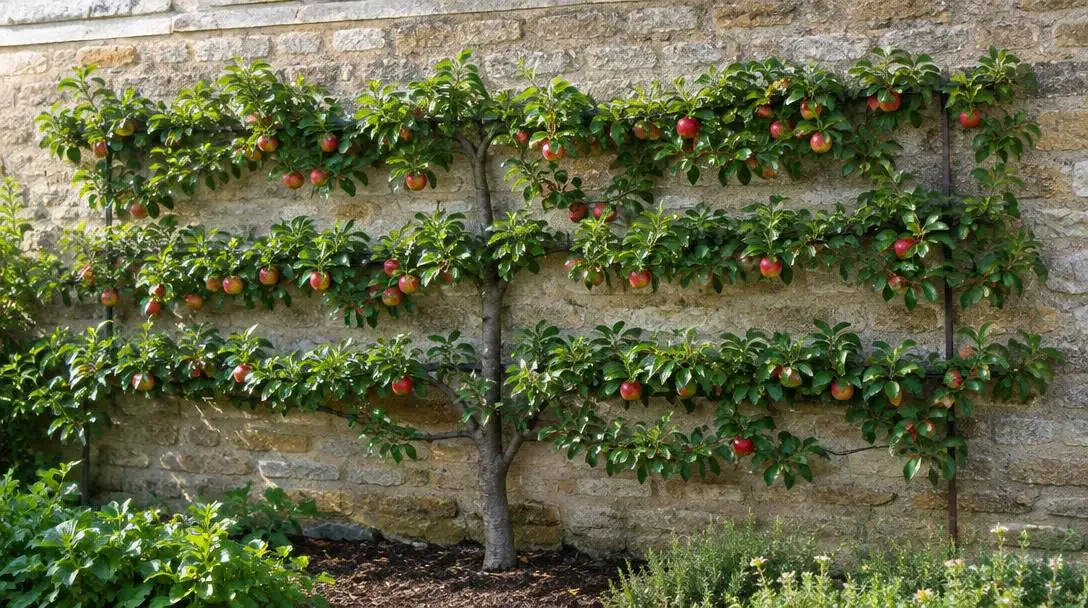
The Horizontal T or Cordon is the most widely recognized espalier design. A single central trunk rises vertically, with pairs of opposing branches trained horizontally along parallel wires at uniform intervals, typically spaced twelve to sixteen inches apart. It offers clean, balanced symmetry that sits naturally against residential walls and simple wire fences.
Fan
- Structural style: Radiating angled shoots
- Difficulty level: Intermediate
- Preferred species: Peaches, nectarines, cherries, apricots
The Fan pattern features a short central trunk from which structural branches radiate outward and upward in an open, semi-circular layout. This configuration is the premier choice for stone fruits, which bear their crops on one-year-old shoots rather than long-lived fruiting spurs. The open design permits regular renewal of fruiting wood without ruining the outline.
Candelabra
- Structural style: Horizontal tiers turned vertical
- Difficulty level: Advanced
- Preferred species: Pears and apples
The Candelabra pattern extends a pair of low primary branches horizontally outward before bending them sharply upward at ninety-degree angles. Secondary tiers can be trained inside or outside this framework, creating a row of parallel, vertical leafy columns reminiscent of a classical menorah or multi-branched candlestick.
Diamond
- Structural style: Angled cross-hatched lattice
- Difficulty level: Advanced
- Preferred species: Apples and dwarf pears
The Diamond design relies on stems trained at balanced 45-degree angles, intersecting symmetrically to form a diamond trellis. As shoots cross one another, they are secured together or joined to form an ornamental lattice that functions as a striking decorative focal point against courtyard walls.
Belgian Fence
- Structural style: Multi-tree interlocking lattice
- Difficulty level: Advanced
- Preferred species: Apples and pears on matching rootstocks
The Belgian Fence expands on diamond geometry by planting a series of young whips along a straight line, spaced roughly two to three feet apart. Each tree is pruned into a simple V-shape; as the stems extend upward at 45-degree angles, they overlap with the stems of neighboring trees, forming a continuous living fence of interlocking diamond windows.
Step-by-Step Guide to Training Your Fruit Tree
Training an espalier is a gradual process that spans several growing seasons. Approaching each phase methodically guarantees a sturdy framework and dependable crops.
- Install the support framework: Mount heavy-gauge wires along your fence, wall, or freestanding posts before introducing the tree. Secure eye bolts firmly and tension the wires using turnbuckles. Align the spacing precisely to your chosen pattern.
- Plant the tree: Dig a generous planting hole in well-draining soil centered directly against the middle guide wire. Set your dwarf or semi-dwarf specimen so the trunk aligns with your primary vertical axis, keeping the graft union several inches above the final soil line.
- Identify primary branches: Evaluate the young tree for flexible, well-positioned lateral shoots that align with the bottom tier of your wire system. Select the strongest lateral stems on opposite sides of the trunk to serve as your foundational leaders.
- Secure branches to the wires: Carefully draw the chosen stems toward the guide wires, securing them with soft twine or flexible plant ties every six inches. Never force a stiff branch; tie it gradually over several weeks if it resists lying flat.
- Initial pruning: Using clean bypass pruners, remove any shoots growing straight forward away from the wall or backward into the mounting surface. Cut back the central leader just above the next wire level to force the emergence of new lateral buds for the subsequent tier.
- Guide new seasonal growth: Check the tree every two weeks during the height of spring and summer. As fresh green shoots emerge, tie them down into the pattern before the stems become woody, brittle, and resistant to direction.
- Maintain shape and light penetration: Routinely prune back non-structural lateral shoots to three or four leaves. This checks excessive growth, keeps the profile flat, and prevents upper branches from casting shade onto lower tiers.
Ongoing Care, Watering, and Maintenance
Because an espalier tree is restricted to a small footprint while bearing full crops, it requires focused cultural management throughout the year.
Water management is vital. Because espaliers are frequently placed against heat-radiating brick walls, concrete surfaces, or painted fences, the soil dries out faster than in an open orchard. Water the root zone deeply once or twice every week rather than offering shallow daily sprinkles. Deep soaking encourages the root system to dive downward, making the plant resilient against midsummer heat waves.
Fertilization must remain moderate and controlled. Provide a balanced, slow-release fertilizer formulation once per year in early spring or late winter just as dormancy breaks. Do not overfeed with high-nitrogen fertilizers; excessive nitrogen prompts a massive flush of soft, watery foliage that blurs the geometric design and discourages fruit bud initiation.
Pruning must be split across two seasons:
- Winter pruning: Performed when the tree is dormant and leafless. Focus on structural integrity, eliminating damaged or diseased stems, thinning out overcrowded spur clusters, and heading back leaders to maintain the silhouette.
- Summer pruning: Performed around midsummer when vegetative growth is surging. Trim back unwanted new green shoots to a few leaves from the main framework, redirecting seasonal energy into the developing fruit and allowing sunlight to penetrate directly to the spurs.
Pest and disease management is made simpler by the open structure. Conduct weekly visual inspections across the leaves, twigs, and fruit. Keep a watchful eye out for common fruit tree ailments such as aphids, spider mites, scale insects, powdery mildew, and fruit rot. Treat localized outbreaks promptly with targeted treatments before pests gain a foothold.
Common Mistakes to Avoid
Even experienced gardeners can stumble when first tackling flat-plane training. Avoid these common missteps:
- Selecting standard rootstocks: Planting a vigorous, full-sized tree will create an endless pruning battle, leading to thick, unruly trunks that break free from their wire anchors.
- Permitting ties to girdle stems: Garden twine or plastic fasteners left uninspected will cut deeply into expanding bark, cutting off nutrient pathways and potentially killing entire branch tiers. Check ties twice each year and loosen as needed.
- Skipping summer pruning: Postponing all pruning until winter allows vigorous vertical water sprouts to shade out the lower levels, causing lower fruiting spurs to decline and die from a lack of sunlight.
- Bending stiff, mature wood: Trying to force an older, woody branch onto a guide wire often results in structural breakage. Bend only pliable green wood that yields easily under light pressure.
- Allowing branches to cross: Permitting wayward branches to weave across one another destroys the clean architectural design and creates dense pockets where moisture settles, inviting fungal problems.
Frequently asked questions
How long does it take for an espalier fruit tree to produce fruit?
Dwarf and semi-dwarf fruit trees trained into espalier forms typically start bearing fruit within two to three years after planting. Establishing the full architectural shape of complex designs, such as a Belgian Fence or multi-tiered candelabra, generally requires three to five seasons of careful training.
Can I train an already established, mature fruit tree into an espalier?
Training an established, mature tree into an espalier is rarely successful. Mature trees have thick, rigid trunks and brittle scaffold branches that will break if bent against a flat wire guide. It is far better to start with an unpruned, flexible one-year-old whip or a nursery-started dwarf specimen.
How far away from a wall or fence should an espalier be planted?
Trees should generally be positioned roughly six to twelve inches away from the wall or fence. This gap ensures sufficient air circulation behind the leaves, prevents moisture from getting trapped against the wall surface, and leaves room for future trunk expansion.
Are fruit yields lower on an espalier tree compared to a standard tree?
While an individual standard tree produces a larger aggregate volume of fruit due to its overall bulk, an espalier yields significantly more fruit per square foot of garden space. Furthermore, the fruit produced by an espalier is generally larger, more evenly colored, and easier to harvest due to superior light exposure.
What is the best espalier pattern for a beginner?
The Horizontal T or Cordon pattern using an apple or pear tree is the best starting project. Its right-angle geometry is easy to visualize, the pruning steps are straightforward, and pome fruits naturally produce reliable fruiting spurs along horizontal branches.
The Bottom Line
Espalier is an exceptionally rewarding gardening discipline that blends careful structural planning with the natural vitality of fruit trees. By committing to routine seasonal pruning, choosing the right dwarf rootstock, and constructing a stable support framework, you can turn any small garden boundary, walkway, or bare wall into an enduring, bountiful centerpiece for years to come.