These 5 Aggressive Insects Can Turn Any Camping Trip Into a Nightmare
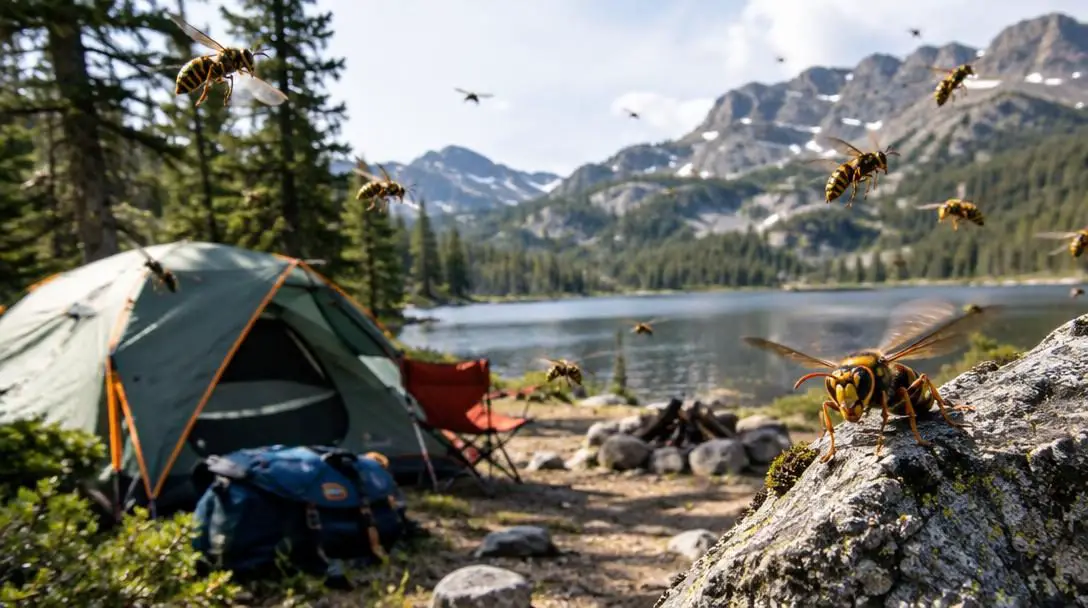
Every corner of the country offers scenic landscapes, dramatic vistas, and pristine backcountry locations for travelers to explore. Yet alongside these stunning environments, native wilderness areas host aggressive and territorial insects that stand prepared to defend their natural habitats. For outdoor enthusiasts, hikers, and campers, crossing paths with these organisms is a real and constant possibility during warm-weather excursions.
While these creatures are simply following their natural survival instincts, their defensive strikes can turn a peaceful camping trip into a painful emergency. Campers who inadvertently disturb nests, gather firewood near burrows, or pitch tents on foraging grounds can suffer debilitating stings, severe systemic symptoms, or emergency room visits. Knowing which species present substantial dangers, understanding why they strike, and learning proper campsite safety protocols is critical for safeguarding yourself, your family, and your pets.
Key takeaways
- Territorial insects strike campers primarily when nesting, feeding, or resting habitats are inadvertently disturbed.
- Specific species rely on unique defense mechanisms ranging from mechanical drilling to urticating venomous hairs and collective swarming.
- Site selection remains the frontline defense against attacks, requiring careful checks of soil, tree canopies, and camp gear.
- Immediate and proper field first aid helps limit tissue damage and prevents dangerous secondary bacterial infections.
At a glance: Dangerous camp insects compared
| Insect | Primary Region | Primary Defense Mechanism | Primary Symptom |
|---|---|---|---|
| Wheel Bug | Southern half of the United States | Rigid piercing beak | Intense mechanical puncture pain |
| Fire Ant | Southern states (Texas, New Mexico, Arkansas) | Mandible anchor and repeated stings | Burning pustules and fluid-filled blisters |
| Africanized Honey Bee | Widespread southern and western regions | Mass defensive colony swarming | Multiple toxic stings and systemic trauma |
| Tarantula Hawk | Southwestern desert regions | Neurotoxic stinger injection | Blinding, incapacitating acute pain |
| Saddleback Caterpillar | Eastern United States | Poisonous contact hairs (urticating spines) | Throbbing local pain, swelling, and nausea |
Meet the 5 aggressive insects to watch for
Wilderness insects are uniquely equipped to immobilize prey and ward off perceived threats. When selecting a campsite or exploring remote trails, outdoor travelers should remain vigilant for these five notorious species.
Wheel Bug
- Active Season: Mid-to-late summer
- Native Territory: Southern half of the country
- Attack Weapon: Elongated, rigid piercing beak
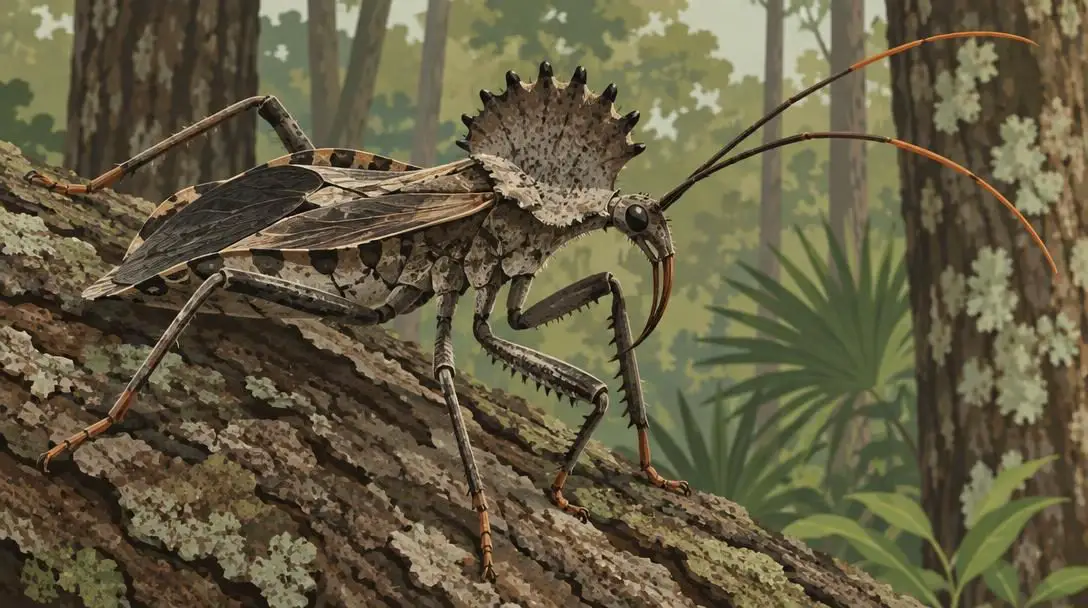
The wheel bug presents an intimidating, prehistoric appearance that looks straight out of a nightmare. Its most prominent physical feature is a long, pointy beak that remains folded under its body when the creature is resting or walking. In the wild, this beak functions as an essential predatory hunting tool designed to puncture other insects and drain their bodily fluids.
When handled, stepped on, or pressed against skin, the wheel bug immediately deploys this feeding structure as a formidable defensive weapon. Rather than stinging with an abdominal barb, the insect mechanically drives its hard, needle-sharp beak directly into human tissue. The resulting puncture wound produces instant, intense pain that can throb and cause lingering distress for hours afterward. Wheel bugs become especially active and mobile during the mid-to-late summer across the southern states.
Fire Ant

- Active Season: Warm weather months
- Native Territory: Southern states, including Texas, New Mexico, and Arkansas
- Attack Weapon: Locking mandibles and abdominal stinger
Notorious throughout southern states such as Texas, New Mexico, and Arkansas, the fire ant poses an exceptional threat to campers. These social insects prefer open fields, sunny clearings, and grassy pastures—precisely the open, flat areas campers favor when pitching tents and setting up camp chairs. A single colony constructs expansive subterranean networks marked by low earthen mounds.
When an unsuspecting camper steps on or pitches a tent stake near a mound, a massive defensive horde rushes out in seconds. Fire ants employ a sophisticated two-step attack: they bite into the skin with strong mandibles to anchor themselves firmly, and then rotate their bodies in a tight circle to drive their stinger into the victim multiple times. The envenomated sites rapidly develop into sterile, fluid-filled blisters and pustules that are intensely itchy, prone to breaking open, and vulnerable to serious secondary infections.
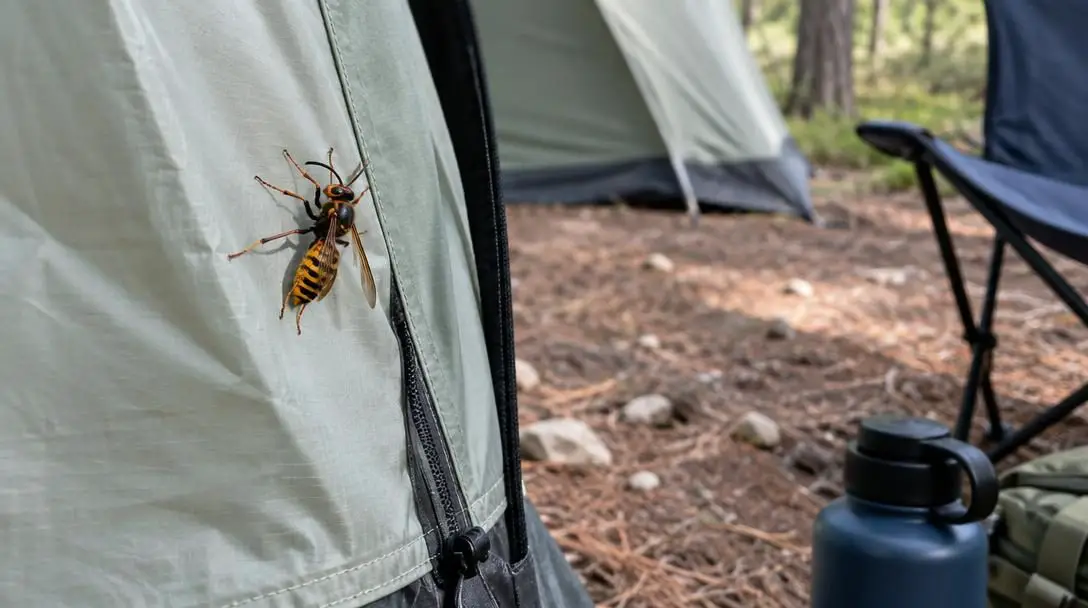
When fire ants strike, their mandibles anchor firmly into skin to provide leverage for repeated, circular stinging that leaves blistered wounds.
Africanized Honey Bee

- Attack Threshold: Ten times faster reaction speed than standard honey bees
- Identifiable Traits: Visually indistinguishable from regular European honey bees
- Known Impact: Over 1,000 documented human fatalities
The Africanized honey bee represents one of the most perilous wildlife threats in North America. These insects operate with extreme defensive vigilance, guarding their hives with overwhelming collective force. What makes them uniquely lethal is their hair-trigger threshold for alarm: their reaction time to an implied threat is roughly ten times faster than that of ordinary domestic honey bees.
Because Africanized honey bees appear virtually identical to standard honey bees, outdoor recreationists cannot distinguish between the two until an aggressive attack has already begun. When provoked by vibrations, foot traffic, or proximity to their colony, hundreds or thousands of bees deploy simultaneously. To date, swarms of these aggressive bees have caused more than 1,000 human deaths. Campers must scan their surroundings attentively and steer clear of any hollow logs, rocky crevices, or branches harboring active hives.
Tarantula Hawk
- Classification: Oversized desert wasp species
- Native Territory: Southwestern deserts of the United States
- Attack Weapon: Potent neurotoxic sting
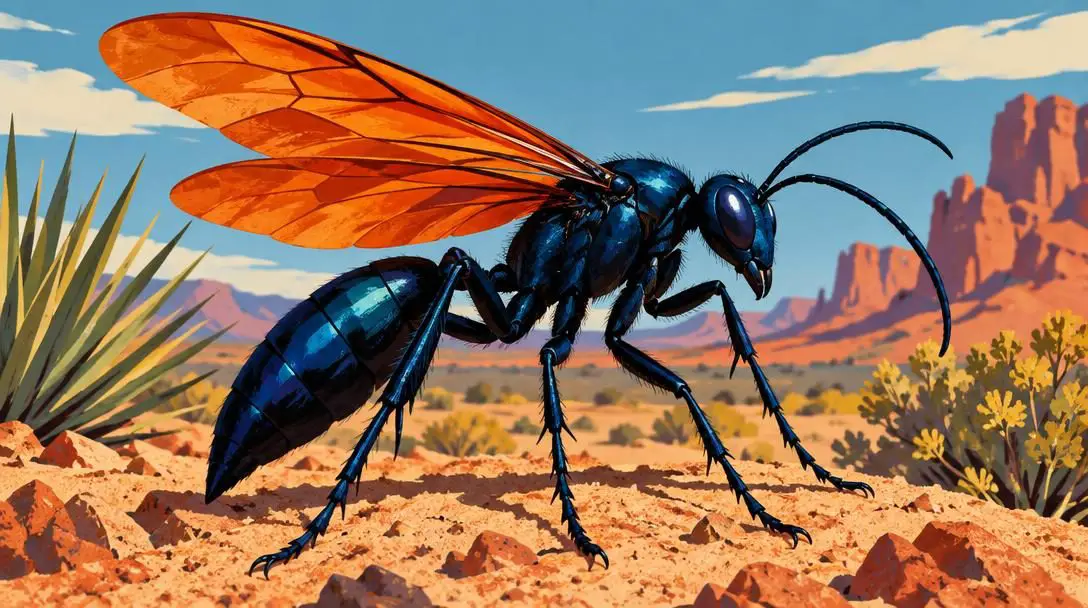
Despite its avian moniker, the tarantula hawk is not a bird, but a gigantic species of desert wasp native to the American Southwest. The insect earned its name due to its specialized reproductive life cycle. Adult females actively hunt down enormous desert tarantulas, paralyzing the massive spiders with a precision venom strike before dragging them underground to serve as fresh, living food for their growing larvae.
Because the wasp's venom is chemically formulated to shut down the nervous system of large arachnids, a sting inflicted on a human produces extraordinary agony. The experience is widely characterized as the single most painful insect sting on earth. The pain is instantaneous, blinding, and completely incapacitating, rendering a person helpless to do anything other than lie down until the initial wave of shock subsides.
Saddleback Caterpillar
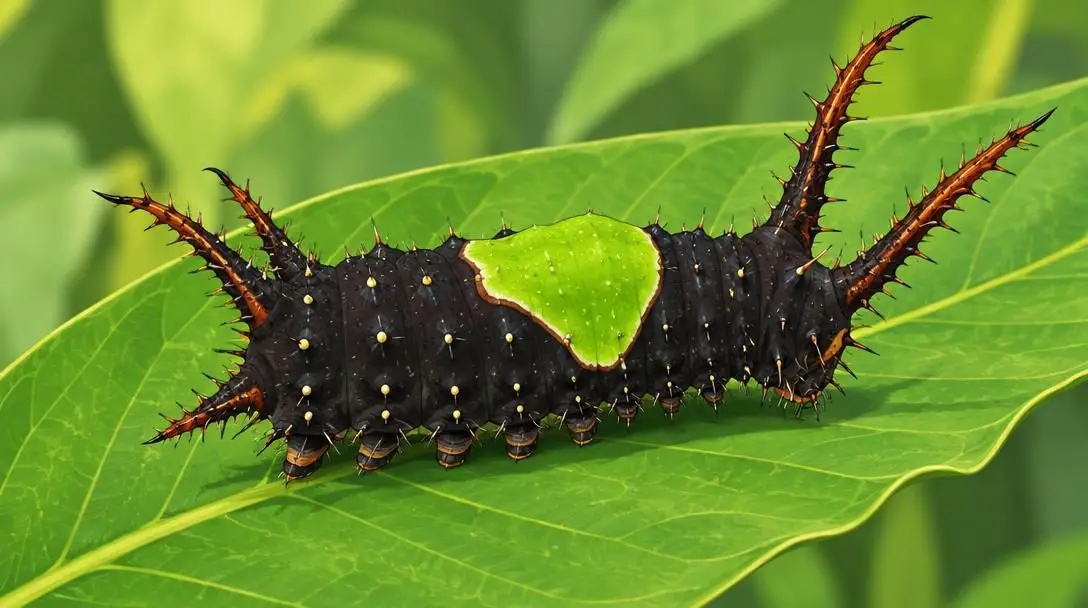
- Visual Camouflage: Green and brown patterns resembling a saddle and blanket
- Native Territory: Eastern United States
- Attack Weapon: Poison-filled urticating hairs (bristles)
Found primarily throughout eastern forests and woodlands, the saddleback caterpillar is an unusual larval creature with distinct, vibrant coloration. It features a bright green central patch flanked by dark brown markings, creating the distinct appearance of an equestrian saddle and pack blanket. This clever coloration allows the caterpillar to blend effortlessly against deciduous leaves, low shrubs, and garden vegetation.
Beneath this ornamental exterior lies a potent passive defense. The body of the caterpillar is armed with prominent fleshy horns lined with hollow, poison-filled spines. When a camper brushes against a branch or leans against an infested trunk, these brittle hairs puncture the skin and break away, releasing toxin into the dermal tissue. The immediate sting feels comparable to a bee sting, but the symptoms escalate rapidly, producing spreading swelling, nausea, and throbbing pain that can persist for multiple days.
How defensive insect attacks work
Wild insects do not target humans out of malice; their offensive strikes are driven by territorial disruption, defensive reflexes, or hunting instincts triggered by proximity. Understanding the biological mechanisms behind these encounters helps campers respect their space and treat injuries accurately:
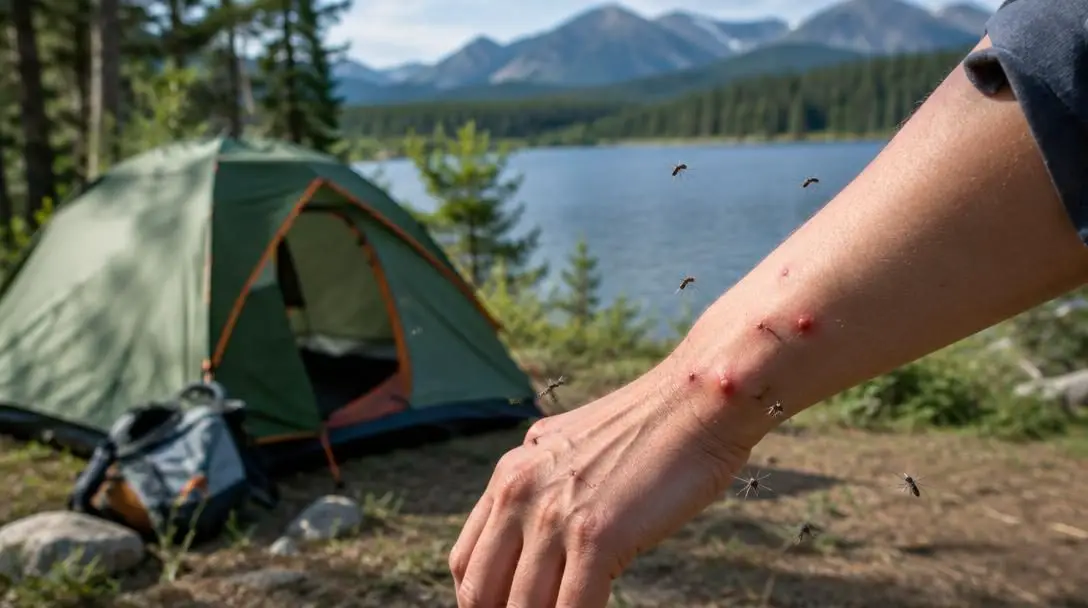
- Mechanical Piercing: Used by creatures such as the wheel bug, this attack relies on physical leverage. The rigid rostrum punctures deep into the skin, tearing through tissue and exciting nerve endings through brute mechanical force without requiring venom.
- Anchoring and Multi-Stinging: Perfected by fire ants, this approach combines mechanical restraint with chemical envenomation. By biting and holding tight with sharp mandibles, the ant creates a sturdy anchor point, allowing its flexible abdomen to deliver multiple venomous stabs in rapid succession.
- Mass Colony Envenomation: Africanized honey bees depend on alarming numbers. Pheromone trails trigger a coordinated mass assault where hundreds of defenders sting repeatedly, rapidly delivering a cumulative toxic dose that can trigger systemic shock.
- Neurotoxic Injection: The tarantula hawk employs specialized biological warfare. Its venom is packed with neurotoxins engineered to incapacitate spider nervous systems, which triggers immediate, full-scale activation of human pain receptors.
- Contact Urtication: The saddleback caterpillar relies on passive chemical traps. Its hollow, brittle hairs snap upon contact, acting like microscopic hypodermic needles that deposit inflammatory poisons directly into superficial skin layers.
Step-by-step campsite safety and inspection
Preventing an encounter before pitching your tent is the best way to safeguard an outdoor trip. Follow this systematic routine whenever you arrive at a backcountry or campground location:
- Inspect the bare ground: Thoroughly survey the soil across the entire campsite area for low, dome-shaped earthen mounds, small burrow openings, or steady trails of foraging insects before unrolling ground tarps.
- Examine the tree canopy: Look up into overhanging limbs, dead hollow trees, and adjacent rock crevices for the flight patterns and buzzing sounds of wild bee colonies.
- Check campsite infrastructure: Inspect picnic tables, fire pit stones, and low-hanging foliage near trailheads for resting wheel bugs or camouflaged saddleback caterpillars before leaning against surfaces or tying camp lines.
- Shake out personal gear: Before dressing in the morning or climbing into bedding at night, vigorously shake out sleeping bags, canvas tents, hiking boots, and hanging jackets, especially in desert environments frequented by tarantula hawks.
Field first aid for aggressive insect strikes
When an accidental insect strike occurs, prompt and proper action mitigates tissue trauma and speeds recovery. Different insect weapons require distinct first-aid approaches:
- Dislodging fire ants: If you step into a fire ant mound, vigorously brush the ants off your skin and clothing using a cloth or your bare hands with rapid sweeping motions. Stamping feet or running will not dislodge ants whose mandibles are clamped into your flesh.
- Escaping bee swarms: If an Africanized honey bee colony reacts, do not stand your ground, swat at the air, or jump into water where bees will wait for you to surface. Run immediately in a direct line toward enclosed shelter, such as a vehicle or sturdy tent, pulling your shirt collar over your mouth and nose to protect your airway.
- Extracting caterpillar hairs: After touching a saddleback caterpillar, avoid rubbing the area with your hand, which pushes broken hairs deeper into the dermis. Instead, press a strip of sticky tape or duct tape gently over the injury and pull it back to pull out the venomous spines, then wash thoroughly with soap and water.
- Managing puncture and sting sites: Clean all wheel bug punctures and desert wasp stings thoroughly with clean water and antiseptic wash. Leave fire ant blisters intact; popping them breaks the skin's natural barrier and invites dirt-borne bacterial infections.
Common camping mistakes to avoid
Human instincts during sudden insect encounters often make a bad situation worse. Avoid these critical mistakes to protect yourself and your camp companions:
- Pitching tents in open fields without soil checks: Setting down a tent floor directly across a fire ant territory will prompt an aggressive, swarming colony invasion through tent zippers and floor vents.
- Assuming regular bees and Africanized bees act identically: Treating a swarm casually can be fatal; Africanized bees react ten times faster, mobilize in far greater numbers, and pursue threats across substantial distances.
- Slapping caterpillars or wheel bugs against the skin: Striking a saddleback caterpillar flattens dozens of venomous spines deep into your skin, significantly increasing the volume of injected toxin and triggering widespread nausea.
- Popping pustules and blisters: Lancing fire ant blisters ruins the body's protective sterile seal, creating open wounds that easily develop secondary bacterial infections in outdoor field settings.
- Leaving children and pets unsupervised in brush: Small bodies receive a proportionally higher concentration of insect toxins relative to body mass, making bites and stings far more dangerous for toddlers and camp dogs.
Pre-trip planning and medical preparedness
Before heading out on any outdoor excursion, tailor your preparation to the specific seasonal factors and geographic region of your destination. If your travels take you to southern states during mid-to-late summer, plan ahead for active wheel bugs and dense fire ant populations. Venturing into southwestern arid lands requires vigilance around desert rocks and shrubs where tarantula hawks hunt, while eastern woodland treks demand care around leaf foliage holding saddleback caterpillars.
Ensure your camp first aid kit includes reliable antiseptic wash, adhesive bandages, sterile gauze, and durable tape for hair extraction. Finally, always maintain an emergency evacuation route. Know the location and driving time to the nearest 24-hour emergency room or medical clinic before settling into remote campsites, ensuring severe allergic reactions or multiple stings can receive prompt medical care.
Frequently asked questions
Can you tell an Africanized honey bee apart from a regular bee by sight?
No. Africanized honey bees appear visually identical to standard European honey bees. You cannot differentiate them by their physical appearance alone; their defining characteristic is their hyper-aggressive collective behavior and lightning-fast reaction time when their hive is disturbed.
What should you do if you are stung by a tarantula hawk?
The sting of a tarantula hawk delivers blinding, incapacitating pain that makes standing or walking almost impossible. The best response is to immediately lie down in a safe area away from hazards, protect yourself from falls, and wait for the acute, overwhelming wave of pain to subside, keeping the wound clean afterward.
Why shouldn't you pop fire ant blisters?
Fire ant blisters and pustules contain sterile fluid formed by the body's reaction to the venom. Popping these blisters breaks the protective skin barrier, creating an open wound that readily invites outside bacteria from dirt, sweat, and camping gear, leading to serious skin infections.
How do you safely remove saddleback caterpillar spines from your skin?
Do not rub or scratch the affected skin with your hands, as rubbing drives the venomous hairs deeper into the dermis. Gently apply adhesive tape, cellotape, or duct tape over the area and lift it away to pull the brittle spines out, then clean the skin with soap and cool water.
Do wheel bugs have a venomous stinger?
No, wheel bugs do not sting with an abdominal stinger. Instead, they defend themselves by mechanically driving their rigid, needle-like predatory beak directly into the skin, causing severe, localized puncture pain that can linger for hours.
The bottom line
Spending time in nature brings campers into close contact with wildlife that has evolved powerful tools for survival and defense. Insects like the wheel bug, fire ant, Africanized honey bee, tarantula hawk, and saddleback caterpillar are formidable defenders of their natural habitats. By conducting thorough campsite surveys, recognizing the unique hazards of each geographic region, avoiding common panic reactions, and packing proper first aid supplies, campers can stay safe while exploring the great outdoors.